
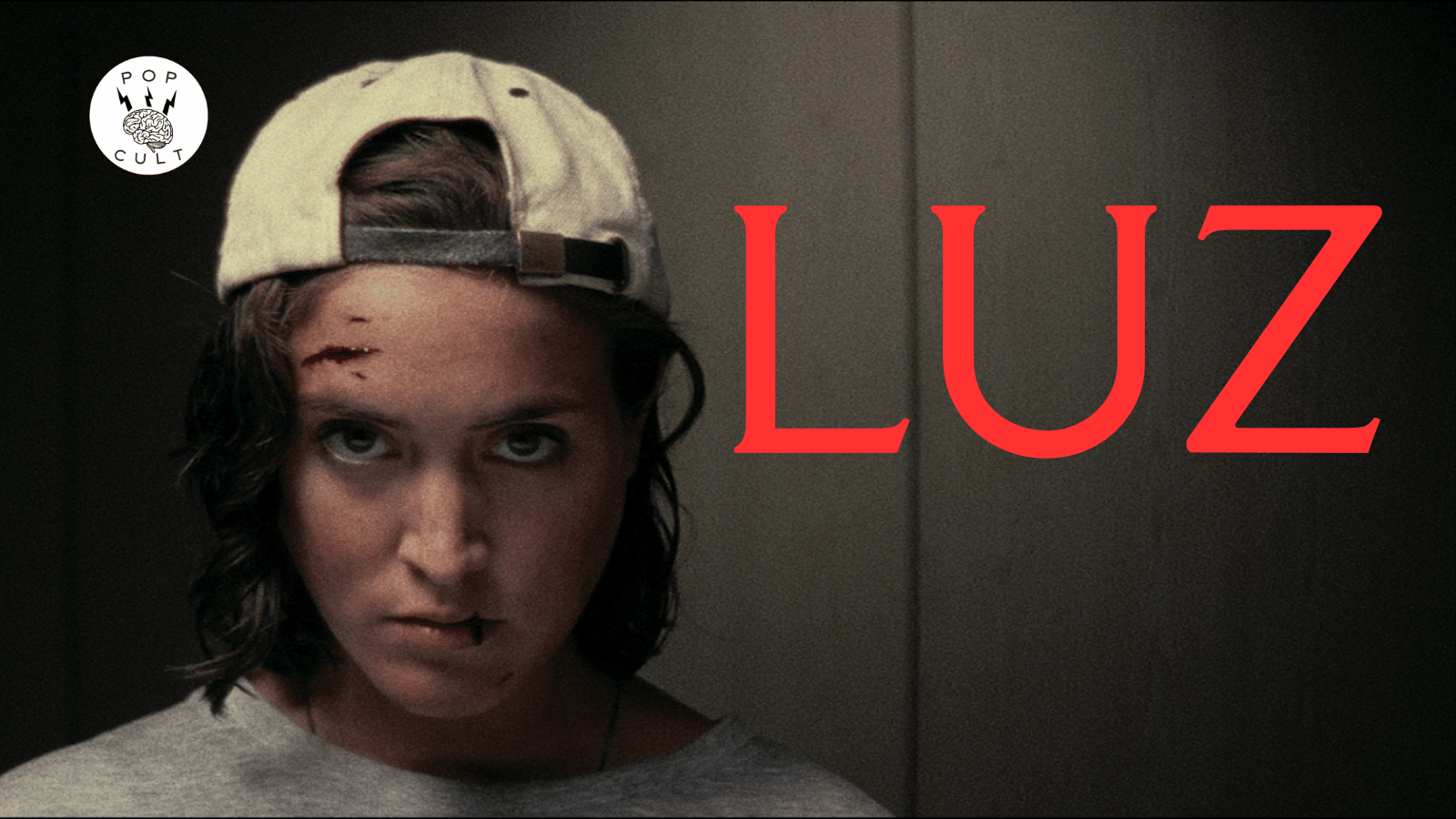
Luz (2018)
Written and directed by Tilman Singer
I decided to do a different kind of film series for December. There were several films that I had been adding to my Watchlist based on either enjoying more recent work by the filmmakers or simply curiosity. So, for the first half of December 2024, I will give myself a Christmas present, watch through nine of these pictures, and write up reviews. The last week and a half of the month will be focused on my Favorites of 2024 lists. This first film ended up on the list due to enjoying this year’s Cuckoo, filmmaker Tilman Singer’s sophomore effort. We reviewed that film over on the podcast, and while it didn’t blow me away, I enjoyed the point of view and style and wanted to see what Luz was like.
Taxi driver Luz (Luana Velis) was in a car crash. She’s brought into a police station for questioning. It turns out that years prior, as a student at a girls’ boarding school in Colombia, Luz attempted to help one of her classmates. This involved a ritual that awakened something. It seems she got the attention of something that doesn’t want to let the young woman go and has chased her around the globe to Germany. The film takes place primarily in a conference room at the police station as Luz is put under hypnosis and made to re-enact that night’s cab ride and her encounter with something sinister that is chasing her down.
One of the elements Singer nails is the early-mid 1980s vibes. Shot on 16mm, with a dreamy synth score, Luz has to give a lot of credit to the giallo horror work of directors like Dario Argento. This isn’t the psychedelic horror of the 1970s like Suspiria, but a more acidic, chromatic vibe that so many retro horror films have tried to reproduce lately but failed. Despite my dislike of the series, I think Stranger Things had come the closest in its last season, with the sequences involving Vecna near the end. Wide angles and fluorescent lights paint a very particular tone on the screen.
Singer says the idea didn’t originate as a genre piece. It started as a scene in an interrogation room with the subject of questioning reliving the day in their mind and that being acted out in front of us. As he read further about the way subjects are heavily susceptible to influence while hypnotized, the director figured out the second part of his story – a malicious interrogator. Out of this came a story of one woman’s dark past chasing her across the Atlantic Ocean, refusing to let go until it can have her completely.
One of Luz’s most intriguing aspects is how characters are layered on top of each other. The main antagonist is Dr. Rossini (Jan Bluthardt), but we don’t see him in most of the picture. It is just his physical form. The character the actor is actually playing is first played on screen by Julia Riedler. Riedler plays Nora, a woman the doctor meets at a bar while nursing a drink. Nora knows the doctor will be paged that night to enter the station and administer the hypnosis. But Nora isn’t really Nora, but a vessel for an unseen threat.
I wouldn’t be surprised if some people get overwhelmed around the middle of the picture (it’s only a 70-minute runtime) when languages become layered. Luz is under hypnosis and being questioned by Dr. Rossini. A technician in the sound booth translates Luz (who mainly speaks Spanish) into German or, in some instances, English. This is the part of the movie where it begins to feel like a piece of theater, and I think a stage production of Luz could easily be mounted by someone with the technical know-how. This isn’t a film driven forward by plot beats; instead, it’s a slight character study and an experiment in scene structure.
My one big complaint would be that the film feels more like an extended scene in a larger horror film. I would have loved to see a grander narrative surrounding this because it feels slightly too long to be an effective short but not enough meat on the bones to feel like a satisfying feature-length work. Singer is clearly doing some interesting things with sound design and playing with the physical space of the scene. The cinematography here is perfect. Between this and Cuckoo, I see lots of potential for Tilman Singer, but we’ve yet to see a work that brings together all these wonderful ideas and images he had floating around in his head.

 PopCult Reviews
One thought on “Movie Review – Luz”