
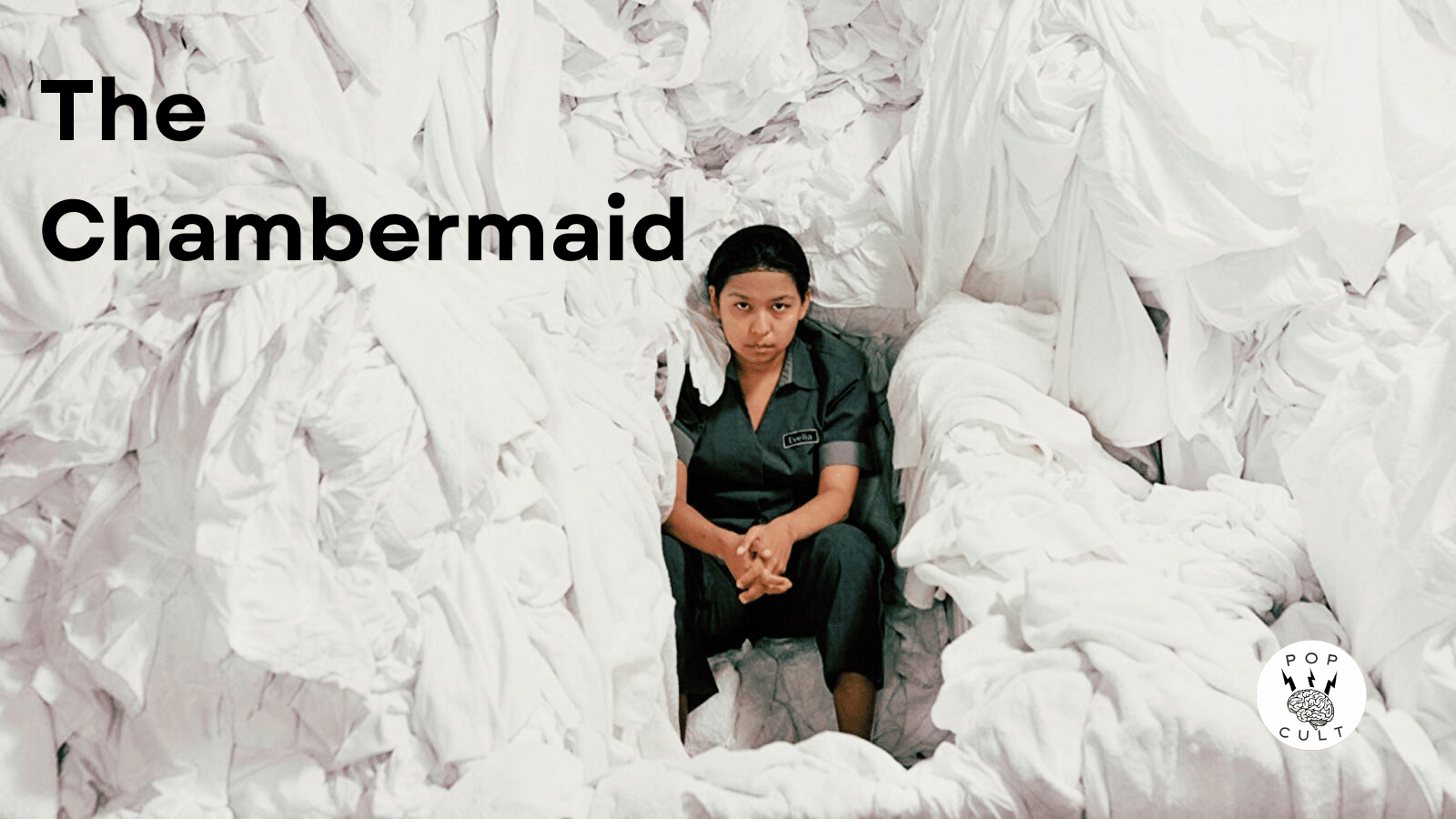
The Chambermaid (2018)
Written by Lila Avilés and Juan Márquez
Directed by Lila Avilés
I was profoundly impressed by Lila Avilés’s Totem, which will be on my list of favorite films in 2024. Her previous feature, The Chambermaid, was mentioned in an interview I came across about Totem. I put that on my To Be Watched list, and with this December film series, A Christmas Gift to Myself, I had the perfect opportunity to watch it. The film is not focused on a plot, much like Totem; it is a character study about a pivotal moment in a person’s life. They are not someone most of us would likely notice, yet their life is complicated and full of powerful moments of connection.
Eve (Gabriela Cartol) is a young woman working as a maid in an expensive hotel in Mexico City. She’s been told that if she keeps up her strong pace, she’ll be promoted to one of the more exclusive floors and get better tips. Moments arise when Eve or her co-workers need help, and they try to fill those gaps for each other as best as possible. One instance is when Eve watches an infant while their overwhelmed, wealthy mother takes a shower. She thanks Eve and continues asking for help, eventually leading to a conversation about having the maid come with her back to Argentina to work as a nanny.
Eve also starts taking GED classes offered in the wee hours of the morning as one of the perks provided by the union. She befriends one of her classmates, nicknamed Minitoy. Eve is reticent at first but opens up as the two women learn to rely on each other through various incidents. There’s also a window washer that keeps showing up outside the rooms. Eve is working. A flirtation begins that escalates as the young woman finds more confidence. But eventually, things start to go south; what once felt like strong friendships dissolve, and promises made are quickly forgotten.
In the West, there is a massive underclass that acts as the foundation that treats the rest of us with privilege. Most of this exploitation happens without much thought by us, as the nature of underclass labor is hidden away from day-to-day life. It’s the way we often don’t acknowledge the hotel maid or the homeless person on the street or never look our waiter in the eye. We’ve been socialized to not see humanity in service work to help perpetuate the hierarchies of power that keep us miserable. The most energy you’ll see concerning these people are anti-tipping assholes who also never advocate for raising wages, so tips aren’t something depended upon.
Alfonso Cuaron attempted to explore this life in Roma, following an indigenous housekeeper in 1970s Mexico City. However, Cuaron adds more elements of melodrama to the story than Aviles. She opts to not give a specific timeframe. It’s the present day, but how long the story takes over is open to interpretation. What she aims for is far more akin to Chantal Akerman’s Jeanne Dielmann. It’s the mundanity and the repetition of the days that shape The Chambermaid. This sort of static energy isn’t going to appeal to every audience member, but it is effective in conveying when the routine is disrupted and how those disruptions quickly unravel Eve’s world.
A rule that Aviles holds true to for the entire runtime is that the camera never leaves the hotel. Eve will leave to make the odyssey of mass transit back home, but we cut to the following day as she arrives to work for her next shift, a la Severance. Eve exists for us only in the context of her labor as a hotel maid. We learn through phone conversations that she has a young child living in a poor neighborhood. Everything she does is part of pulling herself out of something that feels permanent. There’s a quiet desperation in Eve’s choices; she’s trying hard to follow all the rules to please her bosses, but it becomes clear they don’t care.
There are no villains here, but there are undoubtedly dishonest people. A guest keeps ordering the maximum amenities allowed daily as he sits in his hotel room watching television and recording voice-overs for a documentary. He barely acknowledges Eve’s existence. There’s Eve’s boss, only seen from the back, who barely looks up from her desk and acknowledges Eve’s questions with the most terse, non-committal responses. The locker room attendant is constantly running her side gig, trying to sell plastic food containers while Eve clearly doesn’t want any. Even the mother from Argentina fills Eve’s head with stories of an escape that will never really happen.
Ultimately, The Chambermaid is about Eve’s inner life. The film is about discovering what she loves, fears, and hopes for. It is an act of humanization in the same way Akerman sought to dive into the seeming domestic simplicity of her mother’s life. Eve keeps asking about a red dress left behind and kept in the Lost and Found. She’s repeatedly told that Eve is first on the list, and she eventually gets that dress. But the moment it’s in her hands, our protagonist’s perspective is altered. This totem that felt so powerful just a day before has suddenly lost all luster.
Totem ends on a similar note of powerful realization. In that film, the music score takes a horror-like turn as the little girl at the center of the story fully understands what this birthday party means. In The Chambermaid, I got a more hopeful sense. Eve understands something about what she went through at the hotel, which will inform what she does next. The world is still uncertain, and there’s just as much a chance she will fail at what comes next, like what happened in the hotel. But she has to try and see, and that’s where she’s become empowered. Eve knows she’s the only one who can truly shape her future and will push for something better.

 PopCult Reviews
One thought on “Movie Review – The Chambermaid”