
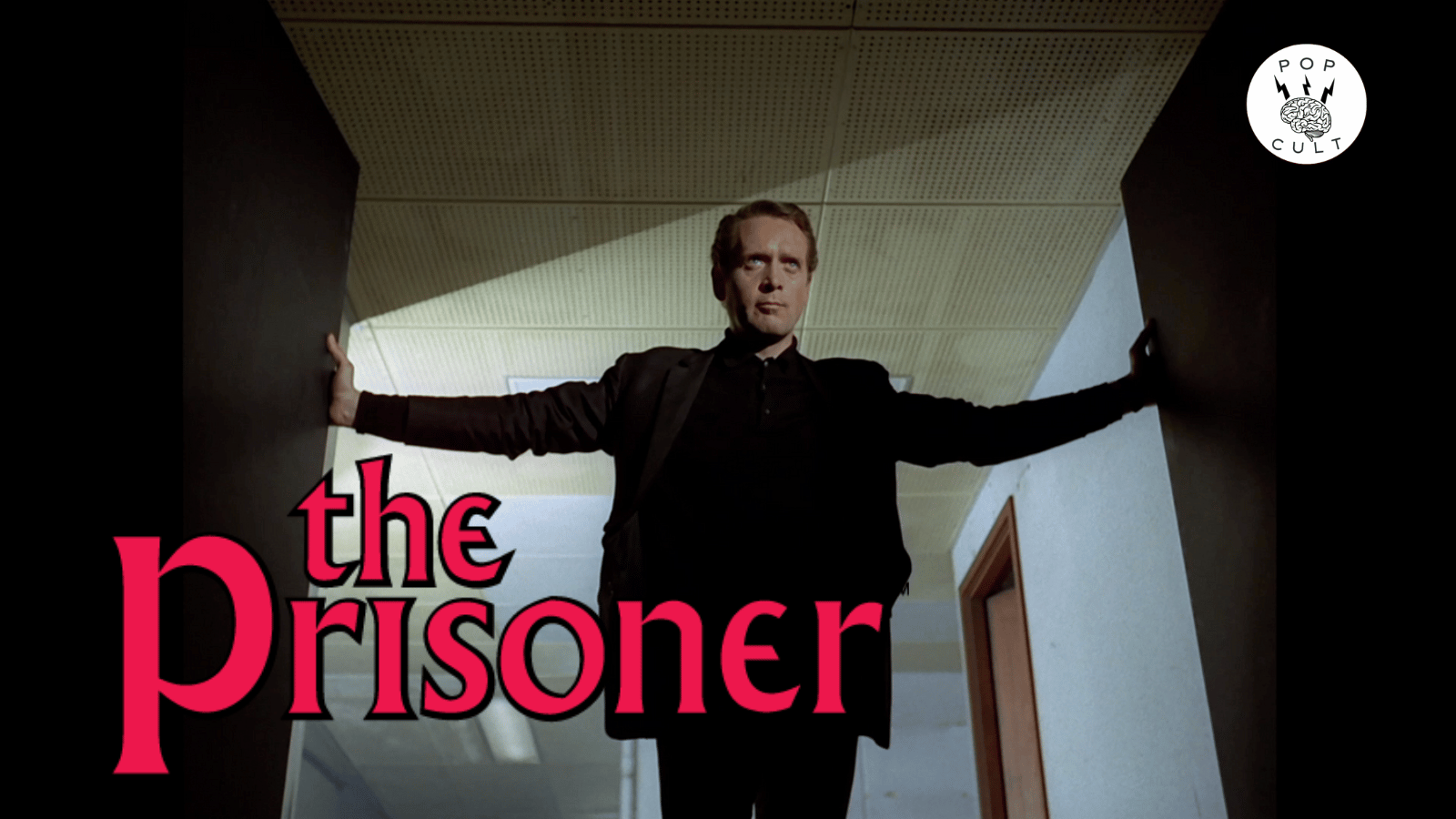
The Prisoner (1967)
Written by George Markstein, David Tomblin, Vincent Tilsley, Anthony Skene, Patrick McGoohan, Terence Feely, Lewis Greifer, Gerald Kelsey, Roger Woddis, Michael Cramoy, Roger Parkes, Kenneth Griffith, and Ian L. Rakoff
Directed by Don Chaffey, Pat Jackson, Patrick McGoohan, Peter Graham Scott, and David Tomblin
As a citizen of the Western World (born in the States, residency in the Netherlands), I have been told from birth that I am free and those outside my sphere are not. For many years, I took this to be the truth. Why? The people who told me I was taught to see as correct in all things. These are the institutions responsible for my freedom, after all. But as I got older, the more I read & observed, it became clear that I wasn’t free. Well, I was free, in about the same way as a dog chained in a backyard is free. I can move up to a point, but then the chain chokes me and reminds me of the limits of this supposed “freedom.” I am as free as the establishment that controls my world allows me to be. I don’t think that can be defined as actual freedom.
An unnamed British intelligence agent (Patrick McGoohan) angrily submits his resignation to what seems to be a job with high-level clearance. While packing for a trip, gas is pumped into his apartment, rendering him unconscious. When the man wakes, he’s in the Village, a strange coastal settlement populated by colorfully dressed and odd people. It’s all overseen by Number Two, a title that rotates to a new face each episode. Number Two focuses on why this new arrival quit his job and what he knows. The man is given the name Number Six. Despite all his attempts, escaping the Village appears impossible. He is typically stopped by Rover, a large rubbery ball dispatched by Control to retrieve runaway citizens. The question that lingers in the back of Six’s mind at all times is, “Who is Number One?” for which he won’t get an answer until the very last episode of the show.
I first became aware of The Prisoner as a teenager. The television network Fox loved to show cheap-to-produce specials during the 1990s, and one of those was a retrospective about science fiction on television. It was piggybacking on The X-Files’s popularity at the time & Boomer nostalgia. It was watching this special that I first heard about The Prisoner. As someone entranced by Twin Peaks and other weird TV as a kid, I thought The Prisoner looked like it was in my wheelhouse. But I had no way to watch it, so I moved on.
Years later, I bought the DVD box set when it was on sale on Black Friday. I have to admit I never watched the thing. Instead, it got sold with all our DVDs and most of our books before we moved to the Netherlands. I just never felt the hook to sit down and dig in. Jump to this year, and I see the show streaming on Tubi, which has quickly become one of my favorite streaming platforms. There’s no time like the present, so I dove in and watched all 17 episodes of The Prisoner. It was certainly an experience with highs and lows.
The Prisoner was the brainchild of its star, Patrick McGoohan, and writer, George Markstein. It came up while they were working together on Danger Man, a series where McGoohan played British secret agent John Drake. After McGoohan became tired of that series following the fourth season, he asked to pitch a new show to ITC. That pitch was The Prisoner, which got green-lit and was negotiated down to 17 episodes rather than 20+. What we got was a complicated show about the tension between society and the individual. It asked questions about how both can be held together without compromising the other.
The cleverness of The Prisoner comes from its riding on the back of the 1960s spy craze. Danger Man had been a program cashing in on the popularity of James Bond, as were several other shows and movies. Get Smart, Mission: Impossible, The Man From Uncle. All of these happened because of Bond. Rather than make Bond for TV, The Prisoner uses the “swinging spy” basics to create stories around McGoohan and Markstein’s philosophical interests. McGoohan had been in contention to play Bond in Dr. No but turned down the role because he found the work glorified violence and murder. This is something fascinating about The Prisoner; it is a show where guns are rarely used, and the battles are often between two people’s wills.
The Prisoner manages to capture the zeitgeist of the 1960s without falling into unintentional camp. There are a lot of silly, over-the-top moments in the series, but it’s always clear the show is in on the joke and that from that absurdity, a horror often arises. At the height of the Cold War, British spy media was able to deliver on one key mood – paranoia. I’ve always loved the bleak existentialism of Le Carre’s spy writings and Bond’s shiny comic book adventures. The older I get, the more I gravitate towards perspectives that see the spy as someone utterly obliterated by the institutions using them.
The first five episodes of The Prisoner are very strong. Quite a fantastic opening for a new show. There’s an argument over the correct order to watch these, as some lists have organized them by air dates while others have them by production number. I went with the default arrangement by Tubi, which I believe is the former. The typical formula for a Prisoner episode is established early on in the series: Number Two cooks up a plot to extract information from Number Six or generally breaks his will. The plan is implemented and whether right away or later, Number Six realizes what is going on. He counters the plan and ruins Number Two’s efforts.
The second episode of the series, “The Chimes of Big Ben,” immediately establishes something important. Number Six may sometimes think he’s escaped the Village, but he will always learn there is no way out. The infrastructure available to the Village is quite vast to the point that they can make it seem like Number Six has left and taken a steamship back to London, where his former boss waits to be debriefed. This episode stars Leo McKern as Number Two, one of only three Number Twos to make multiple appearances in the seventeen-episode run.
A, B, and C is the third episode and features the weird science that was a common thread in most of Number Two’s plots. Three of Number Six’s contacts have been identified as people he might have confided in. Thus, an experimental dream manipulation technology is used on Six for Number Two (Colin Gordon) to observe and eavesdrop on the subject’s hypothetical conversations at a party. Number Six becomes aware of this after noticing an IV scar on his arm and putting that together with some other clues. He can override the scheme and embarrass this Number Two. Colin Gordon is an excellent Two here and showcases the wide variety we’ll get. McKern’s Two was fueled by smarm and anger at being embarrassed by Six. Gordon has a habit of drinking from large glasses of milk and wildly pivots between confidence and total paranoid collapse.
Subsequent episodes see Six forced into an election against Two, which is one big farce. Six is convinced he is a spy pretending to be the real Number Six, who he must combat. Six wakes up to find the Village completely deserted, making yet another seemingly successful escape. Six plots with other villagers to escape. Six wakes up in an Old West scenario where only he can defend a small town from a dangerous gunslinger and more.
There’s a marked drop in quality near the end of the series. McGoohan was working on a film, and the shooting schedule couldn’t be changed. To work around that, they had an episode where his consciousness was transferred into someone else’s body. There’s another episode where they didn’t have a solid script, so instead, they shot an unused Danger Man script as a flashback/bedtime story Six is telling to children in another of Two’s failed plots.
The show’s ending is probably what makes or breaks it for the audience. By this point, Markstein had walked away after increasingly intense arguments between him and McGoohan. When it came to finishing the run-off, McGoohan wrote and directed the final two. The first part is excellent, seeing a return of Leo McKern and hinting at the Number Two position being just as much a prisoner as everyone else in the Village. He gets the unseen Number One to agree to an extreme method of extracting information from Six. The episode is essentially a two-hander with recurring supporting figures in the background. It’s McGoohan and McKern’s show, and they do an excellent job with it.
The second part, which wraps up the show while revealing the identity of Number One, is more of a mixed bag. Any pretense of the real world is thrown out, and The Prisoner delves into a type of four-color madness. A vast complex beneath the Village housing a nuclear missile resembling Blofeld’s base in You Only Live Twice. A council of masked bureaucrats is the jury for a trial against McKern’s Number Two. The episode is absolutely a mess, and that’s intentional. All logic and reason seem to have leaked out of this world, which points to a couple of outcomes, in my opinion. The first is that Six has reached the center of things, which is complete madness. What else could it be? The Cold War was something that drove people to literal insanity in the West and caught up in layers upon layers of mistrust. The second is that this is the moment Number Two is successful and breaks Six. That’s why the ending feels so bizarre and unreal. It simply is unreal.
My favorite part of The Prisoner was the rotating Number Twos, which served an excellent metaphorical purpose. It becomes clear early on that Two doesn’t really hold power, at least no power independent from Number One. There’s even an episode that involves a civil war between the aged outgoing Number Two and the incoming youthful one. The people who are the faces of our institutions and systems are not the ones in charge. They are eager collaborators. It also doesn’t matter who you place in seats of power within evil systems.
While McGoohan’s beliefs kept him a libertarian Catholic, The Prisoner has been interpreted favorably from both right and left-wing perspectives. In the United States, people invest to the point of cultish fervor in federal elections, but they haven’t seen life improve for the working class and the poor ever for all of this spent focus & emotion. Elected officials seek office not so much to improve our lives but to gain some power over the system, which they can manipulate to their own ends. As the people, we must hold them accountable and ensure that our basic needs are met, or those elected should be stripped of their power by any means necessary.
I found the final episode’s subtle commentary on individualism to be surprising and refreshing. Number Two is adamant that he will be recognized as a free man and is granted that by the Village and its masked council. Yet every time he tries to speak to them, they start shouting “I” over him. That’s the problem in the end. If society becomes entirely individualistic, no one is heard because everyone sees their voice as the only source of truth. It’s only in recognizing diversity & individuality while also strengthening those needs & desires that connect us so that we can live in a better world. Where McGoohan and I would agree is that the paranoia of the Cold War, the violence it led to, and the loss of connection with reality were horrible things. Humanity was not made better by that conflict; it was broken, and those bones have never been set and healed.

 PopCult Reviews
One thought on “TV Review – The Prisoner”