
The Spirit of the Beehive (1973)
Written by Víctor Erice and Ángel Fernández Santos
Directed by Víctor Erice
Despite the best efforts of Hollywood and Peter Pan, childhood is often a melancholy, mysterious experience for most children. They are born into a world already in flux, expected to adhere to systems & institutions they had no say in creating, and shouted at when they hesitate or show fear. The Spirit of the Beehive is a film that lives in that space, told through the eyes of a child living in the early years of the Franco regime in Spain. Filmmaker Victor Eric pulls off this dreamlike atmosphere by letting us pivot between the complicated world of the adults and the rich, imaginative inner life of our young protagonist.
Ana is a six-year-old girl living on the Castilian Plain just after the conclusion of the Spanish Civil War. It’s 1940, and General Franco and his fascist forces are now in charge of the country. Everyone in Ana’s family is disassociating in one way or another. Her elderly father observes and writes about the beehives he keeps while her young mother daydreams and writes letters to a distant lover. Ana’s only real friend is Isabel, her older sister, who begins to exhibit cruel behavior, needling her little sister’s fears.
These become even more intense after Ana attends a screening of James Whale’s 1931 horror classic Frankenstein. The scene that sticks the most with Ana is when the monster plays with a little girl only to toss her into the lake and kill her. Isabel feeds into her sister’s nightmares & daydreams, insisting that the disused sheepfold is the monster’s house. Ana starts slipping out of the house at night to check if this is true. In one critical instance, she comes to find a wounded Republican soldier hiding there. She decides to take care of him as best she can, but it’s only a matter of time until the fascists track him down and execute him.
The Spirit of the Beehive is a film about a crucial moment we have experienced from one degree to another. It’s that moment where the naive innocence of childhood slips away to the often stark, grim reality of our world. We try to cling to some vestige of those simpler times, and we can usually hold onto something. However, this experience ushers us into a new reality. We reevaluate people around us with this new knowledge, and that has now evaporated for some of those we trusted. For others, we suddenly see the burden they have been carrying all this time, yet are still children, so we cannot do much to help ease that.
For Ana, she is learning to distinguish between imagined horrors and real ones. She comes the closest she ever has to death by watching Frankenstein, which is why it takes over her mind. A classroom discussion about the parts of the body using a wooden effigy in class takes on new meaning for the girl. She begins to see the body as something that can be deconstructed, that we’re a collection of parts performing functions. Yet, Erice never becomes too explicit with his themes. This is a fantastic example of why European cinema draws me in more than American films, the director trusts his audience to make connections and paces himself. Plot is far less important than character.
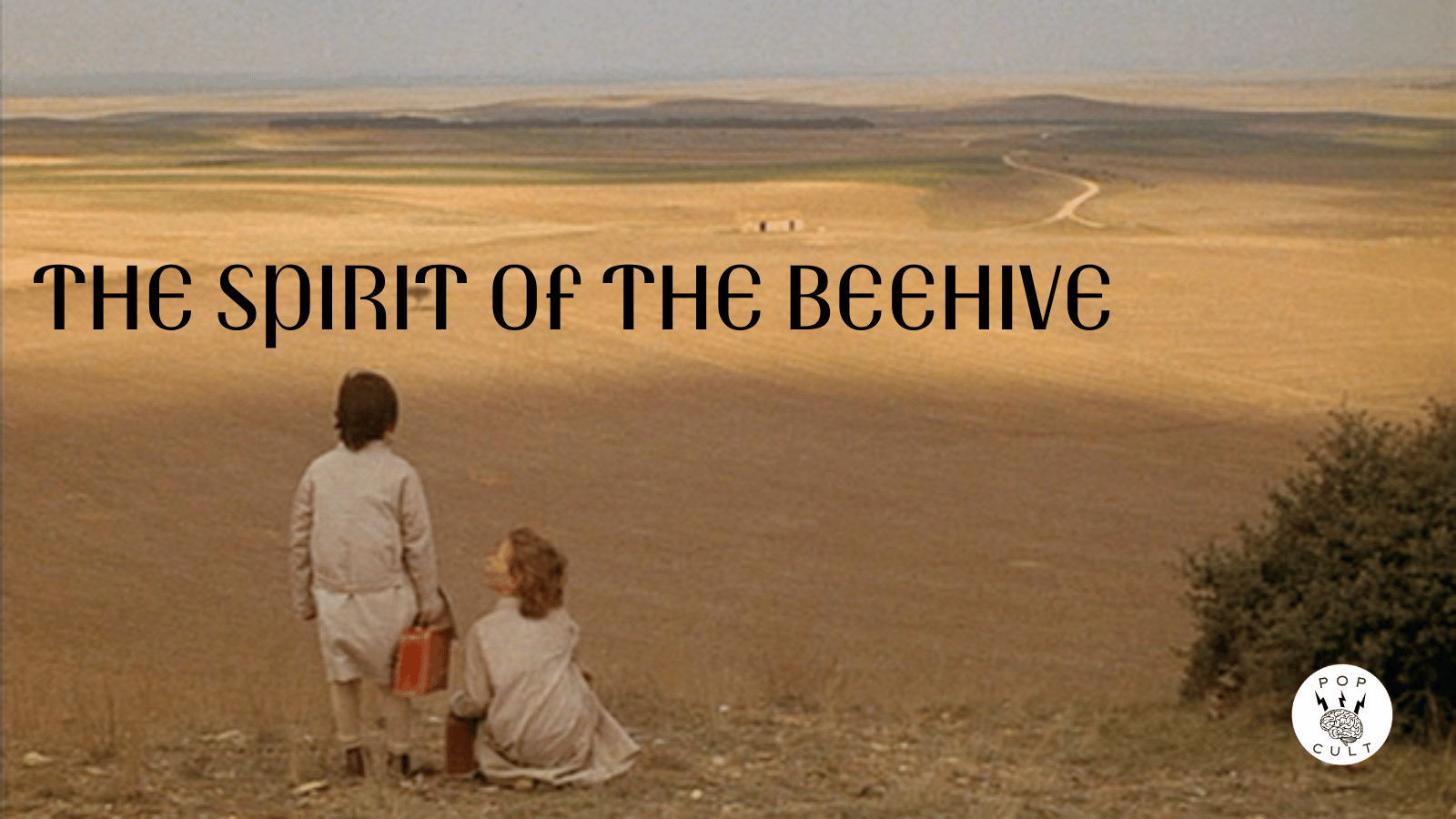
Because Erice relies mainly on his visuals rather than dialogue, The Spirit of the Beehive could be an extremely frustrating film for some audiences. Some scenes appear to go nowhere, just the wanderings and observations of a little girl. By eschewing unnecessary dialogue, Erice makes room for atmosphere and tone. Certain shots reminded me of paintings. At one point, I remember thinking of Wyeth’s Christina’s World with its desolate plains, character with their back to us, and a profound sense of foreboding.
By going back to childhood, Erice is committing an act of rebellion. Made in 1973, this film was released in a Spain where the Franco regime had pulled back slightly on its previously brutal censorship. That doesn’t mean things were good. Erice has to tread carefully, ensuring his symbolism can be interpreted as having neutral opinions about the fascists while hiding his disgust for them just under the film’s surface. The family’s disintegration directly results from realizing the horrors that have been and are to come.
The father expresses his revulsion at the mindless behavior he observes in his beehives. There is a lot of organized action, but it is done without thought by its participants. The old man thinks he can improve upon this and builds a glass, clockwork honeycombed hive, but the bees become agitated and are less productive. In the same way, the fascists sought to squeeze more labor out of the people but only knew brutal methods that created an increasingly unstable society.
The mother spends very little time with the rest of her family. She pens letters to men at war, expressing her love & lust for them. The men in town stare at her like predators as she walks by. But there is brokenness in her face, signs of a profound depression. Like her husband, she consistently fails to be there for their daughters, who desperately need their love & guidance. There’s no direct backstory about how she ended up with such an older man, but we can extrapolate that it was likely a better financial situation than the one she had been in. He seems preoccupied with his interests so she can pursue her own.
Despite seeming slight regarding dialogue and plot, Spirit of the Beehive is a dense movie. Characters’ faces carry a lot of emotional weight. The scale and scope of the landscape are just as important. The vast, sprawling plains with a single building dropped down in the distance evoke a sense of isolation. As a child, Ana is trapped in an inner world that no one else understands. Isabel takes advantage of this and does considerably cruel things to her little sister. Ana is alone.
Spain was also alone. The international world simply let the dictator take Spain, and thus, fascist influence spread into the Spanish-speaking world further, particularly in Chile. They used entanglements with the Roman Catholic Church to solidify their control of the people. Erice was of Ana’s generation, a child himself in 1940, seeing the rise of evil to power with no help on the horizon. This regime would not end for thirty-seven years. Franco’s death would be followed by socialist victories in the 1982 elections.
Is this a vision of what will come for the States as Donald Trump retakes power? That would assume the States aren’t already an intensely censored, fascist police state, which they are. We already live like Ana’s parents, trying to escape through any means necessary to avoid facing the bleak truth of our present. We keep buzzing, mindlessly performing actions, very little happening as a result. Families have been disintegrating for decades. Children have been horribly neglected for as long as the States have been a formal institution. The hive is getting angry, but the question remains: Who will receive our stings?

 PopCult Reviews
2 thoughts on “Movie Review – The Spirit of the Beehive”