
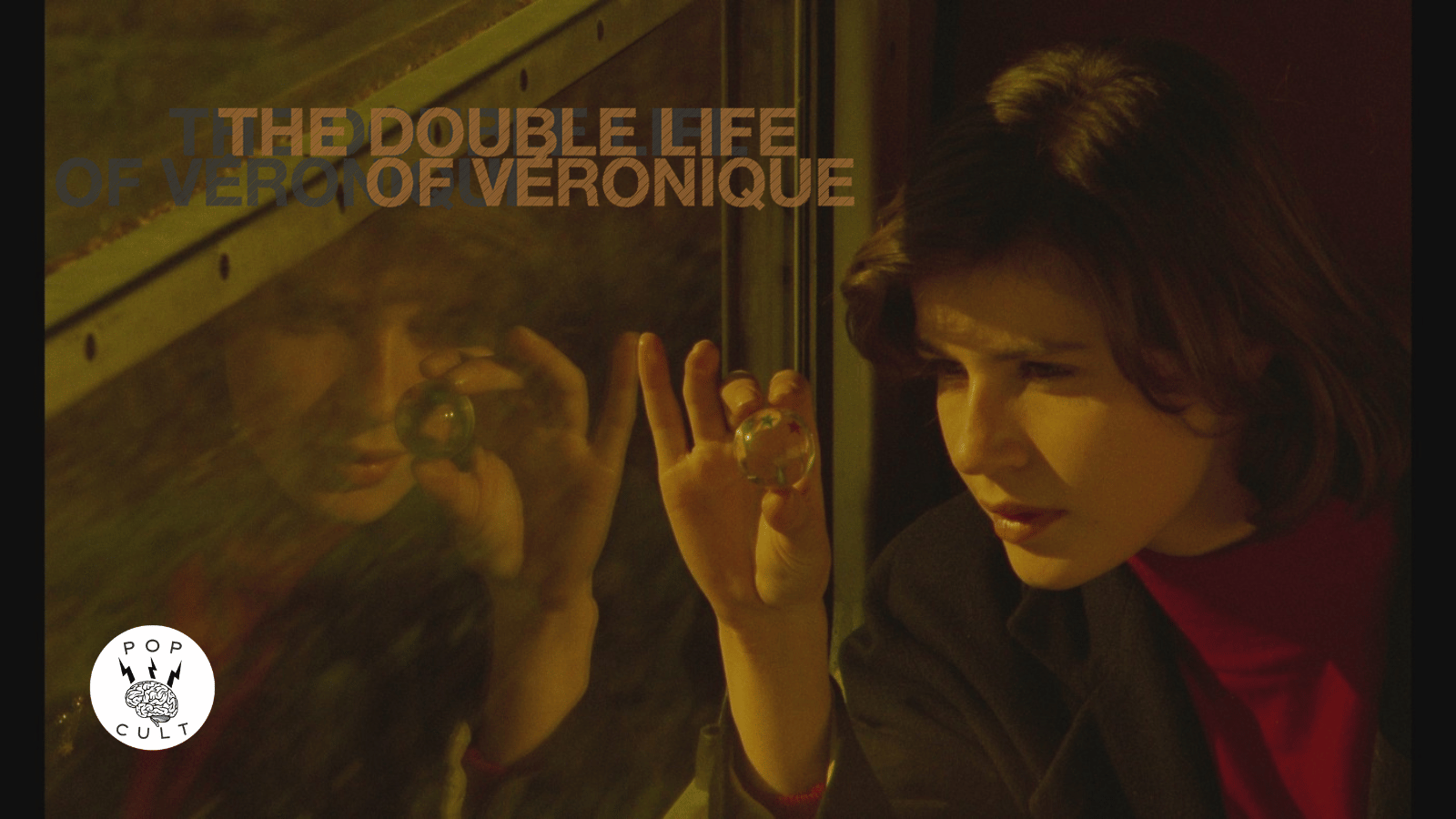
The Double Life of Veronique (1991)
Written by Krzysztof Kieślowski and Krzysztof Piesiewicz
Directed by Krzysztof Kieślowski
Ever since I was a kid, I’ve found the idea that people shouldn’t have regrets incredibly strange. I know that on my deathbed, there will be things I look back on with shame or think about what I could have done differently. I do these things now, and I believe I have quite a while before I pass. In my opinion, to live and never regret is to have never lived. It means you avoided the tough choices, one thing that lets us know we are alive. So many of those choices aren’t even up to us; they remain in the hands of chance. Why did I end up living where I do, married to this partner, and working this job? If I could go back in time, I would certainly change some things, but I would want other things to remain the same. Yet, those changes would make me a different person living a different life, right? Is our existence just a series of possible realities collapsing into a single material reality as we encounter each moment?
There are two women. Weronika (Irene Jacob) is Polish and loves singing. She does so regularly with a choir. She leaves for Krakow to care for her sick aunt. Weronkia mentions in passing to her father that she’s always felt she isn’t alone in the world but can’t explain much further. While walking through the city’s Main Square, she spots a French tourist who looks exactly like her. During the next concert, Weronika experiences a life-changing event.
Veronique (also Irene Jacob) is French and loves singing. She feels a sudden wave of grief one day and quits. Her school holds a performance of a famous marionette puppeteer, and his music is the same as Weronika was singing. Veronique feels a strange connection to this music but can’t explain why. This music keeps popping up throughout her life, and one night, she suddenly confesses to her father that she is deeply in love with someone. Yet, she doesn’t know their face, name, or anything else. She also feels like she’s lost them, which is where the grief has emerged from. The more she looks into this, the more mysterious her life becomes.
My first Krzysztof Kieślowski films weren’t until 2022, and I began with his last work, The Three Colours Trilogy: Blue, White, and Red. After I posted those reviews, this was heavily recommended to me, and I’ve been waiting for the right time to view it. I decided to make The Double Life the last film of my December “Gift to Myself” series, and I wasn’t disappointed. What a fantastic way to conclude this series. Kieślowski is a filmmaker less interested in explanations than the emotional resonance of the mysteries of life. He embraces uncertainty as it is the only thing a person can be certain of. Like in the Three Colours, Veronique’s life is ruled by forces beyond her observation or control.
Kieślowski makes second chances a center point of his work, exhibited here through Weronika’s exit from the narrative at the halfway point only to have Veronique replace her as the film’s protagonist. Strangely, the errors and pitfalls of the first woman’s life are erased, and she’s brought back to square one as Veronique. Like in a video game, she has used up a life and is now on her second. The same type of incident occurs in White, where an immigrant and his bride can have a second chance at marriage, albeit with the iron bars of prison between them.
I find the world of Kieślowski’s films, despite being made in the early 1990s, to speak to our present condition with a voice loud & strong. This world is where the myth of a human-like, caring God has been accepted as a fairy tale. Humans haven’t necessarily progressed into more enlightened beings, though. Instead, we’re left confused by a world where God doesn’t exist as an explanation. For some people in our world, avoiding responsibility for one’s life is easy; just say that God (or the Devil) made you do it. That’s just not an option in this film.
Further, the concept of The Self is abated. If the certainty of a personified God is erased, so is the idea of me as a unique individual. There is no divine guiding hand in my life. I have how I react to what is done to me and random occurrences interrupting my existence. COVID-19 is a great example of this. It is the most significant event to have ever happened in my lifetime so far. No other event has so dramatically shifted people’s personal journeys than that one. Some people are desperate to find some logic or meaning, to blame the Chinese or Fauci, etc. If only it were that easy. By discovering evidence and assigning blame, we can be freed and returned to the point where everything diverged. That’s simply not possible.
Weronika chooses to make singing her life, and we see the outcome. Veronika feels compelled to walk away from singing, and her life goes differently. But the film makes it clear that singing is the passion of both women. While Veronique avoids a disastrous outcome, she also gives up something that gives her value in living. She talks about this mysterious grief as the driving force in this choice. Is this God telling her to change her life? If this loving God exists, why didn’t he give the same advice to Weronika to save her a tremendous amount of grief? Are these the same person, in some strange way, and she is being given a second chance at life?
There are similarities between this film and Hitchcock’s Vertigo. In that film, the doppelgangers are not the protagonist. Instead, they are the object of desire and pursuit by our amateur detective, who becomes lost in his obsession. Even here, double people come to represent a second chance, and that ends in a bleak, existential way. That film at least provides a sense of downbeat closure, while The Double Life ends comfortably in a place of ambiguity.
The film also hints at Kieślowski’s post-work plans for himself. After finishing Red, the director retired to the country and spent his days fishing and reading. He also had a heart condition, which Weronika shares with him. That retirement lasted only a couple of years before he died. Would Kieślowski have lived longer if he kept making films? Would he have died no matter what he chose to do on that day from that same cause? There’s no way we can ever know, so existence can be confounding for those who desire logical, meaningful answers. At this very moment, there could be a clot floating through your bloodstream that, in a matter of days, will cause a stroke, and you die. Or maybe it takes years to reach that point. Will it matter what you do in the meantime?
This is what the terror of being alive is. I can make choices and exercise a sort of freedom. That freedom is limited by the institutions of the society I live in. In turn, my economic status affects my freedom. Money can certainly keep you alive for longer. But there’s always going to be the force of chance, things happening that you have zero control over that is embedded in your DNA or connected to events far removed from your life. The image of the puppeteer lingers with Veronique, and what follows is a series of serendipitous encounters and discoveries. They seem like they should mean something, but that meaning eludes us and Veronique. The revelation of a book and then a puppet effigy of her activates a desire to keep living in our protagonist. We don’t know what she makes of this life; she only chooses to keep living it.

 PopCult Reviews
2 thoughts on “Movie Review – The Double Life of Veronique”