

Good Night, Sleep Tight: Stories by Brian Evenson

I have never been disappointed by Brian Evenson, so I was delighted to see his short story collection coming out the exact same day as Laird Barron’s new book. These two books helped improve my October, and I needed it. This story collection was a slight shift from Evenson’s normal fare. I noticed a lot of variations on the same themes (mothers, robots, the end of humanity) and a shift to more science fiction stories than just horror.
- The Rider
Reiter’s car breaks down, and he decides to go on foot and search for help in the nearby town tucked away. The place seems absolutely barren. Knocks at a dozen doors result in no answers. But then he finds an occupied home. It’s inhabited by an adult man who seems completely out of it and a little boy who sits on his shoulders, steering him around. This is a true “weird” story, surreal and nightmarish.
- Mother
Our protagonist lives with his Mother and younger “sibling,” Martu. Mother insists on adhering to a set of rules about where and when the “children” can go. They live in the wilderness with a couple of stable structures. The protagonist realizes he has a cavity in his torso and hides an odd piece of metal he comes across while exploring. That cavity turns out to be able to do molecular analysis, and he learns the truth behind Mother’s rules.
- Good Night, Sleep Tight
A more traditional horror story about a man with fragments of memories from his childhood. His mother would tuck him in for bed, then leave the room. A little while later, she would return and tell him bedtime stories. Except these tales were dark & sinister. His mother seemed to get enjoyment out of tormenting him. It’s decades later; he’s a dad, and his mother insists they visit and stay in the house. Our main character must prepare for when night comes, and his mother wants to tuck her grandson in.
Not a Speck of Light: Stories by Laird Barron
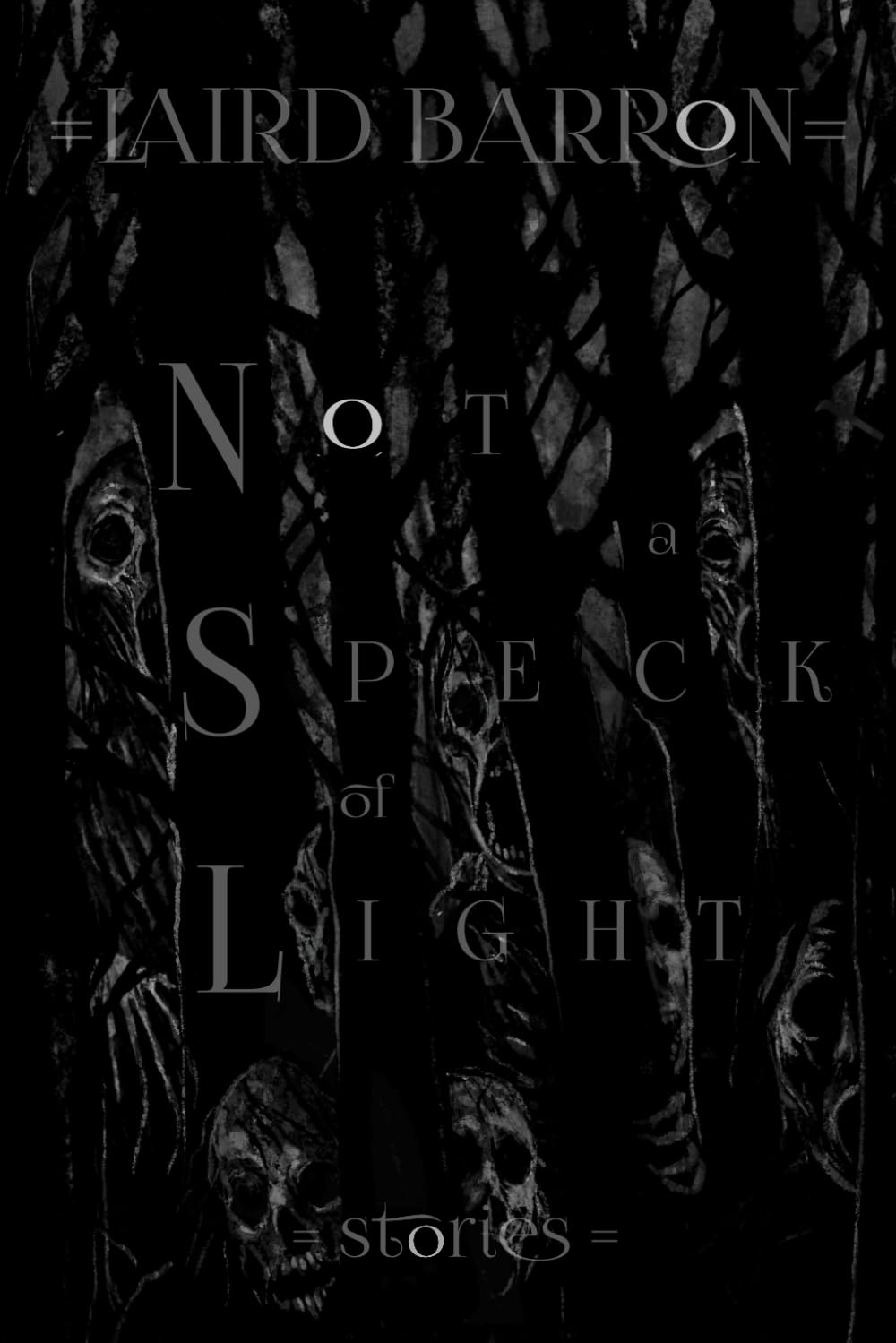
I was very worried we might not get more from Laird Barron as he had a recent medical scare that sent him to the hospital, which he’s still recovering from. This latest collection is not my favorite. It continues Barron’s shift away from the tone of his first three collections and goes beyond the new territory he covered in Swift to Chase. This is the thing about loving a contemporary author. The work I discovered him for will likely remain my favorite. Yet he’s an artist and doesn’t want to do the same thing repeatedly. While I didn’t enjoy several of these, I still respect the hell out of him for trying new things and stretching himself beyond Lovecraftian horror.
- In a Cavern, In a Canyon
It’s a play on the skinwalker stories. A middle-aged woman who has lived a rough life hears a crying noise from the dark edges of her property one night. She goes back to a memory of the time her father went missing. Her uncle suspected something terrible and told her stories about something that lives in the woods and lures people. It cries like a person and hooks them in like fish to devour. This is the exact story I want when I read a book like this.
- Joren Falls
A couple buys their dream home out in the country. But we all know how that goes. Larry can feel something is off about the house, but he can’t pinpoint what it is. Every time he goes into the attic, he can’t help but feel something watching him from the darkness. Roger, a neighbor and friend, is called to come over and inspect. Something clear spooks him, but he doesn’t go into detail. Larry remembers a work trip to Japan and what he brought back. Things get increasingly worse.
- Tiptoe
I read this in Ellen Datlow’s horror anthology for 2023, and it’s one of the best horror stories I’ve ever come across, probably since Barron’s last collection. A grown man thinks back on his strained relationship with his father, and while perusing some old family photos, he comes across a horrific truth he’d chosen to ignore for all these years.
Blackwater: The Complete Caskey Family Saga by Michael McDowell
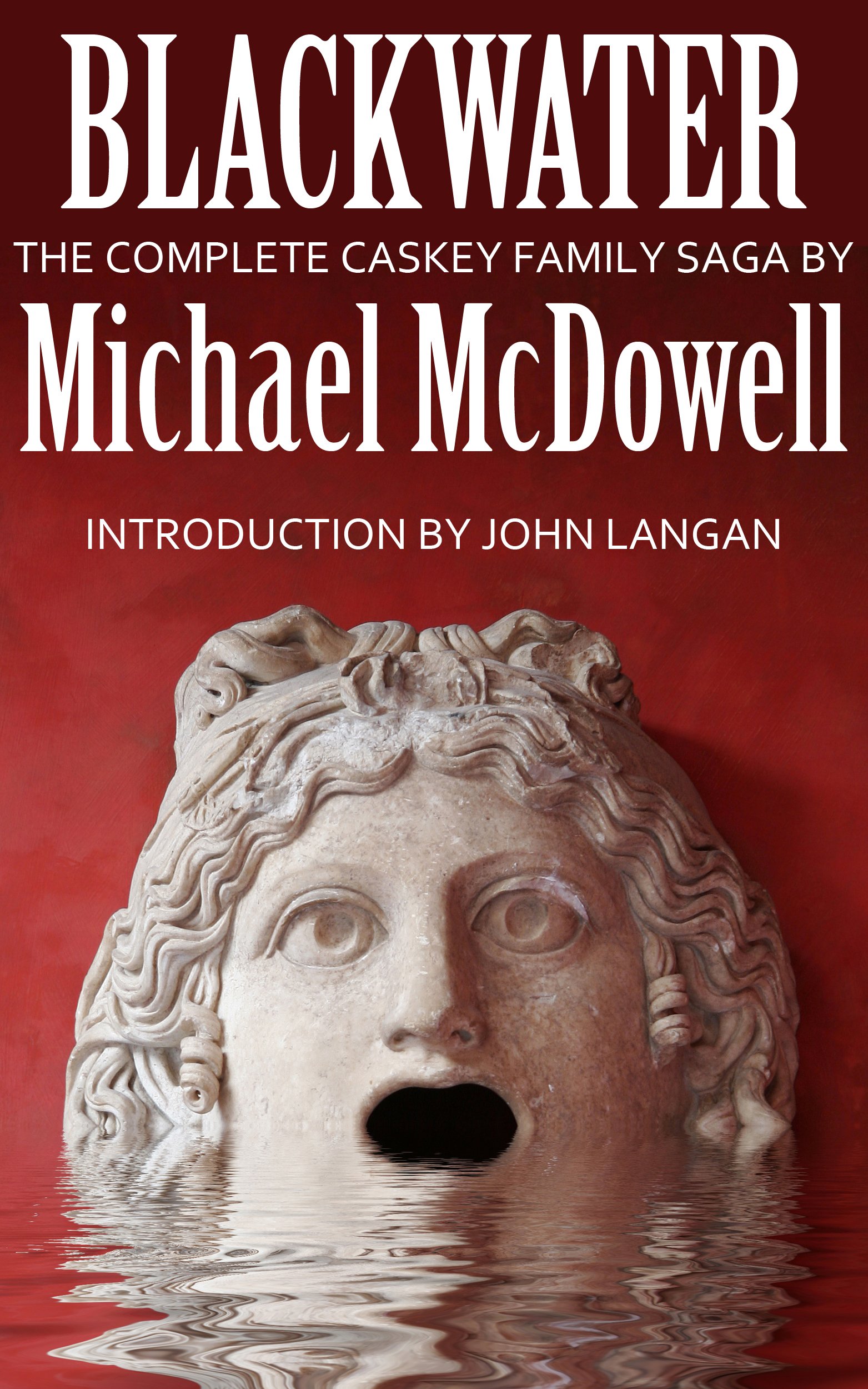
I’ve been wanting to read Blackwater for a few years now. I can’t remember where I first heard about it, but it was in the context of it being a cult paperback classic from the 1980s. Michael McDowell had written Beetlejuice, among other (primarily television) writing gigs. He was most prolific as a horror writer, penning novels like Cold Moon Over Babylon, The Elementals, and more. Blackwater was originally published as six serialized novellas, initially published in 1983. Instead of tackling them one book at a time, I went with the 900+ page omnibus to get the whole story.
Spanning from 1919 to the late 1960s, Blackwater focuses on the wealthy Caskey family of Perdido, Alabama. Through the ownership of a lumber mill, they have come to amass a small fortune that keeps them comfortable and their houses staffed by servants. Everything changes when a disastrous flood also brings the mysterious Elinor into town. She charms James Caskey and his daughter Grace, eventually building a relationship with James’s nephew, Oscar. There’s something very strange about this woman; she appears to have an intense connection with the Perdido River from which the town gets its name.
McDowell has created a Southern Gothic that is clearly influenced by Faulkner, but not quite at that level. It’s still a beautifully written story with plenty of space to wander and peek into the lives of so many characters. I would argue that it’s not precisely horror, though there are several horror moments in the story. Most of those were concentrated near the end, with a long stretch just chronicling the lives of these people as they fall in love, have children, and time passes by unceasingly.
Because the novel spans a long time and many pages, you might feel this is going nowhere sometimes. When you get to the final book in the series, it suddenly comes into view. There’s a beautiful mirror to the book’s opening, Elinor exits the story in a manner extremely similar to how she enters it. The difference is how many people she met and shared her life with are gone when this happens. Some of them became friends and some enemies, but Elinor shaped this family and ensured they would keep going on and on. The catch is that this way of living – stuck in the post-Reconstruction era and perplexed by the mechanization of industry – has to crumble and fall away.
McDowell, an Alabama native, wrote from a place of experience. He takes his time introducing us to each family member and puts them in situations that reveal who they are to us. There’s a lot of political maneuvering among the family, but it’s typically not hugely significant. It’s more the result of someone unwilling to have empathy or listen to another person. Children turn their backs on parents to show loyalty to other family members. People fall in love, but every wedding seems like a lowkey-rushed affair. They even get a levee built to hold back the river. And in the middle of it all is a monster in the water who eats people.
Dune by Frank Herbert

I’ve wanted to read Dune for a while now, and after seeing the second part of the recent film adaptation, I decided to finally do it. Part 2 provided enough new details I wasn’t aware of in the story to get me curious. I still think Hyperion by Dan Simmons is my favorite science fiction novel; Dune has incredible world-building from start to finish.
You know the story. Paul Atreides watches as his family’s House falls at the hands of the treacherous Baron Harkonnen and the Emperor. It all happens on Arrakis, a desert world which produces the Spice, a substance that enables all sorts of advancements in humanity. Paul comes to believe he is the prophesied messiah that will liberate Arrakis from the control of the Houses. By the end, Paul does become *a* messiah, but it doesn’t seem like things will get better, just worse in a different way.
One observation I made about Dune was that most of the first section is about a person in a room, and another person comes into the room and talks about something that happened a long time ago or between chapters. I don’t know why, but I found that so funny as it happened chapter after chapter. Paul comes into a room where the Bene Gesserit Reverend Mother is sitting. Paul is in his room, and Doctor Yeuh comes in to talk. It’s not the most creative structure to deliver exposition, but it is very readable.
Things get more interesting once the coup occurs, and Paul and his mother, Jessica, join the Freman. The amount of terminology in the book is awe-inspiring. Seeing multiple film adaptations helped in contextualizing everything for me. I remember trying to read this when I was around thirteen and getting lost very quickly. It may have just been that I was so young, and a few years later, it would have been a cinch. However, understanding the various names of the messiah made it less confusing when I was reading through bits where people were throwing around terms like Lisan al-Gaib and Kwisatz Haderach like crazy.
The book showed me how much influence this story had on something like Game of Thrones. People make the Star Wars connection, but that’s a very thin connection at most. The courtly intrigue being preferred over action set pieces makes that obvious. I’ve always found well-written dialogue between people attempting to exert control over the other more enjoyable than pages of physical combat being described.
The book also cemented Lady Jessica as one of the most complex villains I’ve ever seen. Harkonnen is an easy villain because he’s so disgusting, and the same goes for Feyd Al-Rautha because of his murderous tendencies. Jessica is a perfect zealot villain in that she is convinced what she is doing is right while ignoring that part of this mission is driven by her ego and resentment of the Sisterhood. There’s also the revelation of her parentage and how that drives her down this path. When I call Lady Jessica a villain, what I mean is she is an excellent example of a person who has convinced themselves that what they do is righteous while ignoring the underlying personal hate that is driving it. The central aspect of potential villainy lives within us all, and we must watch over it.
I also loved how abruptly the book ended. There isn’t closure, which makes it resonate for longer. We have this crescendo moment where Paul has defeated his enemies, and Chani sees the edge they’ve come to. The final line is Lady Jessica’s, and it underlines a big reason why things have descended into madness, why the Freman are now going about to commit nuclear genocide on a large swath of the known universe. Jessica tries to comfort Chani by telling her they, the concubines, will be remembered in history as wives. It’s chilling. I agree that Jessica should not have been limited in her relationship with Duke Leto, but the extremes she goes to by the end of this novel are wild. What a fantastic character with such complexity and relatable but terrifying motivation. I definitely plan on reading Dune Messiah sometime in the near future.
Hyperion by Dan Simmons
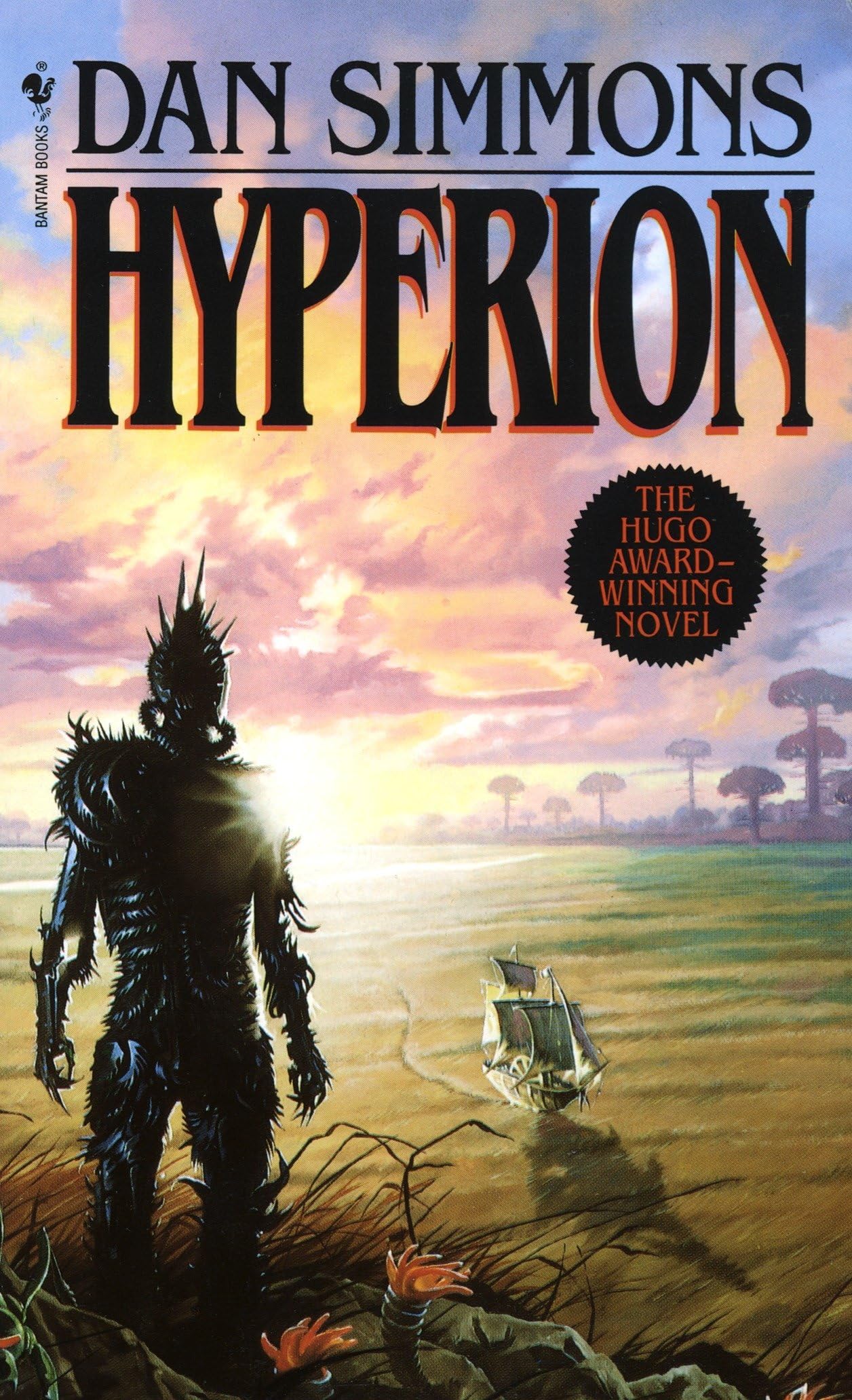
As a teenager, I came across this book in the now-defunct Wizard Magazine. I am trying to remember the context in which it was mentioned, but I do remember the striking cover. Years later, when I took Chaucer & Medieval Literature in college, someone told me Hyperion was a retelling of The Canterbury Tales. Only at the end of 2023, at 42, did I pick up Dan Simmons’ acclaimed science fiction epic to read. Wow. What an incredible treat to enjoy.
Through the framework of pilgrims telling their stories on a journey to an important religious site, Simmons showcases some of the most enthralling worldbuilding I’ve ever encountered. The Hegemony of Man rules most of known space, apart from the Ouster (separatist humans that rebelled and have been hiding in the dark corners of space), the TechnoCore (AI existing in a parallel universe of data), and the mysterious planet Hyperion. The Time Tombs are located on Hyperion, immense structures moving backward in time and beginning to open. No one knows what happens when they are, so the Hegemony has organized a final pilgrimage before the planet falls into a long, brutal war.
Among the pilgrims are The Consul, The Priest, The Soldier, The Poet, The Scholar, and The Detective. Journeying from their landing spot on Hyperion to the Tombs takes quite a while, and so to pass the time, the pilgrims tell the stories of what led them to this odyssey. As the details unfold, we learn copious amounts of information about this universe and how their individual stories reveal a shared link with the Tombs and Hyperion’s enigmatic cyborg predator, The Shrike.
I am not a big consumer of science fiction, but this has me wanting to search out similar titles. There is a Hyperion series, but I have not heard anything positive beyond the second book. What I appreciated about Hyperion is that it is a complete story. Yes, it continues into the next book, but even if I never picked that one up, I was treated to a beautifully written piece of literature. You don’t need any background knowledge of The Canterbury Tales to appreciate the novel, but having that does bring another layer to the story.
A Feast of Snakes by Harry Crews
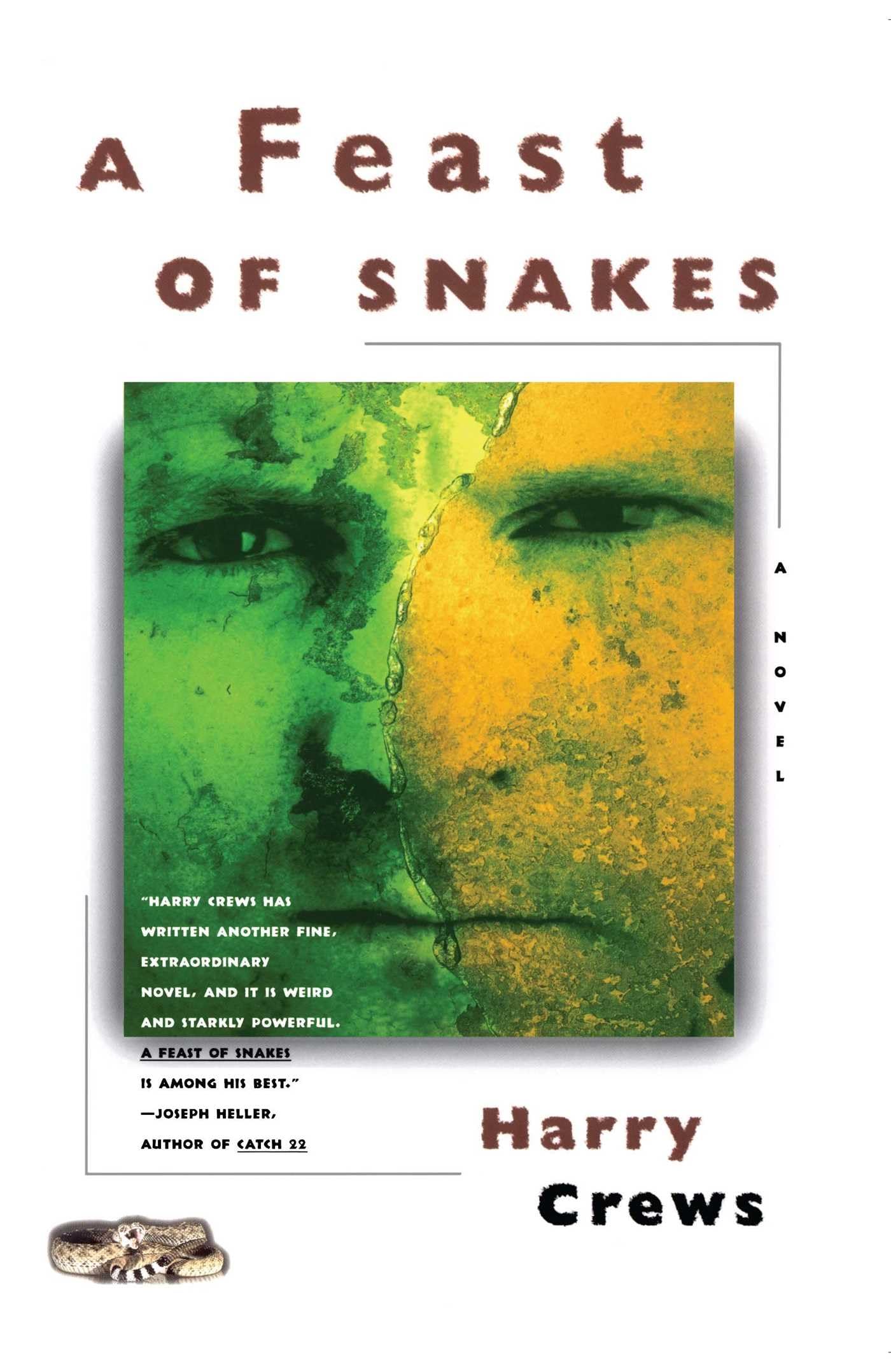
I found a scanned PDF of the Salon.Com Reader’s Guide to Contemporary Authors online. That book played a pivotal role in shaping my reading as an undergrad. It was published in 2000 and has never been updated, providing a snapshot of what was seen as prominent contemporary lit circa the turn of the century. Crews has a write-up in that book where his work is compared with Kafkas and described as presenting a parade of social misfits against a Gothic Southern backdrop. That explains A Feast of Snakes perfectly.
Set in Mystic, Georgia, circa 1975, we follow Joe Lon Mackey, a former high school football star turned alcoholic abusive husband. His town is home to the Rattlesnake Round-Up, where people come to kill and eat the area’s ubiquitous hibernating snakes. This brings Joe Lon’s high school flame, Berenice, back from university and her new beau. There’s a sleazy sheriff with a penchant for falsely arresting women and raping them, which he does to Lottie May, a young Black woman in the community. Joe Lon’s sister, Beeder, is a shut-in who has lost a grip on her insanity after witnessing their mother kill herself. Joe Lon’s dad raises pit bulls for a brutal fighting tournament. Amidst all of this roiling evil & chaos, it becomes clear that our protagonist will face a mental & spiritual breaking point.
This is certainly not a novel for everyone, but I loved the rotten, seedy atmosphere Crews was able to immediately establish. This is the deep South as filtered through the horror-melodrama of Lynch’s Twin Peaks. Characters are grotesque, and toxic masculinity is put on display as something absolutely abhorrent that forces men to behave in horrific and nasty ways. A Feast of Snakes is a perfect example of having a central character who we aren’t supposed to want to be like but whose perspective is one of a person who knows the things they have been taught are wrong & cruel; they just don’t know how to be anything else.
Bullshit Jobs: A Theory by David Graeber
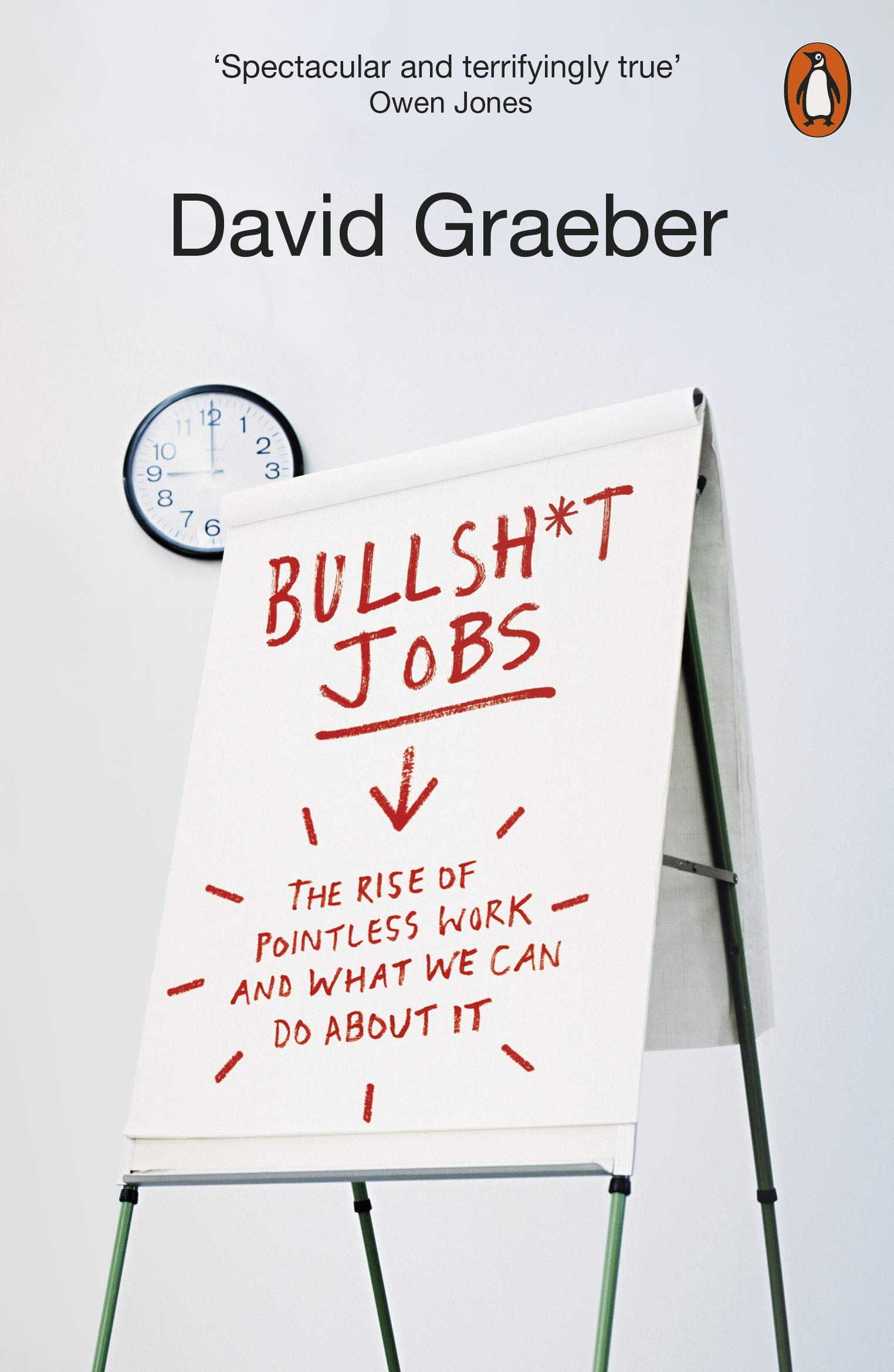
The late David Graeber saw himself gain some prominence with the publication of the essay on which this book is based. He uses John Maynard Keynes’s supposition that automation would lead to a 15-hour work week in 1930 to ask why that hasn’t come to pass. It’s been shown in reams of data that productivity has never been higher in human history. Yet, people are miserable, both physically and especially mentally/emotionally/spiritually. Graeber believes this is linked to so much of the labor in developed Western nations being busy work that exists to make corporations look successful. People end up doing work that doesn’t contribute to their communities or the world, and it takes a piece of their soul with it.
Graeber received hundreds of messages and letters from people after they read his initial essay, and he shared volumes of their accounts of their own bullshit jobs. Many jobs sound like an easy paycheck with lots of unmonitored free time, but even those got to the people who had them over time. They say they felt like they went into an office every day to waste hours of their life, that the world was spinning by, and they were detached from it. By their livelihood & survival being connected to such meaningless labor, Graeber posits they are victims of “profound psychological violence.” To survive, we must waste large chunks of our lives or, in the worst circumstances, exploit other human beings cruelly.
Graber’s book outlines five types of pointless jobs: Flunkies, Goons, Duct Tapers, Box Tickers, and Taskmasters. Each type is unpacked, analyzed, and detailed, and each plays a distinctive role in a contemporary corporate/bureaucratic setting. Flunkies are often gatekeepers who make bosses feel more powerful. Duct tapers are asked to provide temporary fixes to problems that could be fixed permanently if a different perspective is taken into account. Taskmasters are middle management types who create even more meaningless extra work.
Graeber points out the irony of the modern capitalist sentiment that market competition naturally roots out inefficiencies to show how it has made them worse than ever. Part of this is fueled by the neurotic Puritanical work ethic, which shapes labor into some sort of religious duty that the ownership class has always enjoyed exploiting to their benefit. We have interlinked our labor with our identity, which, when you give someone a bullshit job, wreaks absolute havoc with the person’s image of themselves as a part of society. This leads Graeber to correctly identify a Universal Basic Income as a foundation for a solution. This book makes me keen to check out more of Graeber’s writings on economics and labor.
The Wretched of the Earth by Frantz Fanon

The Wretched of the Earth is a book I’ve wanted to read for years now, and with the genocide happening in Gaza, it felt like the right time. I’m so glad I did. Frantz Fanon was born and raised on the French island colony of Martinique; the descendants of African slaves forcibly moved there. Vichy French forces were blockaded on Martinique after France fell to the Nazis, so they implemented an oppressive regime while stuck on the island. During this time, Fanon saw colonial horrors up close and began articulating his view of why such a system must be destroyed.
The Wretched of the Earth was published in 1961 when Fanon died from leukemia. In the text, Fanon embarks on a psychoanalysis of how colonialism dehumanizes its victims in ways that can last for multiple generations. The first section of the book, “On Violence,” details how violence is used by colonialist forces to impose their will & structures onto indigenous communities. He also describes how violence must be used to rid these regions of their colonizers. He explains how settlers rarely see indigenous people as human beings; in most instances, they are equated with local fauna that are pests.
Even more insightful is Fanon’s observation that the local population gets divided into roughly three groups: There is the proletarian worker in aid of the colonizer, the “colonized intellectual” who is often made into a spokesperson for the colonizer, and finally, the lumpenproletariat – the poorest class, usually living in ways labeled as “primitive,” the peasants who have little. Fanon makes a very pointed critique of Marxist thought by reminding us that this group is often ignored when the proletarians rise up as they focus on industrialized centers. However, Fanon shows how the peasants are the first to understand the role of violence in dethroning their oppressors.
In the essay “On National Culture,” Fanon looks at how the decolonized society can often fall prey to ideological traps that remain due to having been occupied. Part of this is how colonizing forces rewrite the precolonial history as a time of barbarism and savagery. The colonized intellectuals will often try to return to a past they have idealized in a way that is unfair to their ancestors as a violent rejection of colonization. The result is frequently a cliched parody of these traditions, which romanticize the past in the same unconstructive way as their oppressors did their own.
Fanon concludes that the way forward is to move past outdated ideas of nationalism towards a global consciousness. Building a national culture is only a means to reach a greater goal: international solidarity. It is through this struggle to see a society not as something insular from the world but as a part of a larger mosaic that humanity can achieve its highest form of culture. Through this transformation of the consciousness of the entire species, we might end the oppressive movements that have erased so many. But like any Marxist, Fanon also understands this is a multi-generational struggle, the fruits of which he would never see, and neither will I. Simply because I will not be alive to witness a transformation for the better does not mean I can shrug off my responsibility to the work needed to be done to reach that day.
War Against All Puerto Ricans: Revolution and Terror in America’s Colony by Nelson A. Denis

I’d been aware of this book for years now. My wife had read it previously. She is Puerto Rican and lived on the island for much of her life. Her family still lives there. I knew that reading this would upset me, but 2024 feels like a year where we need to stare into the void and confront the horrors previous generations have let slide by time after time. There’s some discourse surrounding Puerto Rico at the moment, which has me pissed off. You’ve probably heard about the comedian the Trump campaign hired who called the island “garbage” at the Madison Square Garden venue. Then we have the disingenuous pandering of the Democrats, completely craven. None of America’s institutions or political parties give a fuck about Puerto Rico. It is a place to be exploited in their eyes. Some of them may be overt in their racism, others more coy, but in the end, it’s evident none of them care.
This book focuses on the attempt at revolution on the island, which went down in 1950. The Puerto Rican flag was banned by the occupying U.S. forces, as well as certain songs about the people’s pride in their home. Sugar cane plantations dominated labor, and Puerto Ricans were forced to work long, torturous hours for wages none of us would accept. The story of Puerto Rico mirrors so many other places with labor exploitation, the dehumanization of the indigenous people, and the unceasing violence of the United States government.
There’s a reason you don’t get taught this history in U.S. schools. You don’t get told about the man taken to what amounts to a black site of the time, starved for days, then fed meat only to be told by the guard it was his own son. The truth of that statement has neither been confirmed nor denied. What we do know is that the man being tortured had a heart attack and died when he was told this. That’s just one story. Some are more heroic, like the barber who housed weapons for the revolution. This man had his business and his body shot to pieces by collaborating local police forces. Yet, even riddled with bullets, he kept doing damage. If I lived to have just a micrometer of that courage, I would die proud of myself.
The fate of the Palestinians is much like the fate of the Puerto Ricans. Occupied people whose current generation has never known freedom. Those of us in the West have enjoyed the fruits of these horrors. It can be excused if you don’t know (to an extent), but the moment you do, there are no more excuses. There’s only one acceptable path: self-determination & independence with ongoing no-strings-attached financial reparations to the people. Death to every colonizing nation. None of us are free until every single last one of us is free.

 PopCult Reviews
One thought on “My Favorite Books Read in 2024”