
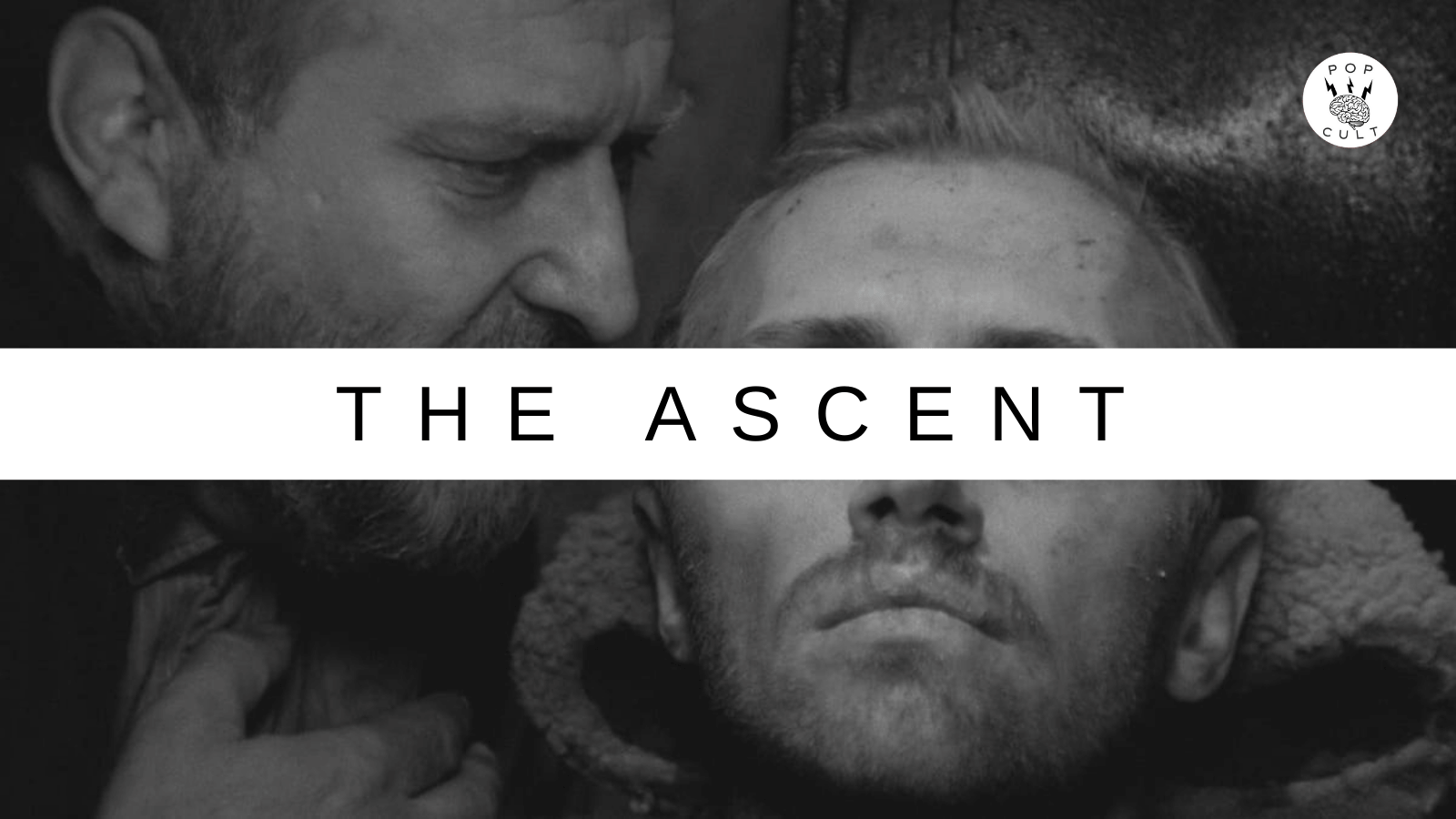
The Ascent (1977)
Written by Vasil Bykaŭ, Yuri Klepikov, and Larisa Shepitko
Directed by Larisa Shepitko
Two years after the release of The Ascent, writer/director Larisa Shepitko would be dead at age 41. She would leave behind her husband, Elem Klimov, the writer-director of Come and See, and Anton, their six-year-old son. Throughout her life, Sheptiko had struggled with her health. While filming her first movie, she contracted Hepatitis A. Her work was repeatedly censored, which caused her to have a mental breakdown. During her hospitalization in a sanitorium, Sheptiko had a fall that damaged her spine, and that caused Anton’s birth to be tremendously more painful for her than the average labor. Strangely, her death was just an accident. She and three crew members were driving home after scouting locations northwest of Moscow. The driver fell asleep at the wheel. Doctors ruled that all four died instantaneously when the car crashed. There is a plaque bearing her face and name on a street in Lviv, Ukraine, where she grew up. Her husband finished her last film, made one more himself, lived to be 70, and died in 2003.
It’s World War II. Two Soviet partisans, Sotnikov and Rybak, have left their group to search for food in a nearby Belarusian village. They steal an animal from one of the collaborators in the town, but on their way back, a German patrol spots them. Gunfire is exchanged, resulting in a German death, but Sotnikov is badly wounded in the leg. Rybak frantically searches for shelter and finds it in the home of Demchikha, a mother of three children whose husband is absent. She doesn’t want to get too involved, terrified of what the Nazis will do if they come to her home and find these men hiding there. What about her children?
From what I could see in The Ascent, there are two overarching themes. The first is comradeship, which means the cost and the benefits. The second is that death is not a moment but a process, often painful but also exhilarating in some moments. Like Klimov’s Come and See, this is also an anti-war film that presents its case by showing how horrifically devastating war is to everyone. Lives are ended, and families are torn apart before our eyes. The worst is a betrayal that happens near the end of the film that immediately comes back to bite that person on the ass.
The odd, peaceful stoicism of Sotnikov, the dying man, stands out. While others weep and gnash their teeth about their fates, he becomes quiet, staring off into the distance at some invisible sight. Those who wish to kill him don’t even register in Sotnikov’s mind; he can perceive something beyond what is immediately around him as he slowly slips further into death. He has finally been allowed to see the light behind all things in the universe.
The way the film addresses comradeship is not in the framework of Soviet nationalism. Instead, it speaks to the full communist ideal, humanity understanding we are all we have. To betray that inherent bond we share with people we know and those we have never met is monstrous. The fascists, especially the Germans our characters encounter, have chosen the path of dehumanization for everyone they meet and themselves. What is worse is when people who claim to be in support of humanity compromise themselves to be spared fascist violence rather than meeting it with their own in response. This comradeship is linked to the cosmic beauty Sotnikov keeps glimpsing somewhere beyond the edge of life.
There has been talk for decades about whether an anti-war film can be made. The nature of cinema is one of voyeurism and, therefore, exploitation. We can see from the last few years of box office returns that people seek out escapist spectacles often riddled with dehumanizing violence and weak justifications for it. Francois Truffaut said that because cinema is about visual beauty, anti-war movies are impossible “because any film will inevitably sanitize and glamorize war.” The same could be said about the Holocaust or any historical genocide. How can the dehumanization and suffering of war ever be successfully communicated across a medium whose chief purpose has become a distraction of the masses?
A debate occurs between Sotnikov and his interrogator when the Nazis bring them in. The enemy wants the Soviet to give up the whereabouts of his group, which he refuses even as they torture him. Sotnikov insists that there is more to life than one’s existence. Humanity is a continuum, not a single person. In essence, we are fragments of the same universal Self, able to produce physical and emotional variations. Bringing humanity together is the highest goal any person could work toward. While communists are materialists in an economic sense, they are deeply spiritual, too. There’s no way to devote oneself to an ideology that seeks dignity for every human being and not be quite soulful.
The interrogator counters Sotnikov, telling him they will spread word about how he betrayed his people anyway. His death won’t matter because the Nazis will ruin his name among his comrades. Sotnikov never loses his steadfast nature, though. At the moment he and several others are set to be hanged, he cries to just shoot him, to let them go, that they did nothing, it was him. The film becomes a variation on the stories of Judas and Christ, of one who betrayed and the other who held fast to his belief that there was more to existence than the physical form. One visual detail is that Sotnikov is surrounded by candles or flames despite the brutally cold environs tearing away at him. That inner fire is stronger than the external elements.
This is not simply an antifascist film but a movie about the nature of what evil truly is. Evil is when you abandon your fellow man, refuse to be true to what it means to be a human, and reject union with others. Sotnikov looks out as they slip the noose around his neck and catches the eye of a young boy watching on in sadness. A tear streams down the man’s cheek. That is the future of humanity, bearing witness to the atrocity. That boy will carry these images with him, and the hope is that they will serve as the catalyst for his own internal fire, to fight back the next wave of monsters that shrug off their obligation to their fellow man and choose evil. The Ascent is yet another example of how the Soviet film industry was making some of the best cinema of the 20th century.

 PopCult Reviews
One thought on “Movie Review – The Ascent”