
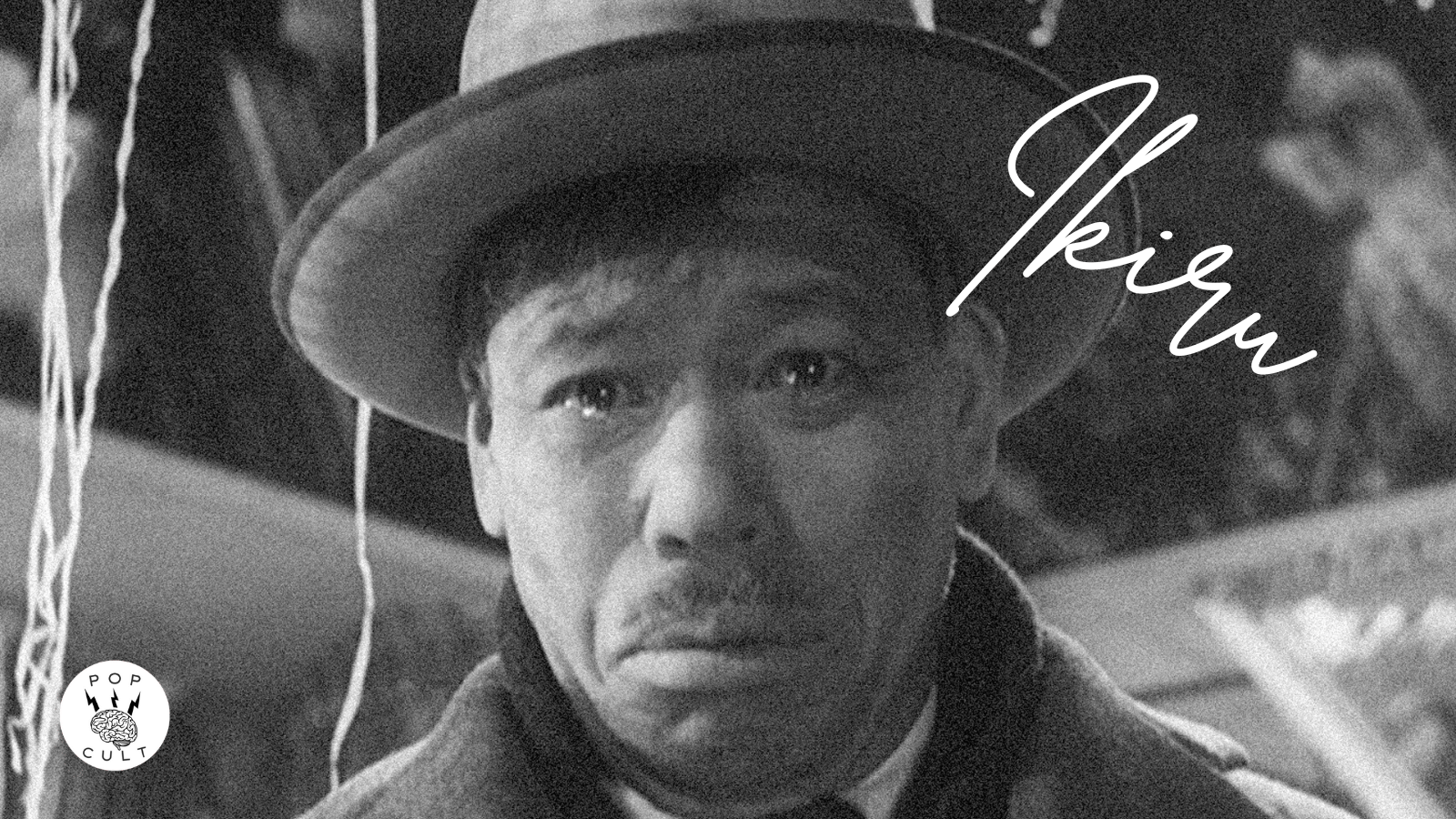
Ikiru (1952)
Written by Akira Kurosawa, Shinobu Hashimoto, and Hideo Oguni
Directed by Akira Kurosawa
After watching a little over half a dozen Kurosawa films in my life, I have concluded that I prefer his modern films more than his historical ones. That isn’t to say films like Seven Samurai or HIdden Fortress are bad. It’s more that I have difficulty emotionally connecting with that era of Japan. It’s certainly entertaining, but I don’t get invested. Perhaps that’s why I’ve gravitated towards Yasujirō Ozu’s films; they are contemporary to the period they are made in and focus on people living their lives with little melodrama. Ikiru is like if Kurosawa tried his hand at an Ozu picture. It has some thematic similarities, but tonally, this is pure Kurosawa. You can see him shaping the minds of audience members who would go on to become prolific filmmakers in their own right, mimicking the techniques of a master they first observed here.
Kanji Watanabe (Takashi Shimura) is a civil servant who has worked in the same bureaucratic position for three decades and is about to retire. Years prior, his wife died, and now his adult son Mitsuo and his wife live with the old man. His job has become a game with the public, telling them they are in the wrong location and must go to X, Y, or Z. The latest group frustrated by this are parents who want to fill in a cesspool in their community, replacing it with a playground for their children. And then something happens that changes Watanabe’s life forever. He goes to the doctor and learns he has stomach cancer.
Reeling from the shock, Watanabe decides to withhold the information from his son. Instead, he delves into the hedonistic pleasures of Tokyo’s nightlife. By the end of the evening, Watanabe finds nothing about this escapade that has helped him feel any better about his future. Instead, he becomes closer to his twentysomething coworker, Toyo. Other people mistake this as a sexual attraction, but he finds her youth and joy to be the salve he needs on a platonic level. Watanabe implores Yuko to tell him why she can find so much hope in an existence many others can’t. She’s working at a toy factory now, and it inspires him to correct something he had allowed to go wrong for so long.
If you listen to the podcast, you probably have heard me complain about overly long movies. These are usually special effects bloated affairs, with less emphasis on creating complicated characters and more on following a formulaic plot. Long movies work when a filmmaker is deeply interested in what it means to be human. If you look at the work of Bela Tarr or Wong Kar-Wai, you’ll find the types of movies I prefer. Ikiru fits neatly within that framework and kept me captivated from moment to moment as Watanabe goes through his emotions while facing death.
Would I have appreciated Ikiru if I had seen it as a young man? I probably would, but I don’t think I would have understood it like I do at 43. If I revisit this film in seventeen years, I expect to have a very different view of it at 60. Where I am now, I can understand the protagonist’s regret to an extent. I am thankful that I have never had a job or approached my work this way, of failing to help people. Being a teacher is quite different from the sort of bureaucrat Watanabe is. But what I found so fascinating was how public Watanabe’s cancer and death were in his community. I expected a story where he kept it all to himself, but this is about a man trying to connect with others before his time is finally up.
This is where Kurosawa diverges from Ozu. Watanabe would have quietly resigned to his home if this had been an Ozu film. We would have had moments where he looked at his adult child with quiet admiration and asked what he was smiling about, only to try to change the subject. The finale would be Watanabe’s son lamenting how he should have done more with his father. Kurosawa is pushing against Japanese norms in art, which is why he has been labeled “too Western in some circles.” He has no interest in discretion and decorum. Society is both beautiful & grotesque, and Kurosawa is happy to show us all the angles. Ozu’s characters accept their fates with dignity, while Kurosawa’s protagonists scream & rage against their impending doom.
I notice our societies ask so much from the dying, often contradictory. We want them to be brave despite their mortality, but we also don’t want authenticity. If a person is deep in depression over death, we want to push them away. In her brilliant book Brightsided: How Positive Thinking Is Undermining America, Barbara Ehrenreich details how, through her own experience with breast cancer, she learned remission makes many support groups push you away. Their focus is on healing and reclaiming your life; when her cancer returned, many of the people in her group gave her the cold shoulder because it was a reminder that, yes, one day, you will die.
I also thought about My Life Without Me, a Canadian melodrama starring Sarah Polley as a woman who contracts cancer. She makes a list of things to get done before she passes, including finding a new wife for her high school sweetheart husband and having sex with another man for the first time. She does everything she can to keep her diagnosis secret from her loved ones. That film’s presentation is slightly different as she’s a twenty-three-year-old young mother. Death is naturally paired with reflection; in the case of Polley’s character, her focus is on ensuring the people she loves continue living without interruption. Watanabe focuses more inward, trying to find something he did that mattered to someone other than himself.
I think Western society should spend more time contemplating mortality. We can see from the unhinged reaction to COVID-19 that the United States is not a place where death is handled with any sort of decorum or peace. I recall stories from nurses about patients in the process of being intubated, screaming curses at them, and saying the healthcare professionals were lying about the diagnosis. I don’t know the circumstances under which I will pass away, but I hope that, if it’s not sudden, I have the frame of mind to focus on the love I have for the people in my life rather than some delusion that I was never going to die. Ikiru is a film that delivers a happy ending but allows death to be a part of the natural process of existence. This may be Kurosawa’s best film, and it is undoubtedly my favorite.

 PopCult Reviews
This is truly one of the most moving films I have ever seen.