
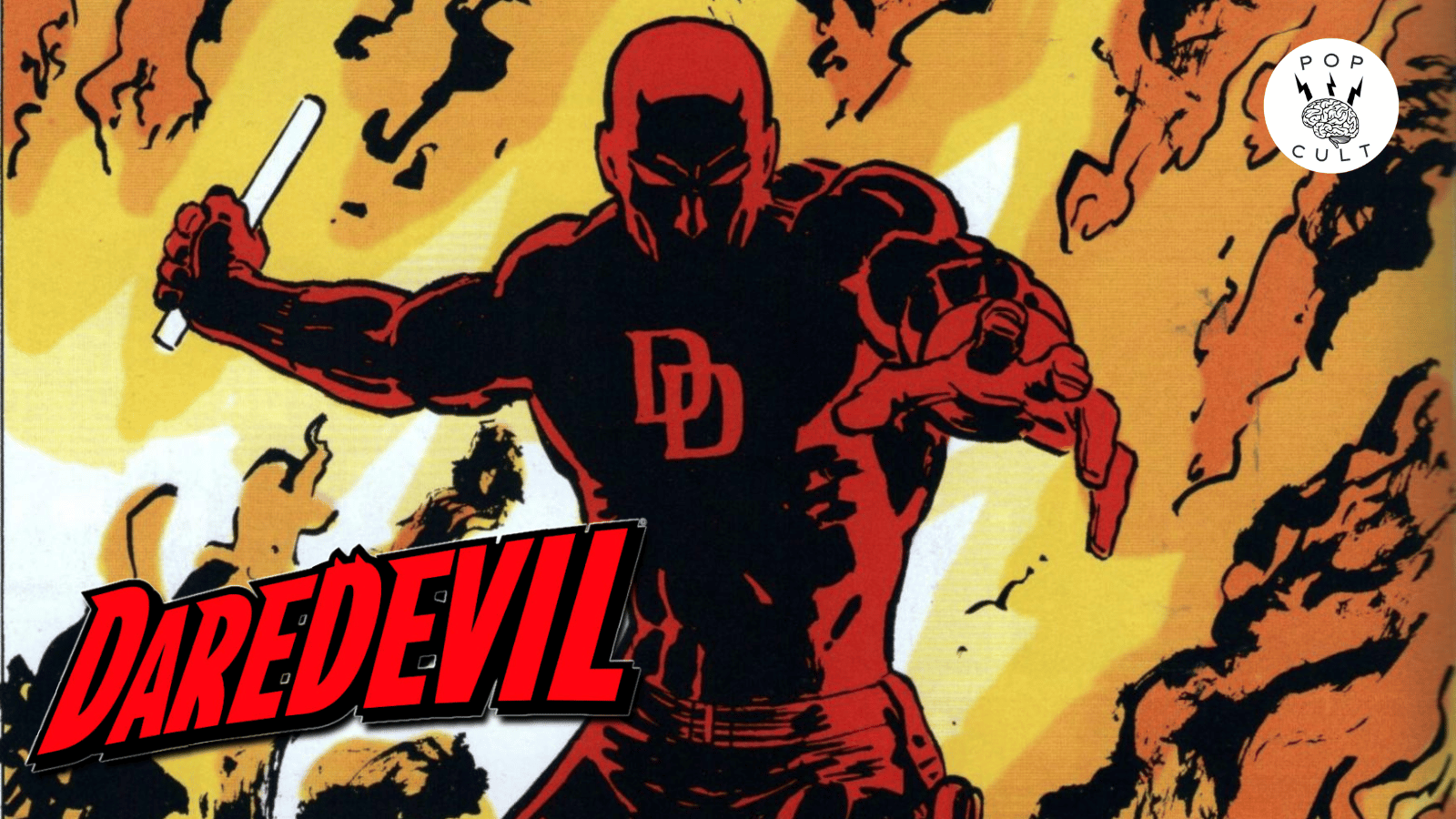
Daredevil Visionaries: Frank Miller Volume Three (2021)
Reprints Daredevil #183-191 and What If? #28 & 35, and Bizarre Adventures #28
Written by Frank Miller (with Roger McKenzie & Mike W. Barr)
Art by Frank Miller & Klaus Janson (with Terry Austin)
Daredevil by Frank Miller Omnibus Companion (2024)
Reprints Peter Parker, the Spectacular Spider-Man #27-28, Daredevil #219 and 226-233, Daredevil: The Man Without Fear #1-5, and Daredevil: Love and War
Written by Frank Miller (with Bill Mantlo and Denny O’Neill)
Art by Frank Miller, John Buscema, David Mazzuchelli, Bill Sienkiewicz, Al Williamson and John Romita Jr.
The second Daredevil Visionaries volume concluded with the iconic Death of Elektra. I’d heard about that story since I was a kid and even seen it recreated in cinemas with the dreadful 2003 adaptation. Nothing could compare to reading the real thing, a wonderfully tense blend of art & writing that delivered an operatic tragedy into the life of the Man Without Fear. Having never read these books, I wondered where Miller would go now. Elektra was such a big part of the first half of his run. I also learned that his “Born Again” storyline wasn’t part of this initial run but a return to the book in 1987, riding high off the acclaim of The Dark Knight Returns at DC Comics, about to return to them for Batman: Year One.
Miller’s first story after Elektra’s death introduces The Punisher as an antagonist. Like The Kingpin, the Punisher was initially introduced as a Spider-Man enemy. While The Kingpin feels like the perfect character to emigrate over the Daredevil title, I’m less sure about Punisher. Conceptually, it works: Daredevil is a lawyer and sees that as the means to get justice. Punisher is a vigilante and believes his direct violence is the means to get justice.
Their meeting is set against the backdrop of a deadly drug outbreak targeting middle school-aged kids. The fantastic art was a pleasure to see, but the story feels dull. I could just never get into those “Don’t Do Drugs” stories from the 1980s, even as a kid. Now, as an adult who has a better understanding of the nuances of various drugs, these stories are clearly written by people who have never experienced the drug or are just being straight-up dishonest in the name of “protecting the kids.” That means it doesn’t grab me as strongly as his Elektra stories because those are written from a place of genuinely caring about the character.
We get some smaller one-issue stories: Daredevil’s girlfriend deals with machinations from the board of her family’s corporation, Stilt-Man shows up for his semi-annual Daredevil appearance, Daredevil’s powers become hyper-sensitive, causing him to make sloppy mistakes, Black Widow returns to the book. One of the common threads I’d never heard anyone talk about from Miller’s run is Turk, a lackey for New York’s crime families who becomes The Kingpin’s recurring stooge. He’s clearly meant to bring levity to the comic, and I liked that a henchman got a name and some character development. Turk even gets the spotlight when he steals Stilt Man’s armor and goes tearing through the city.
Miller’s final arc in his initial Daredevil run starts with the character losing control of his powers. This coincides with Stick’s return to the title and several ninjas he’s trained. The Hand resurrects their dead champion, Kirigi, and sends him to assassinate Stick. Daredevil is still recovering but manages to push himself to save his old mentor just in the nick of time. Stick reveals The Hand’s ultimate goal: to dig up and resurrect Elektra as a brainwashed assassin for their order. And there we have Miller’s epic final story to conclude on.
When I think about most comics circa 1982, especially those published by the Big Two, they weren’t doing this sort of long-scale storytelling. Most stories were one-offs with teases for ongoing subplots or hints at what would happen in the next issue. Reading Miller’s Daredevil sometimes feels like that, but when he’s writing about Daredevil and Elektra, I get a stronger sense that he has a definitive direction and ending for the story. This predates Walt Simonson’s Thor run, which started about a year later and would do similar things during those stories. You feel that Miller has nothing more to say about Daredevil (for now) by the time you finish #191.
But he wasn’t done entirely. Miller returned to the book about two years later for #219. It is a strange story where Matt Murdock never dons the Daredevil costume and wanders about New Jersey. He gets involved in a family of criminals and barely utters a word. I assumed this was part of some longer arc, like an “On the Road” storyline. Nope. Just this weird issue that Miller came back to write. There’d be another gap before he sat down to pen his last big story arc in the book, “Born Again.”
“Born Again” sets the template for the superhero deconstruction story. We’d seen things like this that spanned maybe an issue or two, especially with Peter Parker. This is similar to things we’d see years later, like Knightfall, where everything is taken from the character, and they are built back up. Miller wrote #226, which sees The Gladiator extorted into a life of crime again, but then in #227, the big story begins. It starts with Karen Page, Matt’s former lover, divulging his secret identity to a man in Mexico in exchange for drugs. Since leaving to become an actress, she’s ended up hooked on heroin and starring in low-budget pornography.
The man she sells Matt’s name to immediately goes to New York and negotiates a hefty sum with the Kingpin. Wilson Fisk doesn’t believe this at first; isn’t Murdock blind? How could he pull off the physical stunts Daredevil is capable of? He realizes he has the right man when Daredevil learns Murdock is being targeted and starts prowling the popular criminal hot spots searching for answers. To ensure Murdock knows he’s been had, Fisk blows up the lawyer’s brownstone home, leaving him homeless. And that’s just the first issue.
Illustrated by David Mazzuchelli, Born Again feels like such a huge leap in storytelling in only five years. Miller’s work at DC and the acclaim found by Alan Moore and others had realigned what American superhero comics could be. Longer form stories were possible by trusting the audience to keep up. They could also inject more mature elements like Karen Page’s status so that it does not appear childish or exploitative, hidden with innuendos. Miller was aligning Daredevil with the type of prose fiction he enjoyed, dark, noir stories about the human condition.
We watch Matt Murdock lose his mind in the early parts of Born Again. All the control he had built up, the home he’d made to suit his disability, is gone. Murdock starts to believe his friend Foggy and ex-girlfriend Glory conspire against him. We get to see how brutal The Kingpin can be as he seeks to stomp out any evidence of his connection to the destruction of Murdock’s life. This involves tracking down Ben Urich, Murdock’s confidante at The Daily Bugle, breaking Urich’s hands, and killing his source in front of the journalist. It’s when our hero reaches his lowest point that he ends up in the care of a convent and meets a nun who he comes to believe is his biological mother, whom he has no memories of.
It all climaxes with Daredevil’s return as Kingpin unleashes the unhinged super-soldier Nuke on Hell’s Kitchen. Dozens of innocent people are killed as Daredevil pushes himself to his physical and mental limits to stop Nuke. The story takes a slightly strange aside, bringing Captain America into the mix as Nuke’s origins are explored. It felt like a weird side plot before Born Again finished with a strong landing. Daredevil reverses the situation by publicly shaming Kingpin and revealing that Fisk is not a legitimate businessman like the public thinks.
The graphic novel Love and War is set in between Miller’s two runs on Daredevil. It’s placed after Born Again here, which seems odd based on the ruin Kingpin is left in at the end of that story. It’s also a delight to read and look at, thanks to the incredible artwork of Bill Sienkiewicz. I’ve seen bits and pieces of Sienkiewicz’s art, but the only decent amount I’ve read is the Demon Bear arc from New Mutants. Kingpin’s look in this book is clearly one of the influences for his design in Into the Spider-Verse.
Fisk is tormented by his wife Vanessa’s amnesiac condition. He kidnaps the wife of a prominent specialist to force him to cure Vanessa. Meanwhile, the wife is stashed with an intensely unwell man named Victor. Daredevil feels the most extraneous here, with the other characters dominating the story. Of course, Sienkiewicz’s art makes it a visual delight to read.
The book’s last big inclusion is Daredevil: The Man Without Fear, a five-issue retelling of Matt Murdock’s spanning from childhood to his debut as Daredevil. Miller manages to tweak the characters’ origins, folding in retcons he introduced in the early 1980s to paint a more complex picture of a character who, in his early days, felt like a knock-off Spider-Man.
We get into the psychology of Matt as he deals with his father’s criminal side gig and death. We see his first encounter with Elektra and understand why he cannot get over her. Miller also makes Kingpin’s rise to power a part of Daredevil’s origins. This finally divorces Kingpin from being a Spider-Man character and firmly plants him as Daredevil’s main nemesis.
This mini-series also features art from John Romita Jr. firing on all cylinders. In recent years, I’ve come to find JRJ’s art much like Miller’s, leaning heavily into elements that make it far more grotesque in appearance. This is the perfect balance. You have the street-level grit a character like Daredevil needs, but Romita also provides a cinematic elegance to things. The detail and fluid movement reminded me of Miller’s art on his initial Daredevil run.
So now that I’ve read Frank Miller’s complete body of work on Daredevil, I understand the hype, and it is deserved. I believe Miller was even better at writing the character each time he came back. With The Man Without Fear, he sets the new definitive Daredevil origin, which, to my knowledge, has become the standard in comic book continuity and in media. That dreadful 2003 Daredevil flick tried to do way too much by combining the Death of Elektra, Born Again, and The Man Without Fear. A highly talented director & writer would have a hard time pulling that off, and they weren’t able to get one.
I can’t say this has me keen to watch the upcoming Disney+ series. It’s titled Born Again, but from everything I’ve read, it has little in common with Miller’s story arc. There comes a point where adaptations are fine, but the original work will always be better. Miller was writing a character with little cache, if any, at Marvel and managed to turn him into one of the marquee figures. He did that by taking the character seriously and leaning into the genre of fiction he enjoyed (noir, crime, ninja). That involved an understanding that comic books and their superheroes are many different things. I don’t think Marvel, as a film company, understands that.

 PopCult Reviews
One thought on “Comic Book Review – Daredevil by Frank Miller Part Two”