
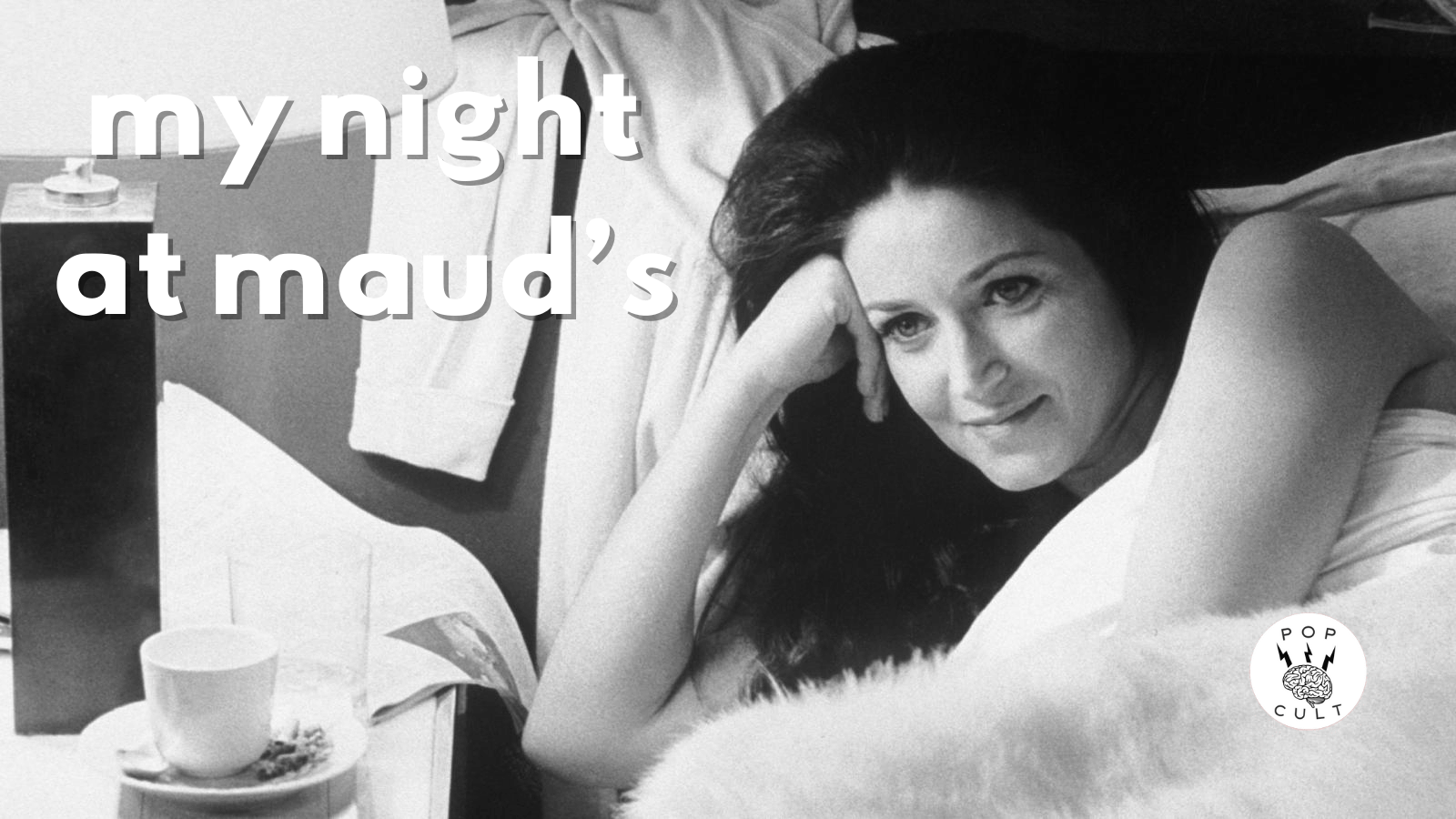
My Night at Maud’s (1969)
Written and directed by Éric Rohmer
Eric Rohmer is considered the last of the French New Wave directors to be established as such. He was known to be secretive about his personal life, with his name being a mash-up of two people he respected: Eric from director Eric von Stroheim (Sunset Boulevard) and author Sax Rohmer. The filmmaker worked as a teacher in the French Alps but quit in the mid-1940s to move to Paris. Rohmer started attending film screenings where he met Godard, Truffaut, Chabrol, and others. This led to a career as a journalist for the many popular film magazines at the time. When he began to get into filmmaking, he invented his pseudonym to keep his parents from learning he was working in the industry.
In 1962, Rohmer started what he would call his “Six Moral Tales,” a series of films inspired by Murnau’s Sunrise, and follows the same basic story: a man who is in a committed relationship of some kind is tempted by another woman but ends up with the first woman. A moralist in the French language is not someone concerned with right or wrong; rather, they are interested in what is happening inside a person’s mind. My Night at Maud’s was the fourth of six films and became the picture that brought Rohmer acclaim and attention.
Over the Christmas holiday in Clermont-Ferrand (where Rohmer taught), Jean-Louis (Jean-Louis Trintignant) is working. He doesn’t know anyone here, which has left him leading a solitary life. While attending church, he spots a blonde woman and becomes convinced they will be married one day. Jean-Louis runs into his old school friend, Vidal, a lecturer visiting the city. After dinner, Vidal mentions a former lover, Maud, who lives here. He wants to see her but doesn’t want to hook up, so he asks Jean-Louis to accompany him in exchange for Vidal attending Mass.
They pop in at Maud’s, with Vidal making a sneaky exit and leaving Jean-Louis behind. She attempts to seduce Jean-Louis into joining her in bed. He kisses her but is overwhelmed with guilt, which annoys Maud. She cools eventually, accepting that he has his beliefs but wants to pursue a platonic friendship. He joins her for a walk through the snow later with friends, but on this walk, he spots the blonde woman and approaches her to talk.
Rohmer knew what he wanted for this film. That can be shown in his adamant that Trintignant play Jean-Louis & wanting to shoot the movie in December because of the natural snow. The actor was not available when asked, so Rohmer delayed filming for one year for when Trintignant had time. A Rohmer film is something precise, intensely written, and rewritten. My Night at Maud’s is full of dialogue, so if you do not like “talky” films, you will not enjoy this one. I implore you to give it a chance because these adults have mature conversations about things of great importance in everyone’s lives.
A core theme of the film is Pascal’s Wager, the idea that logic dictates that if there is a God, it would be an entity of such vast scale & power it would be wholly incomprehensible to us. So, is God real or not? There is no way to prove or disprove such an entity because of this vast gulf of infinite chaos between us and the concept. As humans in this universe, we must make a wager: either God is real, or there is no God. If an atheist devotes themself to any faith, they are least playing the odds.
If an atheist dies and it turns out God does not exist yet, and he spent some time being the most basic level of believer, then he really isn’t out anything. If an atheist dies and there is a God and that atheist did not do some rudimentary belief, then he is doomed. So, the only logical choice, according to Pascal, is to pick some belief system just in case. This is all based on the idea of uncertainty. Nothing can ever be said to be certain in a chaotic universe. But even that statement is not certain.
So far, the sun has come up every day I have been alive. I could argue it’s not a certainty because I know the sun has a finite amount of fuel, and other celestial bodies are moving about. The sun is not the most powerful thing out there. Yet, the uncertainty of the sun “rising” is outweighed by my experience that it has come up every day of my 43 years. You could almost condense this further: “Plan for the worst, hope for the best.
Rohmer was a Catholic, attending a Jesuit school as a child. Yet, his films aren’t interested in proselytizing to the audience. Instead, he tells stories about people living in this uncertainty. These characters must make choices; some may be labeled as “good” and others as “bad.” Rohmer’s characters don’t engage in any melodramatics, they are regular people who are in a sort of psychological and spiritual moment of crisis and questioning. Part of Jean-Louis’s crisis is his chance encounter with the blonde woman and his sense that they are destined to be together. As the film progresses, so does their relationship until they are married. Was that marriage fashioned by God, or was it because of Jean-Louis’s will and devotion that they ended up together?
Rohmer is a director, much like Bresson, who refuses to heighten his stories too much. He enters into a scene unconcerned with the little details around the fringe. He allows them to happen but doesn’t try to set up shots from multiple angles. Maud brings the two men back to her place, where her daughter and housekeeper are waiting. The little girl asks to turn on the lights on the Christmas tree.
They do. The girl looks at them. She goes to bed while the adults sit down to have a drink. Rohmer doesn’t try to spotlight the little girl or the tree, which are objects other directors might want to focus on. The child reminds us of innocence; there’s a bit of spectacle in the tree’s lights. The director cares far more about the adults and their conversation. It is in those aspects that the picture overflows with detail and attention. We see this when Vidal departs, and it’s just Jean-Louis and Maud. Rohmer has spent a lot of time on the page and in conversation with his actors on every movement and line of dialogue.
The rest of the picture grows out of this scene between the two characters. The topics they discuss, the conclusions or lack thereof, all matter and come together in the final scene as Jean-Louis makes a powerful realization about his life. I think so much of contemporary American cinema holds a phobia about characters with articulated, complicated beliefs. Instead, we boil things down to good and bad. In the case of fascism, it should always be presented as evil because it is. But when it comes to people’s views on religion, sex, and love, it is a healthy thing to hear different perspectives. Seeing people have mature, nuanced conversations about these things is so refreshing.

 PopCult Reviews
One thought on “Movie Review – My Night at Maud’s”