
Landscape Suicide (1987)
Written and directed by James Benning
You likely haven’t ever heard of James Benning. He’s never directed a film that ended up in a multi-screen Cineplex. He’s never been nominated for an Oscar or won the Palme d’Or at Cannes. On the most recent Sight & Sound filmmakers poll, Benning was sent a ballot and returned it with a list of his films. His reason when asked about this is that he just doesn’t watch movies, really. Benning makes them, but his influences are literary, and he simply observes the world around him. He’s considered a minimalist but has actually employed many methods & styles as he explores the form. At age 83, he’s still making movies, with almost all of them examining America and its people.
In early 1984, something horrible happened in Orlinda, California. Teenager Kristin Costas received an invitation from classmate Bernadette Protti about a sorority-like group at their school. The invitation was fake. Costas found out it wasn’t real the day of the event, causing the girls to argue in private. Costas went to her neighbor’s home, telling them her friend had “turned weird.”
Protti appeared on the neighbor’s front porch, where she confronted Costas. Protti produced a chef knife and stabbed Costas five times. She ran home. It took six months for the police to determine that it was Protti who murdered Costas. Protti had passed a polygraph, and it was an FBI who spoke with Protti that convinced her to turn herself in. The first half of Landscape Suicide is mainly composed of a single camera on an actress playing Protti, reading from the transcript of her interrogation.
In November 1957, Bernice Worden, a 58-year-old hardware store owner, went missing. The police found bloodstains on the floor of the store. Evidence at the store pointed to local Ed Gein as Worden’s last customer. The police visited Gein’s home outside town, and he was arrested under suspicion. A search of this place revealed that Gein was a profoundly disturbed man.
The authorities found the remnants of bodies, including many of them used to fashion clothing for Gein to wear around the house. It would later be revealed through interrogation that Gein’s relationship with his mother and her death inspired this descent into madness, his goal being to make a “woman suit” that he could wear to “become his mother.” The second half of landscape suicide is a dramatization of Gein’s interrogations, where an actor reads out the murderer’s words.
Benning taught at CalArts starting in 1987, the same year as the release of Landscape Suicide. In his courses, he talks about “landscape as a function of time.” The landscape that surrounds us is an artifact of time. We can see the passage of time in them through various physical interactions, erosion & our own manipulations. Even in the short term, the landscape changes all around us. Things blow into our field of vision and blow away. Rain falls, and dirt turns to mud. The world is anything but static.
In many ways, Benning is a precursor to the Austrian filmmaker Michael Haneke, particularly Haneke’s early films. Take a picture like The Seventh Continent, where Haneke is very slow and methodical. He lets his audience take in a moment, never rushing us through it and often holding on to something he finds interesting. Landscape Suicide opens with a static shot that goes through several changes. It’s a tennis player. She moves while the camera stays locked in place. She grunts as her racquet makes contact with the ball. Benning employs the blackout as a substitution for an eyeblink. Every time we shut our eyes and open them, we see something that has changed slightly.
At a certain point, the shot reverses, and we’re staring at the other side of the night, a green hardcourt littered with tennis balls. By blinking, we have missed the changes; by having our perspective fixed, we aren’t seeing the whole picture. Living in this world is challenging because everyone’s often fixed perspectives differ slightly. We are all not looking at the same things at the exact times, which is the source of so much conflict in the world. A man was sitting in his car and observed Costas and Protti fighting on the front porch. From his perspective, he assumed it was just a fistfight. He stayed out of it. If he had been closer or his car was parked in a different spot, he may have seen the knife go into Costas five times.
The 1980s segment opens with a car driving through the neighborhood where Costas was killed. On the radio, we hear Jerry Falwell denouncing Carl Sagan and giving a version of God’s Salvation Plan. At this point, we don’t know why we are in this place. The windshield wipers push away raindrops as the preacher gives a prayer for those listening who wish to be saved. There’s a woman’s voice-over about her daughter and her taking a trip. Her daughter was reading a copy of Rolling Stone magazine on the plane and ripped out six pages. This was a story about the Costas murder; the girl’s reason was that stories like this scared her.
The 1950s segment opens with brief shots of the rural Wisconsin landscape in the winter. A water tower. A deer wandering through the forest. Various buildings (homes & businesses) with snow-covered roofs are clearly worn down by time. A 1950s Ford pickup idles by a clothesline. The landscape here feels more desolate than the northern California suburbs glimpsed in the first half. Yet, Benning finds a connection. He looks at the suburban ennui and how it can lead to murderous desire.
The 1980s segment mentions that Protti’s crime was one of over 1300 murders in the United States in 1984. We would think living where you are afforded the sort of leisure your ancestors dreamt about would make you happy and peaceful. It does not. Ed Gein grew up in a flat, often harsh landscape. This place has a profound sense of isolation, unlike the suburbs, where your neighbors are a brief walk away. Yet that didn’t prevent Protti’s psychological break and actions. Benning is simply curious as to how where these people lived affected their actions. He’s unable to answer the Why, but he thinks there’s something to be seen by gazing at the landscapes. Maybe it’s a tangible understanding or perhaps something related to gut instinct.
Landscape Suicide is an anti-true crime film in that it refuses to exploit its subjects. Compare that to Ryan Murphy’s recent grotesque regarding the Menendez Brothers, which invents incestuous liaisons to titillate the audience. Benning presents the killers in their own words. He finds that despite the different landscapes around our two subjects, they came to the same conclusion that they have to kill other people.
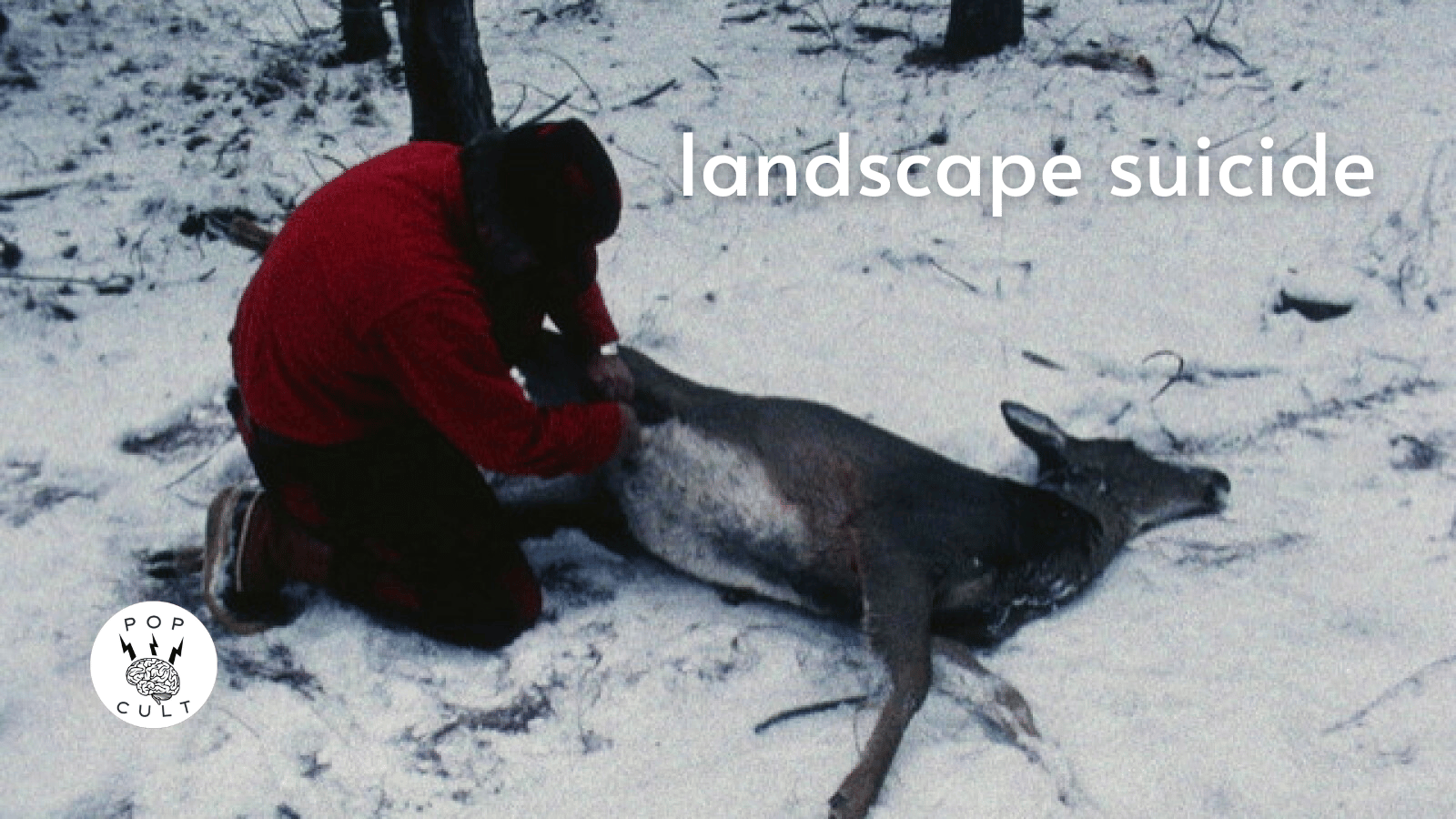
The final images of the film study a man dressing a deer carcass, reminding us that our society is drenched in blood. The fellow citizens horrified by Ed Gein wouldn’t bat an eyelash at the deer being skinned, split open, and its entrails removed. In the words of Gein and Protti, they don’t believe what they did was psychologically related. They talk about what they did with the same dull candor you might expect to hear someone describing what they ate over the last week. Benning has no desire to exploit what happened. He’s here to look and ponder.

 PopCult Reviews
One thought on “Movie Review – Landscape Suicide”