
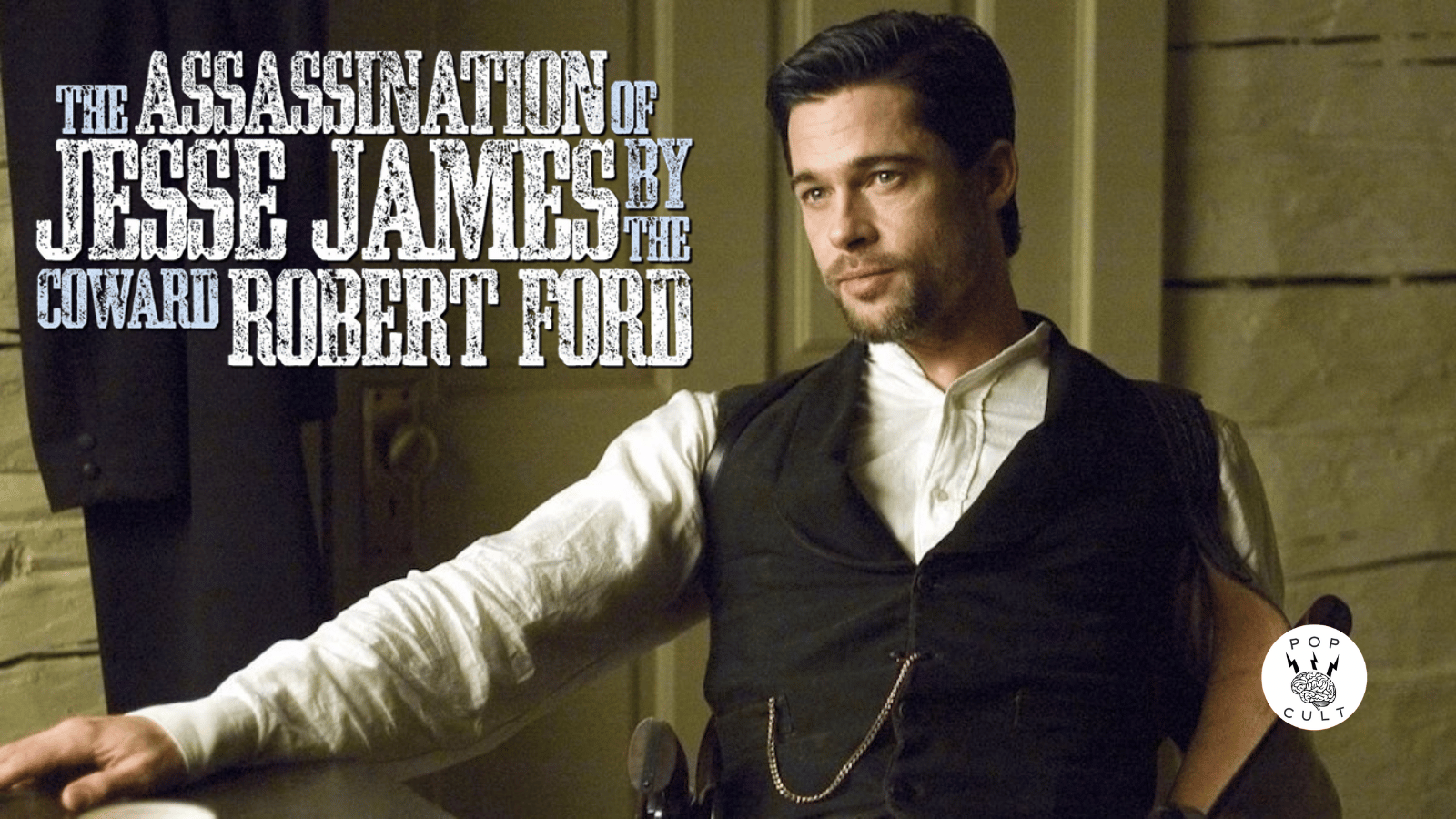
The Assassination of Jesse James by the Coward Robert Ford (2007)
Written and directed by Andrew Dominik
I have watched the films of Andrew Dominik in a slightly odd order. First, I saw Killing Them Softly, his third film. Then I watched Blonde, his dismal adaptation of a Joyce Carol Oates novel about Marilyn Monroe. Now I come to his second film, the one that garnered him attention in the States, The Assassination of Jesse James by the Coward Robert Ford. It was an excellent film; kept its focus on the characters and never got caught up in the tropes of cinematic Westerns, which is the point.
Robert Ford (Casey Affleck) has grown up reading stories about the legendary outlaw Jesse James (Brad Pitt). By the time he reaches maturity, James is married with children living under an assumed name. The James Gang is still operating, but a train robbery in the film’s opening has them finding far less cash than had been hoped. Frank James (Sam Shepherd), Jesse’s brother, leaves, and the gang falls apart. Robert returns home with his older brother, Charley (Sam Rockwell), and other guys.
Meanwhile, Jesse starts to become paranoid as Jim Cummins, an unseen former gang member, seeks out his comrades and plots a trap for the robber. Robert’s admiration for Jesse seesaws during this period, culminating with Jesse viciously attacking Robert’s younger cousin. Then Robert is involved in a murder, which makes him afraid of being caught. That’s enough to send the former admirer to the sheriff and governor, brokering a deal to bring in Jesse, dead or alive, within ten days.
There are a lot of things that happen in this movie beyond the relationship between Jesse and Robert. The film is two hours and forty minutes long and has its share of digressions. What surprised me was how much screen time Jesse James was not in. These are important pieces because they set up a chain reaction of events that jeopardize Robert’s life and force him to turn on his former hero. The film is sprawling but remains intimate, especially when the titular death occurs.
At the core of the film is a deconstruction of hero myths. This is significant because America is built on a foundation of historical lies. The Great Man theory has allowed history to become the venue of a minority of wealthy & powerful men, almost all white. Dominik upends our expectations for a Western by refusing to engage in prolonged gunfights or the iconography associated with the genre. Instead, he gives us a contemplative film closer to Terence Malick than John Ford. There are long periods of silence in this picture, the camera letting actors take in what has just happened, sit with what they learn, or the fallout of what they did.
The Jesse James that Robert meets is not the same man he was reading about in pulp novels and magazine serials. He’s aging, unsure of himself, giving into paranoia. The film is rife with this myth-busting by showing the West as it would have been. Dick Liddell (Paul Schneider), the James Gang’s resident womanizer, is shown flirting with Robert’s niece, who is a twelve-year girl, even talking about peeking under her dress as she giggles. Your reaction to this should be disgust. Dominik must present this scene without commentary. He’s showing this is a part of what life was like back then, just like Jesse’s cold-blooded murder of a mail clerk. These were not good times; they were sick & brutal ones.
Jesse James and all the famed robbers of the Old West were not good people. Unlike what some characters in the film think, Jesse is not a kind of Robin Hood. James was a bad man who was greedy and killed a lot of innocent people so he could get money without earning it. But he was also keenly aware of the system he lived in and how it worked. America is a land of exploitative opportunity. Our history is deeply intertwined with snake oil salesmen and fake cure-alls. Our heroes were not actually all that heroic. I saw the news lauding Jimmy Carter as he recently passed. No mention of the genocide in East Timor by Indonesia, which Carter signed off on, selling them weapons while the system made sure to bury the story as deeply as they could in the daily papers.
My point here is that admiring people who are at the top of an exploitative hierarchy is probably not a good idea. I don’t have a problem with a single thing Luigi Mangione did, and frankly, I don’t think he should be locked up at all. I also don’t think he has much more to teach us. He’s a reactionary who, at least once, pointed the weapon in the correct direction. Nick Cave appears as a balladeer singing a bullshit song of invented things Jesse James did, the film knows we will find this ironic as it comes very late in the picture. The song attempts to rewrite the Jesse we have seen in the movie.
I found the film’s coda to serve as a perfect conclusion. Robert Ford becomes part of the myth-making machine that created James. He spends several years putting on public re-enactments of his killing of the man, with brother Charley playing James. Over time, Charley comes to resent Robert, seeing himself as someone forgotten, even remarking that one day, he expects Robert to kill him, too. The people also don’t buy in on this new myth, singing songs and speaking ill of him. Robert can’t exist without living in Jesse’s shadow; there is no Robert Ford as a public image without the man he killed.
In fact, Robert seems to kill Jesse because his hero didn’t live up to the stories. The fact that the great robber can even be killed by mortal bullets seems an affront to the image Robert holds of the man when the movie begins. The Jesse he read about was a story, and the man he spends time with is someone else entirely, just a man. Jesse is actually quite unpleasant to be around. His charisma is waning, and he broods so much that he slips into ill moods. He disappoints Robert, so there’s no other option than death. Robert’s life ends at the hands of another man hoping to turn his name into legend.

 PopCult Reviews
One thought on “Movie Review – The Assassination of Jesse James by the Coward Robert Ford”