
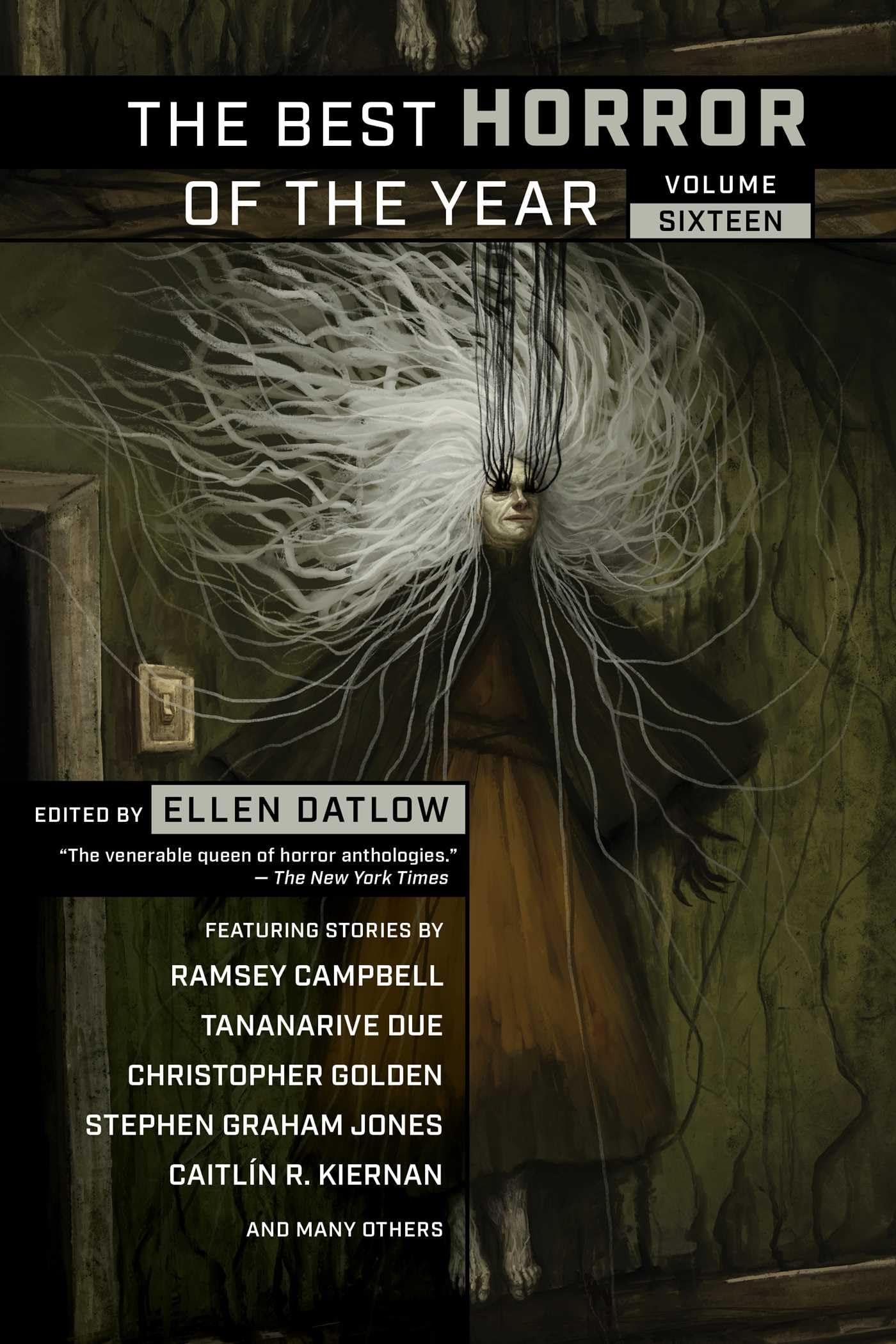
The Best Horror of the Year, Volume Sixteen, edited by Ellen Datlow
Another year means another Ellen Datlow Best Horror of the Year. As with all of these, it’s a mixed bag. I loved some stories; others were fine, and even some I forgot as soon as I was done reading them. Here are the stories that were highlights for me.
- The Importance of a Tidy Home by Christopher Golden
Set in the winter holiday season, this story follows two homeless men in Germany who encounter the Schnabelpercten. These diminutive creatives are said to go home to home during the Epiphany and inspect homes to ensure they are clean. In this story, if they are unhappy with the house’s tidiness, they murder the inhabitants inside. This is a genuinely creepy and very wintery tale.
- That Maddening Heat by Ray Cluley
The narrator reflects on their childhood in a small town and a particularly dark summer. Their father runs a general store, and while making deliveries to the elderly Mrs. Dolores, a discovery is made. She’s completely absent, but there is evidence of something that happened at the well a few yards from the house. The rope lies taught, vanishing into the darkness of the hole. The boy assumes poor Mrs. Dolores hung herself and goes to get his father. But the truth comes out when the deceased’s journal is discovered.
- Jack O’Dander by Priya Sharma
While this is only a short story, it has the narrative density of a novel. We begin with a support group centered around people who have lost a child. Nat lost her sister Isobel back when they were kids on a family vacation. This was the same trip where they watched a video with their cousin, Elle, about the urban legend of Jack O’Dander. This is a supernatural horror story, but it is made even more uncomfortable and twisted by the toxic family dynamics. The tension that builds here is very well done.
- Return to Bear Creek Lodge by Tanarive Due
I was surprised to see this sequel to a story featured in last year’s anthology, “Incident at Bear Creek Lodge.” I wondered how Due would continue a story that felt like it ended on a perfect note. Thankfully, she provided an even more chilling ending than the last one. Teenage Johnny is brought back to his grandmother’s mountain cabin by his mother. The old woman is dying, and her two adult children have come to sit vigil. Johnny is still uneasy about what he saw the last time he was here, and he gets some more answers, but nothing that fully explains the creature that burrows through the snow.
- The Enfilade by Andrew Hook
Matthew meets Pryce in their early twenties, become fast friends, and take a trip to India together. Pryce wanders off, and after a few days, Matthew heads back to the UK. Years pass, and Pryce shows up on Matthew’s doorstep. In the interim, Matthew has become a photographer, and Pryce needs to use this skill. He claims to be confused about his identity and needs his old friend to take a particular photo, which he believes will solve this.
- Lover’s Lane by Stephen Graham Jones
Our narrator is a journalist wanting to discover the origins of the hook-handed man urban legend. She follows a paper trail to a small town in Oklahoma and an elderly woman who claims she & her boyfriend were the original couple in the story. Her account of the hook-handed man seems different from anything we’ve heard before. Then we go tumbling down the rabbit hole into a realm of conspiracies that appear to encompass the nation and hint at terrifying cosmic horror at work behind the scenes.
- The Teeth by Brian Evenson
The always-entertaining Brian Evenson gives us this story of an adult looking back on a reality-altering event in his life. Jens and his father check in on a parishioner, Brother Monson. The story begins with a discussion of Monson’s strange teeth, and it gets creepier from there. While Evenson has recently leaned more into science fiction/weird fiction, this is a classic horror story style, complete with a disturbing ending that leaves the protagonist & reader wondering how much about this world we actually understand.
Soviet Democracy by Pat Sloan
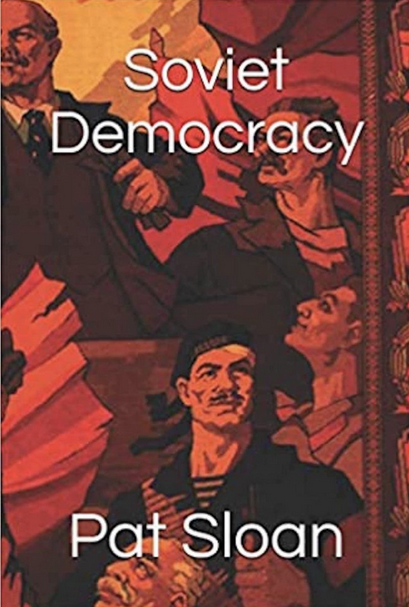
Amid the inauguration and its demon-like energy, I finally cracked open this book published in 1937. I needed to know something better existed at least once in this world. Pat Sloan didn’t fail. He was a member of the British Left during that time and lived and worked in the Soviet Union off and on from 1931 to 1937. My image (and many others) conceptualization of the Soviet Union has been filtered through an intensely aggressive machine of anticommunist propaganda. This isn’t to say that the former communist nation was a utopia, but it certainly wasn’t the miserable hellhole so much of the West has been adamant about convincing us it was. It was also a nation unlike modern-day Russia, which has fully embraced capitalism to a monumentally destructive degree.
Part of this is because capitalism has done an excellent job of obscuring language. There’s never been any thorough education done in the States to explain precisely what communism is. That learning must be done by curious individuals who suspect they haven’t been told the truth. The popular definition of communism in the States essentially describes capitalism – wealth being consolidated under the few. That’s why Sloan’s account of what he observed and learned about the Soviet Union is so refreshing.
The book’s structure has three parts: Life, The State, and Democracy. The first section showcases what life was like for the average person at school, in the workplace, and in the community. Before getting into the details, Sloan clarifies what we mean when discussing “democratic societies.” He does an excellent job of pointing out how supposed democracies never fully extend these rights to everyone. In the West, democracy is not a universal concept, only one afforded to whoever is considered the in-group. In 1930s America, it could hardly be said Black people experienced the same democracy as their white counterparts. Even today, there is an evident disparity of rights if you aren’t a white, Christian, straight person. In the Soviet Union, you didn’t need to formally be a citizen to run and hold political office. The idea was that you lived & worked there, so you have every right to be involved in the political process. If you wanted to officially join the Communist Party, then you had to become a citizen.
Sloan goes on to discuss everyday life. There is a pointed absence of individualist competition and more team rivalry, but not even that negative. In schools, the classes that scored the highest in various exams were recognized, and then members of those classes were expected to confer with other classrooms to share the strategies they found best helped them increase their level of achievement.
This was repeated in the workplace, with Sloan sharing an anecdote about a famous Ukrainian miner who went over his manager’s head and reorganized his fellow workers with a very noticeable increase in productivity. This miner had not been afforded a robust formal education due to his being a child pre-Revolution, but over the years, he had developed a keen eye for evaluating other miners’ aptitudes at various tasks. He was praised and sent around the Soviet Union to teach other mining operations his staff management techniques.
Before the Soviet revolution, well over 80% of Russians were illiterate. By 1937, that had been reduced to only 10%. If you look at contemporary Cuba, you see the continued throughline of literacy hand-in-hand with communism. Their literacy rates are 98% with the US topping out at 79%. The ability to read is the enemy of capitalism because, through reading, we develop empathy and a better understanding of the institutions that rule over our lives. Throughout Sloan’s survey of the USSR, we see how everyday people became well-versed in conflict resolution, labor rights, individual rights, and collective responsibility.
There is a lot in this slim text, and if you are curious, you can find it all over the Internet as there is no copyright on the text. Today may not be the world we hope it could be, but tomorrow is coming, and with that, another chance to get it right.

 PopCult Reviews
One thought on “Book Update – January/February 2025”