
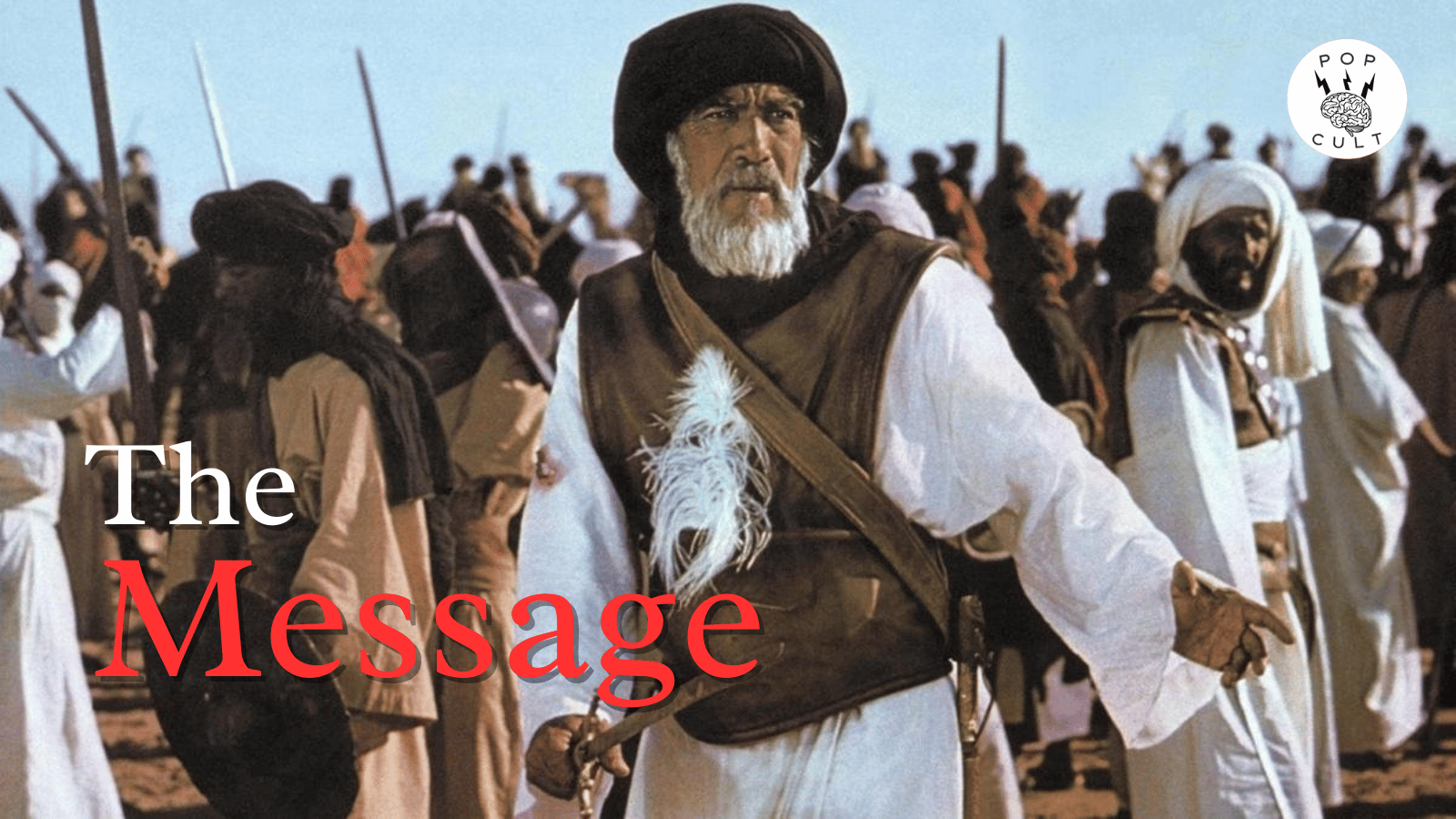
The Message (1976)
Written by H.A.L. Craig (English Version)
Directed by Moustapha Akkad
The Biblical Epic, while a film genre that has fallen off in recent decades, is quite well known as part of the Hollywood industry starting in the early 20th century. Cecil B. DeMille directed two versions of The Ten Commandments, one silent film (1923) and the more famous Charlton Heston version (1956). Ben-Hur received multiple versions as well as adaptations of the stories of Samson and Delilah, David and Bathsheba, and more. A film titled The Bible, directed by John Huston, even covered the first 22 chapters of Genesis. That’s not even getting into the multitude of movies based on the life of Jesus.
While these films are intended for American Christian audiences, and possibly the Old Testament stories might appeal to Jews, there is a notable absence regarding the major world religions in the film landscape. Approximately 1.9 billion people currently practice Islam. That accounts for more than 24% of the world’s population. One of the reasons Islam may not be able to shift into mass media in the same way as Christianity is that Islam forbids the image of its founding Prophet Mohammed. Hence, why Islam uses very different images to communicate itself than American Christianity.
Fascism holds iconography at the center of its ideology. You see this in the pageantry, uniforms, and imagery of the movement. The Catholic Church is similar with its ostentatious outfits and gaudy displays of wealth. American Evangelical ideology loves to intertwine disgusting capitalist imagery with Jesus, leading to some genuinely unsettling, violent depictions of Christ. If the movie industry is about encouraging mass consumption and appealing to our basest desires, then Christianity is quite the perfect religion for such ends, especially in the United States.
Mass media is how people communicate in the modern era, though, and it makes sense that people in the Islamic community would try their hand at making something that could operate in the same sphere. In 1967, Moustapha Akkad, a Syrian-American producer, wanted to make a film about his faith in the vein of Biblical epics. You have likely seen Akkad’s name before, as he produced the original Halloween films. In 1967, a script written by American screenwriter HAL Craig was approved by an imam but then revoked.
For the next nine years, Akkad continued to consult with clerics on how to edit and shape the story so that it would be deemed appropriate and respectful of Islam. I include this film in my 13 Countries, 13 Films series as it was the highest-rated film on Letterboxd cited as coming from Libya. I’m counting it for Libya because I was so fascinated with seeing a genre of film I know but about a religion I am still learning about.
The film follows the life of Mohammed and his followers as they challenge the status quo in Mecca. At the time, the city was ruled by hedonistic slavers who worshiped an endless coterie of gods. As the Prophet’s word spreads, he cultivates many enemies among the wealthy elite. They plot to kill him, so Mohammed packs the crew up and finds refuge in Abyssinia. We see the establishment of the first mosque, a walled space with a tree and canopy. We hear the first calls to prayer and experience the teachings of Islam through Mohammed’s followers.
From time to time, the Prophet himself is in the scene, and the camera becomes his perspective. People will turn and look straight to the camera, talking to the silent man. It was quite a clever thing to do, and I still followed the tenets of the religion. There are also several battle sequences, but the emphasis in this story is not on the destruction of enemies but on the conversion. General Khalid Ibn Walid spends much of the film hunting down and killing Muslims but finds himself dedicating himself to the faith in the end. The lesson here is the power to wash away past transgressions at any time and accept a new path in life.
There was a trend by this time that any film set in MENA (Middle East-North Africa) would be chasing after the incredible visual bar David Lean set in Lawrence of Arabia. You see it in movies like Raiders of the Lost Ark, The Mummy, and more. The Message was not immune to that either. Lean established a very strong standard on how to capture this particular landscape. The Message doesn’t meet the mark. It’s made by someone less skilled than Lean; few directors were and are. It’s an extremely good effort, and there are transcendent moments where all the elements come together, and we touch those heights briefly.
I watched the English version of the film, so I can’t comment on the quality of acting in the Arabic version. The performances here are stiff and awkward. However, isn’t that how acting in Biblical epics typically is too. I’ve always felt actors in these heavy-handed religious flicks feel worried about playing their character in too big of a way, so they give what comes across as what you might see in a Sunday school pageant. This type of film is partially a piece of propaganda, existing to speak to the unconverted and convince them to join.
From my very limited understanding of Islam, it seems The Koran is not exactly a book of stories more than it is a series of lessons and advice about how best to live a life in accordance with Allah. The Bible has those things, but it is also overflowing with stories. The Bible is better suited in a medium-like film, but it also reveals what a limited medium film has been like in the West. A Muslim movie would be best suited for something wildly experimental and poetic. Terrence Malick could probably make a hell of a good one. However, most religious films operate at a childlike level of discourse regarding spirituality.
The films I’ve found to convey the core principles of Islam have been less historical epics and more masterfully made films from nations like Iran. These movies are often about people in conversation with the Muslim culture around them. I’m thinking of Abbas Kiarostami’s movies or the films I watched in my Palestinian films series last year. The Message is a decent piece of historical recreation, and it is very clear in the Message of Mohammed, but it lacks the authentic emotion that makes those ideas resonate.
A film like The Message forces us to think about which ideologies are communicated best and in which forms. Christianity clears sales in movies & TV, and the rash of low-budget conservative straight-to-DVD/streaming movies in the last decade proves that. But what belief would best communicate in spoken words? In poetry? In dance? In music? Film and now video dominate the popular culture in the West because these mediums best communicate those particular ideas in terms of wealth generated. Text may be the primary way to experience Islam and possibly in its original language. I find that fascinating, as it posits ideas as software, and the format is the key to downloading them for people.

 PopCult Reviews
One thought on “Movie Review – The Message (1976)”