
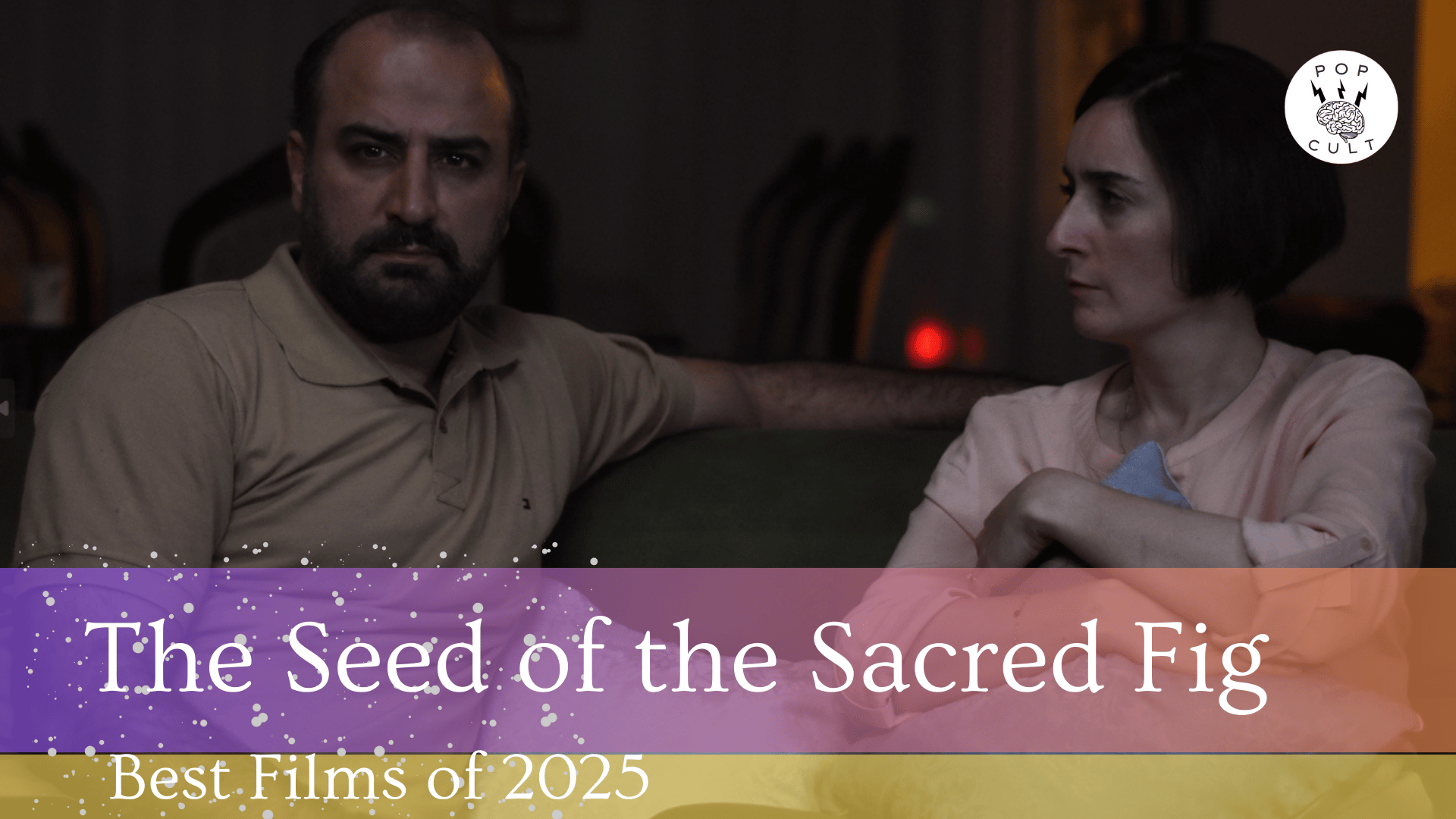
The Seed of the Sacred Fig (2025)
Written and directed by Mohammad Rasoulof
Our perception of Iran in the West is not an accurate picture. How could it be, after decades of propaganda that have mixed truths about the fundamentalist government with lies meant to keep the country in a perpetually negative light? Too often, American media frames people in cartoon terms: good guys and bad guys; a reductive take, to say the least. Iranian cinema has grown tremendously since the late 1970s and often produces powerful works of art. Common elements include minimalism, which allows for ambiguity that can skirt censorship; children as moral lenses through which to view society; and a moral complexity that refuses easy simplification. Humanism is always more important than rigid ideology. All of this is true of The Seed of the Sacred Fig.
The film is a tense political family drama that unfolds inside a Tehran household as the pressures of state power seep into domestic life. It centers on Iman, a newly appointed investigative judge whose promotion coincides with widespread protests, placing him in an impossible position between personal conscience and institutional loyalty. As paranoia and fear take hold; fueled by constant surveillance and the threat of punishment, the boundaries between public duty and private morality collapse. The family home becomes both refuge and prison, using escalating mistrust among Iman, his wife, and their daughters to expose how authoritarian systems reproduce themselves through obedience and fear.
The protests that inform The Seed of the Sacred Fig erupted across Iran in 2022 following the death of Mahsa Amini, a 22-year-old Kurdish woman who died in custody after being arrested by the morality police for allegedly wearing her hijab improperly. Her death ignited nationwide demonstrations led largely by women and young people, who openly removed or burned hijabs in public as acts of defiance against compulsory veiling laws and, more broadly, against decades of state control over bodily autonomy and speech.
The protests, rallying around the slogan “Woman, Life, Freedom,” were met with violent crackdowns, including executions. Rather than functioning as a single-issue movement, the hijab protests became a flashpoint for accumulated grievances, exposing deep fractures between private belief and public obedience. These tensions directly shaped the film’s conception and its portrayal of authoritarian power invading the most intimate spaces of daily life.
The Seed of the Sacred Fig was filmed clandestinely inside Iran. Mohammad Rasoulof worked under extreme secrecy to evade state oversight, using a stripped-down crew and a production process designed to leave as little trace as possible. This underground approach was not a stylistic choice so much as a necessity. Once authorities became aware of the project, the repercussions were swift and severe: Rasoulof faced intensified legal pressure and sentencing related to his work. He was forced to leave the country, while members of the cast and crew were interrogated and, in some cases, subjected to travel bans and professional retaliation. The film’s very existence mirrors its themes—both a narrative about authoritarian control and a record of the risks artists in Iran assume simply by telling the truth.
Missagh Zareh’s Iman is frightening precisely because he never raises his voice. His authority feels less imposed than internalized. He rarely needs to speak loudly because of the social conditioning that positions him as the head of the household. Soheila Golestani, as his wife, is constantly vigilant, with every look and moment of silence weighing her down. Her exhaustion carries more weight than any monologue could. The daughters, played by Mahsa Rostami and Setareh Maleki, bring immediacy to the household. Their performances are charged with the nervous, demanding energy of a generation that has watched their parents become increasingly constrained. What emerges is a family portrait of political repression that isn’t symbolized or debated but lived. These people love one another inside a system designed to turn intimacy against them.
The tension slowly boils to the surface until the conflict is no longer merely ideological but physical. Rasoulof builds his themes through accumulation, allowing moral compromise to quietly rearrange the architecture of the home. The film is interested in the process by which the system breaks people down; hence Iman’s occupation as an interrogator for the Iranian government. The interrogation scenes are staged with suffocating precision, each subject not only isolated but blindfolded, unable to see the man questioning them.
There is also a classic Chekhov’s gun that becomes a key plot point. Iman is given a handgun by a colleague who fears that those working for the regime may be outed. He hides it at home, and then the gun goes missing. This becomes the breaking point. Iman begins treating the women in his family much more harshly, turning on them and seeing them as enemies. This makes the finale all the more tense: a game of cat and mouse in the ruins of a rural village. The father chases his wife and children, driven by madness, a sequence that brought The Shining to mind.
In the years following the protests that inspired the film, it appears that Iran’s government has eased its harsh enforcement of hijab laws. Videos shared by everyday Iranians on social media show women, both young and old, going out without head coverings if they so choose. Others opt for a more traditional Muslim life, which is their right. The final images of The Seed of the Sacred Fig are real video clips of young women in the streets of Tehran casting off their headscarves. Patriarchy is a hindrance to human development, and brutal men cannot sustain their brutality forever.

 PopCult Reviews
One thought on “Movie Review – The Seed of the Sacred Fig”