
The Brutalist (2024)
Written by Brady Corbet and Mona Fastvold
Directed by Brady Corbet
The immigrant has been the subject of a great deal of discourse in the United States for years, with 2025 being a moment when tensions boiled over. There is a convenient amnesia among many Americans who imagine their ancestors arriving on the Mayflower, choosing to ignore the fact that these settlers were invaders of an already populated land. The reality is that most white Americans are descended from immigrants who arrived much later, yet they pretend that the Irish, Italians, and other once-maligned “swarthy” races were always considered white, rather than persecuted in ways not unlike how immigrants from the Global South are targeted today. Brady Corbet’s The Brutalist is a story about an imperfect person, an immigrant, a refugee, who brings talent alongside profound inner turmoil. He is not welcomed with open arms, but with a desire to exploit him and use him up.
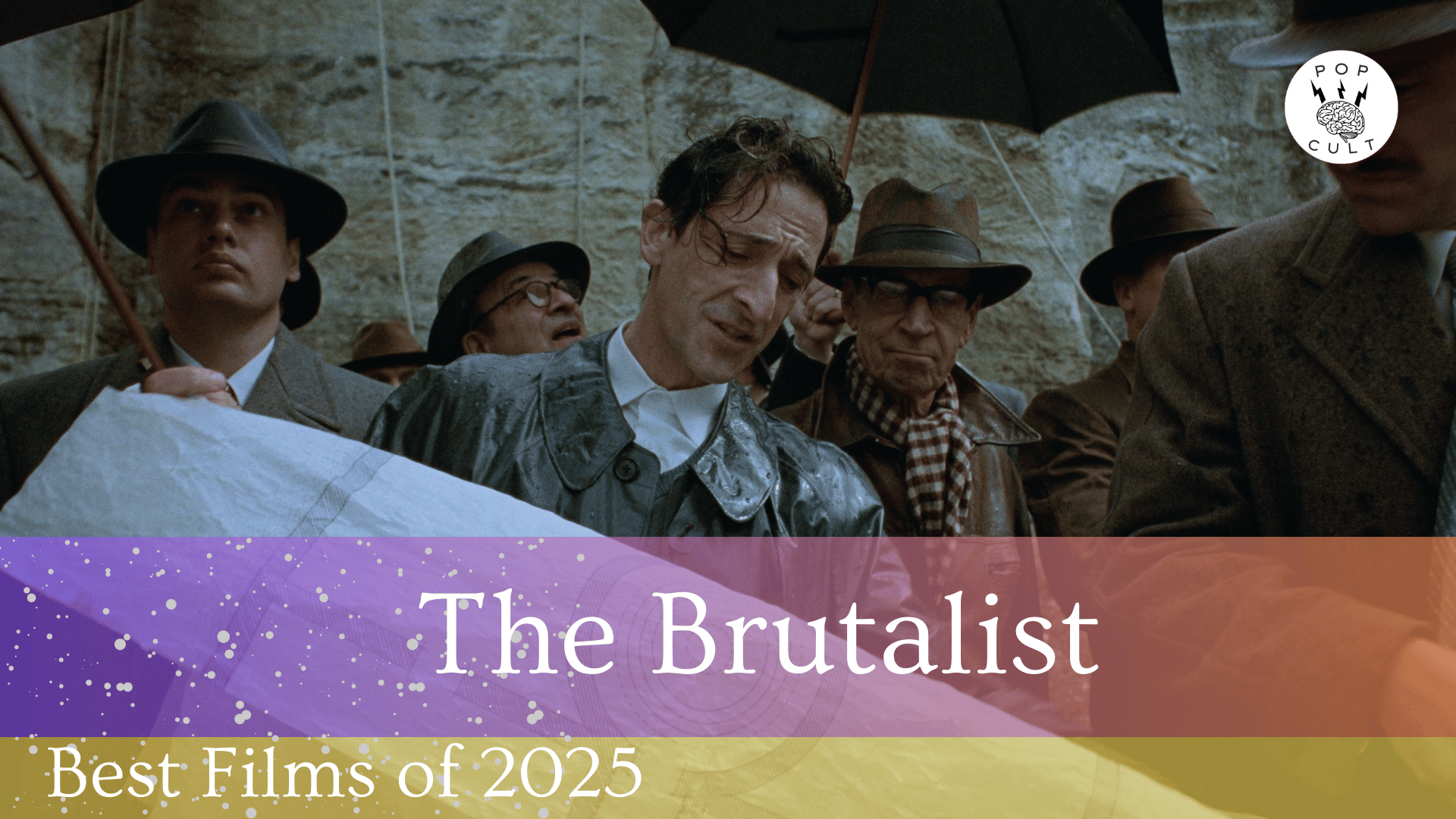
The Brutalist follows László Tóth (Adrien Brody), a Hungarian Jewish architect who survives the Holocaust and emigrates to the United States in the late 1940s, carrying both extraordinary talent and deep psychological damage. Struggling to find stability in a country that promises reinvention but delivers exploitation, László is eventually taken under the wing of Harrison Lee Van Buren (Guy Pearce), a wealthy industrialist who commissions him to design a massive, uncompromising architectural project. As the years pass, the building becomes both a professional breakthrough and a personal crucible. It exposes unequal power dynamics between patron and artist, immigrant and benefactor, survivor and a society eager to exploit his suffering and need. The film traces decades of ambition and compromise, using the slow construction of the building to mirror László’s attempt, and ultimate inability, to reconcile artistic purity with the moral cost of success in postwar America.
Brady Corbet has shown that he has little interest in making films designed to appeal to broad audiences. Instead, he pursues a clear vision and commits to it fully. His debut feature, The Childhood of a Leader, is a dense and intentionally cryptic film about a fictional dictator’s formative years, while his follow-up, Vox Lux, tells the dark story of a pop star who may have sold her soul to the literal Devil. His work is deeply cinematic while feeling like a heavy, demanding novel. That sensibility appeals directly to my tastes, though I understand why others might find it overwhelming. There has been much grumbling about the first half of The Brutalist being a masterpiece while many critics loathe the second half. I think both halves are necessary, as the latter serves to upend what the former establishes.
We don’t often see the scope and scale of The Brutalist anymore. This kind of grandeur is usually reserved for studio franchise films, yet this is a story that requires a mythic sense of scale even as it actively dismantles that myth. We are told stories about great industrialists who shaped society, narratives that now fuel modern technocratic praise. The use of VistaVision reinforces this imposing tone. VistaVision is a widescreen filmmaking format developed by Paramount in the 1950s that runs 35mm film horizontally through the camera, using a larger negative area to produce sharper, higher-resolution images, particularly noticeable in large-scale projection. As Tóth constructs Van Buren’s monument, we feel the cavernous interior spaces. A later trip to an Italian marble mine benefits from this format as well, emphasizing the immense scale of the environment against the minuscule presence of the people within it.
Adrien Brody delivers a magnificent performance, recapturing much of the pathos seen in The Pianist. He is introduced as part of a cacophonous mass of refugees. Daniel Blumberg’s score is equal parts bombast and chaos, complementing the boat’s entry into New York City as the Statue of Liberty is symbolically shown upside down while the camera swirls. From the outset, the film establishes a warped vision: Tóth is not entering America filled with hope, but with apprehension, uncertain of what awaits him on these foreign shores. Those fears prove justified when he reconnects with his cousin Attila (Alessandro Nivola), who runs a successful furniture shop. Tóth’s experience with Attila reveals how American capitalism can exert a corrupting influence, exemplified by his cousin naming the store “Miller and Sons,” a calculated invention meant to make xenophobes more comfortable.
Van Buren promises Tóth the stability and respect he once had in Hungary. His architectural talents are enlisted to help the industrialist construct a monument to his mother, intended to serve as a communal space for his rural Pennsylvania town. Tóth can be read as a stand-in for Corbet himself: an artist striving to create something of substance in a world where such efforts are easily forgotten. The film is shaped like one of Tóth’s buildings; unwieldy, imposing, and unsettling. It is difficult to forget once you have been inside it. Much like modern media culture, the patron ultimately comes to see the artist as a disposable commodity, another resource to extract value from before discarding while claiming the rewards.
To create a work of art that endures, an artist must be ambitious, and ambition inevitably attracts accusations of pretension. One has to be at least a little cocky to attempt something on this scale, to believe that personal obsessions are worth the time and attention of others. That belief requires a temporary withdrawal from the material world, a willingness to disappear into the work and let it eclipse everything else. But ambition alone quickly curdles if it is not grounded in something real, and this is where The Brutalist earns its confidence. It roots its monumentality in lived tensions: the uneasy transaction between America and the immigrant; the asymmetrical bond between worker and boss, creation and ownership. The film understands that buildings do not rise from ideals alone, but from bodies and labor, and it allows those forces to remain visible in the finished structure. That honesty keeps the film from collapsing under the weight of its own seriousness. It is not asking to be admired so much as reckoned with, and that distinction matters. By aiming this high and accepting the risk of being called too much, The Brutalist reminds us that endurance in art does not come from humility, but from a refusal to make itself smaller for our comfort.

 PopCult Reviews
One thought on “Movie Review – The Brutalist”