
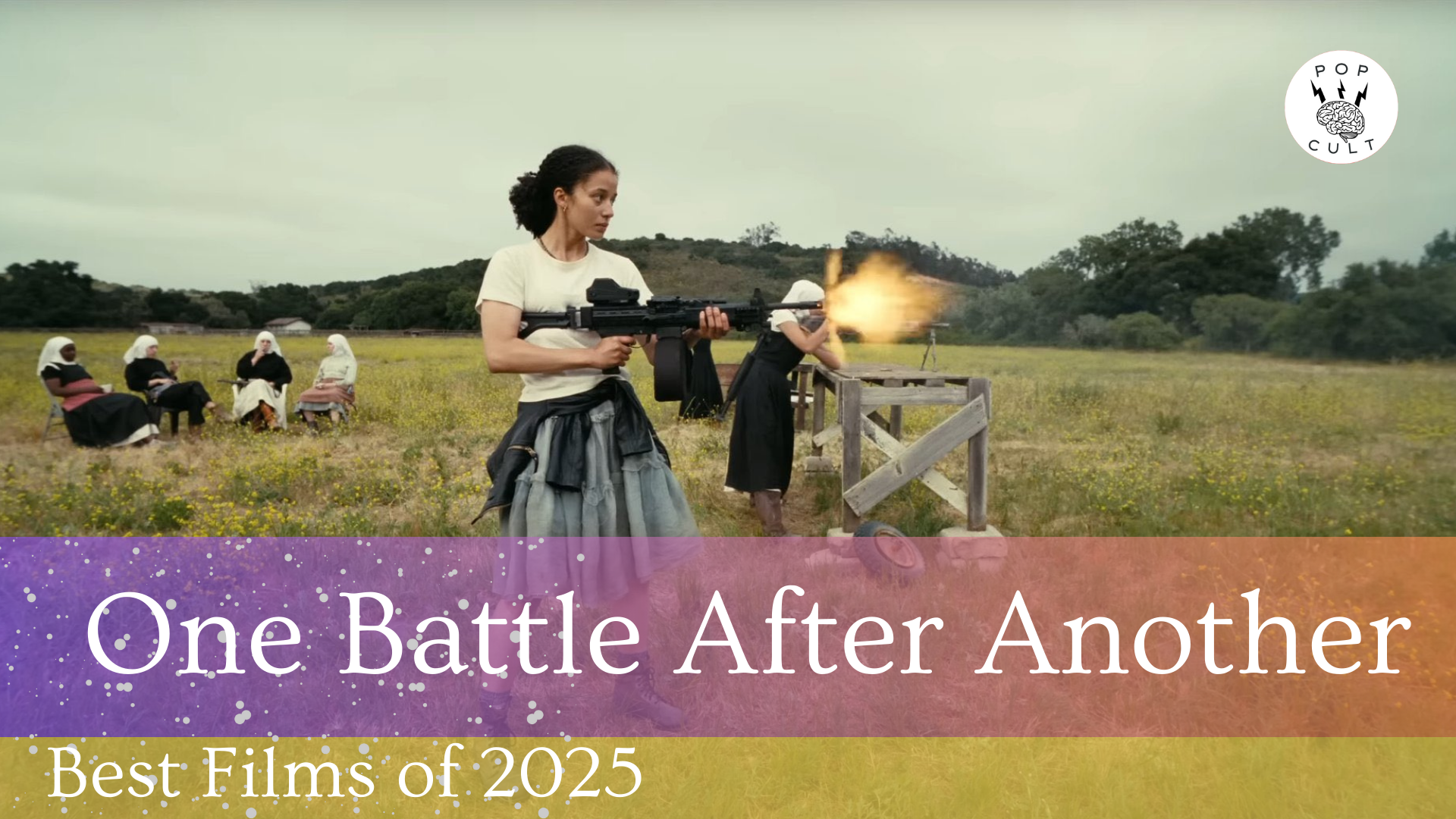
One Battle After Another (2025)
Written and directed by Paul Thomas Anderson
One of the best film experiences I had in 2025 was seeing One Battle After Another with my sister. It was her first Paul Thomas Anderson film, and when we exited the theater she remarked that it might have been the best film she’s ever seen. Unlike me, she is not obsessive when it comes to movies; most of her viewing is limited to films she watches with her kids. That’s not to say they are bad ones—I’ve been recommending a lot since we moved back. Still, it was a special thing for me to introduce her to one of my favorite filmmakers, especially with a film as incredible as this one.
One Battle After Another is a sprawling action-comedy thriller from Paul Thomas Anderson that follows Bob Ferguson (Leonardo DiCaprio), a once-radical revolutionary with The French 75 now living off the grid in paranoid obscurity with his fiercely independent daughter, Willa (Chase Infiniti). Sixteen years after abandoning his insurgent past, Bob’s fragile peace shatters when Colonel Steven Lockjaw (Sean Penn), a deranged old enemy, resurfaces to track down Willa, forcing Bob into a bumbling odyssey to find her. Along the way, he gets help from his daughter’s jiu-jitsu teacher (Benicio del Toro), while Willa finds herself among people who remember her revolutionary mother—and don’t think of her fondly.
This is the most action-oriented Anderson film we’ve ever seen: shootouts and car chases that allow him to try out new filmmaking techniques. The film explores themes of aging and regret, and how difficult it is to create lasting change when the status quo (Lockjaw) is so unrelentingly evil.
The film’s prologue tells the story of Perfidia Beverly Hills (Teyana Taylor), Bob’s partner and Willa’s mom. We see how much this work means to her, but also how it provides a rush, and how that bump of adrenaline causes her to make mistakes. She toys too much with Lockjaw during a mission to liberate detained immigrants, awakening a lust in him for her. He begins following her and coercing her into providing sexual favors. Perfidia plays along because she has little choice in these moments. While she exits the movie around 30 minutes in, she looms over the entire story. Bob, Willa, and Lockjaw are all doing what they do because of Perfidia. I noticed Taylor provides voiceover at the moment we switch to the present day, telling us fifteen years have passed. She is a ghost that haunts them all. Perfidia is the kind of character we have a drought of in cinema: a profoundly complicated and human person, not some Marvel superhero existing in a black-and-white dichotomy. She makes mistakes, but that doesn’t make her a bad person—simply a person.
Anderson’s pacing is masterful, spending just enough time on each piece of the prologue so that by the time we arrive in Baktan Cross, we know everything necessary about the players to understand why they make the choices they do. Bob is a pale shadow of “Ghetto Pat,” his revolutionary nickname. He served as an explosives expert for The French 75 and was eager to get into the mix. When the baby is born, he immediately gravitates toward being a caregiver and is unable to help Perfidia deal with postpartum depression. He doesn’t want to dictate to her, because he knows she’s going to do what she wants. We also come to understand why Perfidia might feel conflicted about loving her child when contrasted with her revolutionary beliefs—she sees this as the possible offspring of the enemy.
Present-day Bob is stoned all the time, still rambling on about “fucking slave owners,” but completely inactive about it. We see that he has done an excellent job educating Willa on many things, and she can certainly hold her own. Bob loves her more than he cares about himself, and that is a detriment to his well-being. When the time comes that she is in peril, he doesn’t have the means to help because he’s become so disconnected from the revolution. His conversation with Sensei in the car—pointing out that he has never known how to fix her hair, admitting he never tried to learn—speaks to the self-loathing he feels.
Yet DiCaprio never lets us forget his comedic chops. One Battle After Another is one of the funniest films I saw in 2025, due mainly in part to him and Del Toro. Bob’s cyclical phone conversations with Comrade Josh work because they feel like dealing with customer service, juxtaposed against the situation he’s in; they provide the absurd levity needed to balance the film’s tone. DiCaprio also provides the right amount of pathos. We believe he is a loving dad, and Willa means everything to this poor old burnout. Like many of the other French 75 members, he’s still too caught up in aesthetics rather than effective material action. He postures, he watches The Battle of Algiers, but he’s seemingly unaware of an underground railroad being run in Baktan Cross. He’s been checked out for too long.
Bob’s foil is Sensei, played masterfully by Benicio del Toro. Without having much screen time together, we can easily infer that Sensei has been a major influence on Willa’s inner strength and resolve. Despite a sudden military presence in Baktan Cross, it doesn’t seem to make him lose a step. He’s calm and organized, guiding what appears to be a hundred people through a series of practiced and thought-out procedures to ensure everyone’s safety. While The French 75 offered an intense militancy, it faltered when its members’ egos got in the way. Sensei’s revolutionary actions are focused on care and protection. He still admires The French 75, asking for a selfie with Bob before they part ways, but what’s happening in Baktan Cross is the reality of revolution. Yes, someone will take direct action and participate in violence, but most of us are needed to help take care of the vulnerable. It is not glamorous, but it is the very foundation of human existence.
Chase Infiniti makes her debut here and nails it. She goes toe-to-toe with DiCaprio and Penn, with whom she shares most of her scenes. I completely believed that Willa was a teenage girl, but also someone who could hold her own under pressure. That difficult blend of strength and vulnerability is not something most actors can believably pull off, but Infiniti blew it out of the park. I hope she has people around her helping her make good choices about upcoming projects. She’s a fantastic young talent, and I look forward to seeing her across a variety of genres and performances.
The grand villain of the piece is Penn’s Lockjaw, both a grotesquely accurate depiction of toxic masculinity and one of the main sources of laughs in the film. The physicality of Penn’s performance is a magnificent tightrope act. He looks like a person deeply uncomfortable in his own body, walking with his shoulders hunched, arms swinging at his sides, and what appears to be a stick up his ass. Penn’s mouth work is also a thing of beauty: a constant underbite and shifting of his jaw. This isn’t a man who feels anything—he’s a trained dog who executes orders and plans. Yet he’s also duplicitous toward the people he’s meant to serve. After being offered a lucrative spot in a white supremacist cabal (The Christmas Adventurers), he attempts to cover up his indiscretions with Perfidia. He claims to be a loyal soldier, but also seeks to avoid accountability—a good summation of the reactionary psyche.
Anderson creates a film that feels epic and expansive, and it boasts the largest budget he’s had to date. He makes excellent use of every cent on the screen. He also continues his collaboration with Radiohead’s Jonny Greenwood on the score, another facet integrated seamlessly into the story. The final car chase has garnered deserved hype, creating remarkable tension. The needle drops are a reminder that this director is one of the best, punctuating moments with the perfect tune and keeping the momentum going.
I’ve seen many voices claim this film is some grand commentary on political action, and while that is certainly present, I don’t think it’s the thematic core of the story. All of our characters, save Lockjaw, are trying to care for someone or something. Bob is trying to be a parent for Willa and goes after her when she goes missing. Willa is trying to care for her dad, whom she knows is falling apart. Perfidia cares about her revolutionary ideals, which is why settling down as part of a traditional family is so difficult for her; she cares enough about the revolution to allow Lockjaw to abuse her. Sensei cares not just about his community, but about the immigrants passing through it in need of help. We see several community members who help Bob along the way, using the limited power they have as a tool. Lockjaw cares about nothing but himself and his status, which is why he’s the most inhuman character in the film.
One Battle After Another is ultimately a hopeful film about love and care. The bad guy gets punished, and the good people keep fighting and taking care of each other. However, this is not my favorite film of the year. That honor goes to a movie that presents a darker view of many of these ideas—one I’ll be posting about tomorrow as my final review in this series.

 PopCult Reviews
One thought on “Movie Review – One Battle After Another”