
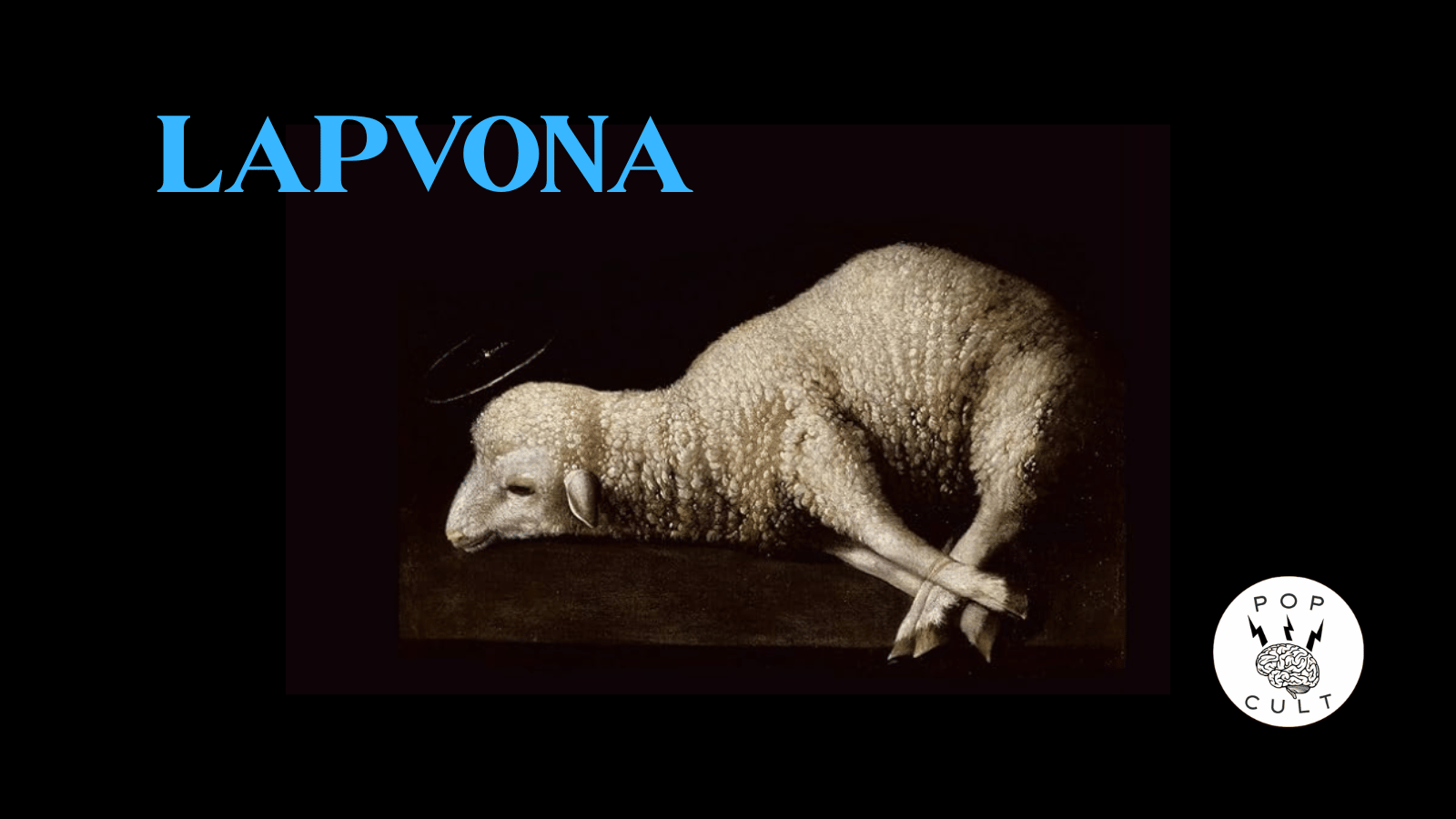
Lapvona (2023)
Written by Ottessa Moshfegh
In medieval Europe is a fiefdom called Lapvona. It’s a bleak place where violence and death are so commonplace they don’t elicit much of a response from the passive bystanders. Marek is a 13-year-old boy, son to the village shepherd Jude who views his child with disgust. The boy is physically disfigured and engages in a pathological religious guilt, which sends him pin-balling between bouts of self-flagellation and self-pleasure. While Jude might be seen as the “main character”, he’s one of many voices author Ottessa Moshfegh rotates into the spotlight over the course of the bleak, satiric novel.
Lapvona is in the middle of a brutal famine which their childish leader Villiam assures them can be overcome through devout faith to the Lord. He’s supported in this by the local priest who benefits from Villiam’s stuffed larder. Villiam serves as a foil to Jude and Marek does the same for the governor’s son. That’s a theme woven from start to finish in the text, everyone has a mirror of sorts which aids the reader in seeing how individual perspectives have created a warped sense of reality. Uncertainty is subjugated with religion and the fervent belief that material suffering is the result of a lack of faith. It should come as no surprise that Moshfegh penned the book during the early years of COVID-19.
Plot is secondary to character, which made my last Moshfegh read, Eileen, one of my favorite recent novels. Because there is no objective narrator, the world is filtered through the individual consciousness of each person as the author chooses to bring them to the forefront. Marek has only ever heard stories about his dead mother Agata who he has been told died in childbirth. Jude knows more about her and when we become privy to his thoughts we see a picture of a lost young girl he kidnapped and raped. Even more interesting are the memories of Agata by the haggard crone Ina who has also taught Marek much about human sexuality.
Agata’s story in these people’s lives is unraveled in pieces, so that our understanding of events changes with each new perspective. We become used to the idea that there is no fixed reality. To people like these the world was the immediate environment that surrounded them and the mystification they imbued into it. At most the ocean served as a clue that there was more beyond here, but none of these people ever went that far from the huts they were born in. Even Villiam, who is more aware of the political machinations going on behind the scenes, is a dullard who is in his position not because of intelligence or knowledge, but dumb luck.
When confronted with the uncertainty that comes out of these different perspectives, the reader must ask themselves what constitutes “real” in this world and ours. So many of the peasants believe there is an active God whose hand guides all things helpful and harmful. There are brief moments of realization for the reader that the characters will never have; learning the identity of the bandit in the stocks is just one of them that causes us to reevaluate our understanding of what is happening in this world. Lapvona is a collection of competing interpretations of the same suffering, where no progress can be made because of this.
Marek’s limited understanding shapes how the reader initially encounters the village. We meet him as he kneels beside the recently captured bandit in the stocks. His perception of religion and morality is filtered through childhood fear and manipulation. Just like most of us as children, the world is binary. There is what makes God happy and what angers the deity and how we know which is which is dictated to us by authority figures. Where there are gaps we create warped beliefs eventually manifesting cognitive dissonance as we age and the complexity of life becomes clear to us. His misunderstanding of morality is the core of the text, creating dramatic irony throughout. Unexpected events are attributed to the movements of God in the boy’s mind. The idea that bad acts lead to punishment is inverted when Marek momentarily gives in to his darker notions and is greatly rewarded. Through Marek’s perspective, Moshfegh illustrates how ignorance allows oppressive systems to feel natural or inevitable – “I must be doing good even if I harm others, because I’m being rewarded.”
Marek’s twisted theology emerges from Jude’s desperation to control his son. Jude doesn’t seem to truly believe most of what he says based on the cruelty he levies on the child. The goal is for Marek to see Jude as a God-like figure because in reality the shepherd is an outsider in the community and exists at the bottom of the communal hierarchy. His child suffers mainly in part due to the pariah status Jude holds in the community and rather than face that painful fact he demands God be blamed. His perspective reveals religion as a system of interpretive power rather than truth. Faith in Lapvona operates as an after the fact narrative imposed upon events as a means to handle the uncertainty of the human condition.
Villiam, the governor of Lapvona, lives in a fortress on a hill overlooking the community which reflects his expanded understanding of what is happening. He knows for a fact that the famine is not God’s response to the evils of the people. As lord of Lapvona, his perspective reflects entitlement and detachment. This makes him like Jude in many ways with the community as his children. He uses religious rhetoric to cow them, keeping their eyes off his gluttony and always ready to turn on each other. There is a joy he finds in watching the suffering of others, it’s part of his everyday landscape. Yet he’s also in denial about his wife and their child, a reality he refuses to reckon with which leads to drowning himself in wine and feasts. His interpretation of events exposes how power normalizes cruelty.
The witch in the woods, Ina represents a perspective from outside institutional religion or male-driven hierarchy. Her belief system puts her in contact with the natural world, not the religious interpretation of it. This means she has a radically different understanding of life and suffering. Ina doesn’t have to come up with complicated justifications of seemingly random harm and she comprehends why the village suffers under Villiam. Through Ina, Moshfegh introduces an alternative perception that challenges both religious and feudal narratives. Ina lives in complete defiance of the Christian morals imposed on the others and ends up in a grim but advantageous position by the close of the story.
The final perspective and the one that overshadows them is the reader’s. We’re constantly being presented with conflicting perspectives from which we’re expected to assemble some meaning. It will become clear from a contemporary perspective what is going on in Lapvona and the true nature of the power dynamics because we still live under these conditions. We’re not village peasants living in rags; our overlords learned this was not ideal in the modern era of hyper-consumptive capitalism. Our age is that of the “treat-lerites” as Hasan Piker coined. Our devotion is to those who keep snacks and distractions coming and we live in a cynical state of normalizing increasing suffering, just as long as it doesn’t happen to us individually.
Moshfegh never passes judgment on her characters, she writes honestly from within each person’s mind and leaves the morality up to us. The reader becomes another participant in the act of interpretation, mirroring the villagers themselves.
Moshfegh’s novel demonstrates that perception shapes reality more than events themselves, showcasing its roots in the COVID-19 pandemic and its aftermath in the States. Lapvona’s horrors persist because characters interpret them through belief systems that justify suffering. I recall seeing a news report during 2020 of American Christians extolling their devotion to God which led them to believe they were immune from the virus. Those who suffer deserve it, right? Following this line of logic allows a person to justify the rise of harmful political ideologies because God wouldn’t let “bad guys” win, right? We have not come that far from the Dark Ages. Moshfegh suggests that societies, both past and present, are built not only on power, but on the stories people accept as truth.

 PopCult Reviews