Breaking Down The New DC Promo

So DC Comics has released a promo image tied to their current Brightest Day theme running throughout their books. The images here gives clues and metaphorical images about where the various titles are heading in the next six months. Let’s break it down, shall we? (Click on the image to enlarge)

Starting on the top left corner we have Hawkman and Hawkwoman becoming part of a skeleton-made portal. From the portal are coming humanoid hawk creatures. If you’re reading the year long Brightest Day bi-weekly series then you recognize these creatures. The Hawks recently went through this portal and found a strange universe that’s terrorized by the ravenous things. From the looks of this image, it looks like these creatures will be filtering out into the greater DC Universe.

Next, we have Guy Gardner, the Guardian turned Green Lantern Ganthet, and the Red Lantern Atrocitus. While Guy and Ganthet are constructing some sort of structure with their rings, Atrocitus is raising a green coffin up. I can’t really think of a dead Green Lantern other than Abin Sur, who was transporting Atrocitus when his ship crashed on Earth and Hal Jordan was given his ring. Could Atrocitus be resurrecting Abin Sur?

We have Hal Jordan as the White Lantern, lying unconscious in a broken White Power Battery. His right arm is bloodied, and I believe the right hand is where he wears his ring. Thinking he becomes White Lantern but the ring is taken by force from him. Beside Hal, in the smoke is the face of The Anti-Monitor, the main villain behind 1985’s Crisis on Infinite Earths, the comic book event to begin all events. The Anti-Monitor was recently resurrected as a Black Lantern, despite wanting to stay dead. Deadman encountered the villain in recent issues of Brightest Day and found him alive and well in the Anti-Matter Universe.

Follow the smoke the Anti-Monitor is coming from, and you’ll see it is generated from the fire Martian Manhunter is starting. MM’s greatest weakeness is fire, so it is interesting that he is starting this fire. The first is also at the base of a tree marked with the symbol of the White Lantern (The Tree of Life?). Recently, a forest grew in an instant in the middle of Star City (analog for Seattle) when Deadman visited. Green Arrow has taken up residence in the forest (note the green arrows in the tree). So this forest will become tied to Martian Manhunter at some point who is possibly responsible for the Anti-Monitor’s return?

Below this we have a pile of boomerangs (Flash villain Captain Boomerang was one of those brought back from the dead at the end of Blackest Night) and what appears to be the broken staff of Blue Devil, an incredibly obscure character created in the early 1980s whose popped up from time to time, most recently as a member of Shadowpact, a collective of occult heroes and heroines. Standing above this is the newly announced Aqualad, and right behind him is a pair of ominous red eyes, which I believe belong to Aquaman villain Black Manta. Speaking of, Aquaman’s skeleton, clad in his Black Lantern uniform lies below Hal Jordan. Aquaman’s wife, Mera is rushing to his side. Below them is Deadman, carving out “RISE” on a tombstone. Since the end of Brightest Day, Deadman has been alive and when he touches the dead they come back to life.

Continuing clockwise, there’s a golden shield on the ground (Wonder Woman’s possibly) and two men trying to lift rocks off a buried figure. The two men are Jason Rusch and Ron Raymond, both have been the superhero Firestorm at some point and have found themselves bonded since Raymond’s return from the dead in Blackest Night. The buried figure is the Blackest Night version of Firestorm. Finally, we have Hawk and Dove, avatars of Chaos and Order respectively, holding Jade, daughter of the first Green Lantern. Both Hawk and Jade were brought back from the dead in Blackest Night, but they have not encountered each other since. Looks like they will be in the next year.

Back Issue Bin: Marvels

Superhero comics are traditionally told from the point of view of the beings of great power. From time to time we glimpse the man on the street reacting to the “gods” battling above his head. In 1994, writer Kurt Busiek and painter Alex Ross united to create a ground breaking mini-series that would influence comics books still today. If you know anything about comic books in the 1990s, you know that it was the boom and bust period. X-Men #1 sold a million copies, a group of upstart creators left Marvel to form Image, DC gimmicked the hell out of the Death of Superman. There was a cynicism that underlined the majority of material being released. Alan Moore’s Watchmen and Frank Miller’s Dark Knight Returns had really colored everything that came after them, but were interpreted for all the wrong elements. It appeared the average comic creator saw those texts and thought “higher levels of violence and sexuality”, instead of “tightly crafted storytelling and manipulation of the genre tropes”. Busiek and Ross decided to take readers back to a time when heroes were objects of wonder, not agents of destruction.

Marvels was originally released as four prestige format books. Each book focused on an era of Marvel Comics history, not paying attention to any sort of real time continuity. Issue one is the story of the World War II era heroes (Captain America, Human Torch, The Submariner). Issue two was a look at the beginnings of the Silver Age in the early 1960s as well as the anti-mutant sentiments beginning. Issue three was the invasion of Earth by Galactus. And issue four was the story of the Death of Gwen Stacy, a moment that marked the end of innocence for the Marvel Universe. All four issues are told from the perspective of photographer Phil Sheldon. Sheldon works for The Daily Bugle, and is even a casual acquaintance with young upstart Peter Parker. Sheldon lives in New York City with his family and is front stage for the rise and fall of the “gods” of his lifetime. This human perspective adds so much and the events being revisited even if you are a long time Marvel Zombie or someone totally unfamiliar with the key moments in the universe.

In many ways Marvels is the story of why people have faith and how they lose it. In the Marvel Universe, World War II is much different due to the participation of superheroes. Captain America in particular is a Messianic figure, saving the world from the Nazis, and “dying” while in battle with his arch-nemesis. His subsequent “resurrection” by the Avengers in the 1960s is the Second Coming for people like Phil. Mr. Fantastic and The Invisible Girl are like a royal couple when they get hitched atop the Baxter Building, an event Phil gets to cover for the Bugle. There’s definite parallels between this couple and the Kennedys, as well  as the optimistic Camelot atmosphere around them both. There’s also a story about anti-mutant hatred that is an obvious metaphor for the civil rights issues that were ongoing during the 1960s, and Phil even brings up the strange contradiction between a people that so easily accept The Avengers yet revile The X-Men.

Marvels is one of the first comics I read that elicited a strong emotional response from me. Its a story told by men who were children when they first read the original stories, and are now retelling them with a mixture of childhood nostalgia and tempered adult reality. The mix is what makes Marvels such a poignant story. Phil’s daughters grow up in a world of wonder, where men and women really can fly, and the good guys defeat the bad guys. Phil came of age during The Great Depression so this is the dream he always wanted for his family, the opposite of the cards he was dealt. When the moment comes that the Silver Age ends, and the Marvel Universe begins to head down a darker path, Phil is worried. Where the mini-series ends is a beautiful moment, Phil choosing to hope that the goodness he has come to believe in will always be there. If you are looking for a superhero comic that works as a perfect counterpoint to stories like Watchmen, this is definitely it.

Comics 101: Martian Manhunter

In 1955, in the back pages of the Batman focused Detective Comics, a new superhero was introduced in a story titled “The Strange Experiment of Dr. Erdel.” Dr. Erdel was a Chicago based astronomer who has constructed a device to communicate with the planet Mars, which Erdel believes is inhabited. The device malfunctions and accidentally teleports a Martian to Earth. Erdel is so shocked by this he has a heart attack and dies leaving the confused Martian alone on this strange new world. His Martian name is J’onn J’onnz and, due to his ability to shape shift, he takes the alias John Jones and fakes credentials to become a police detective in the Windy City. J’onn would keep his Martian identity secret for many years, using his telepathy, flight, and ability to phase through solid matter to foil criminals without them realizing it. But, he could only hide for so long.

J’onn’s big public debut came with the formation of the first Justice League of America. The mind controlling alien Starro attacked the Earth and the greatest of Earth’s heroes came together to stop it (Superman, Batman, Wonder Woman, The Flash, Green Lantern, Aquaman). J’onn joined their side taking a more humanoid form, but keeping his alien nature through his green skin and the symbol of his home planet on his belt. J’onn was to become the most stable member of the League, being a member of every incarnation that followed, except for the current version. During this time J’onn yearned to return to his home world and be reunited with his wife and daughter. Eventually, this wish came true but what he found broke his heart.

It seems that Erdel’s device had not simply transported J’onn to Earth. It had pulled him through a thousand years of time to the present on our planet. J’onn learns that the civilization of Mars had been destroyed in his absence, a few red dust covered ruins remain. He returns to the Earth for good and helps form a new Justice League alongside Aquaman, becoming very attached to his team members which are his makeshift family. The villainous god Darkseid decides to test the mettle of Earth’s heroes around this time and in the aftermath many of the members of the League are killed. J’onn is lost in the world until businessman Maxwell Lord brings him in to help lead a Justice League International. The alien hero takes the position and becomes a sort of makeshift den mother to this group of goofy characters, particularly keeping Blue Beetle and Booster Gold out of trouble. Now relaxed in his new position, J’onn allows himself to shift into his natural Martian form during meditation and also reveals his proclivity for Oreo cookies.

A major turning point occurs for the character when the old Justice League villain Despero comes to Earth wanting to mindlessly kill his old adversaries. Despero attacks the former League-r Gypsy and kills her family. He goes on to kill a few other members, until J’onn steps up unleashing a psychic assault on the villain that fools him into thinking he has won and sends him into a hibernation state. J’onn felt himself growing distant from his team around this time, and goes on leave. As he heads for Chicago, he runs across an African-American man being attacked by a strange entity. Through bizarre arcane rituals, J’onn and the man merge into a being known as Bloodwynd. J’onn’s memories are scrambled and Bloodwynd ironically ends up joining the League. He participates in the battle against Doomsday, the monster who would eventually kill Superman, and is injured. These injuries lead to J’onn’s memories returning and he and the man split back into their individual forms.

The Martian Manhunter retained a steady place with the League in the following years, learning more about the mythology of his home world and even battling the Martian version of the Bogeyman, Fernus. On the eve a great crisis, J’onn was busy with monitor duty at the League’s moon-based Watchtower headquarters when a shadowy figure attack and caused the building to explode. J’onn was believed dead but is actually being used by the crisis’ key villain, Alexander Luthor (son of another universe’s Lex) as a living battery to collapse all parallel realities into one. With the help of Superman, Batman, and Wonder Woman, J’onn escapes and the  young Luthor is defeated. Months later, J’onn is injured brutally by the villainous Black Adam and suffer severe psychic trauma. He gives himself a new form, more reminiscent of his natural alien form. Tragically, J’onn is killed by Libra, a cultist obsessed with bringing about an age of evil on Earth.

When the Blackest Night occurred on Earth, black rings falling from the sky and resurrecting the dead, J’onn was one of those who attacked his former friends. The rings had a corrupting influence on their hosts so it was not truly J’onn speaking through his body. Thankfully, Green Lantern and his allies managed to stop the influence of the black rings through the presence of a white energy. The white energy cause J’onn among others to come back from the dead. The alien has now returned to Mars, rebuilding its surface, but has recently experience phantom memories from his past that seem to tell him he is not the only Martian still alive.

Back Issue Bin: Y The Last Man #1-60

Here’s an entry from DC Comics’ Vertigo imprint. Y the Last Man ran from 2002 to 2008 and was written by Brian K. Vaughn, with art Pia Guerra. The covers were provided by the insanely talented J.G. Jones. If you’re a fan of Lost then you’re familiar wit Vaughn’s writing, he was a writer on staff for seasons 3, 4, and 5. He even received a Writer’s Guild nomination for his Season 4 work on the show. Y the Last Man is one of the comic book series that feels like a perfect framework for a television series as well. We have a regular cast of characters involved in one large arching story, with small six issues arcs along the way. The series looks at some issues of gender in global culture and is one of those great philosophical science fiction stories.

It’s present day, and Yorick Brown is an amateur escape artist practicing a classic Houdini trick while on the phone with his long distance girlfriend, Beth. In the middle of the conversation the world falls apart. It seems a virus has swept the globe in a freakishly quick amount of time killing every male animal on the planet, except for Yorick and his pet capuchin monkey Ampersand. The duo quickly find that the world is both different and depressingly familiar now that it is female dominated. The same sort of tribal mentality that ran patriarchal society is at work in the matriarchy. Some women believe this was an act of god to curse man for his millenia of foolishness. Some women are willing to kill any man they might see alive. Some women see this as biological catastrophe and are working to developing cloning technology to keep the human race alive. Into the mix is thrown Agent 355, a female member of a secret society dating back to the presidency of George Washington. Agent 355 is sent to protect Yorick as he journies from the States to Australia to find Beth.

The series has some wonderfully exciting moments. I’m reminded of a subplot that involves the belief that a group of male astronauts in the international space station might still be alive. Teaming up with scientists hiding out in a secret laboratory in the Midwest, Yorick and crew attempt to aid in the crew’s return to Earth. At the same time, a militant force of Israeli soldiers are closing in on Yorick whom they plan on using to reproduce. The Israeli angle is one of many interesting elements in the series. In real life, Israeli is the only military on Earth that have women as an integral part of defense. This means in Yorick’s world, the dominant military force are the Israelis. They are the only ones with battleships and air force pilots. There’s also some interest threads involving the Muslim world and what happens to it in a culture without men. If gender studies is something of interest to you, then Y will definitely leave you with some clever ideas to ponder.

Comics 101: Spider-Man

Young Peter Parker, high school science whiz, is bitten by a radioactive spider and gains the relative strength of a spider, as well as at the ability to scale walls and a “spider-sense”. Using his scientific expertise, he constructs web shooting gauntlets. At first, he uses these powers to make money as an amateur wrestler, but after a judgment he makes causes the death of his Uncle Ben. Living true to the motto of “With great power, comes great responsibility”, Peter becomes Spider-Man, fighting crime while being vilified by his employer, The Daily Bugle. You know the basic origin, so lets get into some of the details, shall we?

Early on, Peter juggled high school, work as a photographer for The Daily Bugle, and Spider-Man. J. Jonah Jameson, the Bugle’s publisher took a particular relish in vilifying the webcrawler. Peter pressures himself to  bring home his share of money for his widowed Aunt May, while she attempts to set him up with the neighbor’s niece, Mary Jane Watson. Not wanting to be set up, Peter avoids this for awhile (multiple years in our time). Some of Spidey’s early villains were The Chameleon, The Vulture, The Sandman, Doctor Octopus, Electro, Mysterio, Kraven the Hunter, and of course Green Goblin. Peter also dated Betty Brant, J.J.’s secretary in his senior year of high school, but eventually fell for Gwen Stacy once he got into college. A major turning point in Peter’s life revolved around Gwen, an event that would change him forever.

The Green Goblin had figured out that Spider-Man and Peter Parker were the same person, while Spidey was unaware of who the Goblin was. To hit Spider-Man deep, he kidnapped Gwen and held her captive atop the George Washington Bridge. The two men battled and Gwen plummeted off the bridge. Spidey dives, firing a web to catch her leg, but the jolt of the web’s tug causes Gwen’s neck to jerk back and snap, killing her. Enraged, Spider-Man hunts the Goblin down and in the process of the battle, the villain is impaled on his own glider. During his grieving period, Spider-Man is secretly cloned by one of his professors, and battles himself, as well as is tricked by a clone of Gwen. Peter believes his clone is dead, but the clone lives, taking the name Ben Reilly and leaves NYC for the next few years. Peter finds himself in the arms of Mary Jane Watson and the two become inseparable for a long time.

Aftre graduating from college, Peter becomes involved in a secret war on the moon between Marvel’s top heroes and villains, organized by a being called The Beyonder. While on the moon, Peter ditches his red and blue duds, for a sleek black and white costume which he is unaware is a living organism, a symbiote that enhances Peter’s powers but also increases his rage. Back on Earth, Peter is becoming increasingly violent and gets help from Mr. Fantastic to separate himself from the symbiote. Peter returns to normal, but the symbiote eventually escapes its containment, and finds Eddie Brock. Brock was a reporter for the Daily Bugle who has falsified facts in an effort to break a big story. He gets caught in the lie by Spider-Man, and Brock grows to hate the hero. The symbiote detects this hate and merges with Brock to become Venom. Venom plagues Spider-Man with a cannibalistic brutality, but eventually creates his own nemesis by accident, the even more brutal Carnage.

Peter and Mary Jane get married, but their happiness is short lived when Ben Reilly, his clone returns to his life. It turns out there were a few clones made, including Kaine, a violent version of Peter who uses his sticky wallcrawler hands to tear the skin off people’s faces. Spider-Man battles his evil clone and eventually Ben takes up the identity of the Scarlet Spider. The Scarlet Spider’s career is cut short when he is suddenly and brutally killed by the original Green Goblin, returned from the dead. As a way to strike at the core of Peter, The Goblin aka Norman Osborn causes Mary Jane to believe she miscarries, while he actually kidnaps the child to raise as his own. Life continued down this bleak path, with M.J. and Peter separating, Aunt May taking ill many times, and Peter struggling to maintain his personal life. The Kingpin learns of Spider-Man true identity while imprisoned and hired a hitman to take Parker out. Instead the bullet hits Aunt May and Peter searches for help from heroes like Doctor Strange and Iron Man.

Mephisto, Marvel’s version of the Devil, appeared to Peter and MJ with a deal. Aunt May would be saved if Peter allowed his life with MJ and the memories of it to be taken. Peter refused to make such a deal, but MJ agreed to it, knowing Peter would be heartbroken if Aunt May died. In a flash, their marriage was gone, Peter was a high school chemistry teacher, still photographing for The Daily Bugle and MJ had left New York years ago. J. Jonah Jameson has won the election to become the mayor of New York City, while Norman Osborn achieved the highest level of power in American defense.

All of Spidey’s enemies have evolved over the years as well, most tragically The Lizard, who was Peter’s mentor Dr. Curt Conners, has submitted to his mutation and devolved permanently into a mindless reptilian creature. Most recently, Peter has been hunted by the vengeful Kravinoff family, the heirs of Kraven the Hunter. They have killed and tortured characters whose powers are related to spiders (Spider-Woman, Arana, Madame Web) to lure Peter into a trap. He was even reunited with Kaine, his surviving clone along the way. It culminated in the ressurrection of the dead Kraven and a massive battle with Spider-Man. In the end the Kravinoffs failed and were driven out of NYC. Kaine sacrificed himself to save Spidey and the adolescent Arana became Spider-Girl.

Character Actor Month – Part 3


Keith David (IMDB credits: 180 credits, The Thing, Platoon, They Live, Gargoyles, Princess Mononoke, There’s Something About Mary, Pitch Black, Requiem for a Dream, Coraline)

Keith David is an actor known just as well for both his on screen performances as well as voice over work. When I see his face I immediately think of Childs in John Carpenter’s The Thing. When I hear his voice I think of Goliath from Disney’s Gargoyles, one of the best children’s animated shows from the 1990s. David was born in Harlem, New York in 1956 and first found himself moving towards acting as a career when playing the Cowardly Lion for a school production of The Wizard of Oz. He entered into New York’s High School for the Performing Arts and attended Julliard afterwards. You can definitely hear the classical Shakespearean training in his voice, particularly as the Celtic Goliath. David has become a frequent collaborator with John Carpenter and provided the voice-overs for three Ken Burns documentaries (“The War”, “Unforgivable Blackness”, “Jazz”) and won Emmys for the first two. He is one of those actors more and more directors are using and his IMDB boasts 12 projects in various stages of production.

Paul Dooley (IMDB credits: 160 credits, Slap Shot, Popeye, Strange Brew, Sixteen Candles, Waiting For Guffman, Insomnia, A Mighty Wind, Curb Your Enthusiasm, Cars, Hairspray)

Dooley is one of those people that has always had a creative mind and was bound to be involved in entertainment and the arts somehow. Born in Virginia in the 1920s, Dooley was very into cartooning and even drew a regular strip that was part of the local newspaper. He joined up with the Navy, but after getting out and enrolling in West Virginia University he discovered theater. Comedy was his strength, so he moved to New York and did stand up for five years, and then worked as a stage magician and clown. Dooley was discovered by Mike Nichols and cast in the original stage production of The Odd Couple. In the 1970s he helped co-create The Electric Company for PBS and worked as one of its writers for its initial run. Around this time he also got involved with Robert Altman’s films, playing key roles in A Wedding and Popeye. In the 1990s, Dooley got involved in the Christopher Guest movies, as well as becoming a regular in shows like My So Called Life and The Practice.


Grace Zabriskie (IMDB credits: 134 credits, Norma Rae, An Officer and a Gentleman, Drugstore Cowboy, Twin Peaks, Wild at Heart, Fried Green Tomatoes, Ferngully, Seinfeld, The Grudge)

Grace Zabriskie was born in New Orleans and grew up amongst some interesting guests of her father’s cafe and various business in the city. She claims that they were visited by Tennessee Williams, Gore Vidal, and Truman Capote at various times. As a young adult, she wrote poetry and would perform it in coffeehouses in New Orleans as well as Atlanta. It was also during this time she became a very accomplished silkscreener, and she has been recognized for her very artistic lamps, which she says is an attempt to sculpt using light. Zabriskie is best known for her role as Sarah Palmer on David Lynch’s brilliant Twin Peaks. While her character faded from episodes after the middle of the second season, she remains one of the most iconic figures in the series. Since then Zabriskie has had a recurring role on Seinfeld as well as continued to work with David Lynch, one of the few directors she says she continues to enjoy working with.


Harry Dean Stanton (IMDB credits: 173 credits, Cool Hand Luke, Alien, Escape From New York, Repo Man, Paris Texas, The Last Temptation of Christ, Wild at Heart)

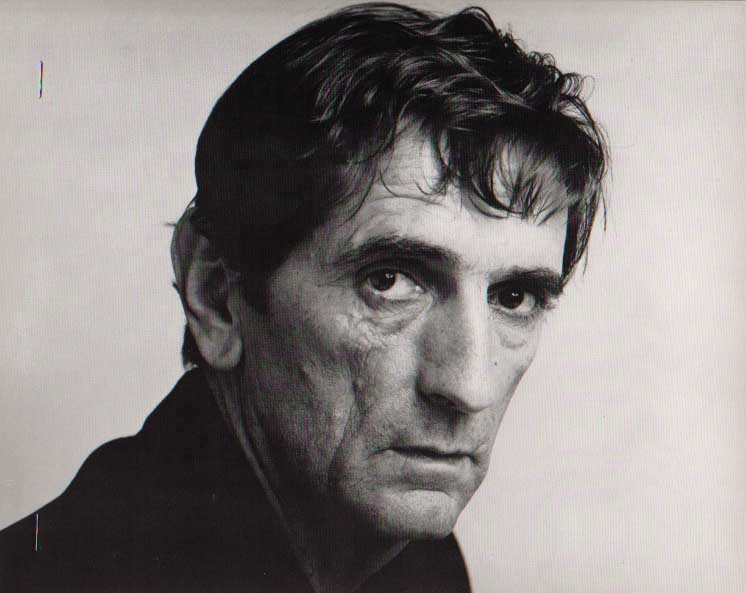
Harry Dean Stanton was born to a Kentucky tobacco farmer, got a degree in journalism and radio arts, and starred in at least one episode of pretty much every Western television series from the 1950 through 60s. Stanton has the perfect face for the weather beaten soul that has seen too much in lifetime. It’s helped him convey a lot of unspoken emotion, particularly in his best film Wim Wender’s Paris, Texas. Stanton got a start in low budget films of the late 1960s like Two-Lane Blacktop, but went on to befriending up and coming directors like Sam Peckinpah, David Lynch, and Franics Ford Coppola. Stanton has become a favorite of critic Roger Ebert who says any movie starring Stanton can’t be bad. Outside of film, he has toured bars and clubs playing covers of classic country on his guitar, a true modern cowboy.

Director in Focus: Brian De Palma – Redacted


Redacted (2007)

So we have caught up with Brian De Palma’s body of work. Redacted goes back to a lot of the same territory as 1989’s Casualties of War. We have American troops in a foreign land and the sexual violation of a native girl is the crux of the conflict. There’s one soldier who above all the rest is still virtuous. This was one was written by De Palma as well and really shows off his weakness as a writer. However, there are some interesting technical elements to the picture, and it really easy very experimental for De Palma, both in its making and the distribution.

Told through soldiers’ personal video diaries, CCTVs, news footage, and user submitted online videos, this is based on a true story where a squad of American soldiers were responsible for the rape of 15 year old girl and the subsequent murder and burning of both she and her family. The film did not do well upon its release, and in no way is this a great movie. However, many of the criticisms were jingoistic blather about De Palma wanted to imply that all soldiers are evil monsters. The fact that one of the squad members goes to the authorities with what happens must have gone over their heads. Its part of this thoughtless creed of “support the troops” which many interpret as do not question or think critically about the actions of the military. I don’t believe every soldier over there is some sort of sociopath, but I believe the culture that surrounds the military breeds that in people who leaned that way in the first place. That said, De Palma doesn’t present either the villains or the hero of the film in an interesting way at all.

The two vile soldiers who perpetrate the rape and murder are drawn cartoonishly broad. There are even scenes where they cackle like the hyenas in The Lion King. The hero is also without flaws and there’s nothing remotely interesting about him. The type of evil that is most interesting is the kind that comes out of mundane and ordinary people. When you have two characters who appear to be walking cliches they don’t come off as truly intimidating at all. A good filmmaker would make us like these guys, show us sympathy for them, and then reveal their darker nature. It makes us question ourselves. Even Sean Penn in Casualties of War, of which De Palma is really ripping himself off on, was a character I understood. Even though his action were abhorrent I could see what he saw in the world. What I did like was De Palma trying to do more with his camera. His typical POV shots were incorporated as part of the soldier’s diaries and there’s some interesting work done with website video.

Looking back on the films of Brian De Palma I have to defend him as a cinematographer. He may not always be a great all-around storyteller but he is one of the best cameramen I’ve ever seen. The level of tension he can generate in a film is amazing, and its all done through some of the tightest editing around. The moment in the prom scene of Carrie, as Amy Irving is figuring out what the bullies are about to do is such a perfect example of that. So much information is told without words, simply looks and cuts. The museum scene in Body Double should be shown to every wannabe filmmaker of how to tell a voluminous story in a only a few minutes and without a single piece of dialogue. Even watching the worst films of De Palma’s, I always knew he would amaze me with the camera. Sadly, his career has been marred by too many failures in a row. According to IMDB, De Palma appears to be working on a remake of his great rock opera Phantom of the Paradise (seen before I started this marathon), a prequel to The Untouchables sub-titled Capone Rising, and The Boston Stranglers, based on a true crime book about the theory that multiple men were placed under the umbrella of one serial killer. My hope is that De Palma can still find a way to produce good films again, I know he has it in him and I think there’s a strong possibility that he can rally a comeback in the same way that Francis Ford Coppola has been doing.

Back Issue Bin: Animal Man #1-26


Animal Man #1-26 (1988-1990)
Written by Grant Morrison
Art by Tom Grummett, Chas Truog, and Doug Hazelwood

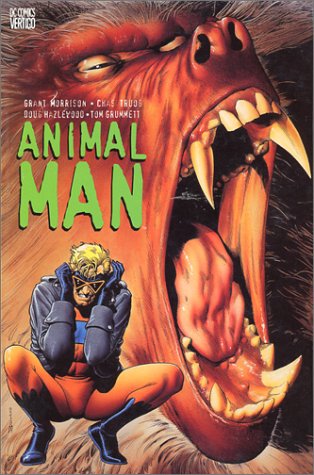
It’s no secret that I love Grant Morrison’s work. He’s like the second coming of Julius Schwartz, the crazy DC Comics innovator of the Silver Age mixed with metaphysical, post-modern sensibilities. Just a year after Watchmen’s publication, Morrison wrote what was in many ways a response to Watchmen’s attempt at realism. With Animal Man, Morrison created a hyper real look at the comic book reality and its the relation of creator and creation. The fact that these were mainstream comics published by DC, yet so innovative and experimental is amazing. Its hard to see anything like this happening again, though there was a brief attempt with Brian Azzarello’s Architecture and Morality mini-series in 2006, more on that later.

Animal Man was created decades before, in 1965 in Strange Adventures. The character could take on the abilities of what ever animal life was in the vicinity, so if a bird was around he could fly, if an elephant was close he could charge with massive strength, etc. The character was pretty flat an uninteresting, and even ironically became a member of a team called The Forgotten Heroes in the early 1980s. It was in the late 1980s, that the young upstart Morrison, newly imported from the UK was given the character. DC deemed it fairly safe to test the young writer out on a superhero with little fanbase invested in him, so if he screwed up it wouldn’t cause very much damage. What Morrison managed to do was turn Animal Man into one of the most complex and interesting characters DC published. The character continues on in popularity, having been a major player in events in the last five years, as well as getting his own eight issue mini-series.

Morrison began things by making Buddy Baker, the civilian identity of Animal Man, a family man. He had a wife, Ellen, and two kids, Cliff and Maxine. In the first story arc of the series, Buddy become involved in a battle between fellow animal-linked hero B’Wana Beast and a company using animals for scientific testing. The story is dark and poignant and there aren’t your typical hero versus villain battles. B’Wana Beast dies and Buddy is changed significantly. In resulting stories he goes vegan, his powers now linked to the emotional spectrum of animals, feeling their suffering. Morrison doesn’t let him get away with this easily, and Buddy ends up in some heated arguments with Ellen who doesn’t appreciate Buddy forcing his personal lifestyle change on the rest of the family. As you can tell, this is not the sort of thing you expect from comic books and its incredibly refreshing.

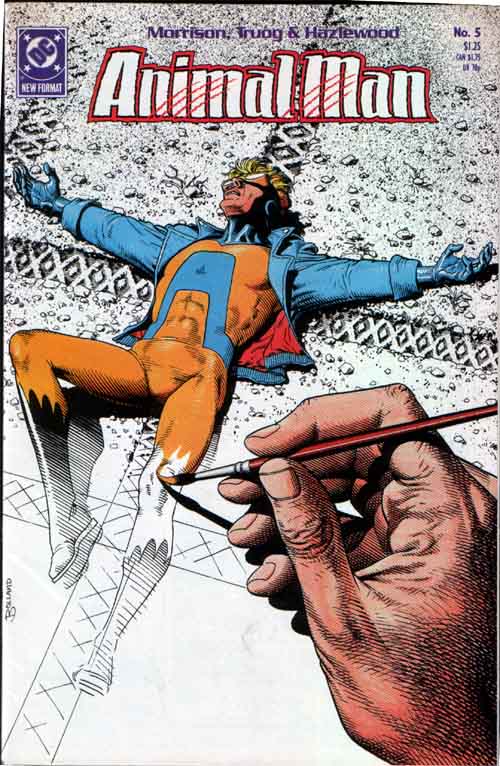
The most mind blowing story up this point came in Animal Man #5, “The Coyote Gospel”. In this story, a humanoid coyote wanders the desolate roads of the American southwest. He’s hunted by an obsessive truck driver who kills him, only for the coyote to rise from the dead again and again. Animal Man, who plays a very backseat role in this story, shows up and the coyote hands him a scroll. The story shifts to the content of the scroll which explains that this coyote came from a universe very much like that of the Warner Brothers cartoons. The inhabitants lived in a state of un-death, dying but constantly ressurecting. This coyote finally became fed up and question his world’s creator. The creator, depicted as a man in a plaid pants and wielding a paintbrush condemned the coyote to wander other worlds. Morrison pulls us back to show that to Animal Man’s eyes the scroll is unintelligible chicken scratch. He tells the coyote that he can’t read this and at that moment the trucker fires, shooting the coyote point blank in the head and killing him. The final full page panel is off a hand drawing this scene which has faded away partially at the bottom as just a simple pencil sketch.

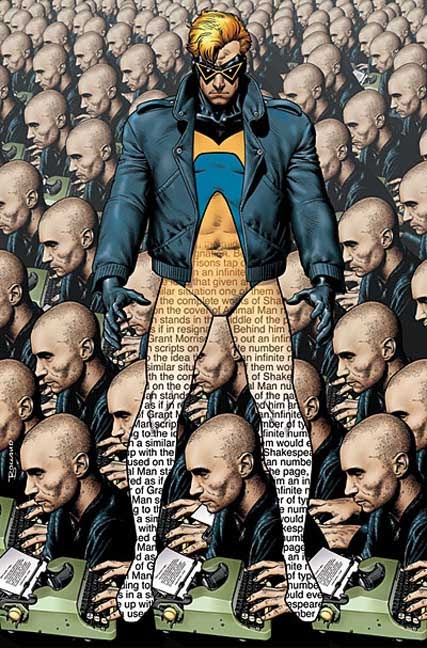
This single issue serves as the thesis statement for the rest of Morrison’s run on the series. He begins to deconstruct the ideas of continuity in comics and how Animal Man’s original creator and his own intentions for the character are drastically different. Morrison looks at the idea of the multiverse and about what happens to comic book characters who are forgotten and never used. All of this culminates in a meeting between Animal Man and Morrison himself. What also has to be one of the trippiest moments in comics books occurs during this run, as Animal Man has gone to a mountaintop and taken peyote in an attempt to break free from the physical constraits of his universe. In this moment, he suddenly feels that he is being watched, then looks right up at the reader, shouting that he can see you, that he knows you are watching. Chills!

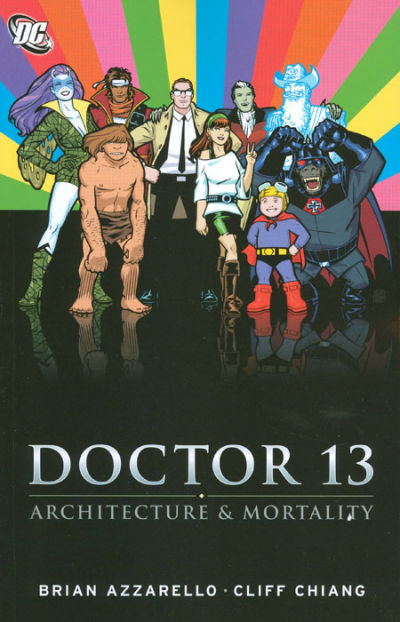
As further reading, Brian Azzarello and Cliff Chiang got together for a very small series of back up stories in the mini-series Tales of the Unexpected (2006). Much like Morrison’s stories, these explore the nature of forgotten characters and their relationship with their creators. The series is a lot of fun and features some crazy characters (Genius Jones, Infectious Lass, The Gorilla Brigade) as well as poking fun at DC’s editorial staff. It’s available in a collected edition titled Architecture and Morality.

Comics 101: Green Lantern Part 2

Hal Jordan was now the Green Lantern of Earth again. Kyle Rayner was still Ion, containing the power of the Green Lanterns without needing a ring to wield it. Guy Gardner and John Stewart were both Lanterns again and lived on Oa, the homeworld of the Green Lantern Corps training new recruits. Things were good. What they didn’t know is that Sinestro was busy in the Anti-Matter Universe, forcing the Weaponeers to construct a massive Yellow Lantern, which mimics the Central Battery on Oa, where the green power came from. With his own yellow battery, Sinestro created multiple rings sending them out to those beings in the universe that inspired great fear. Once his Sinestro Corps was assembled, they led a brutal assault on Oa, killing many Green Lanterns in the process. The battle was unlike anything the universe has ever seen and raged on to eventually come to Earth. Kyle Rayner was stripped of his Ion powers, but managed to get a ring in time to join the Corps. Sinestro was captured, but not before the Guardians allowed the Lanterns to compromise their values and use their rings to kill.

Sinestro was locked up in Sciencell on Oa but told Jordan that the “Blackest Night” was coming, and in this time of darkness Jordan would be compromised. Jordan was shaken up but worked to distract himself. The Guardians adapted to the new threat of the yellow rings of fear but establishing the Alpha Lanterns, regular Corpsmen transformed into emotionless judges, meant to keep the Corps in check. Meanwhile, other rings created from different aspects of emotion were manifesting in the universe. In Sector 666, the demonic Atrocitus vomited up a bloody red ring of rage. On a distant serene planet, two rebel Guardians made blue rings of hope. On the all-female world of Zamaron, its inhabitants made violet rings of love. And deep in a cavern on Okaara, one lone figure clutched an orange ring of greed. All of these various Corps began to get into conflicts and change the dynamics of the universe. In the Anti-Matter Universe, a jet black lantern manifest black rings of death, and these would change everything.

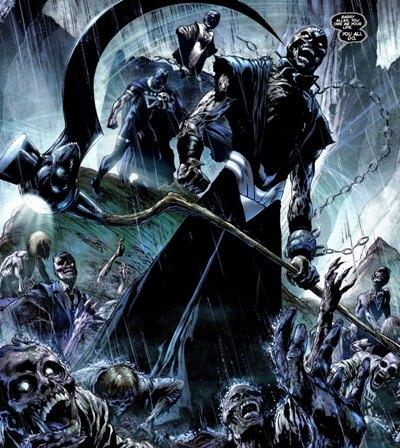
While the Corps worked to hunt down Sinestro’s soldiers still out there, using their rings to torture innocent beings, Hal Jordan encountered the Blue Lanterns and found his could use his green ring in conjunction with a blue one. He also ended up in Sector 666, where a red ring of rage overtook him for a little while. Sinestro was being transferred when his Corps arrived to liberate him and all hell broke loose. The War of Light began, all the various colors battling each other. As they were distracted, an old villain named Black Hand brought the scourge of the Black Rings to Earth. These rings were keyed only to the dead, and allowed hordes of dead heroes and villains to be resurrected as dark versions of themselves. At the time characters like Aquaman, Martian Manhunter, and Hawkman were all dead and came back as monstrous Black Lanterns.

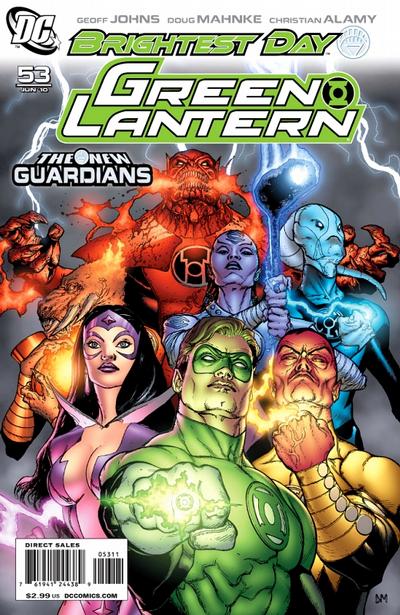
After a few days of fruitless battle, the Black Lanterns merely reconstructing themselves, its discovered that if two Lanterns of different colors use their powers together they can destroy a Black Lantern. Across the globe the battle rages and its revealed that Nekron, a being who controls death has been making the rings. It’s also discovered that an entity lives in the Earth who generates a White energy that creates a single ring and single Lantern. Sinestro gets ahold of it and fails, with Hal using its power to drive Nekron and the Black Lanterns away. Before the White Lantern vanishes, it resurrects a handful of heroes and villains. Through battle, Hal and Sinestro have reached a tentative alliance. Currently, Hal and girlfriend Carol (now wielding a Violet ring) have discovered that the Red Lantern, Atrocitus is on Earth looking for the source of his rage power. The White Lantern has also reappeared in New Mexico, forming a crater where it landed, and much like the sword in the stone is immovable.

Comics 101: Green Lantern Part 1

In Comics 101 I breakdown a comic character’s back history in an easy to understand way for newbies.

The story of Green Lantern began in 1940 with Alan Scott. Unlike the latter and more long running Green Lantern, Scott was based in mysticism and magic. He is a railroad engineer at the time and discovers a mysterious green lantern that imbues him with a magic ring. The ring gives him the power to fly as well as manifest constructs from it. Scott ended up being a founding member of the Justice Society of America, a World War II era precursor to the Justice League. He also had two children out of wedlock, Todd and Jennie who would grow up to be the super heroes Obsidian and Jade, respectively. Scott is still around, as a member of the JSA, and partnered with his old pals plus some new blood. But the core of the Green Lantern story really began in 1959.

In the late 1950s, the Silver Age of Comic Books began. DC has sort of pulled back its superhero publishing, with Superman, Batman, and Wonder Woman being about the only remainders. Julius Schwartz, the editor in chief at the time was wanting to take names used by heroes back in the 1930s and 40s and create all-new characters around them. This time around, Green Lantern was to be ace pilot Hal Jordan. While testing an experimental craft for his employer Ferris Air, Hal was pulled by a mysterious force to a crash site in the middle of the desert. There lay a dying alien wearing a strange green and black uniform. His name was Abin Sur and he told Hal he was part of the Green Lantern Corps, an intergalactic police force. Sur was dying as a result of the crash and Hal was deemed the only one on Earth worthy to wield the ring. Hal accepted and became Earth’s Green Lantern. The ring held 24 hours worth of energy and would have to be recharged in an accompanying lantern. The only catch in its seemingly invulnerable power was an impurity that made it vulnerable to the color yellow in spectrum. Hal would go on to battle a cavalcade of odd 60s appropriate villains, but his arch-nemesis would always be Sinestro.

Sinestro was also a Green Lantern, but unlike Hal, he saw his place as using the ring to control the population of his home planet Krougar. The masters of the Green Lantern Corps were known as the Guardians of the Universe, small blue skinned men whom demanded total submission from all the Corpsmen. Sinestro and the Guardians clashed and as a result he was stripped of his ring. Enraged that this power would be taken from him, Sinestro sought out other sources. He found a way into the Anti-Matter Universe, a sort of reality underneath our own and home to the Weaponeers. The Weaponeers constructed a new ring for Sinestro, a yellow ring that specifically affected the power of the Green Lanterns. While the green ring used the aspect of Will, the yellow ring tapped into Fear to feed itself. For years, Sinestro plagued Hal Jordan and was eventually killed.

Along the way, other Earthmen took up the ring. Hal would become increasingly annoyed with the Guardians dictates and leave the Corps. In time social worker Guy Gardner became a Green Lantern, as well as architect John Stewart. Hal also befriended many of the alien Corpsmen: Kilowog, a lumbering brute, Tomar-Re, one of the most noble of the Lanterns, Salaak, a typically annoyed and distant being, and Arisia, a young girl whose family were a long line of Lanterns. Things went dark when Hal’s home town of Coast City was attacked by Mongul, an alien warlord. Mongul’s massive engine city/ship destroyed the city and killed everyone there. Hal became obsessed with using his power to fix things, rebuild Coast City. This obsession led him into madness and he began to kill other Green Lanterns to amass a large collection of rings. The Guardians were desperate to stop him and resurrected Sinestro. The two old enemies clashed and in the end the Guardians, the GL Corps, Hal, and Sinestro were obliterated. Except for one solitary ring.

This ring found its way to Earth and into the hands of young artist Kyle Rayner. Unlike Hal, Rayner had no one to teach him how to use the ring so he underwent a lot of trial and error. In time, he joined the Justice League and established himself as the one true Lantern. Hal returned as a villain, Parallax, infused with an almost infinite power. Parallax attempted to destroy reality and recreate it in his own image but the heroes of the DC Universe stopped him. He returned once more when Earth’s sun was being devoured by an alien Suneater. Making the ultimate sacrifice and redeeming himself, Parallax flew into the sun, reigniting it. He was rewarded for this act of bravery and made The Spectre, the manifestation of God’s wrath. Kyle Rayner continued on as the Green Lantern and eventually unlocked a power in his ring that turned him into a being called Ion, a sort of pure manifestation of the Green power.

Things changed suddenly when Kyle crashed to earth, after having been missing in space for a few months. Along with this, Coast City suddenly appeared rebuilt. All of Earth’s former Lanterns (Guy Gardner, John Stewart, and even Alan Scott) became involved as Hal Jordan was reborn, as well as The Guardians of the Universe and all of the dead Corpsmen. It turns out that the source of the rings’ power was a cosmic entity known as Ion, while Sinestro’s ring was powered by Parallax. The Lanterns battle the now unleashed Parallax entity while Sinestro returns from the dead. In the end the Corps is restored, but Sinestro returns to the Anti-Matter Universe with some big bad plans for the Green Lanterns….

Continued