Stranger Things Season 4 (Netflix)
Written by The Duffer Brothers, Caitlin Schneiderhan, Paul Dichter, Kate Trefry, and Curtis Gwinn
Directed by The Duffer Brothers, Shawn Levy, and Nimród Antal
In Mark Fisher’s Ghosts of My Life, the author discussed the concept of hauntology. This is a pun on ontology, the philosophy of being. Hauntology is the inverse, the persistence of elements from the social or cultural past. Fisher did not coin this term, which came from Jacques Derrida in the Specter of Marx, a rumination on the post-Soviet world. Hauntology has been incorporated into almost all the arts; think of the DIY music genres that involve remixing old fragments while combining a 1980s or 1990s aesthetic. Fisher sees hauntology as indicative of an obsession with “lost futures.” This manifests as a yearning for repurposing old forms, not because they provide greater insight, but because they help numb the pain over realizing the utopian futures humanity once imagined for itself appear to be crumbling in the face of late-stage capitalism. We live in a disjointed time, out of step with what was supposed to be, and thus forced to retrace our past steps over and over and over, forever.
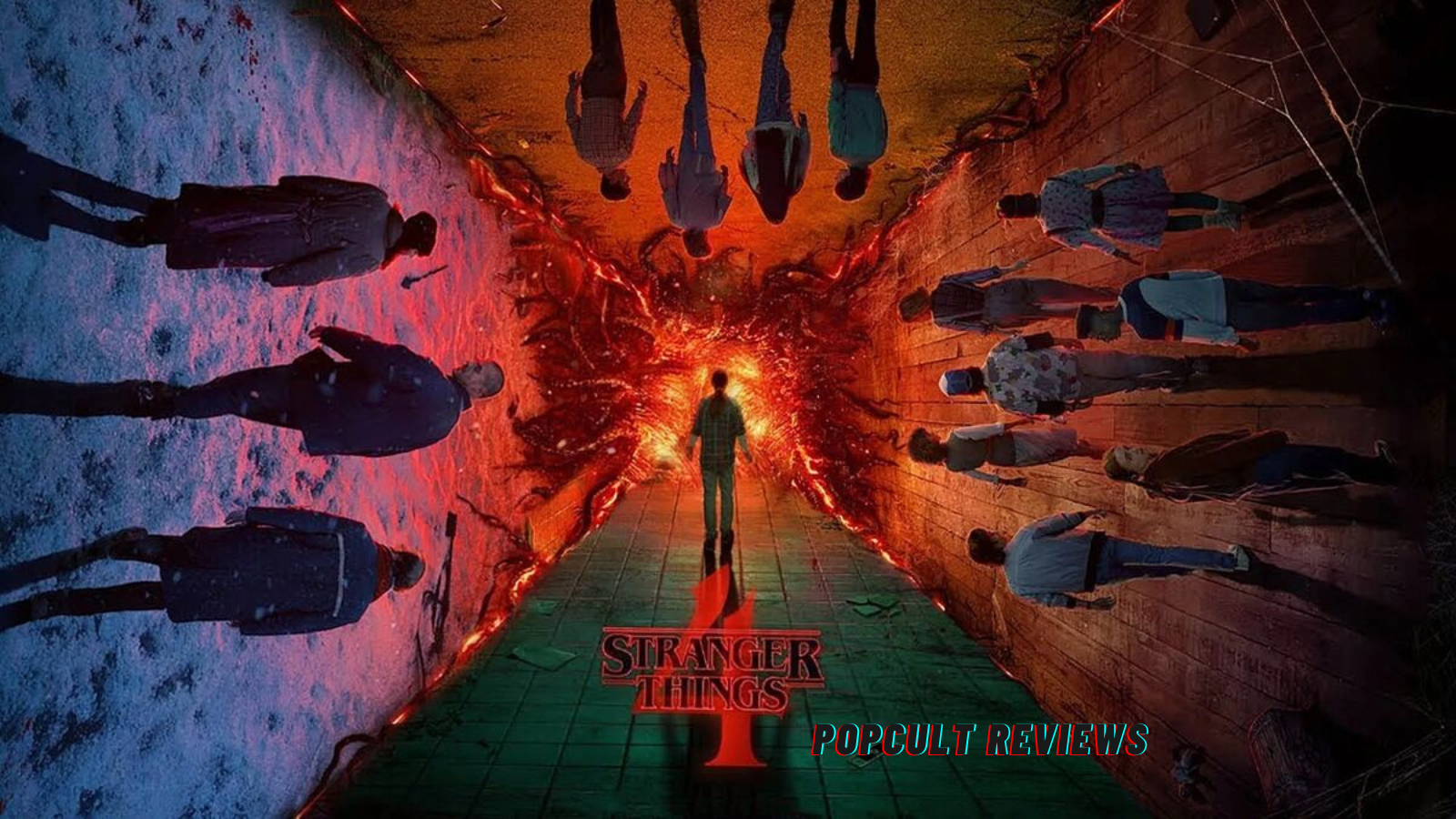
Stranger Things Season 4 finds the familiar cast of characters broken up across the world. It’s March 1986, and Mike (Finn Wolfhard) is going to visit Eleven (Millie Bobby Brown) in California, where she lives with Joy Byers (Winona Ryder) and her sons Jonathan & Will (Charlie Heaton and Noah Schnapp, respectively). Meanwhile, in Hawkins, tensions boil over when popular cheerleader Chrissy is found dead in Eddie Munson’s trailer. Eddie is the Dungeonmaster of the high school’s Hellfire Club, which fuels the community’s paranoia about Satanism in the town. The Hawkins kids realize Chrissy’s murder was done by forces in the Upside Down. However, none of them know that Hopper (David Harbour) is still alive and imprisoned in a Soviet gulag where experiments are happening on creatures that have breached the wall between worlds.
Stranger Things has become one of those cultural signifiers for discussion about a renewed love & adoration of the 1980s. But I would argue it’s not quite that simple. This season Stranger Things became nostalgic for itself, with the extended flashbacks to an even younger Eleven and the tension between her and Papa (Matthew Modine), the scientist behind the program that developed her powers. So the nostalgia is now meta-textual, which works with how the show was received. Two groups find enjoyment in this show. The first are people of an age that makes Stranger Things a source of nostalgia, people in their 50s-40s who can use it as an escapist fantasy to their past. The second group is young people for whom Stranger Things cannot be a nostalgic experience. Instead, it serves as an escape from the nightmare of a futureless world. Both groups are searching for old forms that can be recreated and used to disconnect from the present.
Mark Fisher speaks to this desire to live in perpetually recreating forms. There was a period in American culture where “newness” was a sensation experienced by every generation. Newness came in the form of unfamiliar presentations. Think of the evolution of popular music from the 1940s to the 1990s. Over those fifty years, there were points where someone might have heard music and not recognized it as anything but noise. This type of jarring, new form of music wasn’t something underground but being played on the radio. As a person in the culture, you had to reckon with how that “noise” redefined the collective understanding of music. Fisher argues, and I agree, that we do not encounter that newness anymore. Popular music shies away from potentially confusing new forms and just continues to repurpose the same sounds over and over.
Where generations before us lived in a world that was transforming at an overwhelming rate, presenting them with media that exploded forms and challenged definitions, the 21st century appears to be an era where that is over. Our disorientation is akin to Groundhog Day. We seem to be living the same experiences repeatedly, with slight tweaks to the details. Stranger Things is its own show but is also based on repurposing aesthetics and moods from forty-year-old media. It does not present us with anything new; instead, its familiarity is its reason to exist. Eleven is Firestarter. Mike & friends are The Goonies. Vecna is Freddy Kreuger. What was old is new and renewed and renewed again. The show features contemporary young people, but their characters are designed around fantasized images of old viewers. Nothing is out of date when we no longer move towards a future.
This does not mean the period from the 1980s to the present has been static. On the contrary, we’ve experienced some horribly traumatic moments on cultural and individual bases. The transformation of the Western economies into neoliberalism has upended many institutions that were once able to be counted on, at least by the privileged classes. The rapid-fire evolution of technology since the days of the child heroes in Hawkins has been disorienting, to say the least. I can look at my college days in the early 2000s to the present and see how technology has an entirely different presence in my day-to-day life. One of the side effects of this unrelenting socio-political upheaval is the cancellation of the future.
Francis Fukayama, one of the key authors in articulating the engine of neoliberalism, spoke to the collapse of the Soviet Union and the rise of Western liberal democracy as “not just … the passing of a particular period of post-war history, but the end of history as such: That is, the end-point of mankind’s ideological evolution and the universalization of Western liberal democracy as the final form of human government.” This has led to a cultural “deflation of expectations,” as noted by Fisher. We no longer live expecting the sort of cultural shock moments brought to us by the advent of rock n’ roll or disco or hip hop. Instead, we have new artists wearing the husks of old forms, making no comment or critique on them, simply being them.
This isn’t a new phenomenon. Star Wars was a pastiche, an imitative work based on George Lucas’ childhood love of serialized adventure movies. Upon Star Wars’ initial release, just like Stranger Things, it worked for two audiences: an older audience who understood the reference and was able to lose themselves in the nostalgia and a younger audience for whom this appeared to be a new experience. It’s no coincidence that Star Wars’ ascendency is seen as the end of the introspective film movement of the 1970s. Indiana Jones is not something new either, following in the same nostalgic sentiment. Even Back the Future is a movie nostalgic for the filmmakers’ youthful days in the 1950s. As a child of the 1980s, I’ve really come to understand how much of what I perceived as formative media speaking to my generation is just another level of nostalgia for someone else. Fisher points out that a common refrain when a musicophile is asked about examples of “futuristic music” they will point to Kraftwerk, a group whose core work occurred around 40 years ago. No one has contemporary popular music they can point to as sounding “futuristic.”
The deeper problem with this, Stranger Things included, is that while we have these “nostalgic” pieces of media that are new, they do not ultimately feel right. There is something off about the Duffer Brothers’ the 1980s, whether it be the apparent contemporary use of digital effects or the way hair and clothes evoke a perception of the 1980s rather than the typical suburban blandness that it really felt like. This nostalgia cannot ever genuinely pass for the real thing, so we are left with this nagging psychological after-effect, the sense of disjointed time. The global mental health crisis in Western nations speaks to this growing disconnect. It fuels the sense of apocalypse; it truly feels that we are reaching the end because we have been conditioned to neither seek out nor seek to create new forms. Fisher states, “[,,,] the intensity and precariousness of late-stage capitalist work culture leaves people in a state where they are simultaneously exhausted and overstimulated. The combination of precarious work and digital communications leads to a besieging of attention. In this insomniac, inundated state […] culture becomes de-eroticized.”
There is very little alive about popular art being produced in our time. It seems to speak to some yearning for our past because we are uncertain about our present and beyond. We look to the media as a drug, expected to provide a quick cozy fix, returning us to a time when we perceived life to be simple. This is because we’ve predicated our society on an economic philosophy that can only consume resources, time, people, and life. Those with the means will not risk it on new things because new things bring with them the potential for financial loss and an awakening of humanity. If we were to collectively wake up to our conditions, we might do something about them; we might fight to ensure security for ourselves, our children, and generations to come. Better than we are nestled in the comfy cocoon of nostalgia, the unnerving repurposing of forms. As British music journalist Simon Reynolds put it, “[…] in recent years, everyday life has sped up, but culture has slowed down.”
Edit: Just came across this tweet after publishing this article. Wow


 PopCult Reviews