Newbie Wednesdays – The Last Airbender

The Last Airbender (2010, dir. M. Night Shyamalan)

M. Night and I have a long history together. The first film I saw my freshman year of college was The Sixth Sense. It terrified me. Now, with a decade of film obsession behind me, it takes a lot to creep me out that badly, and I look at The Sixth Sense as a very sad atmospheric film, still good though. His next film, Unbreakable, is still one of my favorite comic book films, in that is captures a certain idea of superheroes that I’ve never seen another film come close to. About there is where my love for the director ended. I’ve seen every film he’s made in the theater, the only other director who I have done that with is Christopher Nolan, sort of the antithesis of Shyamalan. While Nolan produces better and better films, Shyamalan only gives diminishing returns. This latest, his first foray into adapting an already established property, is an utter disaster.

If you haven’t seen the Nickelodeon animated series Avatar: The Last Airbender (I’ve only seen the first five episodes) here’s the premise. In a fantasy world, the planet is ruled by the four elemental nations: Fire Nation, Air Nation, Earth Nation, and Water Nation. A hundred years before the start, the Air Nation was wiped out and the Fire Nation began its quest to spread its empire across the globe. Two Water Nation children, Katara and Sokka, discover a little boy frozen in ice. Once thawed, they learn he is Aang, the last of the airbenders and the one destined be the Avatar, meaning control over all four elements. Searching for the Avatar is Prince Zuko, the exiled son of the Fire Nation king. He sails the world, hoping to prove his might to his father by bringing him the Avatar. Zuko’s forces become aware of Aang and epic battles ensue.

The concept here is ready made for a film franchise, and it has the potential to be as popular and well loved as Harry Potter. It’s a rich, complex universe that doesn’t pander to kids. It treats them like intelligent beings who can handle more than stand alone episodes. The film however, creates a narrative mess. One of the elements of screenwriting that you’ll find is seen as a no-no is voice over exposition. Its passable at the beginning of the film, just to set up the story, but when large chunks of the movie are rushed over and explained with voice over you have a major problem. The sort of things being summed up in a sentence by Katara, the narrator, are romantic relationships, something that you have to earn from your audience, make us care that these two people get together. Not so, and Shyamalan has never been too good with romantic relationships.

This is an incredibly faithful adaptation in terms of story elements, hence the rushed exposition as Shymalan tried to condense 20 episodes of the first season into 90 minutes. Motivations are cast out the window for the sake of hitting plot points. The most glaring omission from the the series though, is the sense of humor. In the cartoon Aang is a mischievous klutz who is both the hero and the comic relief. Katara and Sokka are also not great warriors and don’t master their abilities in the series near as quickly as their movie counterparts did. To delete the humor and sense of growing into these powers sort of turns the film into something that an unfamiliar audience member won’t enjoy and neither will a die hard fan of the cartoon. There really is no audience for this type of film, and its sad because the failure of this picture probably dooms the chances of a different director coming onboard and correcting things. And once again, we have to wonder how many chances does Shyamalan get before they revoke that DGA card?

Director in Focus: Brian De Palma – Carlito’s Way


Carlito’s Way (1993)
Starring Al Pacino, Sean Penn, Penelope Ann Miller, Luis Guzman, John Leguizamo, Viggo Mortensen

In the wake of Bonfire of the Vanities, De Palma returned to Hitchcock-land with Raising Cain, an odd film about twins and multiple personalities that in many ways hearkened back to Sisters. It was another failure for the director, albeit not as quite a large scale one as Bonfire. With a sense of humility about him, De Palma embarked on adapting a novel by a federal judge called After Hours. The film would be renamed Carlito’s Way (to distinguish it from Scorsese’s After Hours) and would return De Palma to some themes and ideas from Scarface. However, instead of the rise and fall of a crimelord who is brash and aggressive, Carlito’s would tell the story of a man once neck deep in crime, now trying to work his way out and go legit.

Carlito Brigante (Pacino) has just finished five years of a thirty year sentence. He has successfully been released when an appeal is issued proving the D.A. illegally made the recordings that sent him up the river. Now, with a re-evaluation of his life, Carlito has his sights set on raising enough cash to join a former inmate’s car rental business in the Bahamas. He buys into a nightclub set up by Kleinfeld (Penn), his attorney and reconnects with his lost love (Miller). Along the way, he draws the ire of Benny Blanco (Leguizamo) an up and coming street tough and must question his loyalty to the ever more frenetic Kleinfeld, whose life in danger of being taken by angry mobsters. The entire time Carlito is trying to make the right choices, stay on the path of good, so that he and his girl can escape.

The first thing that struck me about this film is how phenomenally better and more modern it was than Bonfire. One thing that kept getting to me as I was watch Bonfire was how it felt very dated. Typically if a film is set in the 1980s you’re supposed to feel that through the set design, tone, etc. Bonfire pulled it off in a way that made the picture feel too out of touch with any sort of universal truth. Carlito, on the other hand,despite being set in the 1970s, feels like an incredibly modern film. I think a lot of this is due in part to it being subject matter that De Palma is much more capable of handling. The director himself admitted he was planning on turning it down because on first glance he saw it as a Scarface retread. When he finally sat down to read it, he saw the film was going to be the antithesis of Scarface.

The acting here is a mixed bag, though. Sean Penn as Kleinfeld is spot on. He never exaggerates his character but is able to get across the transition from cool, calm and collected to on the verge of a nervous breakdown without breaking a sweat. It’s interesting to note, that at this point in his career, Penn had all but retired from acting to pursue directing (He was working on The Crossing Guard with Jack Nicholson at the time). His return to the screen was a big deal at the time and his performance definitely caused some people to encourage him to keep acting. It’s a strange thing for people of my generation to think about, as I was not aware of Carlito at all on its original release and have grown up with a viewpoint that you can count on Penn to be in all sorts of Oscar bait type pictures. On the other hand, Pacino nails the character of Carlito but has a persistently annoying accent problem. In his attempt to conjure up a Puerto Rican flair to his voice he ends up sounding at times like a Southerner, and then at others a bizarre interpretation of a stereotypical New Yorker. Accent aside, this a is a complete 180 from Scarface. Carlito is incredibly likable and charming, and it is impossible for you not to root for him to escape.

All the typical De Palma tricks are on display, and while they felt forced in Bonfire, here they feel exciting and fresh. There’s some great looking deep focus shots, just a little POV, and some wonderful Steadicam work, particularly in the final scene in Grand Central. The editing in the film is also some of the best of any De Palma movie. I found myself literally clutching my fists in anxiousness during the final tense moments of the film, which could not have been possible if it was wasn’t for some stellar camerawork and editing. While plots and actors may fail the director at times, his camera is his most loyal friend and you can always count on him to know exactly how to shoot a scene that gets the most out of it.

Next: De Palma does Mission: Impossible and closes out the 90s with Snake Eyes

Newbie Wednesdays – MacGruber


MacGruber (2010, dir. Jorma Taccone)
Starring Will Forte, Kristen Wiig, Ryan Phillippe, Val Kilmer, Powers Boothe, Maya Rudolph

It began with The Blues Brothers and it was a long time before another one was made. Then with Wayne’s World, followed by The Coneheads, Night at the Roxbury, Superstar, and The Ladies’ Man. The idea of adapting a skit from Saturday Night Live series is not new, but never has the source material been so brief. MacGruber is originally a thirty second bumper to commercials, so the idea of making a feature film around the character is a bit of an oddity. It’s also a very simply parody of the MacGyver television series, which itself is almost twenty years past. So how does this longshot stack up as a full length movie?

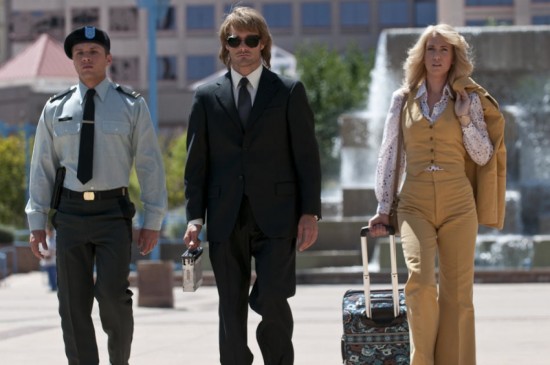
The premise borrows its plot from films like Rambo, with MacGruber (Forte) as a former Pentagon agent who has been living in a monastery for the last decade after the tragic death of his bride. When the villainous Dieter Von Cunth (Kilmer) steals a Russian nuclear missile, MacGruber is called back into action alongside straight arrow Lt. Dixon Piper (Phillippe) and his former sidekick Vicki St. Elmo (Wiig). The trio engage in a series of episodic attempts to either get in contact with Von Cunth and foil his plans. These typically involve Piper suggesting a reasonable military tactic, while MacGruber does something outlandish (i.e. hopping naked with a piece of celery sticking out of his butt). The plot hits all the expected points, and delivers a very hard R-rated comedy.

The sources being parodied here are done by people who know those sources well. Director Taccone, part of The Lonely Island and a writer for SNL, most definitely grew up watching the awful Golan-Globus military action films of the 1980s (Death Wish, Cobra, American Ninja). From that perspective, its an amusing film but nothing terribly special. I believe I chuckled once or twice, but for the most part I felt myself slogging through the picture, simply trying to make it to the end. Of all the current cast of SNL, Will Forte is far and away my favorite, but when he is constrained by SNL material he’s never as funny as he could be. Such is the case here, the jokes feel very lazy and the payoffs are never clever or surprising. In the end, its a case of a flimsy premise being stretched beyond its abilities to hold together, resulting in an incredibly disappointing and forgettable film.

Director in Focus: Brian De Palma – The Bonfire of the Vanities


The Bonfire of the Vanities (1990)
Starring Tom Hanks, Melanie Griffith, Bruce Willis, Kim Catrall, Morgan Freeman, Saul Rubinek, F. Murray Abraham

And so, all great filmmakers must descend into the bowels of hell from time to time. It’s hard for us to understand just how terrible this film is now. Oh yes, Hanks is certainly acting in a way that comes across as acting. And Willis is forced to deliver voice over narration that both shoves the story forward and sounds like he has difficulty saying it. But the utter disaster that is The Bonfire of the Vanities was both as a completed picture and the behind the scenes production fiasco. What was thrown up on the screen was a watered down version of a biting satire, that somehow manages to still offend every major racial group and still feel like the studio was pulling back and watering it down.

The novel by Tom Wolfe, was an attempt to skewer the 1980s greed culture and the rise of a more and more tabloid-influenced media. You have Sherman McCoy (Hanks), a Wall Street financial wunderkind who is sneaking behind his wife’s back (Catrall) to have an affair with socialite Maria (Griffith). During one tryst the lovers take a wrong turn and end up in the Bronx where, with Maria at the wheel, they end up running over a black youth who was attempting to rob them. Sherman thinks they should report it to the police, but Maria convinces him otherwise. Cue an Al Sharpton-inspired preacher, opportunistic D.A., and drunken reporter (Willis) and the hunt is on to catch the WASP in the Mercedes who ran over the poor young man. All of these cynical characters feel set to get their comeuppance in deliciously vicious way…however, it never happens.

The names originally batted around in pre-production color a very different film. William Hurt was originally looked at to play McCoy. Jack Nicholson and John Cleese were named as playing the role that went to Willis. Walter Matthau was brought up when casting the judge, but he wanted more money than they were willing to spend. And nineteen year old newcomer Uma Thurman has been up for the role of Maria. These people in these roles would have presented a much better film, not perfect, and they would have fit the types they were meant to play. Hurt would have played into the Ivy League, born into money mold much better than Hanks, who has always come across a more everyman than anything else. And anyone would have been better than Willis as the reporter, who seems to never know what he is doing and simply plays “smarmy”.

De Palma throws us some cinematography bones: steadicam shot, quick POV, deep focus. It all comes across as him jumping up and down, shouting “Hey, remember I’m directing this!” Otherwise this is any other lofty studio picture trying to tackle the race issues of the early 1990s and come across as “edgy”. I was reminded of Lawrence Kasdan’s Grand Canyon (also released in 1990) which is on the other end of the spectrum from this picture. In Grand Canyon, Kasdan seems to tread as if he is walking on ice while broaching the issue of black-white relations and so the film never feels like it comes to any point. Here, we have a film that seems to be promising its going to go where no one else will while constantly tugging at the reins. The final courtroom scene snuffs out any chance that the film will end on a provocative note, as the judge descends from his bench and delivers a sermon to the characters and to us. The entire didactic droning feels like it should have ended with an American flag unfurling behind him and tiny sparklers appearing from out of frame. De Palma was at a major low point here…but he was about to prove he could deliver a monumental picture.

Next up: Carlito’s Way

Jolly Good Thursdays – I Capture the Castle


I Capture the Castle (2003, dir. Tim Fywell)
Starring Romola Garai, Rose Byrne, Henry Thomas, Marc Blucas, Bill Nighy

This is not the sort of story you would expect from Dodie Smith, the same author behind 101 Dalmatians. Instead of a tale aimed towards the younger set, this is a coming of age story set in the mid-1930s. Themes of wealth and love and how the two are intertwined make up the spine of the picture and, what might have been a trite film, is aided by great performances to become something quite a bit better than that. The picture manages to be both an escapist romance and a grounding story of how much love can hurt.

The film opens with the Mortmains’ arrival at an old castle where their author patriarch has relocated them. The events are narrated by middle child Cassandra (Garai), who is overshadowed by their father’s second wife Topaz and Cassandra’s older sister, Rose (Byrne). The castle, which was a magical place when they first came to live there, has become a dank and moldy tomb for the family. Things begin to change when the owners of the castle, American brothers Simon and Neil Cotton arrive to decide what they are going to do with the estate. Rose sees this as her opportunity to marry into money and tries to woo Simon, the elder brother. However, Cassandra is also smitten with Simon and Neil has feelings for Rose.

The Mortmain family is incredibly eccentric and director Fywell is tasked with finding humor in their quirks as well as showing they have consequences. This is particularly highlighted through Mr. Mortmain, a successful author when his family was young, but who has failed to be able to write anything of value since. At first his hang ups and odd behavior come across light, but as the film progresses we see the detrimental effect that have on his entire family. Cassandra is also forced to face the fact that her father’s mental state may be beyond help. That’s quite a heavy weight for our plucky 16 year old protagonist to handle. In a similar fashion, Rose’s vapidity and desperation to find a man are played for laughs at the start, but when she enters into a relationship with a man she doesn’t actually love we can see how a harmless quirk becomes destructive to many people.

The film is not a major cinematic achievement by any means, but it is a very solid and well paced story about eccentric people having to deal with how their behavior effects others. The story is a very mature one, that lets the characters lose themselves in the giddiness of a first love, but also grounds them by not having everything tied up in a neat package. There is hurt and not much closure for our protagonists. In many ways this is a more adult Nicolas Sparks tale, that refrains from maudlin sentiment and allows its characters to have real flaws.

Newbie Wednesday – Iron Man 2


Iron Man 2 (2010, dir. Jon Favreau)
Starring Robert Downey Jr., Gwenyth Paltrow, Mickey Rourke, Don Cheadle, Sam Rockwell, Scarlett Johansson, Samuel L. Jackson, John Slattery, Jon Favreau, Paul Bettany, Garry Shandling

In 2008, two major comic book based films were released: The Dark Knight and Iron Man. By the end of the summer I had seen The Dark Knight three times, Iron Man only once. Now, I admit a predisposition towards the DC Comics characters, but I have enjoyed many of the Marvel movies (X-Men 1 & 2, Spider-Man 1 & 2). The first Iron Man was an enjoyable film, I just never found it as amazing as it seems much of the movie-going populace did. Robert Downey Jr. is a great, witty actor but the character is where my problems lie, because Iron Man/Tony Stark just isn’t that interesting.

It’s been two years since Tony Stark went public with his superhero identity of Iron Man. The news made its way to Russia, where Ivan Vanko, son of a Soviet physicist betrayed by Stark’s father sees his pop’s designs being used in the Iron Man armor. Vanko spends awhile building his own cobbled together suit to attack Stark but is arrested. The second villain in the picture is Justin Hammer, a military industrial complex billionaire who is frustrated with being unable to copy Stark’s technology. These two forces will inevitably come together to create a force that will challenge Stark’s resources. And these are two of the myriad of half-hatched plots and sub-plots that turn the film into a complicated mess.

Iron Man 2 is definitely suffering from sequel-itis. The pressure to up the ante in comic book franchises is hard to fight and so many new elements are introduced to try to keep the series feeling fresh. The part that is missing though are motivations. Stark is given a very weak motivation do something in the film and it definitely comes across as a plot element thrown in about a dozen drafts into the screenplay. Hammer’s motivation is only a few shades different from Obadiah Stane’s in the first film and Vanko’s reasons for revenge are just as hackneyed. Every thing felt like pieces in a jigsaw puzzle you had pieced together so many times that it just wasn’t fun anymore.

What the picture did have was a lot of “sound and fury signifying nothing”. There were “hot babes” and “sweet rides” but for an hour and a half that’s pretty boring. There were a lot of attempts to hint at the Thor movie coming next summer (all the mentions of New Mexico from the SHIELD people) and of course more hinting at the inevitable Avengers film. But all the actual material dealing with Tony Stark fell flat. Vanko didn’t ever come across as a formidable enemy and Hammer was the sort of character you knew was doomed to fail from the moment he showed up on screen. Scarlett Johansson was stage prop, but her stunt double did an amazing job. Looking at it all together, its not much better than some of the mediocre Marvel movies (Daredevil, Fantastic Four), sadly not even the power of RDJ could save it.

Newbie Wednesday – Kick Ass


Kick Ass (2010, dir. Matthew Vaughn)
Starring Aaron Johnson, Nicolas Cage, Chloe Moretz, Christopher Mintz-Plasse, Mark Strong

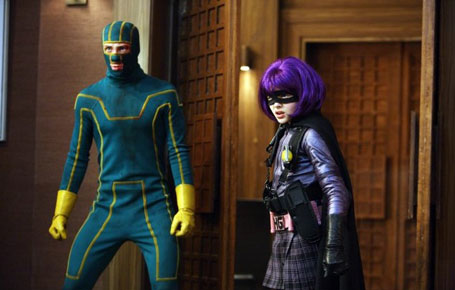
There’s a sort of geek wish deep down in those that read comics that somehow, someway they could don a cape and cowl and fight the criminal element of this world. The superhero idea goes all to the mythological heroes and into figures like King Arthur and Robin Hood to the Three Musketeers and the pulp mystery men and finally into comics. So our protagonist proposes a very legitimate question early on “How come no one has ever tried to be superhero?” It’s obvious that there are plenty of crazy people in this world and it comes as no surprise that there actually *are* people who have tried this. You can check them out at the World Superhero Registry. So how does the hero of our film try to tackle the nuances of masked crime fighting?

Dave is a high school student who is invisible to the opposite sex, but very visible to the bullies and street thugs of his city. After being robbed one to many times, Dave purchases a few essential components and becomes the mystery man known as “Kick Ass”. Kick Ass is immediately sent to the emergency room after his first battle and has steel rods and plates put in him that ironically grant him a certain level of invulnerability. And this is where the film completely goes off the tracks of its premise “What if superheroes were real?” and decides to be no more different than any other comic book flick. The duo of Big Daddy and Hit Girl are introduced, a father-daughter team of armed to the teeth avengers as well as The Red Mist, the son of a local mafia don who suckers his pop into stocking him up. The film goes through a lot of tonal changes and shifts, finally settling into a fairly predictable final battle sequence.

The movie is only shades different than Superhero Movie, a descendant of the Scary Movie parody genre. Whereas that film knew it was a comedy and behaved thusly, Kick Ass seems to want to be aloof and post-modernly ironic, yet still be a “bad ass” super hero movie. I’m not willing to go as far as Roger Ebert in his review, calling the film “morally reprehensible”. After watching the 2006 remake of Hills Have Eyes I think it could serve as a contender for that. I didn’t have a problem with the concept of this young girl, trained to be a super soldier by her father, slaughter masses of mob men on screen.

My problem with the film came from a couple elements that diverged from the comics which actually lent it real world credence. If you know me well, you know that I am not one of those comic book geeks who natters on about minutiae that differs slightly from the source material. I’m a geek who can be reasonable about conceits that have to be made in the process of adaptation. However, the first divergence from the original mini-series that irked me was when Dave reveals he is not truly gay to his love interest, she has mistaken him as such for the majority of the film. In the film, she is unnaturally forgiving and its implied the two have sex, after which they are a couple. In the comic book, she is pissed and eventually has her new boyfriend beat Dave up. That would be the actual real world way the story would play out. So while the film wants to be a wry commentary on the implausibility of superheroes in the real world, through this change it actually invalidated its premise to me.

The second divergence colors the audience’s entire perceptions of a character in a disturbing manner. In the film, Big Daddy was a police officer whose career was ruined by the mob, sending him to prison, while his wife went broke and died on the table giving birth to Hit Girl. Once out of prison, Big Daddy began training Hit Girl. In the comics, Big Daddy raised Hit Girl with this story. In reality, he was a no body, an accountant who had a mid-life crisis and kidnapped his daughter to create this more exciting existence. Once again, the film compromises its original intent for the sake of “superhero-ing” it up. I found the film to be enjoyable, but nothing I would watch again. Because it is too scared to make its characters truly real and give then the downbeat ending that naturally would happen it ultimately fails and ends up being yet another generic comic book movie.

Newbie Wednesday – Clash of the Titans (2010)


Clash of the Titans (2010, dir. Louis Leterrier)
Starring Sam Worthington, Liam Neeson, Ralph Fiennes, Gemma Artherton, Jason Flemyng

When I was 8 years old I went through the entire Webster’s Dictionary so I could catalog the Greek gods and monsters listed therein. Afterwards, I got the idea the library might have books on these things, and from there I devoured the stories of Greek mythology. Once, while visiting Nashville’s local to scale replica of the Parthenon around the age of 10, I began telling my mom and visiting aunt whom all the figures in the statues and carvings were. An man touring the structure began following and listening and remarked to my mom “Your son knows a lot!” I tell you these things to show that I am onboard when I hear about films based around Greek myths. How does director Louis Leterrier’s (The Transporter, The Incredible Hulk) remake of the 1981 fantasy film stack up?

Perseus, son of Zeus and a mortal woman has his adoptive family taken from him when they are bystanders to an vengeful act of the gods. The hero ends up in Argos, where its citizens are rebelling against the Olympian Pantheon and Zeus has decided either they all die or they sacrifice the princess to his beast, the Kraken. Perseus and a rag tag group of Argosian soldiers head out into the wilderness to figure out if there is a way to defeat the unstoppable beast. Along the way they battle giant scorpions, blind witches, a beast who bleeds acid, and finally the classic Medusa. Oh yes, there’s flying horses, too.

Why does Hollywood insist on continuing to cast Sam Worthington (Terminator: Salvation, Avatar) in films? The man is an uncharismatic bore. He has two acting settings: “grunt” and “brooding”. It can be said that the action films of the 1980s and 1990s were inane, but at least the leads were charismatic. Think about Schwarzenegger, Willis, Stallone, etc. They all had charming personalities that made us root for them. With Worthington you root for him out of default, he’s the protagonist on the screen so you hope he wins because that’s what mainstream cinema has taught you. I also was flabbergasted at the actors cast as gods. Why cast Danny Huston as Poseidon if you give him one line? Just cast an generic actor for the role! And Nicholas Hoult (About a Boy, Skins) as Eusebios, what a waste of great talent. And he’s a million times more charismatic than Worthington!

The plot is a mix of the original film, mixed with attempts to “bad ass” it up. It became apparent to me that the screenwriters and art directors seemed to want to make a God of War film rather than a remake of the 1981 Clash of the Titans. Every encounter feels like a stage in a video game, complete with boss battles. I can forgive discrepancies between the original myths and the film (Example: Pegasus is the name of one specific winged horse, in pop culture we refers to the species as Pegasi now), I’m not one of those fanboys who harumphs when they change a detail. I understand the need to create a fluid, organic script. However, there are some pretty glaringly dumb subplots in the film that were attempts to blend elements of the original picture. I also rolled my eyes at their attempt to be clever by giving Bubo the Mechanical Owl from the original film a cameo. Bubo has more charisma than Worthington, people!

At the end of the day, this is yet another dull CG-dependent action flick. Leterrier’s previous films have left me bored and with this one I was literally falling asleep halfway through. His upcoming Captain America movie has my expectations about as low as they could get. But, if you are hoping to cleanse your palette for Greek myth based flicks, Tarsem Singh (The Cell, The Fall) has one coming out November 11th, 2011 titled Immortals. Hoping he shows Leterrier how it is done.

Newbie Wednesday – How To Train Your Dragon


How To Train Your Dragon (2010, dir. Dean DeBlois, Chris Sanders)
Starring Jay Baruchel, America Ferrara, Gerard Butler, Craig Ferguson, Jonah Hill, Christopher Mintz-Plasse, T.J. Miller, Kristen Wiig

In 1981 we got Dragonslayer, which was a step up in the medieval film genre in terms of effects. In 1996 Dragonheart was released, and while its hard to dislike a film with both David Thewlis and Sean Connery, the picture never stuck with me as a re-watchable one. In 2002, the movie was Reign of Fire…and well, lets try to forget that one. The latest dragon-centric film is Pixar Animation’s How To Train Your Dragon, from the writer/director team behind Lilo and Stitch and Mulan. And how does this flick stack up against its fire-breathing brethren?

Hiccup (Baruchel) is the son of a gruff Viking king (Butler) whose village is regularly attacked by a variety of diverse dragons. During one of these attacks, Hiccup witnesses an elusive go down in the forest outside of his village and ventures into the wilderness to find it. The two are confrontational at first, but grow on each other. Simultaneously, Hiccup is being pressured by his father into being a dragonslayer. What is he to do as he begins to understand this creatures better than anyone in his village?

What this movie does best is put you on the back of a dragon. The flying scenes are far and away the best aspect of the picture, many times done from the POV of Hiccup. There’s also an interesting variety of dragons presented in the film, each with quirk that makes them unique and different. The look of the flick is thanks to cinematographer Roger Deakins (“No Country for Old Men”, and pretty much every other Cohen Brothers film ever). I also liked that the film focused on thinking your way through a problem over just rushing into battle. Hiccup’s tendencies to go to books and conduct scientific study pay off and save his father and the entire village.

I liked that the film shied away from previous Dreamworks ventures, which seem to rely so heavily on modern pop culture references. It felt more like a Pixar film in establishing its own universe. However, every character except for Hiccup feels underdeveloped. It would have been nice to get some backstory on the village and how their conflict with the dragons developed. Despite these hiccups (pun intended) in the story, its still one of the better and more intelligent films marketed towards kids.

Director in Focus: Brian DePalma – Carrie

Some pre-conceived notions about Brian DePalma: Before I get into the review of this first picture in the DePalma series, I will address some ideas I have about this director. Of Mr. DePalma’s films I have seen are Phantom of the Paradise, Raising Cain, Mission: Impossible, and Mission to Mars. I wouldn’t say DePalma is a director I actively dislike, I just have never been overly impressed with him. Without further ado, my first review:


Carrie (1976)
Starring Sissy Spacek, Amy Irving, Piper Laurie, Betty Buckley, Nancy Allen, John Travolta, William Katt, Edie McClure, PJ Soles

I was homeschooled through my entire elementary, middle, and high school grades. So, I was never subject to the sort of direct bullying I’ve seen in countless films and television shows. I definitely was raised in a sporadically religious home and was a quiet kid, so I felt some connections to the character of Carrie White. My ideas about this film from its osmosis into popular culture was that Carrie is a “weirdo” character. I found myself pleasantly surprised by the depth actually brought to her in the film.

In the town of Bates (named after Hitchcock’s nefarious Norman), is the home to quiet and shy Carrie White (Spacek). In the opening of the picture, Carrie experiences her first period while in the girls’ showers at school. Her mother (Laurie), has kept Carrie completely ignorant of her own sexuality and Carrie immediately thinks she is dying. The other girls mock her, tossing tampons at the poor girl as she cowers. Miss Collins (Buckley), the PE teacher chastises the girl and comforts Carrie. As punishment, the girls are forced into an afterschool PE detention, which causes popular girl Chris (Allen) to harbor resentment towards Carrie. Conversely, Sue (Irving) feels bad about the incident and convinces her boyfriend to ask Carrie to the prom. If you are aware of the way this film has been parodied since, then you know how things turn out.

The picture has not aged too well. The majority of the music, particularly a lot of light-hearted montage scenes feel incredibly cringe-inducing. Piper Laurie, who plays Carrie’s mother, is an actress who hasn’t met a piece of scenery she hasn’t enjoyed chewing and that’s fun for the most part. I was reminded of author Stephen King’s cliched zealous fanatic archetype that seems to crop its head in almost all his work. However, I can definitely see how a lot of the high school movie tropes were borne out of this film. Nancy Allen as the uber-bitch Chris does an excellent job and Amy Irving as Sue comes across very genuine.

Where the film won me over was the famous prom scene. Wow! The tension that DePalma is able to create in the moments before poor Carrie is pushed over the edge are breathtaking. He is most definitely a skilled editor, knowing how long to stay on a shot before cutting to a reaction or image related to the previous shot. It’s like a cinematic Rube Goldberg device where every little piece click and leads to the next perfectly. The music here is an homage to the work of Hitchcock’s composer, Bernard Hermann. Hermann died before he could compose the score for Carrie so it was brilliant to make it a reference to his previous works, especially Psycho; four notes of that film’s score are heard repeatedly through the film.

I was most impressed with the portrayal of Carrie White. She was not the “weirdo” or “freak” you might see portrayed in derivative films made since. Carrie shows resentment and anger towards her mother about not being told about her sexuality. She isn’t completely naive and shows reasoned skepticism when invited to the prom. And Spacek’s choices in acting, particularly in her scenes with actor William Katt at the prom are exceptional. I found this to be a great start to my exploration of this director’s films. It wasn’t perfect, but it showed a wonderful sense of pace and restraint that a lot of contemporary horror films could learn from.