Games for Two – Dice Heist & Welcome to the Dungeon

Dice Heist

Designed by Trevor Benjamin, Brett J. Gilbert
Published by AEG
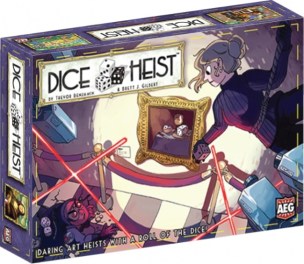
dice heistIn Dice Heist, each player is a master thief about to take on the four major art museums of the world: The Hermitage, The Met, The British Museum, and the Louvre. There are famous paintings, jewels, and artifacts to snatch up but you’ve got to be skilled and bring in sidekicks to help you out.

The four museums are each given a dice rating from easy (The Hermitage with 2 pips) to the hardest (The Louvre with 5 pips). Each player starts with one black die and each turn has the option to roll for a heist or recruit a sidekick (a white die). There is a limited pool of sidekicks and once you claim one it is yours for the rest of the game. Each turn, a player draws a card and places that item under the matching museum. If you roll on a museum and succeed then you get every single treasure that has accumulated there. When you roll your dice you look for at least one that beats the target value on the museum.

At the end of the game you add up the values of your total paintings, first place gets 8 points and the second gets 5. For each artifact you get 2 points and each set of gems scores in an ascending order (first red gem is 1 point, second red gem is 2 points, third red gem is 3 points, etc).

The game was very fast paced and there was some strategy in which museums you wanted to target based on their target value and what treasures they held at the moment. This was a game I think would benefit from a third player just to increase the tension. An okay game, very simple and easy to learn, very light on strategy.


Welcome to the Dungeon

Designed by Masato Uesugi and Paul Mafayon
Published by iello
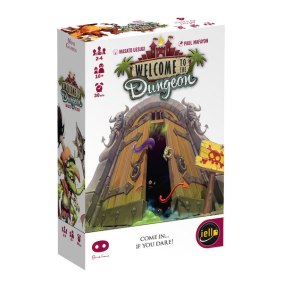
WelcomeDungeon_3DboxWelcome to the Dungeon is a game about a staple in tabletop gaming: heroes going into a dungeon and fighting monsters. The twist in this small card based game is that players all play the same hero. The first round of play is bidding which consists of pulling a monster card from the deck and either placing in the dungeon deck face down or keeping the card which allows you to take a piece of equipment from the hero. This mechanic does a couple things: the players are trying to make the dungeon as uninviting to the other players yet still beatable by themselves. There is the danger that you will think you are going to Pass and leave the dungeon in another’s lap only to have them drop out and leave you with a hellish dungeon.

Each successful run through the dungeon earns the player a Success card. The number of Success cards up for the getting varies depending on how many players you have. If you are killed in the dungeon you must flip an Aid card you individually have over to its red side. If you die again with this card on its red side you are out of the game entirely. To defeat the monsters you either expend a piece of relevant equipment (the Dragon Spear defeats the dragon for example) or be able to absorb the hit point damage based on the card value and your total armor added to your base HP.

While the game works with two players, the Bidding phase screamed out that it would work so much better with at least three. Bidding between two is a little lacking in the tension while adding a third would create some more variables. There are four different heroes to choose from at the start and we did only play once so with additional playthroughs some things might shine forward.

Games for Two – Lost in R’lyeh & Sushi Go

After attending Origins 2016, I returned home with a decent assortment of new card and board games. This year I focused on smaller games that worked with two players, as my wife is my most common playmate. Expect posts through the next couple months as I play these games.


Lost in R’lyeh (Atlas Games, designed by Kedrick Winks, Illustrated by Kelley Hensing)

lost in rlyeh

Lost in R’lyeh is one of my favorite games I played at Origins for couple reasons. First, we got to play it with our wonderful friend Renee who was putting in many hours at the Atlas Games’ space. She did a great job laying out the game and it’s mechanics. Second, it was a game that my wife and I picked up quickly and, when we returned to waiting at the Games on Demand area, were able to get out and play a couple games of.

Lost in R’lyeh is a Lovecraftian trick taking card game. The premise is that the players are all trapped in the realm of Cthuhlu and must escape. This involves laying out cards, trying to create matching sets of numbers. Numbered cards have effects and the more of them in a row the more powerful the effects become. There are also Elder Sign cards that are like Wild cards in Uno. They can be played at any time and can be very disruptive to other players. Certain Elder Sign cards duplicate numbered cards, force the entire stack of cards onto another player, allow you to take the stack and all the tricks within it, and more. The game ends when only one person is left with cards and they are trapped by the Elder Gods.

As I said before, very easy to learn and Renee even mentioned Uno as she was explaining it. So think of it as that classic card game with effects added if you stack up similarly numbered cards in a row. I can see it being one of those warm up games before a roleplay session or a great way to kill some time. We were lucky enough to buy a copy at Origins before the game dropped for all consumers. Good news, Lost in R’lyeh is available as of today!

Amazon link – https://www.amazon.com/Lost-Rlyeh-Kedric-Winks/dp/1589781635/

Cool Stuff Inc link – http://www.coolstuffinc.com/p/227156


Sushi Go! (Gamewright, designed by Phil Walker-Harding, illustrated by Nan Rangsima, Tobias Schweiger, Phil Walker-Harding)

sushi go

When I went over to the Cool Stuff Inc booth on Sunday morning, looking for last minute slashes in pricing I didn’t find anything that caught my eye. Then when I looked to the register and smaller card games I noticed the little tin box for Sushi Go! I’d seen it before online, my wife likes sushi, it was only $9, so I bought it. Our friend Mark expressed a lot of enthusiasm over the game when he saw it in my bag so I wondered what this game was all about.

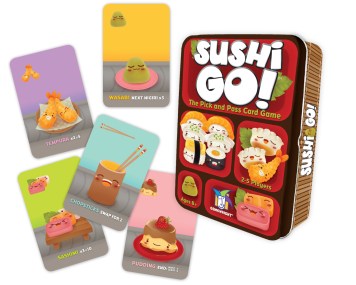
Sushi Go! is a “draft and pass” card game. Each player has a number of cards in their hand and chooses one and plays it face down. Once every player has done this they reveal their card and then pass their hand to the player on their right. You repeat drawing a single card face down and then pass. Your goal is to create sets. Different sets are worth different point values. Maki have either 1, 2, or 3 on them and at the end of the round the player with the most Maki gets 6 points, the next player down gets 3. Nigiri has a set value, but that can be multiplied by three if you play Wasabi first. Every two Shrimp Tempura offer up 5 points, every three Sashimi offer up 10. Chopsticks allow card swapping and Pudding stays on the table through every round and is used to add 6 points to the holder and take 6 points from the people without Pudding.

There is quite a bit of interesting strategy here. You can go for the quick points, just dropping Nigiri on the table, or set up larger point drops for later, laying out Wasabi or putting down Sashimi. If you only have two players, there is a Dummy player variant listed in the instructions. Playing this with two players has a much more subdued and direct strategy. I suspect with a larger number of players things get crazier and even more fun. Simple, easy for everyone to pick up on and play.

Amazon link – https://www.amazon.com/Sushi-Go-Pick-Pass-Card/dp/B00J57VU44/

Cool Stuff Inc – http://www.coolstuffinc.com/p/188409

Games for 2: Workplace Bully

workplacebully

Workplace Bully is a two player tabletop role playing game written by Steve Hickey. The game uses Vincent Baker’s Apocalypse World as a basis, but also more importantly Avery McDaldno’s Dream Askew, which gets rid of the dice involved.

In Workplace Bully, one player is the Manager (MGR) and the other player is the Employee (EMP). An audience can be included and will actually have ways to contribute to the game.Players contribute in a rotating series of Goes, verbal exchanges referring to a list of actions exclusive from each other. When the story comes to the point that neither knows what happens next the scene ends and Evaluation begins.

Evaluation is made up of a series of subjective decisions made about the scene that just occurred. The MGR could be rewarded with Stress points and the EMP might get some Insight points based on their growing understanding of what is happening at work. If the MGR gets stress points during Evaluation they decide if the EMP has become more Broken or Transformed (into a bully). The EMP does have three uses of a Panic Button to avoid this, but in turn the MGR can spend Stress to still force the EMP to have some sort of public outburst at work.

Stress and Insight are spent during additional goals to use special moves and permanently unlock moves. For every point of Stress the MGR uses, the EMP gains a point of Insight. This means the more active the bullying the more the EMP learns about what their MGR is doing and their methods. The game ends when either the MGR has blown through all their methods of deflecting and defending themselves from confrontation or the EMP is either Broken or Transformed by the MGR.

Workplace Bully is a great, and sometimes overwhelming, example of asymmetrical play: a game where players have opposing goals and ways to play the game. My wife, Ariana, and I played the game twice, each of us taking a turn in each role.

In our first game I was Manager, Mrs. Farnsworth and Ariana was Employee, Mr. Felt. Our place of business was Heartstrings, an online dating Service, I took the stance of being over concerned with details to mask my personal incompetence as a leader. My main strategy as the bully was to turn everyone against Mr. Felt. Mr. Felt finally gained enough Insight to purchase a cell (more than three victims of my bullying in the office). This led to a complaint filed with the Human Resources department and ended with me begging Felt to back off. Felt didn’t have much sympathy for me and rejected those. Eventually I resigned and left the office quietly.

Ariana said we had to take a break because she was getting stressed out at the passive aggressive attacks from my Manager, so I guess I was pretty effective. Because the game is a playtest we had some confusion about how to activate tags, the main way a MGR defends themselves and an EMP confronts. Before our second game, we sat down and made sure every tag had an explicit way to earn them, which helped the second game run more smoothly.

In our second game, I was the Employee, Stanley and Ariana was the Manager, Jenny. Our place of business was Reassurance Inc., an insurance adjuster.  As the employee I was starting a new career after working as a teacher for a number of years. I had a disabled son and was a single parent. I was able to find allies in fellow employees Rhonda and Stan, as well as Jenny’s own secretary, Megan. Ariana’s strategy was that every time I claimed an ally she spent Stress to make that ally neutral and in one case turned that ally into her pawn. For most of the game Stanley was moving speedily down the Broken path. I accrued a good amount of Insight and began to confront the MGR on a daily basis, faster than she could spend Stress to defend herself. In the end I barely beat the MGR who was fired and left in a very destructive way.

Workplace Bully is a very interesting game about a phenomena we encounter in our lives from time to time. While most games we play are escapist, it is interesting to play a scenario of such real weight. It was also a mental hurdle to get into the Stress/Insight points method after being so used to dice rolling. As mentioned above, Workplace Bully is an alpha playtest so it is rough around the edges and requires players to take an active role in shaping the game if you encounter errors or absences. With people of the right mindset this can be an intriguing experiment into stepping in the shoes of other people.

Download Workplace Bully for free.

Check out more of Steve Hickey’s game work here.