
The Hike by Drew Magary
2016, Viking
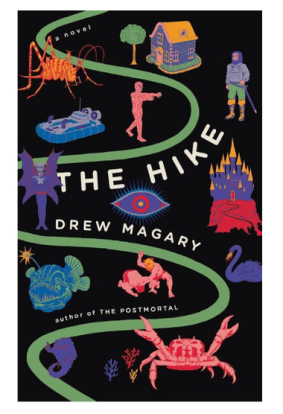
The Hike wastes no time in jumping right into the journey down the path. Ben is a businessman on a trip to the hills of Pennsylvania. Before dinner with a client, he decides to take a hike behind the rural hotel. He quickly becomes lost and finds himself on a path, a path that he must stay on or die. Ben meets a series of strange and fantastic creatures and finds he is on a journey of redefining the perceptions of himself. The resolution of the story brings a huge revelation that reframes the context of the entire novel.
Author Drew Magary is an odd fellow. He wrote for the sports blog Deadspin and currently GQ, he authored a nonfiction book on what a terrible parent he is and won a Chopped amateur competition. This unique point of view makes the prose of The Hike stand out. It’s sparse in a very Hemingway-esque style at moments. This is an interesting counterpoint to the ridiculous encounters like a cursing crab, a giant control panel manipulating cricket, and a good-humored man-eating giantess.
Magary cites books and video games as his main influence for The Hike. Homer’s Odyssey is a primary reference throughout the structure of the novel, a man on a quest to get back to his wife. There’re threads of Grimm and other traditional folktales woven throughout, particularly with an elderly woman in a cottage in the middle of the forest who turns out to know much more than she first lets on. There’s also some outright horror, especially with the Doberman-masked madmen that pursue Ben throughout the story.
Magary stated in an interview that many of the elaborate and silly solutions to problems in the text are inspired by the illogical or irrational reasoning of many King’s Quest PC games. I remember the monster manual Ben comes across in the hotel, and it’s utterly ridiculous methods for killing the bizarre and strange creatures listed therein. In the same interview, he explains that impetus of the novel came from his similar experience of going out and getting so easily lost in the woods.
The novel felt fairly like some fun fluff and then when Ben learned about his fate from the crab and confronted the Producer I started to see a significant turn in what was happening in the subtext. The final scene where Ben sees his wife again after decades of being away, while only a few hours have passed in real world time, and also has the revelation about what happened to her years ago was the big change. The Hike is a story about how impossible it is to share the effects of trauma and life-changing experiences. Ben sees it in his wife’s eyes, realizing she lived through the same journey as him, but we are left in a place where we see they cannot connect on this. The journey was such a singularly personal one that even though they see it in each other’s eyes we know they will never be able to sit down and share anything about it.
Discussion Questions:
How do you successfully communicate personal trauma and life-altering experiences?
Ben goes through a major metamorphosis throughout the Hike. Is he the same person on a physical level at the end as he was when he started? What makes our physical form our self?

 I became a lover of Jorge Luis Borges’ writing in college. If you’re not familiar, he was an Argentinian writer who trafficked mostly in short stories that evoked magic realism and played with the ideas of authorship, fiction, and meta-reality. Brockmeier doesn’t get as deeply academic as Borges would, but still touches upon the same ideas. The Truth About Celia begins with the mysterious disappearance of the title character, the daughter of science fiction author Christopher Brooks. The book’s structure is that of a collection of short stories written in the seven years since she vanished that revolve around that tragedy. Some are directly about Celia other opt to explore more fantastical spaces.
  I picked this novel off the shelf at a bookstore my sophomore year of college knowing absolutely nothing about it. Over a decade and a dozen books later I consider Japanese author Haruki Murakami one of our greatest living writers. Murakami is unlike anyone else you will ever read and has always felt more like film than literature. He’s about setting a mood and examining characters in their spaces. He’s about hinting at mystery and fantasy but never letting the lens explore it too closely.
 I was in the dorms the summer between my sophomore and junior year when I read this novel. I was blown away. It was my first encounter with Cormac McCarthy and I knew I had read one of the great American works of literature. Surprisingly, this is a variation on the story of Davy Crockett. That is never clear but if you are familiar with some of the tropes you begin to see them underneath the surface. The story follows a character known only as The Kid born under mysterious signs who encounter a powerful figure known as Judge Holden. Holden becomes a recurring figure throughout the novel and might possibly the Devil. The Kid ends up working to help expand America into the west by exterminating Apaches. The landscape becomes a surreal nightmare plane seen through the eyes of the Kid. Blood Meridian is one of those pieces of literature that you must imagine nearly killed the author to write. It is supremely intense, violent, and sprawling. It outright spits in the face of the romantic Western genre by making us seeing the horrible brutality and biblical horror of a lost time.
 The collection begins with a story that only hints at the supernatural tales to come, keeping things fairly mundane. By the second piece, you are pulled into a beautifully created fantasy world. While the Black Stars Burn is a mix of Lovecraftian horror, fantasy, and science fiction and author Snyder handles each genre perfectly.

 PopCult Reviews