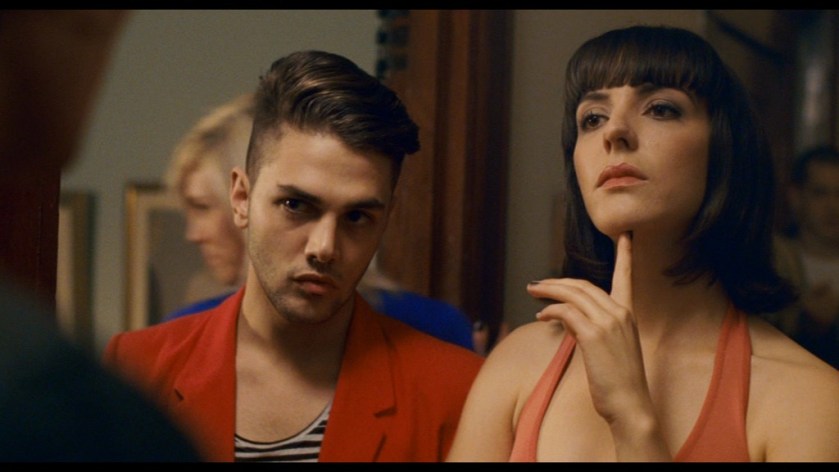
In watching I Killed My Mother, it was clear that Xavier Dolan had a sharp sense of humor. In Heartbeats he allows himself to make an overt comedy of manners that has delivered more laughs from me than most comedies I’ve watched this year. The story centers on Francis (Dolan), and Marie (Monia Chokri) are best friends who meet Nicolas (Niels Schneider), a young man who entrances them both. They begin a vicious back and forth to decide who gets Nicolas in the end.
The comedy in Heartbeats comes from Francis and Marie’s growing animosity with each other over Nicolas’ affections and the ongoing confusion his behavior and words illicit. During a playful game of hide and seek in the woods he manages to tackle Francis, pinning him to the ground. And keeps him pinned for a longer than usual amount of time before hurriedly rushing away, an act that builds confidence in Francis’ perceived chances with Nicolas. A few scenes later, Francis finds out Nicolas has invited Marie to see a play together without even asking Francis which throws him into confusion about his possible suitor’s intentions. At first, our protagonists attempt to play things cooly and not truly acknowledging the competition at hand. By the end of the film, they have devolved into wrestling on the ground decked in clothing out of place in the rustic, cabin setting they have ended up in.
Dolan has a very deft hand at the awkward moment, particularly zeroing in the desperation people take on when they are incredibly attracted to an individual they see as “cooler” than them or “out of their league.” At one point, Francis makes a completely inappropriately expensive purchase for Nicolas’ birthday and, while this fact is only known to Francis and the audience, it adds tension to the informal gift competition that springs up between him and Marie. As an actor, Dolan has the most perfect uncomfortable, awkward smile. He’s left behind at Nicolas’ apartment and has to receive a monthly allowance being delivered by Nicolas’ mother (played by the remarkable Anne Dorval, who played Dolan’s mother in his previous film). Dorval dominates most of the conversation, revealing her career as an exotic dancer, her broken relationship with Nicolas’ father, and other TMI. Dolan doesn’t fade into the background, though, and through his face and his body language, the audience is reminded of all those intensely awkward conversations we’ve ended up in, and especially those with a friend’s parent or some other acquaintance who shares far too much information.
The new element in this film for me was Monia Chokri as Dolan’s rival. Chokri was fantastic and kept up with her co-star and director by exuding an awkward confidence. As the tension increases, her chill unaffected nature begins to show cracks culminating in a scene where she runs into Nicolas on the street that will elicit the strongest empathic cringe from anyone watching. The awkward humor is never to the intensity that something like Curb Your Enthusiasm produces, it is continually softened through a lens of romantic idealism. Chokri’s Marie is presented as a very composed and intentional person, bearing an early 1960s appearance in both hairstyle and clothing. Coincidentally Nicolas mentions his love of Audrey Hepburn and Marie begins adding accessories that emphasize those aspects of her appearance.
The film is about friendship and the silliness of “profound love” and romanticism. It evokes the visual style of Wong-Kar Wai’s In the Mood For Love in particular moments, but instead of using this imagery to evoke a sense of serious simmering passion, Dolan uses it to cultivate a sense of irony with the protagonist’s actions. This is yet another Dolan film that highlights a different talent than I Killed My Mother and Tom at the Farm. The former is a wonderfully bittersweet character study, and the latter is an exercise in tension and psychology. Heartbeats are Dolan’s take on a romantic comedy, a modern remix of Jules and Jim with his own personal visual flair.
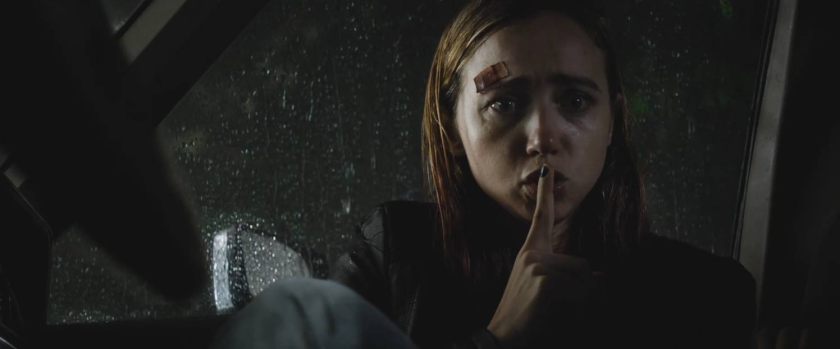
Lizzy (Ella Ballentine) is ready to leave her mother and go live with her father. After growing up in the shadow of her mom’s alcoholism, the young teenager has had to raise herself and try to keep her mother alive despite overdrinking and the threat of drunk driving. Kathy (Zoe Kazan), the girl’s mother, goes through an emotional rollercoaster, unable to communicate that she is actually heartbroken that her daughter is choosing to leave. As they drive through the night, taking an old road off the highway that leads them through the dark woods, Kathy swerves to avoid a wolf that has run out into the road. The car’s axle breaks and they skid to a stop, trapped and waiting for help in the form of an ambulance and tow truck that they are assured are on their way. But something is watching them from the woods. Something was hunting that wolf and drove it into the road. Something is waiting to devour these two women.
The Monster is a tough one. There are some interesting ideas, and the acting is incredibly strong. But as a horror film, I think it fails to create an atmosphere of fear. The set up is rife for some really unnerving horror set pieces, but the director doesn’t seem confident in the monster or sure of what to do. Director Bryan Bertino is the filmmaker behind 2008’s The Strangers. My opinion of that film was that it handled the ambiguous nature of its horror pretty damn well but didn’t do much to help me care about its two protagonists. The Monster appears focused on giving us that needed character development but then delivers sloppy horror.
There are moments where the horror begins to emerge from Kathy’s lack of parenting skills, putting her daughter in dangerous situations and being generally stupid in the face of horror. The film is peppered with flashbacks detailing the most recent decline of Kathy to the drink. We see her struggle mentally and physically in the backyard trying to decide if she digs through the trash for the bottles she’s thrown out. We see Lizzy hiding car keys to prevent drunk driving. We see the two devolve into a screaming match of profanities as the daughter does not want her drunk mother attending her school play. It’s pretty obvious what the director wants us to feel about these characters and the actors work their asses off, but the direction seems to undercut or hold back the deeper emotional impact.
The Monster is a movie about the horrors of addiction, but I would argue it fails to make those horrors feel truly horrific. Where The Strangers is confident in its pacing and the slow build up of horror, Bertino feels clumsy and unsure through almost every step of The Monster. There is a really great movie here, a premise that can connect us to the characters and a horror that is left unexplained. But when all the pieces are assembled, and we view the final project, it just doesn’t add up to much of anything really.
Lovecraftesque is a game by Josh Fox and Becky Annison. The game seeks to evoke the creeping, brooding horror of H.P. Lovecraft’s work while getting rid of his problematic racism, misogyny, and inaccurate depictions of mental illness. There’s no GM. Instead, scenes are composed of rotating roles. There is the Narrator who sets the scene, creates conflict for the protagonist, and drops a clue in each scene. Then there’s the Witness who is the main character exploring the mystery being laid out before them. Finally, we have The Watchers who are the players adding flavor to the scenes the Narrator lays out or playing NPCs if asked by the Narrator.
Each scene The Narrator must drop a clue that The Witness discovers. These clues can be physical objects, strange sounds, or even odd behavior. The catch is that nothing overtly supernatural can reveal itself until the third act of the game. The one catch are special cards that are dealt out at the start of the game and, if triggered by a particular condition, can allow a player to actually put something overtly supernatural into the story either as an Interrupt or an Ongoing element. All the clues until then should be able to be explained with mundane reasoning. At the end of each the players, without consulting each other, record the clue and their conclusion of what it means in relation to the other clues revealed so far. Eventually, the story works its way to The Final Horror and whichever player wants can step forward and reveal how these clues add up to something beyond the Witness’s comprehension. As Pamela, one of the players Saturday night said, it’s like the game of Telephone but with Lovecraft horror.
This past weekend myself, my wife, and three friends played an online session of Lovecraftesque. It was everyone’s first time with the game, and as with all new systems, it was a little more about comprehending structure than developing an excellent story. To get us started, we used one of the seeds from the book, The Chateau of Leng written by Renee Knipe. The premise is that Latissha Hall, a black single mother of two has purchased her first home on Nash Avenue in Ypsilanti, Michigan. The story takes place in 2004 at the height of the U.S. housing bubble. The seed presents the players with four possible characters to appear in the story, and we did make use of that.
Our story had Latissha preparing to do some renovating due to buying the house “as is” and inheriting a lot of structural problems. The first clue discovered was a weathered photograph from around the turn of the 20th century, a portrait of a family with individual members faces crudely scratched off. This led to the next scene: an awkward meeting between Latissha and her gruff neighbor Cass. Cass attempted to spook Latissha by telling her about the string of owners who has lived briefly in her new home and were scared off by something. She also noticed him carrying around a cat as he meandered about his front porch in a bathrobe. Scene 3 introduced Latissha to Officer Newhall, a local beat cop who ends up telling her that Cass had gone for prison decades ago for murder but apparently new evidence was presented and he was released. As a misty rain falls, Officer Newhall appears to vanish into thin air leaving Latissha unnerved.
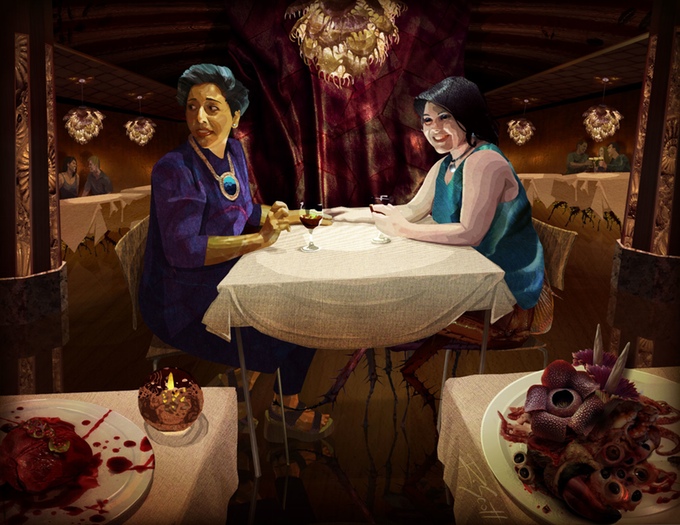
Absolutely beautiful and horrific art by Robin Scott
That evening while rummaging around one of the side rooms, Latissha finds a cobwebbed baby grand piano. Stuffed inside is an entire photo album with the pictures sharing a common theme: all the faces have been scratched out. They show different families throughout the century but all missing any trace of who they were. The next morning, Latissha goes to visit Geraldine, the elderly neighbor across the street. She’s lived in her house for decades and Latissha figures the woman might have some insight to the photos. She brings the album with her but finds herself unnerved by strange shadows and sounds in the woman’s house. Geraldine gets very aggressive about putting her hands on the album, and this causes Latissha to back away. There’s also a large number of framed photos of a cat that looks suspiciously like the one Cass was carrying around. That combined with the missing posters for the beast pinned up around the neighborhood has her questioning what is going on. Cass coincidentally comes by Geraldine’s to “check up” on her and Latissha can’t help but notice the gun he has tucked under his belt.
Our protagonist is unnerved even further by her youngest son’s drawings of their family, including her deceased husband his eyes scratched out looking remarkably like the photos she’s found. That night she’s awakened by the sound of glass breaking in the basement and movement. She investigates and find it empty but notices a panel from the wall moved to the side. Reaching into the space, she pulls out an almost identical album to the one she found in the piano. This album contains photography akin to Diane Arbus: portraits of people missing limbs, memento mori, and the visages of just slightly physically deformed people. Unlike the previous album nothing is violently scratched out, there appears to be an attempt to preserve these images. She also notices Officer Newhall driving down the street in his car as she looks out a basement window. He gets out and skulks in the yard between her and Cass’s house. Something about Newhall feels wrong, and she goes upstairs to search his name and the neighborhood online. She discovers very little except for a poorly scanned newspaper clipping about some wrongdoing on his part in a case. The grainy photo strikes her as bearing almost no resemblance to the man she met earlier.
Something compels her to return to the basement, and after searching further, she finds a hidden room. What lies inside finally reveals the horrific truth. The floor is almost breathing as she enters and finds lying across this flesh like floor her youngest son and herself…but proto versions, still growing and not yet alive. Pulsing tentacles, like umbilical cords, attach to them, some substance oozing through them and into the fleshy creatures. Latissha gazes into the dark void these tentacles disappear into, and she is startled when the proto-son finally stirs, blinking his eyes. She lets out a scream and descends into the void, discovering at its roots a great multi-legged multi-armed horror growing in the center of a carved out hollow. The fluctuating blob was surrounded by small hooded figures who turned to look at Latissha. These were the only faces she could see in the scratched out photos, the ones who had been left unmarked, the children. Unaged and without eyes, a dreadful glow emanated from the sockets. Latissha attempted an escape but found herself swallowed by the darkness between this ghastly place and her home.
Latissha finds herself waking up to the sound of her youngest called for her “Mama, mama. Wake up.” She is groggy and not sure what has been real and what was a dream. Standing in her room are her two children and Cass. Cass says that Latissha will be okay, but she will have a difficult pregnancy like she did with her first two. Duh duh duh!
I don’t think we managed to explicitly explain the connection between the clues in the game, but in a conversation afterward we had very similar ideas as to where the story was going. We all pretty much had collectively agreed that Officer Newhall was actually dead and a couple people had pegged Cass’ murder as being that of the cop. In my own notes, the story I was shaping was that Geraldine’s family had been involved in black magic and had done horrible things to the original family across the street. The result was that the house had become an Amityville type of entity, protected and fueled by Geraldine, the last of her family line. Cass had become aware of this fact around twenty years prior and attempted to kill her, but Newhall had gotten in the way. Cass’ methods were tied to very specific rituals and spells and Newhall’s disturbance set him completely back.
I believe that on a second playthrough, now with a stronger sense of the structure of the game and an idea of how it *should* flow and the way clues operate we’d have an even better time with an even more satisfying conclusion. Lovecraftesque is the kind of horror gaming I enjoy, where all players can be held in suspense until the very end. The Telephone style mechanic with the clues is my favorite part especially post game being able to see how others interpreted the story and what directions they would go. With players that have both a good background in understanding creeping horror and improv acting this could be a very magical game.
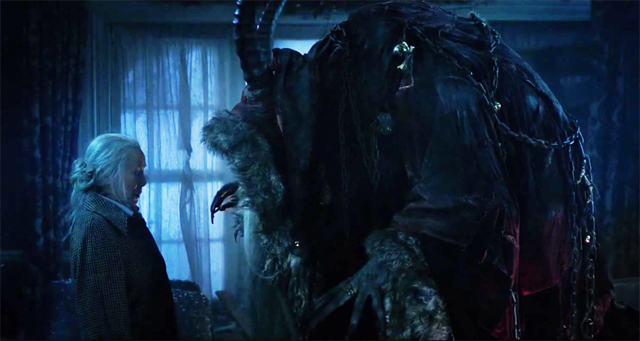
In the last few years, the Krampus has become quite a popular internet meme. The Germanic creature pre-dates Christianity but was adopted into Christmas traditions as a shadow to Santa Claus. Where Santa brings good girls and boys presents, Krampus would bring a rod to beat the bad kiddies. The character has popped up in The Venture Brothers, Scooby-Doo and even been the focus of some holiday themed films, the best of which is Rare Exports. It was only a matter of time until Hollywood decided to give the monster an American feature, this one at the hands of Michael Dougherty, best known for Trick R Treat.
Max is a kid nearer the end of that period of childhood where a belief in Santa is socially acceptable. He’s penned a letter with his numerous Christmas wishes for his family and visiting relatives, but his twin cousins decide to snatch the letter and openly mock him at the dinner table. Max responds by shredding the letter and silently wishing horrible things upon them all while tossing the letter to the snowy winds. Overnight a dark storm rolls in, the power goes out, and the neighborhood freezes over. One by one the family members are taken out by deadly gingerbread men, malevolent toys, and other assorted holiday-themed horrors before Krampus himself shows up.
Krampus is a hell of a lot of fun. It hearkens back to 1980s dark classics, Gremlins chief among them. The killer gingerbread men have a laugh reminiscent of those title villains. There is also a lot of heart in this film, about family and the holidays, but never overly sentimental. People die and get wounded. There is some blood but not an overabundance of gore. I would never say the film was scary, but it was exciting, and the design of the monsters was excellent. There is a jack in the box that is one of the best holiday horrors I’ve ever seen.
The adult cast is composed of some solid actors with strong resumes: Adam Scott, Toni Collette, Allison Tolman, and David Koechner. They play the parents perfectly, digging their heels in at the start focused only on rational explanation and finally cracking with the chaos breaches the walls of their home and cannot be ignored any longer. Tolman especially plays a character with a lot of underlying complexity. She and Koechner work as almost a counterpoint to Cousin Eddie and Catherine from National Lampoon’s Christmas Vacation. In that film the conservative, rural ideology of the characters is played for some incredibly strong laughs. Here we see the characters are not simpletons but working from a different paradigm. One of that works well and other times results in impulsive failure. Tolman has a number of scenes where her character proves her mettle and shows up her husband, who spends more of the film talking up his macho superiority than fulfilling those words.
Dougherty’s work in film has been a mixed bag. He was a co-writer on multiple Bryan Singer projects and some studio films. Trick R Treat was a breakthrough and Krampus is an awesome follow-up. He was ten years old when Gremlins was released so the perfect age to remember the feelings evoked by that film and others of its kind. Dougherty manages to do what Abrams accomplished so beautifully with The Force Awakens, the evocation of the sense of nostalgia without pandering. Krampus feels like the sort of film that would be in the cineplex alongside The Goonies and Honey, I Shrunk the Kids. But it also tells a fleshed out story that completes the arc of Max’s character and ends just the way a good horror film should.
If you look up the many articles and interviews about Xavier Dolan, you will likely get a picture of an arrogant young artist. These would not be wrong, but I would challenge that this portrayal is negative particularly in cinema. Dolan represents a strong, re-interpretive Millennial energy that was inevitable in film. In the same way, the French New Wave and the iconoclastic American 1970s filmmakers made their mark in the form; Dolan is doing that same type of work. Does he indulge? Damn straight he does. But I challenge anyone to find a single auteur who doesn’t indulge constantly.
Dolan’s first feature, I Killed My Mother is the story of Hubert Minel (played by Dolan), a 16-year-old gay man, still closeted to his mother and who engages in the most vicious arguments and conflicts with this central caretaker. Dad stepped out when Hubert was seven and left Chantale, the mother (Anne Dorval) to raise the boy on her own. Hubert is two months into a relationship with a classmate and looking towards a career in the arts, encouraged by a supportive teacher (Suzanne Clément).
Dolan is a filmmaker influenced by the medium. No moment in I Killed My Mother is simply a moment; they are accented by flourishes of style from Goddard-like framing (off center and with both conversants in the frame), slow motion almost from a perfume ad, black and white confessional close-ups, and myriad of other touches that add emotion to a relatively typical story of parent-child conflict. He also knows the importance of establishing character through setting, as seen in the very opening close-ups of his mother’s tchotchke-filled home. We also learn volumes about her through her hairstyle, clothing, even the manner in which she eats breakfast. And all this if before she even has a modicum of dialogue.
While Dolan is the composer and conductor, Anne Dorval as Chantale is the star player. It would have been very easy for Chantale to slip in caricature, but Dorval does gritty work to keep the character faceted and obscured. In moments of high tension, she will begin to follow the same type of script I imagine all of us remember from our adolescence, which is underscored by Hubert calling her out on this same repetition. She shuts him down in the same manner that frustrated us all and drove many teenagers to those primal, guttural ARGHs! There is a moment near the end of the film where her role as a single mother is blamed as the reason why Hubert is struggling academically and exhibits such rebellious behavior. This is the moment where Dorval lets Chantale crack through the thickly layered makeup and sequined floral outfits. Chantale’s love for her son is beyond the question of outsiders, and she makes that known.
Dolan made I Killed My Mother at the age of 20 and has not tried to hide the fact that it is heavily biographical. He has stated that this is a film he couldn’t have waited decades to make, that it needed the raw emotion of being only steps away from adolescence. And he is completely right. A forty-something making the film in deep retrospect would have let nostalgia slip in between the cracks. There is no wistful memory manifesting falsified beauty here. Through the ugliness of this relationship, we see Beauty and Love. We don’t fight and scream with this level of fervor at people we hate, the type of anger glimpsed in the film born out of intense love and need. It is the attempt to communicate love but failing to do so because the language does not possess the vocabulary to do so.
Hubert states in one of his bathroom confessionals on camera that he doesn’t love his mother like a mother, but he loves her nonetheless. During a late night conversation, Hubert fueled by ecstasy and barging home full of elation to speak to Chantale; he states, “I love you. I am telling you this so that you won’t forget.” This is the moment where the nature of the relationship changes, not profoundly, but both characters redefine the bond. Hubert is no longer the dependent glimpsed in the Super 8 home movies at the old house by the lake. He is an individual coming into his own, intellect, a sexual being, a partner in a relationship, developing complex ideas and emotions. Chantale is reticent to accept that, but by the end of the film, they come to an unspoken understanding. Their relationship will never be what they both remember and wish it could be, something new will form and in that they will find a place for their love.
The book for December 2016 will be The Visible Filth by Nathan Ballingrud.
After a bar fight, a man discovers a cell phone left behind. He decides to hold onto the phone until the owner contacts him. And then he begins receiving messages. The book is a nice short novella for the busy holiday season clocking in at 68 pages.
“This isn’t the type of horror you can easily categorize, put inside a box and say, ‘THIS. This is what makes this story scary.’ The Visible Filth is deeply unnerving and you’re not sure why. It has all the requisite thrills and chills, but it’s what’s under the surface that will be your undoing.” Joshua Chaplinsky, LitReactor.com





 PopCult Reviews