
Walker (1987)
Written by Rudy Wurlitzer
Directed by Alex Cox
When I see or hear gringos complaining about Central & South American immigrants showing up in large numbers in the States, I can’t help but think in response, “This wouldn’t be a problem if the States and other colonizers just stayed the fuck home and minded their own business rather than imposing themselves and intentionally destablizing already established cultures.” Colonization means disrupting indigenous people’s development and almost always ends with them becoming an exploited class by foreign business interests that make up our extraction economy. Alex Cox is clearly furious, and we can see that broiling on screen in his savage, intentionally historically inaccurate depiction of one American madman’s crusade into Nicaragua. Something that happened long ago and was happening as Cox made this film.
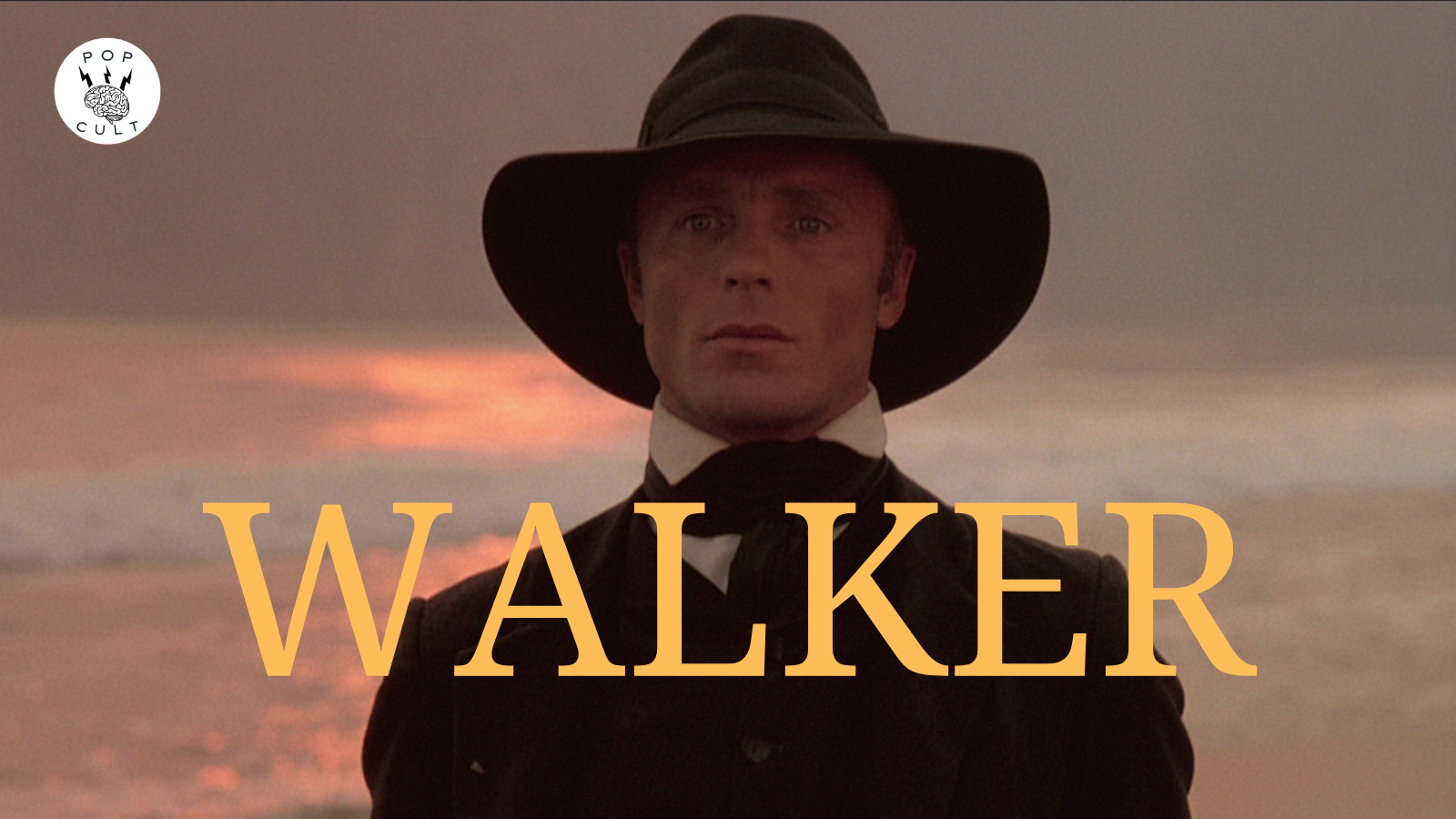
William Walker (Ed Harris) fled Mexico in 1853 after failing to pull off an armed insurrection. This freebooter is placed on trial by the U.S. government but is acquitted and professes his devotion to the concept of Manifest Destiny. Walker plans to start a propaganda rag to spread his ideas, but when his financier girlfriend (Marlee Matlin) dies suddenly, those plans fall through. Instead, the madman is financed by Cornelius Vanderbilt (Peter Boyle) to take a group of 60 mercenaries to Nicaragua and help one side win the ongoing civil war.
This will allow Vanderbilt overland shipping rights between the Pacific and Atlantic, so it’s not being done out of a sense of honor, though Walker can manufacture that in his delusional mind. What follows is a descent into insanity through the character of Walker and Cox’s filmmaking, with anachronistic objects and technology popping up. At one point, some of Walker’s men are reading Newsweek. This is not an attempt to recount history but to speak to the contemporary situation through an impressionistic lens.
We need a general understanding of what happened in Nicaragua to understand Cox’s anger. Nicaragua has long been of interest to American corporations because it is part of that thin strip of land that separates the two great oceans. If you are invested in shipping, having control of this region could be beneficial in moving your own products and charging rivals for the use of the passage. Throughout the 19th century, the United States and several European nations schemed and plotted to overthrow regional governments that were not favorable to their economic interests despite these governments being democratically elected.
After shaking off the chains of imperialist Mexico, Nicaragua finally had independence, but war broke out mostly between factions labeling themselves Conservative and LIberal. Don’t confuse popular American definitions of these words to mean anything in the context of Nicaragua, though. At one point, the real William Walker did show up with a band of mercenaries, fighting for the Liberal side, and proclaimed himself President of Nicaragua for less than a year before he was driven out.
For 43 years, Nicaragua was ruled by the Somoza family, and they came to power as part of a US-engineered policy that included dissolving the country’s current military in favor of Somoza loyalists. The new regime took control after deposing the current president in a rigged election. This came after a long period of American occupation of the country, and while the U.S. was not officially in power, they ensured their proxies always remained at the head of the table. By the 1960s, the Somozas had devastated the national economy, siphoning off every coin they could, which was even worse when they stole bundles of relief money intended to help rebuild Managua after a massive earthquake.
In 1961, the Sandinista National Liberation Front was founded to create a large enough force that they could depose the Somozas. This socialist liberation army engaged in target attacks on officials in the Nicaraguan government tied to some of its most devastating policies and, of course, were labeled “terrorists” by the Somozas. By 1979, the Sandinistas took control of Nicaragua; the former president fled to Argentina, where he was subsequently assassinated by workers’ party members there. In 1980, the Carter administration and the American press made a big deal out of the Sandinistas providing arms to the rebels in El Salvador and worked to turn public opinion against this socialist government. Groups labeled “contras” formed in Nicaragua, and the CIA began providing these right-wing terrorists with arms, training, and funding. Any time the CIA supports any group, you know it is incredibly evil and bad; that’s sort of the CIA’s brand.
Through the 1980s, the American-backed Contras engaged in terrorism against rural Nicaraguans to disrupt the social reforms being rolled out by the Sandinistas to help those impoverished by the former US-supported regime. Ronald Reagan’s administration seemed to love helping these monsters as they tore across the countryside, destroying health centers & schools, murdering, raping, and torturing men, women, children, babies, and the elderly. In 1984, Daniel Ortega and the Sandinista Party won both the presidential and parliamentary elections.
America immediately said it was a rigged election and said Arturo Cruz, the far-right candidate they backed, was the legitimate winner. Never mind that Reagan’s advisors privately argued that Cruz should not participate in the election so they could later claim illegitimacy. During this period, the story broke that Reagan’s people had been selling arms to the Iranians and using that money to help fund the Contras, hence the Iran-Contra hearings that have become infamous. Throughout the long war between the Sandinistas and Contras, 30,000 people were killed.
Alex Cox’s Walker is his angry proclamation about the effects of over a century of American interference in Nicaragua. The director visited the country in 1984 during the elections to see if Nicaragua was as bad off as he kept hearing in Western media. Cox found that it simply wasn’t the case & that the Sandinistas had dramatically lifted many out of poverty, and what was hindering this process from continuing was the terroristic acts of the Contras. Cox became aware of William Walker after this and became obsessed with the insane lengths the man would go to and his religious belief in Western dominance of the world. He aimed to make a film about the illusion of “The Great Man” theory wherein people posit the “natural” greatness of men in history who violently take over other nations or cultures, claiming a divine right.
Cox has always had a great interest in the American Western, especially those from the late 1960s and 1970s de-mythologizing period. These ideas found their way into this movie visually and in the story. The theme of Walker is to see how this man rises to greatness at the cost of producing piles of dead bodies only to be toppled with little effort. Cox also intended to outline that the American obsession with this region was tied to monied interests, who then used the media to create a fake need to “aid” the poor people of Central American countries, always leading to American occupation and banana republics. Not wanting the audience to miss the point, Cox includes a montage of Ronald Reagan’s speeches as the final scene drawing that direct line between this film and what was happening right at that moment in Nicaragua.
It’s tricky to describe what the film Walker is like. Cox draws influence from those Western films and the Rambo archetype, mocking it and showing how paper thin these action heroes are. Yet, nothing plays like an overt comedy; the satire is incredibly dry and feels like horror in many moments. His cinematographic choices make the world feel warped & disturbed. This isn’t a knee-jerk reaction film; it is very clearly researched and studied with the sudden bits of the contemporary world not popping for a laugh but to make a cogent point about time moving in circles. Ed Harris is the perfect actor for this role, giving it the absurd intensity it needs where he ultimately believes in what he’s doing, yet the audience can laugh at this nutjob and his pointless crusade.
Alex Cox obliterated his career by making Walker. It was backed by Universal Pictures and followed a series of movies that had been building up his credibility as a cutting-edge director (Sid and Nancy, Repo Man). The director chose to use much of the money the studio gave him to help the Nicaraguan people rebuild a lot of their infrastructure and get away with it. Universal clearly did not like the final product and put no support into marketing Walker, so you probably have never heard of it. They had given him $6 million, and he had made a movie the executives deemed too political & too violent for them to actively promote.
For me, this is a perfect example of using the standing institutions against themselves, taking their money and giving it to those who need it, and fuck the company. Many call themselves “punk” while never seeing that as more than a fashion statement. Cox is a genuine punk, seeing that empathy & humanity are far more valuable than the disposable crap we’re conditioned to see as “high quality.” Cox would never direct a film backed by a major Hollywood studio again, almost directing Fear and Loathing in Las Vegas but being replaced by Terry Gilliam while Cox’s script was still used. He stuck to his principles over kowtowing to American corporate interests, and I must admire that. He literally put his money where his mouth is. Walker is a stunning work of course-correcting American propaganda, telling how that nation poisoned another simply to have better access between oceans.

 PopCult Reviews
2 thoughts on “Movie Review – Walker”