
Books of Blood Volume 2 by Clive Barker
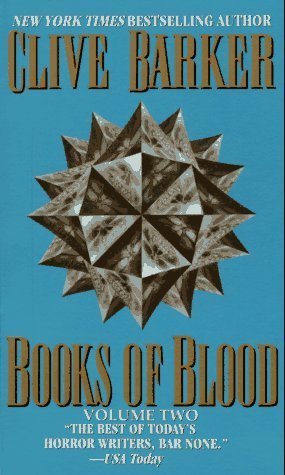
Because it was October and I enjoyed Books of Blood Volume One so much (I have read it twice), I decided to pick up the following collection by Clive Barker. This one does not have stories as strong as volume one. There are good ones here, but the weaker entries make volume one much more substantial.
“Dread” – This is one of the best and most fully developed stories in the collection. A college student comes under the thrall of a svengali who is fascinated with making people confront what they dread. This has a fantastic conclusion that is vividly rendered by Barker.
“Hell’s Event” – Boring, a contest between demons to torment humans, felt more like the seed of an idea.
“Jacqueline Ess: Her Will and Testament” – A woman tries to kill herself but fails. As a result, she becomes something monstrous. This new power allows her to tear apart anyone who crosses her path. It’s a pretty good story.
“The Skins of the Fathers” – I wanted this one to be better than it was; it did not stick the landing. A small town becomes overrun by a host of twisted & bizarre monsters, but this isn’t the first time. This feels fragmented, like pieces of a larger idea that could be developed better. Perhaps a prototype for Nightbreed?
“New Murders in the Rue Morgue” – I have never clicked with Edgar Allan Poe’s style, and this is clearly an homage to his work. Barker seems to love him, but this story wasn’t for me.
The Devil Takes You Home by Gabino Iglesias

I wanted a more satisfying horror story after Books of Blood V2 was not as great as I wanted. This book won the Shirley Jackson Award and the Bram Stoker Award for Best Horror Novel of 2022. Sounded like a safe pick for a Halloween-time read. Mario is a Puerto Rican man living in Austin, Texas. As the novel opens, he & his wife are facing down their daughter’s terminal illness. Mario takes a criminal job from his junkie friend Brian to help pay medical bills, but it’s all too late. In the aftermath, Mario’s wife leaves, and he turns to a darker mood. Brian offers a new job, and his acquaintance Juanca wants to take out cartel members and steal millions in cash. Juanca seems very assured that things won’t go badly, and Mario feels a mix of suicidal and desperate to start over.
However, the journey is fraught with horrors. Mario discovers a web of tunnels underneath the border between Texas & Mexico. There are creatures living in outcroppings along the way. The people that Juanca associates with are brutal characters, making human sacrifices and employing a mutilated witch to help bless their men before they send them into battle. There’s also the home of a boy who should have died at childbirth, whose parents cut off pieces of him and offer them up as boons for people venturing into dangerous territory. I was reminded of the work of contemporary horror writers like Stephen Graham Jones and Sylvia Garcia-Moreno, who substantially use their cultural backgrounds to inform their horror. This is a quick read; the momentum will keep you going and deliver a satisfying, dread-filled conclusion.
Make-Believe Media: The Politics of Entertainment by Michael Parenti

Inventing Reality by Parenti is a better, more relevant book than this one, but Make-Believe Media is still a great read. Where the former book was a communist analysis of American news media circa the early 1990s (and it is still very relevant), the latter book is an examination of American entertainment as political & cultural propaganda. Parenti touches on a lack of representation of non-white voices at the time, which I think the industry has improved on, but only in the most surface-level ways. BIPOC voices in mainstream entertainment still uphold the insidious individualist, capitalistic, and anti-communist indoctrination of older media.
Where Parenti’s critique still has teeth is in the way United States institutions are presented in popular culture, with violence being given carte blanche while healthy portrayals of sexuality are often shrouded & treated as inherently offensive. He also gives some strong examples of the way the poor & working class are framed as crude, stupid brutes, which has aided in warping working people’s perspectives on themselves and their communities. American media continues to have a hard-on for law enforcement, always presenting the institution as excellent and perfect and framing any transgressors within it as a “rare exception,” which is hardly the truth, ACAB.
I get the sense Parenti has much more passion and has spent more time analyzing news media rather than entertainment. I would love to read a book along these lines written in our current era because I still see so much wrong with what Hollywood is presenting to people as morally correct. Despite having written this in the late 20th century, Parent’s words still ring turn as he sums up his thesis:
“We need to exercise the limited consumer sovereignty available to us by voting with our pocketbooks and refusing to attend slick, superficial, Hollywood movies. Also, we need to stop sacrificing large portions of our lives to the unsatisfying but addictive television set. We need to rediscover, or discover for the first time, the gratifying nourishments of reading and of engagement in community activities with other humans. There is much talk today about people taking control of their own lives. One way to start is by dropping out of the mass-media culture as much as possible and reclaiming our own brains and sensibilities.”
Hollywood: The Oral History by Sam Wasson & Jeanine Basinger

This massive 700-page tome took up so much of my reading time, but it was a delight to read. Using the American Film Institute’s interview archives, authors Wasson & Bassinger have patched together a history of Hollywood beginning with its founding as a home for the newly created film industry all the way up to our present, where filmmaking studios have become more interested in financing & marketing than making art.
To say this book is thorough is an understatement. It begins with the advent of cinema as a popular entertainment form with snippets from interviews with performers, producers, and filmmakers who worked in the industry at the time. I got a strong sense of how new media like YouTube or TikTok is perceived with the caveat that early filmmaking was much more open-source. Where contemporary media services have created walled gardens, almost anyone could get into filmmaking early on and make something of it.
There is an extensive section on the era of studio contracts where every worker was guaranteed/required to output a certain number of films a year. One of these chapters is broken into parts where every single member of the crew gets spotlighted, their craft defined, and what it was like to work in those fields is well-explained. I learned the difference between a production designer & an art director (it just comes down to the title & pay). It helped give me a model for how to look at American films in four eras – Early/Silent, Studio System, Franchising & Licensing, and now our modern era, which is where any iota of artistic inclination is being removed to make media companies focused on finding new revenue streams.
If you are a film fan interested in the people who made these movies, Hollywood: The Oral History is a no-brainer. This is chock full of interesting anecdotes that humanize figures you might have never considered regular people. One of my favorite stories is how silent stars Mary Pickford & Douglas Fairbanks would invite friends over for dinner every evening; Mary would go to bed, Douglas would screen new movies in their home theater, and he would inevitably fall asleep during them waking just before they ended. The book does an excellent job of helping you understand the sense of community that existed in those early days before movies became the cultural monolith they remain today.
Elite Capture: How the Powerful Took Over Identity Politics (and Everything Else) by Olúfẹ́mi O Táíwò

Author Olúfẹ́mi O Táíwò lays out a solid case to show how the wealthy & powerful in the West have co-opted the discourse on racial capitalism to obscure the fact that this economic system inherently promoted prejudice. I found myself thinking a lot about Class Notes by the great Leftist professor & writer Adolph Reed, Jr., who also outlines the class divide that exists within Black American communities as a result of capitalism. Táíwò points out the way the vocabulary of identity politics has been allowed to come into the mainstream, but the underlying analysis and thorough definitions of these terms are being intentionally obscured by institutions with an interest in protecting capitalist hegemony.
Táíwò communicates how identity politics, introduced as a concept by the radical Black feminist Combahee River collective to unite people despite their observed differences, is now used as a cudgel to divide people. Initially, these ideas were meant to help disparate racial & sexual identity groups unite as workers & human beings against the establishment, which always seeks to sow division. Táíwò outlines how capitalism has been used to undermine the development of marginalized communities by turning them against each other. I’ve seen this when growing up in the American South, poor white communities at the throats of poor Black communities & Latine immigrant communities. It’s also found within the Black community, Black evangelicals who have been conditioned to hate Black queer & transgender people via a religion imposed upon their ancestors as a colonial method of control.
Táíwò’s ultimate point is to push for radical solidarity, working towards a union with all people who struggle to survive in this cruel, harsh, capitalist-controlled world. The author often uses the metaphor of “being in the room,” the idea that we only hear from voices that institutions have allowed to hold space where we exist. So, as a white straight male raised under evangelical Christianity, the rooms I have frequented are designed to not let in voices that present alternatives to my personal indoctrination. This means I must make a concerted effort to find those alternate voices to illuminate my understanding of humanity. It’s also required by those of us with the privilege to find whatever ways we can to lift up those voices that get buried by the noise of the dominant culture. This is a slim book, under 200 pages, but it’s a dense read and one I recommend you take your time to fully appreciate.

 PopCult Reviews