
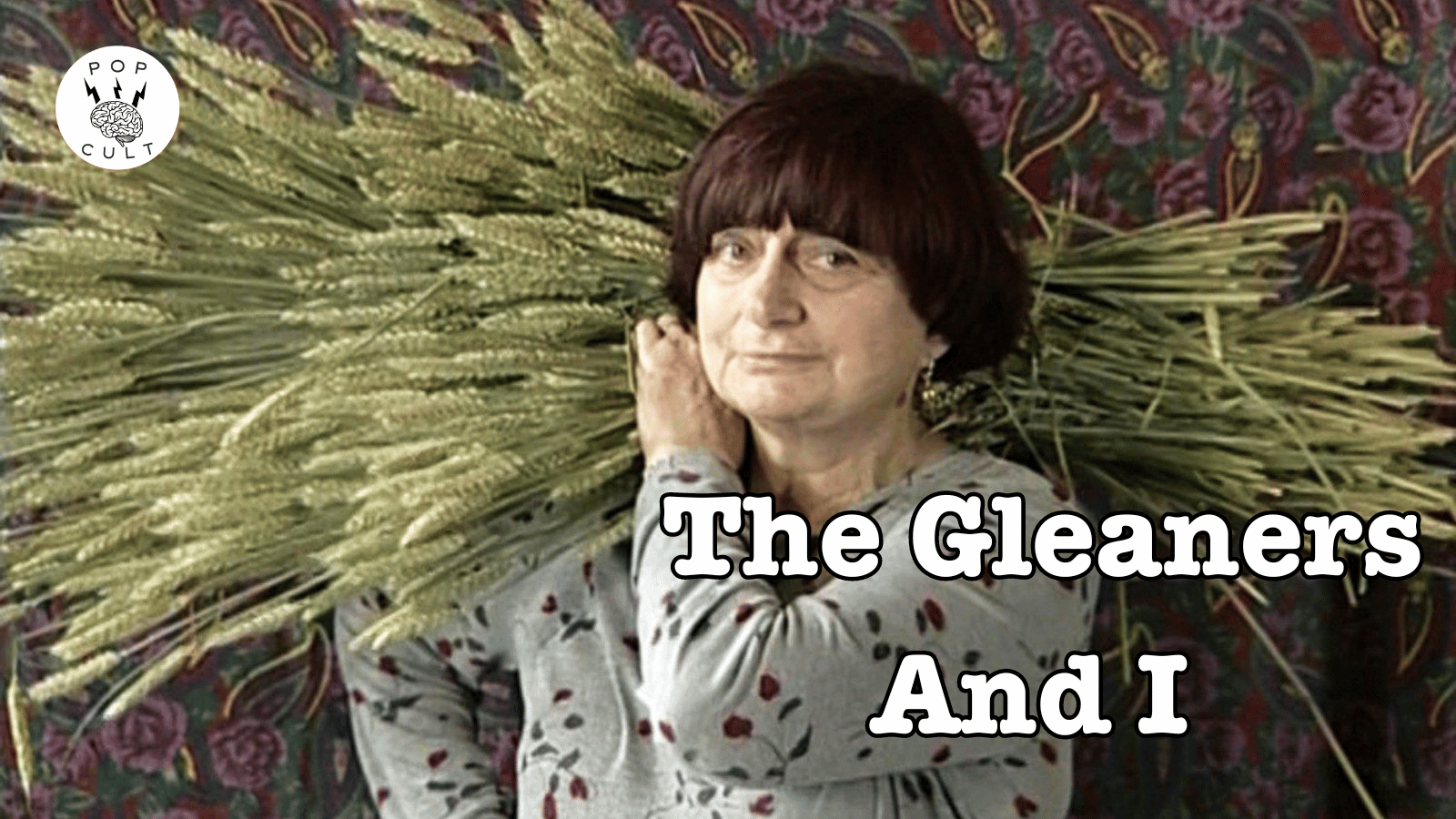
The Gleaners and I (2000)
Directed by Agnes Varda
There is a tension in art between planning & spontaneity. I feel it when I write fiction. I’m always wrestling with how detailed an outline I give myself. Where is the room left to be surprised? But I also need to ensure the whole piece feels cohesive and connected. Agnes Varda embraces spontaneity in her documentary The Gleaners and I but strikes a good balance. She sets out with an idea of what she wants to explore but allows herself to be open to drift. Varda is so fascinated with people that she won’t hold back if the people she encounters inspire something new in her. I can see how contemporary filmmakers like Nathan Fielder or John Wilson are inspired by Varda’s work, particularly how she engages with strangers.
Varda, ready to put her beloved new digital camera to work, travels throughout France wanting to document the tradition of gleaning. Gleaning originated as the act of collecting leftover crops from the harvest. She wonders if gleaning is still alive and finds it has transformed over the centuries. There’s also the question of what else is gleaned beyond food. Her focus is always the people, and she meets people like a Michelin chef who gleans as part of his adherence to sustainable cuisine, an artist who uses objects gleaned from the trash, urbanites who subsist on what they find in the aftermath of farmers’ markets, and the rural poor who make the most of potatoes left behind.
The gleaning is just a jumping-off point, the link to meeting people and starting a conversation with them. Alain has a master’s degree in philosophy and gleans from a farmers market in his Paris neighborhood. He’s out of work but spends his evenings teaching French to immigrants. Varda visits one of his classes, and the rather direct, terse man she meets on the street becomes a joyful, engaging educator.
At a farm whose potato crop has been harvested she meets a man estranged from his wife who eats what he can gather with his roommate. The man talks to her about how more people should know how much is wasted every harvest simply because the size or color is slightly off. Varda concludes that she doesn’t have to say much in her film; the people she meets are making the essential statements others need to hear.
What comes through the screen is Varda’s enthusiasm for meeting new people and hearing their ideas & about their lives. As she makes this film, two recurring symbols inform Varda’s thoughts: heart-shaped potatoes and a clock missing its hands. The former is a rather beautiful metaphor. These potatoes will be left behind, turned into compost in time, but never eaten as they were intended to be when planted. These are the hearts of her subjects, not seen as having any value by the larger machine of the world, but to Varda, she wants to collect them all.
The clock is a desire to remove time and be in the moment. It’s a core piece of making a documentary, the in-the-moment-ness of the form, and a remark on aging. Varda was 72 when she made this film, and I have no doubt she was contemplating how much time she had left. Little did she know she would have almost two decades to keep making pictures (and she did).
The digital camera becomes a subject of the film. Varda plays with the ability of the device to warp & manipulate images. She zooms in on her collection of heart-shaped potatoes, filming them over time as they decay, finding beauty in their transformation. Varda is a gleaner of images & people. She sorts through the world as she travels through it and finds discarded things full of value. There’s a scene where Varda returns from a trip abroad and surveys what she has gleaned: a suitcase full of souvenirs and mementos from Japan. She remarks that her memories often fail her when she returns from a journey, so Varda turns to what she gleaned. To me, this is speaking to the experience versus the effect.
The “going to a place,” the “having of an experience” is not what remains with us. The things we take from those are what matter. We glean from our lives when we are curious and desire to know more about what it means to be alive. For me, film is a process of gleaning, of searching through the pile and finding moments of beauty that a large part of the world isn’t even aware of. Varda’s Cleo From 5 to 7 was a gleaning experience, sifting through the noise and coming across something remarkable and beautiful that became a part of me. Those emotions I felt watching it, the thoughts I had in the days that followed, are valuable to me.
Varda gives herself time to make asides, to play. She pretends to capture the trucks her driver passes in her hand as she films through the windows. Lingering images of gardens and corners of her home. This is not a form of capture but a form of interaction. Varda loves to play, which might be a friendly chat with a stranger, puttering around her house with a camera; the world is here for us to be in. She does not consume it; Varda ensures she is a part of the whole. The world has been flooded with cameras, making it easy for everyone to record their lives and play with the world. But we don’t. Not enough, at least. We need to use these incredible devices to their full potential. We would benefit from studying Varda’s example, going out into the world and gleaning from the beauty all around us, often hidden.

 PopCult Reviews
2 thoughts on “Movie Review – The Gleaners and I”