
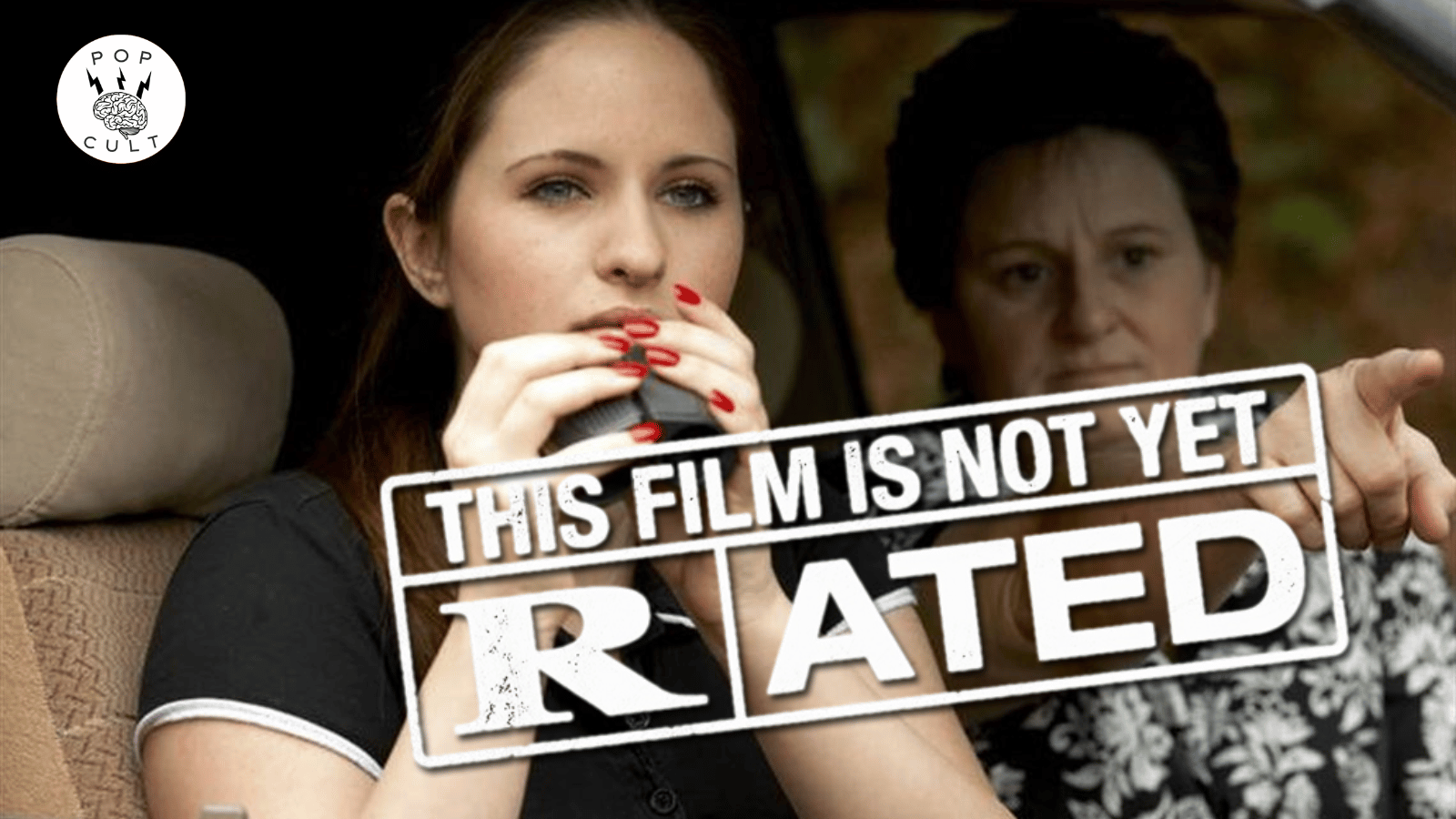
This Film Is Not Yet Rated (2006)
Written by Kirby Dick, Eddie Schmidt, and Matt Patterson
Directed by Kirby Dick
The United States is currently experiencing one of its most consistent features: moral panic. Every generation has gone through multiple cycles of this nonsense, yet we seem to learn nothing from them. Social media is the root of all evil in society. Or it’s LGBTQ people existing. Or it’s an accurate survey of American history. Or it’s rap music, dancing, comic books, video games, television, comprehensive sex education, the list goes on and on and on. Shortly after its creation, the novel was said to be aiding in the decay of society. All these young people spending hours in books thinking about people and places that don’t exist. Oh, the humanity!
Censorship is the weakest form of political action, the assumption that the masses are too stupid to understand a piece of art. There are never robust social movements to help build media literacy in society because that might lead to people restructuring things, and thus, those who wield power now very well might lose it. Instead, we push people to regress in their thinking, to adopt the stance of reactionaries, always terrified of anything new & unfamiliar. And this is why the MPAA was created.
The unfortunately named Kirby Dick set out to uncover as much information as he could about the people working on the ratings board for the Motion Picture Association of America. This private institution was founded in 1945 as a trade association to keep the film industry growing. It’s very much a lobbying org. In 1966, Jack Valenti, a former aide to President Lyndon B. Johnson, was appointed president. The voluntary film rating system was his most significant and long-lasting change to the MPAA. This system was focused on “appropriateness for children” with a range from G (General Audiences) to X (non-pornographic films that were deemed utterly unsuitable for a child to view even when accompanied by a guardian).
Dick looked back on the ratings system’s history and listened to his fellow filmmakers, which led him to notice significant disparities in how films were rated. Part of the problem is that the MPAA is profoundly secretive in how they come to a decision, refusing to justify their choices. They certainly hint strongly to the movies made by the large studios about specifically where cuts can be made and are ultimately much more lenient on these establishment pictures. With independent films, the ratings board became much stingier, and it eventually became easier to just release a movie as “unrated” if all you were going to do was show it in the festival/art-house circuit.
While Dick focuses mainly on the disconnect between how violence and sex are rated – with an emphasis on how same-sex acts are rated much more strictly than straight sex – I do think ratings have changed in the eighteen years since this film was made. One of the most dramatic shifts is that I don’t think ratings matter as much to the average American as they once did. My key evidence for this, while purely anecdotal, is that from my childhood up through working as a primary school teacher, the amount of R-rated content I have seen children exposed to certainly appears to have increased. After Valenti left the MPAA as president, the organization’s focus seems to have shifted much more to the growing piracy market rather than ratings. Money is always more important than people to those in charge. I feel that LGBTQ representation in mainstream movies has improved, though it’s certainly not where it should be.
As a childless adult, I don’t consider American (or any culture’s) film ratings in the slightest when I choose what films I want to view. The only adults I’ve ever known who do are either parents (and even then, it’s not a hard & fast rule for them) or some of the most psychologically & emotionally stunted people raised in the trauma of Christian fundamentalism. I attended a private Christian college; it was restrictive but not nearly as awful as places like Liberty University or Bob Jones University, where students are expressly forbidden to view R-rated films in a theater or privately as per the school’s codes of conduct.
Any reasonable person is going to see this as madness. Why should any institution have the right to control what art a person views? But part of that is these institutions, and the parents who send their adult children to these universities do not view the masses as capable of making their own decisions. Their conservative beliefs, entangled with a cult-like worship of rigid, punitive hierarchy, lead them to believe humanity is a blank canvas onto which their “superior” morality must be written and imposed.
Like most forms of censorship, when something is “forbidden,” it only entices the curious more. This is why, in the early 2000s, releasing “Unrated Editions” of sex comedies was a widespread practice. Horny teenagers & college students would secret away this version of the movie that promised even more sex and nudity only to be ultimately disappointed that, at most, it was an extra topless scene or something else fairly dull. Not that I was one of those people… It’s made even more irrelevant when you compare the MPAA to the UK’s ratings board, where sex is given a much softer rating compared to graphic violence.
Censorship in its current form has let the mask drop. American mainstream media is subsumed in some of the most graphic violence I’ve ever seen. Every other film seems to be aping Deadpool or John Wick, using a comedic tone and quippy dialogue to make its acts of death & mutilation appear “softer.” Meanwhile, depictions of sex in mainstream films seem almost non-existent unless you go outside the States. It’s not like graphic sex is hard to find either; access to pornography has never been more ubiquitous. But this has always been the twisted story of the United States, rooted in unhinged Puritanical beliefs and then commodified by capitalism.
I don’t see a purpose for the MPAA. I know that it exists as an arm of Hollywood to try and crush piracy (spoiler: they have continually lost that fight). The veil of being a moral arbiter at anything has fallen away, and that’s good. A private organization whose membership is kept secret, who, through this documentary, we know are just employees of the studios with their interests at heart, has no place dictating morality to the people. A morally just society will never be born out of a system where the chief goal is to amass more wealth in the hands of the few. That leads to a culture where only art that reflects that craven hunger is centered, while anything that might expose the public to positive humanist ideals is hidden away and left to rot in obscurity.

 PopCult Reviews
One thought on “Movie Review – This Film Is Not Yet Rated”