
This special reward is available to Patreon patrons who pledge at the $10 or $20 monthly levels. Each month, those patrons will pick a film for me to review. If they choose, they also get to include some of their thoughts about the movie. This Pick comes from Matt Harris.
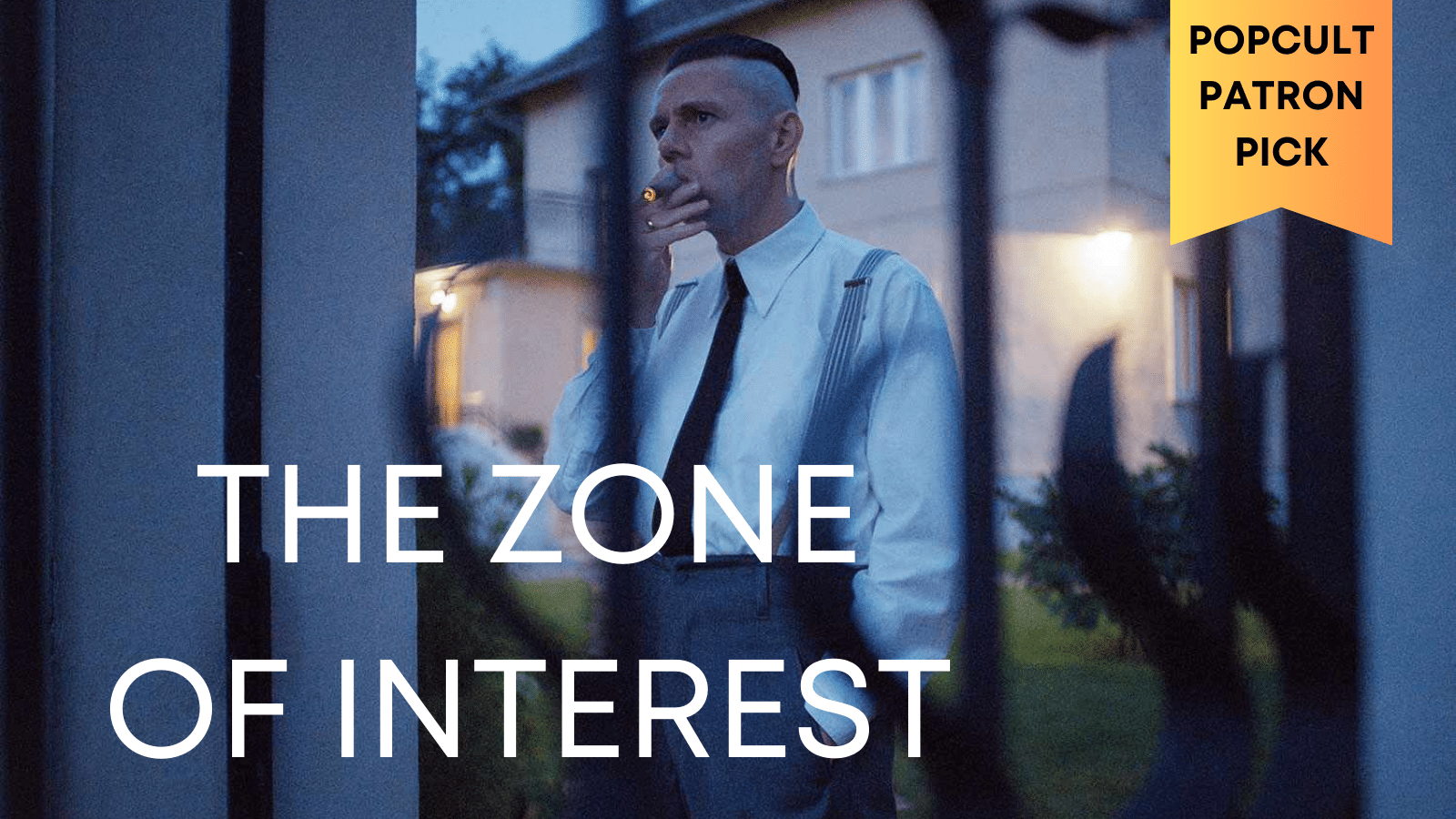
The Zone of Interest (2023)
Written and directed by Jonathan Glazer
A droning echo from deep in the bowels of the underworld is the first thing you hear as the screen remains black. This is a descent into Hell. The music distorts and warps, communicating this mood of decay & rot. It is also a signal that this will not be a film about the spectacle of war or even the direct horrors of the Holocaust. Instead, this will be a story from right on the periphery. The title, The Zone of Interest, was a term Nazis used euphemistically to refer to the complex of over 40 death camps in Auschwitz, Poland. Filmmaker Jonathan Glazer uses his talents to deliver a story about genocide unlike any other I’ve seen. This is a film where the details are withheld, and it is through inference that the true horror emerges.
Rudolf Hoss (Christian Friedel) is the commandant of Auschwitz and lives in a beautiful home next to the camp. Large walls have been built around the property, so the family never has a direct view of the compound. His wife Hedwig (Sandra Huller) cares for their five children and goes about making her dream home. At first this seems like any other home with a lovely yard and garden. Then, the servants bring over bundles of goods – jewelry, clothing, even fur coats. Hedwig puts on one of the coats and admires herself in the mirror. There’s a moment of realization as she looks at herself; a slight look of mirth drops. She realizes something, but she doesn’t speak it.
Two gentlemen show up for a meeting with Hoss. They talk about their plans for the crematorium. It can run 24/7 and has a rotating system to avoid overheating the ovens. They never say what this will be used for, and how they discuss it might lead one to think it has innocuous purposes if we didn’t know the history. Later, Hoss and two of his children swim in the nearby river. One of the children emerges holding a piece of bone. They are confused about this. Their father panics and makes them pack up and go home. He pens an angry message to the camp personnel that they need to handle the materials much better than this.
The rot grows. Hedwig’s mother comes for a visit and looks over the house with some hesitation. She also says nothing directly, but her gaze tells us everything. This doesn’t feel like a home for anyone, especially for her grandchildren. That night she lays in bed and hears the sounds from the other side of the wall. The unceasing machine grind of the ovens as they bake long into the night, tall ashen plumes stretching out like a plea towards God. She leaves a note at the end of her visit that sends Hedwig into a fury.
The sounds worsen, and the characters in front of the camera attempt to ignore them. We can hear the furnaces roar, people scream, soldiers shout, and gunshots fire. This becomes a steady cacophony hovering in the background. The children play in the yard; they don’t acknowledge what is happening over the wall. They’ve discovered a way to make this normal. Hedwig is adamant about staying put when Hoss is promoted, which means a transfer to another city. Her husband can go oversees the entire network of camps, she finally has her dream home in Auschwitz she’s yearned for.
I began to feel nauseous around the middle of The Zone of Interest. Nothing graphic is shown on camera. I realized the sounds had been growing in intensity since the film’s start. The death off-screen simply never stopped. When we contemplate the number of people killed in the Holocaust, it totaled 17 million. Jewish people made up the majority at 6 million, but that left a mix of 11 million Soviets, Poles, Serbians, disabled, Romani, Freemasons, Slovenes, homosexuals, Spanish Republicans, and Jehovah’s Witnesses that were slaughtered by the Nazis in camps. Such an avalanche of death would be unceasing as this occurred over just a handful of years. Glazer likely didn’t have to exaggerate what someone would have heard living in Hoss’s house.
The director also places his camera in strange positions or at a distance from his subjects. As a result, the audience feels an emotional distance from these people. Glazer does not want us to sympathize too much with this family, even the children. At night, when Hoss reads fairy tales to his children – mainly the story of Hansel & Gretel – we see it juxtaposed with shots filmed as a photonegative of one of the house servants hiding apples in the dirt along a path where she knows prisoners in the camps will walk by. This slight flourish doesn’t create a tone of spectacle but of even more alien distance.
Glazer showed prowess at this alienating filmmaking style in his previous picture, Under the Skin, released a decade earlier. Through cinematography & sound, the director can profoundly disturb us. Things are familiar yet warped & disturbed. We know this place but not in this way, or we have pretended we didn’t see the horror, much like the Hoss family. Only Denis Villeneuve’s Arrival comes anywhere close to making me feel the same sense of strangeness about the mundane as Glazer’s work.
This is very much a film of this moment, too. This same wholesale slaughter of human beings is happening in the Gaza Strip to Palestinians. The occupying forces, whose ancestors were the victims screaming off-screen here, are recreating genocide in a twisted performance. Occupying soldiers and the settlers post grotesque videos on social media mocking their victims. We can all watch online as children starve, the disabled wither & die, human beings are blown to bits, or, in one of the most harrowing images I have ever seen in my life, crushed to death by the treads of a tank.
There is little difference between us and the Hoss family at this moment. We can all hear the screams. All that separates us is a metaphorical wall, but it doesn’t hide the reality we all know. Maybe you’ve finally constructed your dream home, like Hedwig, and in finding your comfort, you just plug your eyes and pretend everything is fine. But the screams will not cease; they float over the wall at such volume that you cannot ignore them. Glazer points out a brutal, cold fact throughout this film – we are all perfectly comfortable ignoring genocide as long as we can live in moderate comfort. It becomes hard to argue in favor of the survival of societies that can function in this manner.

 PopCult Reviews
2 thoughts on “Patron Pick – The Zone of Interest”