
Public Housing (1997)
Directed by Frederick Wiseman
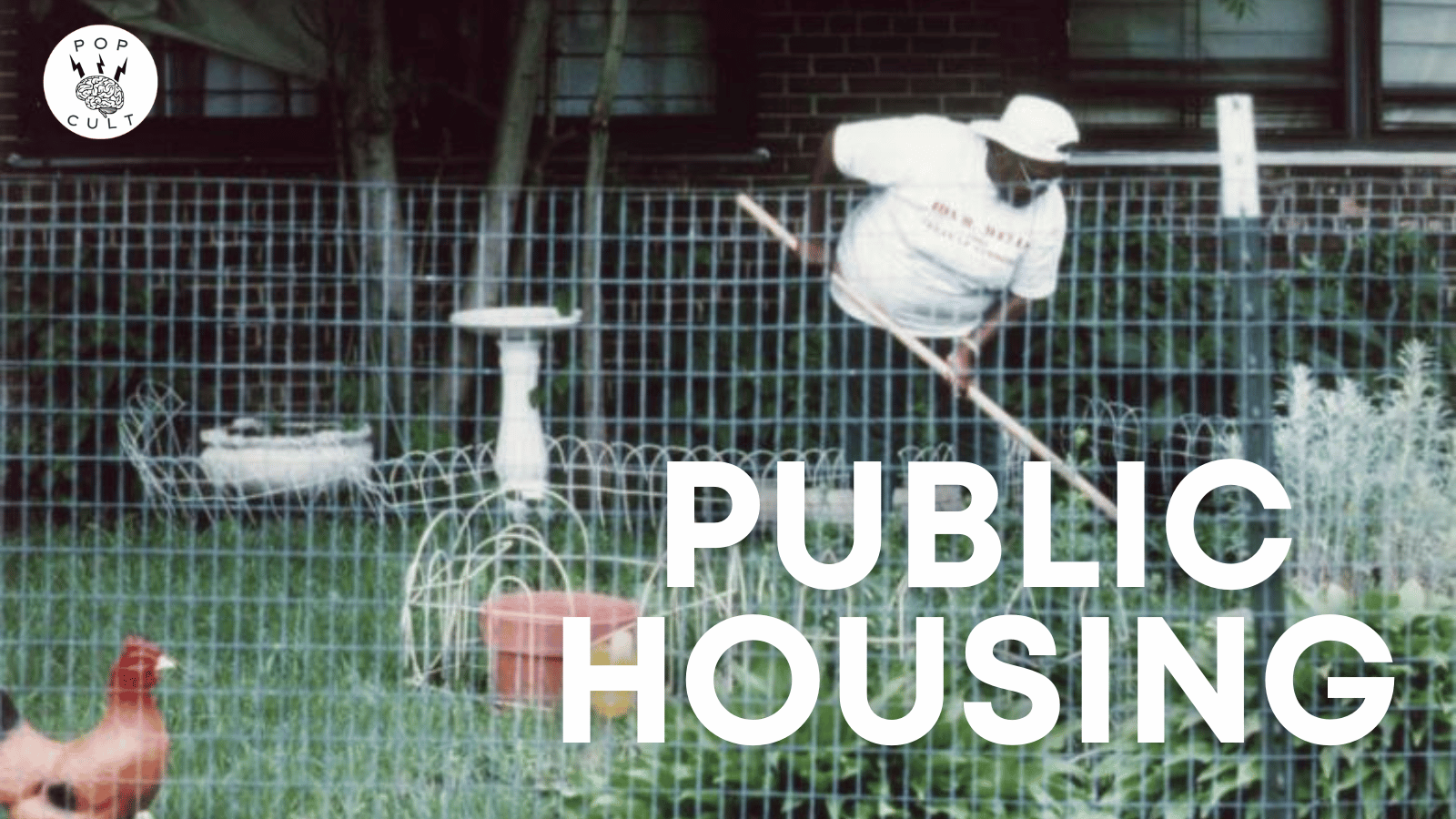
Frederick Wiseman didn’t slow down in the 1980s or 1990s. He continued to put out a film almost every other year about topics as varied as horse racing, a Neiman Marcus department store, Central Park, and a series of docs about people with disabilities. In 1997, he delivered this three-hour exploration of the politics that governed the Ida B. Wells public housing development in Chicago, Illinois. Much like Welfare, Wiseman is trying to capture the voices of the people in power within the institutions as well as the recipients (or people who should be getting, but often don’t get) these services.
Just before Wiseman’s filming, the US Department of Housing and Urban Development took over the Chicago Housing Authority and ordered the demolition of high-rise buildings. This demolition would be completed in 2002, but you can see how changes to the public assistance system made life hard for people who never had much. Despite the decision of the Clinton administration to pivot to the right and destroy America’s already underfunded welfare system, the people in the Ida B. Wells homes are attempting to live with dignity. It can be a frustrating documentary to watch, but it is the people who give you hope.
Early in the doc, Wiseman shows us an encounter between Chicago PD and a woman standing on a sidewalk. She’s immediately treated like a criminal. Their reasoning is that anyone just standing on a corner is, by default, a suspect in drug dealing. There is some logic behind this based on how street-level drug dealers operate, but I would think you need a hell of a lot more cause to treat someone the way they do. What I think makes this interaction even more difficult to get through is that the officers are both Black men. I don’t know much about the woman they are speaking to beyond what the documentary shows me, but I could tell she was someone who needed help, not harassment. However, the police, by design, cannot help people; they only protect the interests of the monied classes.
There’s Helen Finner, a community leader, calling the housing authority to demand placement for people in need. Wiseman captures her on the phone in her office; a young woman sits to the side, holding a child. Finner knows she is being filmed and uses this to her advantage, bringing up uncomfortable truths that the CHA would prefer not to bring up. She talks about the many vacant units that don’t correlate to the massive waiting list she is told exists. Finner is a person you don’t want to get in the crosshairs of because she will fight to house every person who walks through that door.
I started thinking about other Chicago films from this era, Candyman and Hoop Dreams, and how they reflect this reality. Like many horrible things in the States, there is often a precedent that can be found that not enough people gave attention at the time. The corporate gentrification of urban spaces that has come to make many of America’s cities fortified police fiefdoms is emerging from the soil in these art pieces. Decades earlier, Black people had migrated out of the South and into the Northern industrialized cities because there were plenty of jobs. Then, to crush unions and maximize profits, these industries were obliterated. Through austerity policies done by Carter, Reagan, Bush Sr., and Clinton, we saw the States’ industries crumble and shipped overseas. The fallout is what Wiseman presents in his documentary.
The director chooses to jump back and forth between laborious, long meetings between local leaders and federal representatives & the lives of the ordinary people in the Ida B. Wells homes. The meetings often have someone speaking in the pattern that has become familiar in the Obama era. I’ve heard variations of this type of speech used by other contemporary politicians like Pete Buttigieg and Vivek Ramswanay. It’s rehearsed, deceptively congenial, but ultimately just as manipulative as any other form of rhetoric. The residents of Ida B. Wells are told everything looks bright and the slashes & cuts made by the Clinton administration are actually the best thing that could have happened for them. Lies from top to bottom.
Public Housing is an excellent reminder that our institutions have been gutted, and those in charge do not have the best interests of the people they are meant to serve at heart. Those interests have been diverted to what corporations demand. Real estate in these large cities is inflated in value, and owning it is a lucrative move. The problem is all the working people who live there. Putting the already insufficient American social safety nets through the shredder did the job in the 1990s. Yet it hasn’t diminished the anti-Black & anti-poor rhetoric among working-class people that anyone receiving assistance is being lazy….well, except for them, right? They really need it; it’s everyone else who abuses the system.
How do the people in charge in this documentary suggest the working poor handle these destructive changes? During one meeting, a former NBA star turned spokesperson for the federal government tells residents of Ida B. Wells that they can start small businesses in their community. His example is paying people to turn lightbulbs on and off in the complex’s public spaces to save money on electric bills. Then, they can come on bended knee to the housing authority and ask very nicely if they might have part of those savings. It is one of the most insulting things I’ve seen caught on film, the type of logic that only comes from someone who “got their bag” and now doesn’t really care what happens to people living back where they started. In other words, it’s the goal of capitalism to alienate us from each other, to see only our own immediate needs & desires as important and everyone else as not even human.
Every solution presented to the residents has this in common: The problem is not the society’s; it is yours, so fix it yourself. Malcolm X once said that if you stab a person and then pull the knife halfway out, it doesn’t mean things have gotten better. This is the equivalent of blaming the person in need for being stabbed by their attacker. Some well-meaning people from outside the community do what they can – a Catholic nun runs a weekly thrift store set up in a parking lot, allowing residents to purchase new clothing or other items at significantly discounted prices. What gets in the way is the lack of funding or how the funds are kept at the top of the food chain, eaten by executive directors and boards paying themselves in the six figures. There’s absolutely no effort to address the centuries-long systemic problems that have brought people to this current state of affairs.
If nothing about this documentary breaks you, then one scene must: a mentally disabled old man is forcibly evicted by Chicago PD. The officers (also Black, underlining the way the system makes people turn against their own communities) dispassionately inform the man he has to leave. This resident can barely speak and depends on a cane for movement. One officer pathetically attempts to toss some belongings in a plastic grocery bag, but we know most of this old man’s possessions are being sent to the landfill. Juxtapose that with a rap music video filmed in the complex where the residents are encouraged to be part of the fawning crowd to a musical performer who might donate something to them – if his accountant has informed him, he can write it off on his taxes.
Public Housing is a must-see documentary because it will awaken you to the fact that all that’s changed really is that things have gotten worse for people on the bottom. Once, you might have had a shot at some type of subsidized shelter. However, as we look at the skyrocketing homeless population, you’ll most likely live on the streets. Is it any wonder so many seek out drugs & alcohol to kill their conscious experience in this Hell that begins at birth? I don’t blame a single person in these circumstances for shooting up. They shouldn’t have to experience such unceasing cruelty without an escape hatch.
As we look down the barrel of the 2024 election gun, the same two bullets loaded in the chamber four years ago, we must admit that nothing about the current political structure works for anyone but those at the top. Housing, like education & healthcare & essential nutrition, should never have been commodified in the first place. To turn these foundational elements of being alive into something intended to make a profit is obscenity. I hope people can look back at Wiseman’s documentaries and not see them as a reminder of the decline of living in the States, but as a relic from long ago, that doesn’t reflect the present situation. Sadly, I don’t think that will come in my lifetime.

 PopCult Reviews
One thought on “Movie Review – Public Housing”