
City Hall (2020)
Directed by Frederick Wiseman
At age 94, Frederick Wiseman is still making documentaries. While elements of his style have changed over the decades, and he has very distinctive periods within his filmography, Wiseman has always retained sight of what is important to him in making docs. He believes presenting a moment as true to the heart of what was happening when the camera was rolling is more important than anything else. The process of making movies is inherently biased. There is no way to be objective in the editing bay; each cut is a subjective choice, and we can see that it feels different when someone re-edits a movie. Wiseman does not believe his films are THE final word on anything. They are simply the director and his camera being present in a moment and capturing what happened.
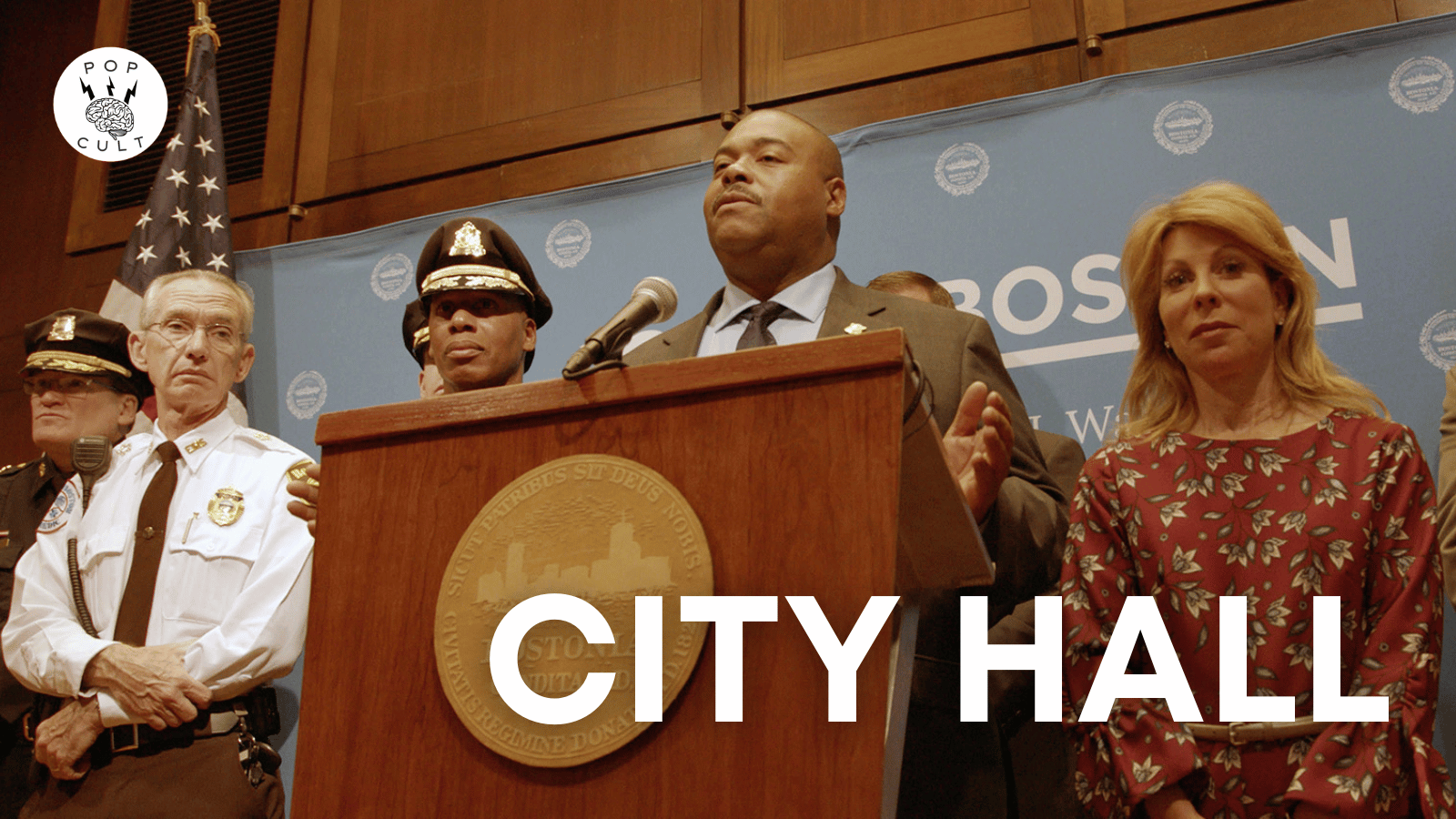
Filmed from the fall of 2018 to the winter of 2019, Wiseman explored the day-to-day activities of the Boston city government. There is no narrative arc, more a collection of short films, sometimes interlinked, about how the city operates and delivers services to its citizens. Marty Walsh, mayor of Boston at the time of the film, is the most recurring face we see. He leads meetings among department heads, attends public events, and does what he can to keep the city functioning. Climate change and the rising sea level are some of the topics you can tell Walsh is very concerned about. Boston is directly threatened by such drastic changes, but as the documentary continues, we see how limited a city government is in addressing global crises.
I visited Boston early in Walsh’s tenure as mayor as part of a work trip to observe some of the schools in the area. It was my first time in the city, and I could see anyone put in charge would have a lot on their plate. Those of you who know understand how awful traffic is in that city. I was astounded at how long it took to go a couple of miles by car in the middle of the downtown area. I also think Walsh is ultimately a liberal and, therefore, a defender of capitalism, and that limits what he can do in significant ways. The capitulation to corporate interests is ever-present; every initiative seems to be a partnership between the city government and a business, with the private business getting the better end of the deal.
Through Wiseman’s documentary, we also glimpse community moments. Thanksgiving is observed at Goodwill Industries, the mayor listens to veterans at Faneuil Hall, and the city celebrates achievements and grand openings. On the flip side are the services. We get snippets inside 411 call centers as operators listen to people’s inquiries and either direct them to the correct department or relay the message to someone who can go into action immediately. Meetings are held around the development of new construction in the city, an eviction prevention task force, the economic advancement of Latina women in the city, and small-time contractors submitting their complaints about how the city hands out deals to only large megacorporations.
Clocking in at four and a half hours, City Hall covers a lot. Yet, there is a part of the conversation missing here. Almost every problem in the city can be linked to capitalism and the commodification of basic necessities. Now, you can say that the city of Boston can’t possibly push back against capitalism even if it wanted to because that is just how things are. I don’t think we can cure cancer if all we do is hand out pain relievers for the symptoms but never address the tumors and growths happening inside.
There will always be inequity in capitalist economies. It is part of the design. You can have a task force dedicated to preventing evictions, but if you allow housing to remain commodified, you’ll never put that fire out. If housing remains a way for some people to turn a profit off the labor of others, then the landlords will also seek to maximize their profits. In cities like Boston, where real estate and rents skyrocket as a result of these predatory tactics, you will always have a portion of the population that is homeless or living in chronic housing insecurity. The actual solution is not band-aids but ending the commodification of housing. Everyone deserves a place to live, no matter who they are or how much money they make. And they deserve a nice place to live because they are human beings with inherent dignity.
Wiseman acknowledges, in his trademark nuance, that Marty Walsh is a good person who wants to make Boston the best it can be. There are also lots of well-meaning civil servants working at every level of the city government who have great intentions. The problem is that they are pinned inside a box that limits how they can respond. The stakeholder that holds most of the power in these interactions is a private corporate interest. Cities do not belong to their citizens; they belong to the wealthy, who get to shape & reshape them however they please. The U.S. government has formally acknowledged that money is the only form of speech that matters (see Citizens United), so those with little wealth are the first to be displaced and tossed into a corner, forgotten.
My takeaway from City Hall is that it is a lamentation of the failures of four decades of neoliberal economic policy. Nothing trickled down that helped anyone. Democrats have adopted Reagan-era economic policy and act like they are “progressive.” I mean, technically, anyone looks progressive when they are compared to the denizens of Hell that make up the Republican Party. You won’t see an inquest of how it got to be like this in this documentary. You would need to read a text like Thomas Frank’s extremely accessible Listen, Liberal: Whatever Happened to the Party of the People?
The Vietnam War tore apart the Democratic Party, and that was made evident in the 1968 presidential election. As a result, the McGovern Commission was set up to figure out what exactly went wrong. Before this commission, the States did not have this prolonged primary season state after state. Primaries are a good thing in theory because they allow for even more democracy in choosing candidates. That is if the process of selecting who makes it that far is free & open.
The McGovern Commission also suggested that the Dems shift their focus away from organized labor. Part of this is that labor unions sided strongly with Johnson when it came to the Vietnam War. At the time, labor was many steps behind where it should be, but I don’t think that warranted abandoning it. It left the Dems without a solid economic focus by pivoting away from labor. So it became the growing white-collar professional class that Dems catered to, leading to their current state, paying lip service to unions for their financial contributions but being much more capitulating to what Wall Street desires regarding policy.
Wiseman’s City Hall is a case study of where this led. Boston is a city full of potential, and it’s getting eaten up by business interests that would love to hollow the town out and move on to the next victim. That is the inevitable outcome of capitalism. You cannot have infinite growth in a finite world, so hierarchies are erected to sort people. The winners get everything, and the losers die young, likely unable to ever retire. You can have an army of well-meaning civil servants busting their asses every day, but it won’t matter if the system they operate within is designed to ensure those being helped end up on the losing end.

 PopCult Reviews
One thought on “Movie Review – City Hall”