
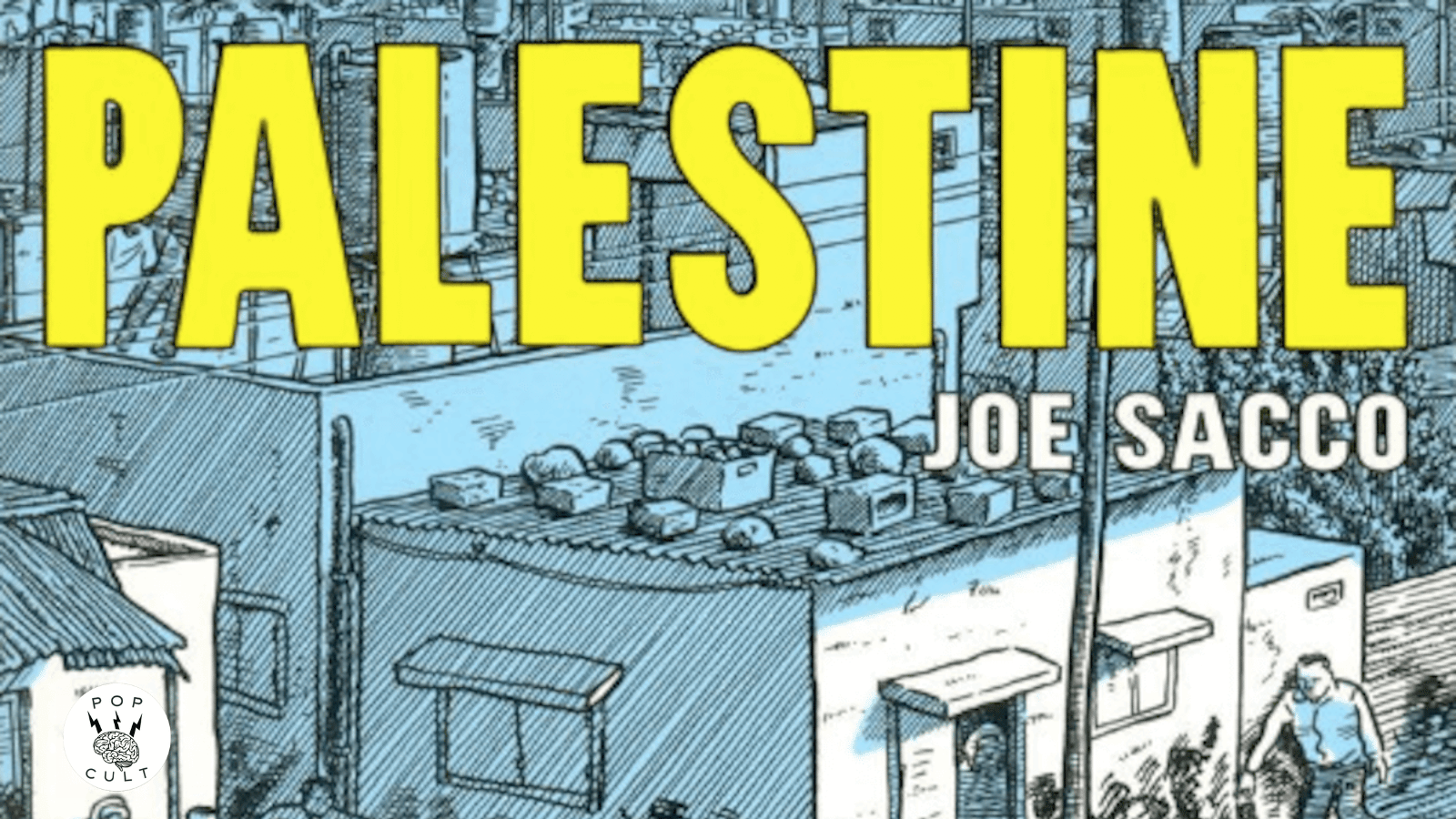
Palestine (Fantagraphics)
Written and illustrated by Joe Sacco
Journalist/cartoonist Joe Sacco visited the Palestinian territory during the First Intifada (1987-1993). You may have seen the word, Intifada lately, and, depending on how you had explained it to you, you very possibly got the wrong definition. The Intifada was a period of sustained protest and civil disobedience by Palestinians against the Israeli occupation. 1987 was the twentieth anniversary of the Arab-Israeli War, which saw the occupation seizing even more territory, pushing the indigenous Palestinians into smaller & smaller walled-off spaces. Sacco spent a lot of time visiting the West Bank and Gaza Strip, having conversations with Palestinians of all ages who had all experienced brutality at the hands of the Western occupying force. He recreates these moments in this incredibly moving graphic novel.
Sacco can get past the headlines & talking heads to see the way people live in these concentration camps. Beyond showing how the Israelis do constant harm to the Palestinians, Sacco also shows how complex life is in their culture. Like any cultural group, they are not a monolith, and a variety of responses to the Israeli aggression are held by the people of Gaza and the West Bank. The book outlines how Hamas has changed in response to the larger Palestinian whole, becoming less militant as they see these tactics are not being met with growing unity. It’s made very clear that even within the Muslim Palestinian population, there is not one single way of approaching their multi-generational crisis. The one point of communion is that the current occupation cannot stand.
We must never try to argue that any group of people deserves to be protected from genocide because they are angelic and good. It doesn’t matter. Genocide is unacceptable. Period. We do not need to have model minorities to say why it shouldn’t happen. This is something I have seen become lost in the discourse of a lot of U.S. Liberals who have chosen to go all-in on defending Israel. Across social media, I see people telling queer pro-Palestinians that they shouldn’t support the Palestinians because of an assumed homophobia embedded in the culture. Perhaps there is a strain of virulent homophobia. So what?
As someone who grew up in “real America,” homophobia is baked into the DNA of that culture. Homophobia is bad. But just because someone is, it doesn’t mean they are stripped of their human dignity. The hope would be that, over time, cultures would become more accepting. Some queer Palestinian people have been and will be executed by the occupying force, but somehow their identities get erased by Westerners who purport to support human rights. The same with Western feminism and the tens of thousands of Palestinian women who have been slaughtered, imprisoned, and tortured during this current phase of the occupation in the last few months. Those women and their rights are made invisible by the “girlboss” cheerleaders in the States.
Sacco can tell so many stories succinctly yet never lose their impact. People’s experiences having their homes bulldozed, going from having a home to houseless in hours. Family members are murdered in front of people’s eyes and then are denied access to the body for burial by occupation soldiers. People made to wait for hours, dropped in the middle of nowhere, only to realize no one was coming back to help them. Forced to drink contaminated water and food. The Israelis do not see Palestinians as human beings, in the same way the Nazis viewed Jews as vermin to be wiped out.
Throughout the text, Sacco does a great job of taking in what he has seen & heard, questioning his own perspective, even hearing from Israelis or visiting Zionists. The conclusion he comes to is a very logical one – that the treatment of Palestinians cannot continue. This ongoing genocide is morally wrong on the most profound level. He does this by allowing himself to not define Palestinians based on the rhetoric of the Western media or the Israelis he meets but by looking at the actual people. He learns about how Palestinians organize themselves while in prison to the point that the Israelis have to regularly rotate out the guards because they become too sympathetic to the prisoners. They, too, see their undeniable humanity.
He also does an excellent job of contrasting life in Tel Aviv versus Gaza. The former feels like a pleasant place to visit or live. All the comforts of life are available, and basic amenities are provided. It makes sense to him why tourists come away with such a positive view of the occupation. It’s in crossing the checkpoints and speaking with the people in Gaza that Sacco’s perspective expands. One of his translators opens his home for Sacco to stay in. He gets an up-close view of how the occupation makes life miserable. Educators work without pay because there aren’t enough resources for them, yet the children must learn, or the people’s knowledge of their history will disappear. The Israelis certainly aren’t going to provide an accurate record.
I couldn’t help but recall the work of Art Spiegelman on Maus while I read this. This made me want to research his stance on Palestine, which I was happy to discover was not caught up in the blind Zionism of so many who share his background. Spiegleman stated in an interview with The Telegraph, “My feeling is that America shouldn’t be subsidising this terrible thing [Israel and the Palestinian occupation]. My sympathy and my charitable giving often goes to Palestinian causes, not because I think the Palestinians are pure but because somehow the text of Maus leads me into having to support them.”
This is how you can judge if an artist is honest & authentic when their previously stated beliefs are shown to be consistent over time. How can Spiegleman detail the methodology and intergenerational effects of the Holocaust and not condemn genocide in all its forms? It shows us he is a consistent and moral person. The same goes for Sacco, who doesn’t deify the Palestinians but reminds us of their humanity.
Sacco self-reflects and critiques himself throughout the text. The conclusion the book comes to as he converses with a colleague about the situation is that a two-state solution that allows the continuation of this conflict solves nothing. This conflict is present across the globe – cultures clashing and drawing lines across a map to eke out bits of territory. I am a firm believer in simply not allowing that. People must be forced to live together and get along for one express purpose: we are all we have in this universe.
None of the problems of our time or the ones to come will be solved by atomizing into smaller and smaller units. That’s how we ensure the extinction of our species. Those who have benefited from an oppressive system have to go first to acknowledge how our comfort was predicated on the suffering of others. We have to let those comforts go. They were never worth it in the first place. We have to wrestle honestly with our ancestors and their mistakes. We have to seek reparations for the descendants of the people our ancestors victimized. It may not have happened on our watch, but the benefits have continued in our favor, and now it is our responsibility. Clearly, this is something that far too many refuse to engage with. But they must be forced to. Otherwise, humanity has no place on this planet and will be its destruction.

 PopCult Reviews
One thought on “Comic Book Review – Palestine”