
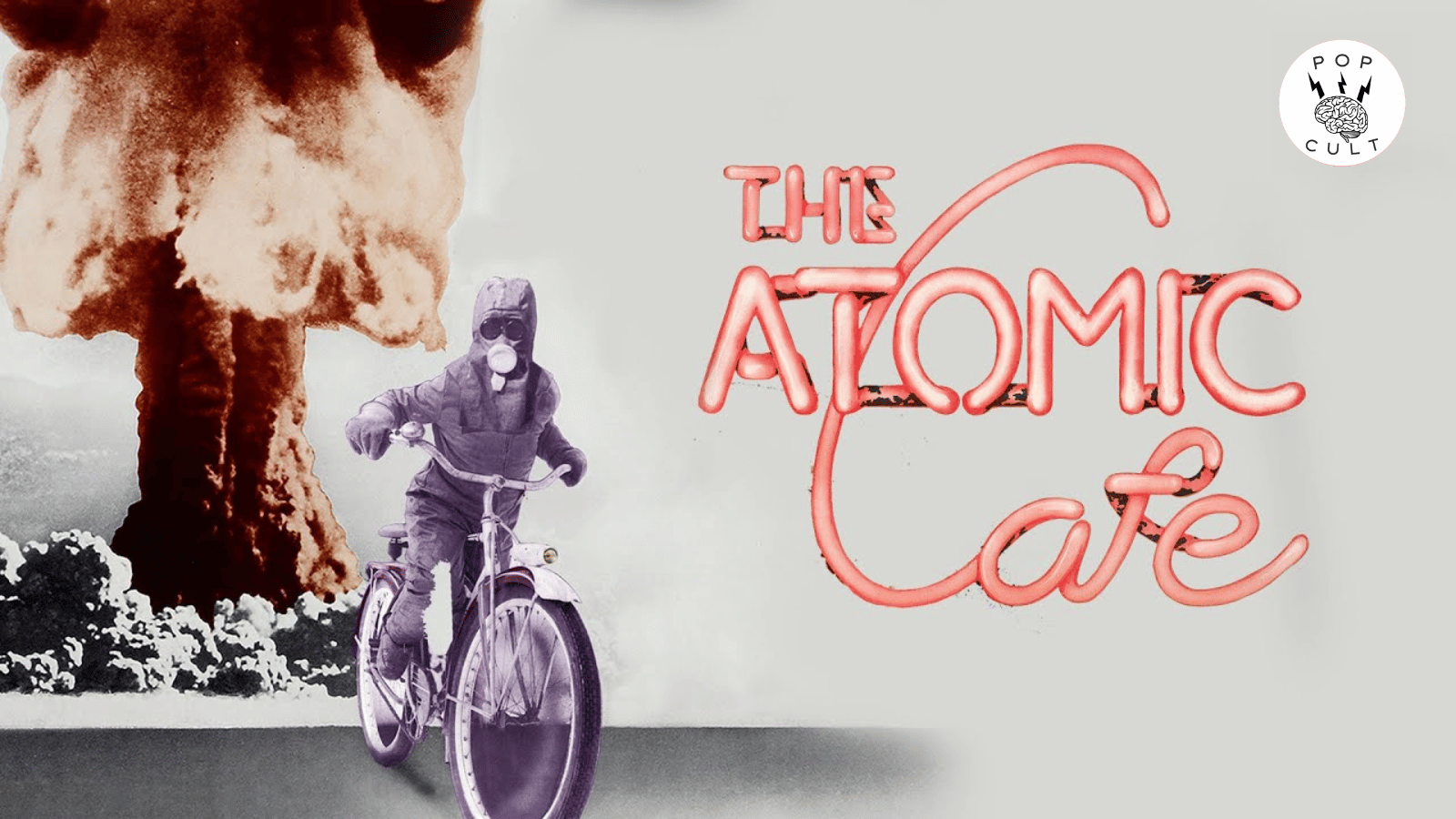
The Atomic Cafe (1982)
Written and directed by Kevin Rafferty, Jayne Loader, and Pierce Rafferty
The context of the atomic bomb at its inception is not the same as it was viewed by the public two decades later. Our relationship with this weapon of mass destruction continues to evolve. We no longer have children practice “duck and cover” drills under the fear that the Soviets or their allies might launch nukes on the United States. Those drills weren’t really about protecting anyone if a bomb was dropped. We can look at what happened to Hiroshima and Nagasaki to see that our buildings would be of little protection to anyone. Those drills were about instilling fear of communists in the population. This is quite ironic, as no communist nation has ever dropped an atomic weapon on a civilian population. That “honor” is held by one country on this planet, and they did it twice.
Jayne Loader and brothers Kevin and Pierce Rafferty spent five years going through hundreds of hours of archival footage to construct The Atomic Cafe, a comprehensive look at the birth of the nuclear warfare age. Presented without a second of voice-over narration, in a style Loader referred to as “compilation verite,” the audience sees images from the 1940s into the 1960s. Much of this is newsreel or government film footage where a contemporary context highlights the absurdity of many statements. On a broad level, The Atomic Cafe is a meta-analysis of U.S. propaganda surrounding this weapon.
One of the most chilling moments is taken from a military training film where soldiers are instructed to walk directly toward a mushroom cloud in the case of a Soviet invasion of the United States. The voice-over in that film tells the soldiers that the effects of the cloud are minimal, and they will still be able to fulfill their duties in killing the enemy. The overly cheery tone is part of the indoctrination, convincing the soldiers that somehow the atomic bomb is a weapon of mass devastation that will wipe their enemies from the Earth while also being nothing to worry about if you have to march through it without protective gear. The narrator chimes in, “Viewed from a safe distance, the atomic bomb is one of the most beautiful sights ever seen by man.”
The Atomic Cafe can be viewed in two ways from my perspective. The first is a mockery of cheesy U.S. propaganda in the post-War era. These films should be seen as ridiculous and wholly disconnected from the reality of atomic energy and its weaponization. The other read is a survey of U.S. propaganda’s effectiveness in this specific instance. You could pick many different topics that garnered a lot of attention, and propaganda was made for, but the atomic bomb is particularly insidious because of what a horrific thing it is. There are moments where the creation of the bomb is connected to the Christian god, an alarming conclusion but very effective in villainizing communism and justifying the proliferation of these deadly tools.
This is important because it is easy to reflect retrospectively and point out absurd rhetoric. How well are we doing with that about contemporary events? The propaganda is just as strong today because it has become savvier in some instances. Russia’s invasion of Ukraine is terrible. But blind devotion to NATO and Zelensky doesn’t make things better. Sadly, things have reached a point in occupied Palestine where groups like Hamas do kill. Yet, we have to have a complex understanding of how colonialism is responsible for things reaching this point and for a group like Hamas coming into existence.
One area where propaganda seems unable to be defeated is energy consumption. The planet is clearly dying as we look at temperature records being broken across the globe this year. Antarctic ice is melting at an unprecedented rate. The oceans are heating, leading to a significant disruption in the food chains, which could lead to mass extinction in our lifetimes. Yet, energy corporations pump out propaganda telling us they donate to some do-nothing environmental charity or trying to convince us that individual choices will have the most impact and not rigid corporate regulations.
So much of this propaganda is momentarily effective but is revealed as farce decades later because it is based on fear. Fear is not a long-term sustainable motivator but can get people to react in the moment. Looking at the history of the atomic bomb, the logical perspective would be for the rest of the world to be terrified of the United States. When you look at the power shift that occurred in the post-war era, that is clearly what happened. It continued as the U.S. spends astronomically more on its military budget than every other nation. Being afraid of U.S. imperialism, which uses the bomb as an ambient threat in the background, is justified.
When we look at U.S. propaganda regarding the bomb, it presents something illogical. We were told Americans should live in fear of the Soviets dropping the bomb on them. Why? The reason the arms race happened was incited by the U.S. The Soviets and other nations began stockpiling weapons, including nuclear bombs, because the U.S. used them. They thought they could ensure their safety by building their own, testing them, and making this widely known. Today, I see North Korean atomic bomb tests as a justified act. There was never a formal cessation of the Korean War, and the continued presence of the U.S. in South Korea is an act of war. I don’t have to agree with the North Korean regime to understand the need to protect themselves from a proven threat to life.
The Atomic Cafe brings us back down to Earth with footage of the victims of the bombing of Hiroshima and Nagasaki. We see human beings pushed to the edges of their sanity and physical existence. Their bodies have been deformed instantaneously for some; for others, they will suffer slowly over the rest of their lives. There’s also the intergenerational cost, children born into an irradiated world who never had a single choice and suffer because of the actions of people on the other side of the world.
We should not discount that the Japanese government was fascist and part of the war coming to their front door was their fault. However, when you witness the scope of the horror caused by this weapon, it should make you feel disgusted with ideas of collective punishment. The United States is a war-mongering fascist nation. Do you believe atomic bombs should be dropped at the doorsteps of the average citizen? Somehow, we find ways of making exceptions for ourselves at every turn.
One of the great evils of our neoliberal era is the effort to disconnect us from our own history. History has not ended; it is not something from the past; it unfolds all around us. When our institutions lull us into passive complacency, they cause us to forget this fact. We see our existence as a construct of moving parts that ensure our comfort. The “great” wars are all happening in some fantasy place called “the Middle East” or “Africa.” The United States’ geographical distance is what made it so confident in dropping the atomic bomb. It’s that distance from the violence we cause today that keeps us feeling as if we are safe.
When there is a retributive act, 9/11, for instance, it is a genuine shock to our numbed sensibilities. We are confronted with the consequences of our actions. We are reminded that we are in history, and the reaction of so many Americans is hostility toward that fact. Our ignorance of this inevitable truth can be observed in the rabid anger of certain parts of the citizenry regarding the Palestinian genocide. These Americans argue very loudly that their immediate comfort should never be disturbed by the plight of another, even if that harrowing condition is caused by our government’s active support of the occupation. In a decade or more, we will react with shock that the survivors of our actions will justifiably strike back at us somehow.
Today, we do not walk around fearing the atomic bomb in the United States for one simple reason: The Soviet Union was taken down by a mixture of internal collapse & Western interference. The one entity that used atomic weapons as a successful deterrent against the United States (the Soviet Union via Cuba) is gone. China has nuclear weapons, but economic warfare is far more effective for their purposes with less horrific damage. North Korea doesn’t want to launch an atomic weapon because they know it would be met with brutal reactions, yet they cannot afford to exist without one. Iran understands its role in the Middle East, and thus, having an atomic weapon serves a similar purpose: to keep enemies in check. Pakistan and India build up their arsenals out of fear of what the other might do. Likely, the world would not be in this state if the U.S. had not developed and dropped two nuclear weapons on Japan. Anxieties about the bomb are borne entirely out of that event.
The Atomic Cafe should not just be a mockery of past generations’ ignorance & gullibility but a reminder that we are in this same process of being indoctrinated. Re-education is a necessary process because, from the moment of birth, you are inundated with indoctrination from every institution. “The police are good guys.” “Other countries threaten peace, not the United States.” “It’s human nature to be unable to cooperatively work together.” By treating propaganda like common sense, we encourage people to shut off critical thinking. When they encounter ideas antithetical to what is pushed by the institutions in their societies, they will see these new ideas as a threat to the very minimal comfort & distraction provided to them. Yet, it is only through our ability to imagine a better world, not settle for the horrors we were given as a birthright, that we hope to save this planet.

 PopCult Reviews
One thought on “Movie Review – The Atomic Cafe”