
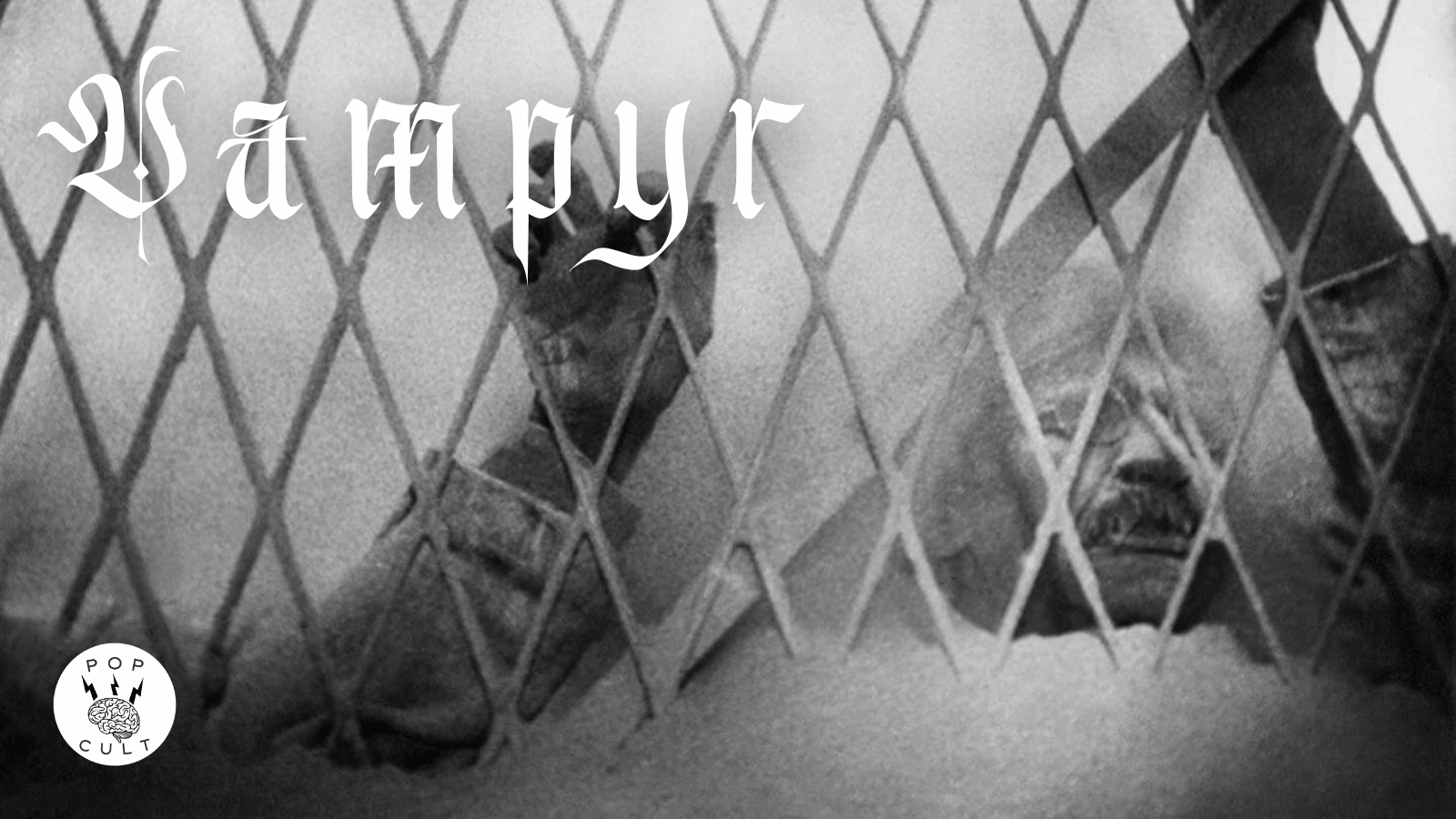
Vampyr (1932)
Written by Christen Jul and Carl Theodor Dreyer
Directed by Carl Theodor Dreyer
Vampyr is a strange, troubled movie. It was Danish filmmaker Carl Theodor Dryer’s follow-up to The Passion of Joan of Arc, one of the great silent masterpieces. Vampyr came about at a time of transition in films. Dreyer conceived of the film, based on a collection of ghost stories, as a silent picture. That DNA is still very present in the sparse spoken dialogue and the film’s emphasis on movement and camerawork. The end result is a mixed bag. There’s not enough story here to say it’s a compelling horror narrative. It feels more like an interesting mood piece that evokes the spooky tone of Halloween and creepy old houses.
Allan Gray (Julian West) is a young man interested in the supernatural. He wanders Europe studying the occult and ends up at an inn in Courtempierre, France. It’s a quiet, rural community. During his first night in town, Allan is awakened by an old man who enters his locked room. He leaves a package on Allan’s desk, which contains a note that reads, “To be opened upon my death.” This captures Allan’s attention, and he starts searching. Along the way, he witnesses spirits cavorting about the village at night, an old woman who seems to hold the spirits in her thrall, and a mustachioed man with sinister intentions. Eventually, our protagonist opens a package to find a book detailing the vampire, a creature that drinks the blood of its victims, and a greater mystery unfurls.
Going into Vampyr, I expected a variation on the told and retold Dracula framework, which was the same narrative that fueled Nosferatu. The film completely flipped my expectations. Instead, we get a deconstruction of horror tropes remixed into the loosest narratives. A movie like Skinamarink might be the closest for a modern comparison. The images you expect are present – a door opening by itself, a shadow that moves independently of its human, and a man walking down a lonely path through the woods at night. It’s the way Dreyer chooses to shoot the image that imbues it with a midnight fantasia sensation that we are piercing the veil and seeing beyond the material world.
The less revolutionary part of Dreyer’s work is the evil vs. good, heaven vs. hell setup. Dreyer was an ideological conservative in the Danish tradition. He was born to an unmarried woman, a maid, and was put up for adoption by his birth father, a married farmer. After two years of living in orphanages, Dreyer was adopted by an emotionally distant couple who adhered to Christian traditions. Dreyer said that he did not believe in revolutions and preferred the idea of slow evolutionary change in the social and political realm. We see this in Vampyr through the doctor being a figure of evil while the nuns are paragons of virtue and hope. There’s no real chance you’ll be surprised by a plot twist, as that portion of the film runs very straightforwardly.
The framing of these ideas takes the film into a whole other realm. The black-and-white nature of the universe is extruded through a lens of abstraction. Every image is so striking and esoteric that whether this is literally happening to Allan or it’s all his dream becomes unimportant. The realm of sleep and nightmares has seeped into the waking one, and now we’re all along for this strange ride. At one point, our protagonist must enter a dream where he becomes a ghost who can see his own corpse because it’s the only way he gets answers to seemingly impossible questions. There are also moments in this film beyond my understanding to summarize.
The imagery of the final moments reveals a hint at what Dreyer was attempting to communicate in the whole work. Two shots are juxtaposed: our hero and the woman he’s saved walking towards the light in an idyllic forest. Then, we see the cranking gears of the mill machinery. This is a declaration about modernity and its relationship with our lives. Are they walking away from the machinery that saw an end to their foe and living in peace with nature? Or is the machinery what lies underneath the dreamlike nature of reality? We view the dream of the ending and the moving parts that make it happen. At its most basic, cinema is a dream born out of machines.
Vampyr is a very unique horror experience. I can easily see why someone might not enjoy this because it is totally unconcerned with popular narrative structures. This movie is interested in thematic concerns, how images interplay with our subconscious, and the communication that good must defeat evil. It was released after being delayed for Universal’s Dracula and Frankenstein to audiences that did not like it in Europe and the States. People either found the whole thing hypnotic & enthralling or something ridiculously stupid. I can’t say I adored it, but Dreyer continues to impress me as a filmmaker who pushed the visual boundaries of the medium. He clearly saw the world in a certain in his head and was able to pull that out and put it on film.

 PopCult Reviews
One thought on “Movie Review – Vampyr”