
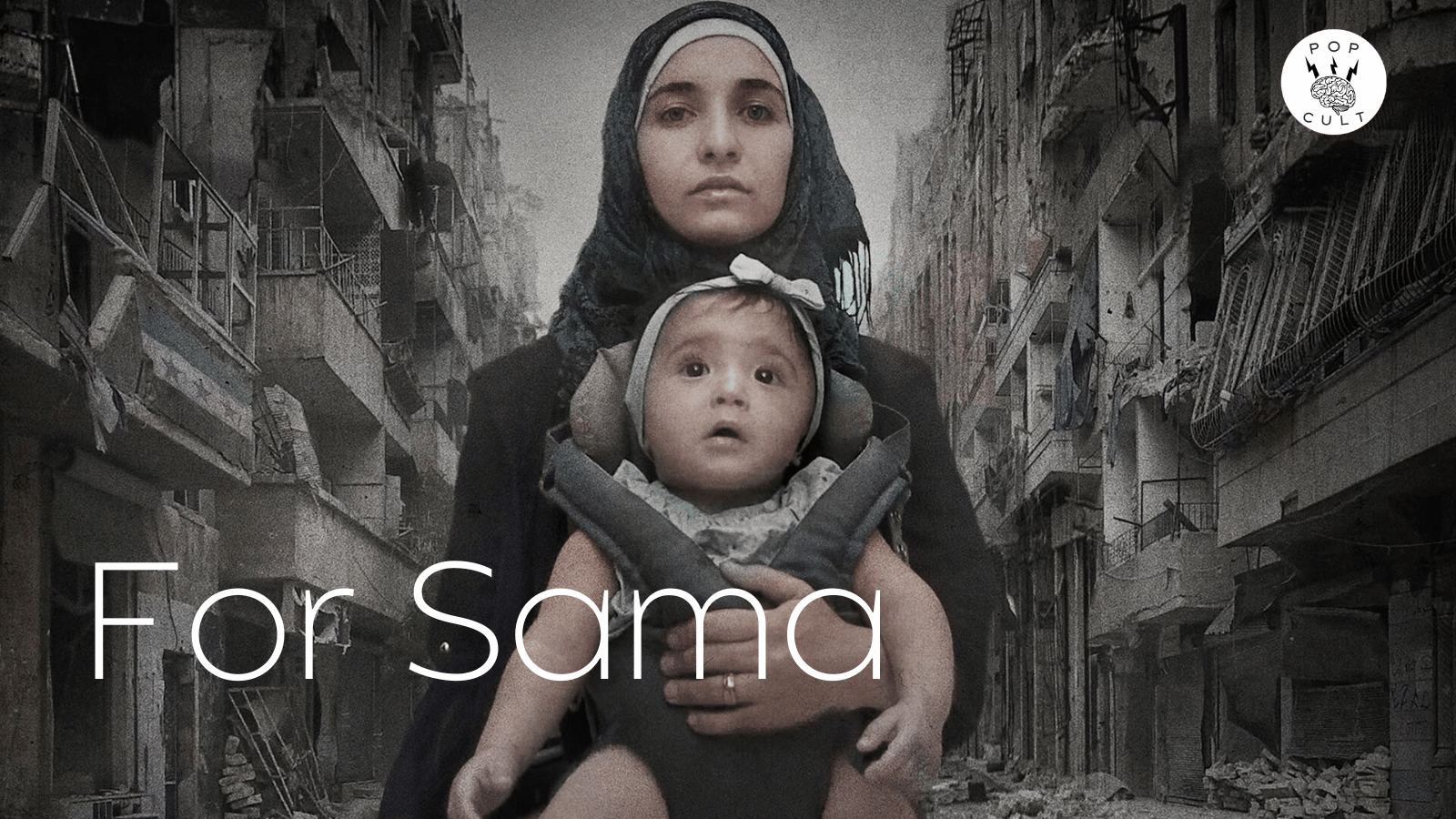
For Sama (2019)
Directed by Waad Al-Kataeb and Edward Watts
Our film series for March is 13 Countries, 13. On the website Letterboxd, if you pay for an annual subscription, you unlock a stats page that tracks your films watched. One feature I started looking at was the world map highlighting the countries from which you’ve seen movies. I decided to go through all the countries I hadn’t seen a film from and select a feature to watch at some point. While I won’t be watching them all in one go, I decided to pull some of them for this series.
For Sama is a documentary shot in Aleppo, Syria, during the uprising and subsequent siege by the Syrian government aided by Russian forces. The film is shot by its subject, Waad Al-Kataeb, a journalist who stayed behind in Aleppo with her husband, Hamza, a medical doctor. During this time, she gave birth to their daughter Sama, and the film is framed as a letter written to this child about the circumstances of the first few months of her life.
The Syrian uprising began in March 2011 as part of the Arab Spring, with protests against President Bashar al-Assad’s government demanding political reforms, economic improvements, and an end to corruption. Inspired by movements in Tunisia and Egypt, demonstrations started peacefully but were met with brutal crackdowns by security forces, leading to mass arrests, torture, and killings. As violence escalated, opposition groups took up arms, and by 2012, the conflict had evolved into a full-scale civil war involving rebel factions, extremist groups, and foreign interventions.
The war led to a humanitarian catastrophe, with millions displaced and Syria becoming a battleground for regional and international powers. As of this writing, al-Assad has fled the country and resides in Moscow. Syria is not entirely in the clear, though. There are questions about internal stability, mainly because the forces that appear to have taken the nation possibly have US backing. More immediate are the Israeli forces currently making threats and moves to seize the southern part of the country.
Films like For Sama are the reason cinema should exist in the first place. The ability to capture such high-definition images of history and human cruelty is essential if we move forward as a species. The crimes of the Assad regime and its aid from Russia are undeniable because they are captured on digital video. Al-Kataeb was genuinely scared during moments when she was with people crossing the border that not only would they be arrested and “disappeared” but that this footage would be destroyed. She literally risked her life to ensure the outside world could see what happened inside Aleppo.
We meet many people throughout this film. Some of them make it to the end. Some do not. We see two brothers bring their youngest sibling to the doctor. The body is limp. It is evident life is gone. These little boys only know that doctors are supposed to help the injured. The medical professionals go through the motions to no avail. The brothers cling to each other in the hallway, weeping. One of the doctors, when he is finally alone, breaks down into heavy sobs. The child’s mother arrives and insists on carrying them back to her home. Hospital staff try to discourage her but eventually escort her home as she wails about her youngest child, her baby, dead because of a bomb.
We can easily see how al-Kataeb must have felt a lump in her throat, thinking of her Sama as she takes part in another mother’s grief. I have no children of my own, but many I see as “my children” that I think of in these instances. I would not have the strength to do what al-Kataeb did. I do not believe I would have stayed. We see others who remain, such as a school director who stays behind with her family because the doctors, ambulance drivers, journalists, etc., all need a place for their children to be while they work. It’s also an act of defiance that these people will cling to their lives as much as they can until Russian troops sit one block away, ready to blow them away.
Al-Kateab tells her story non-linearly, jumping from the present (living in the hospital as her husband tries to save lives) and what things were like before. They take part in student rebellions. They witness close friends murdered by the Assad regime. They fall in love, they get married, they buy a home. By the film’s end, we follow the journalist as she mourns the backyard garden she had so looked forward to having. It’s just some plants, but they represented something bigger for her.
There are miracles caught in these images. The most remarkable is a stillborn baby, skin pale, body limp. The doctors go through the motions, performing CPR, rubbing the baby’s limbs and chest, praying. It was one of the most incredible things to watch color, as if almost by magic, spread through the newborn’s body. Then, the rise and fall of its chest as it fills with oxygen for the first time. The baby lives, an act of defiance in the face of so much death & destruction. It’s also a testament to the resolve of these doctors and nurses. Giving up is not something they can think about during these times.
There is no lack of documentaries about war, but there are not many that communicate the humanity that exists within the battlefields. I don’t think anyone would have blamed al-Kateab and her husband if they chose to leave. I don’t think anyone ever has the right to tell someone how they should react in such circumstances. The fact that they stayed is a testament to a level of bravery and love that truly means to be human when the individualist ego falls away, and you become part of something collective, something greater than the Self.
I believe films and footage like in For Sama should be shown to the public whether they want to see it. In nations as geographically comfortable as the United States, it becomes very easy to cheer on war because you don’t have it on your face. Seeing these images inevitably made me recall the horrors I’ve seen come out of Gaza. Dead children’s limp bodies. City blocks laid waste. Yet, if you listen to US media, they will happily talk about Syria while Palestinian lives are verboten to mention.
Al-Kataeb has, unsurprisingly, come out in support of the Palestinian people. She’s a decent human being who sees the value in all lives. Meanwhile, the West seems only capable of viewing Arab lives as cannon fodder for their rolling war machine or only of value when they can blame Russian people for their deaths. America. Russia. NATO. Whoever is wreaking havoc on these people’s lives must be stopped. This is why I cannot condemn acts of “terrorism” as they are labeled toward the parties responsible for these atrocities. Russian forces didn’t care that they were slaughtering the people of Aleppo. The United States and their proxy, Israel, don’t care a whit about the lives of the Palestinians, whom they have walled into a kill box. They should not be shocked that the people whose lives they immiserate attempt to strike back at them, often in a manner so minuscule compared to the suffering caused by the imperial giants.
For Sama is a perfect film in that it uses the ability to capture moving images to tell a story of fundamental importance. For all the billions spent on Hollywood blockbusters, none of them can touch the true power of films like this one.


One thought on “Movie Review – For Sama”