
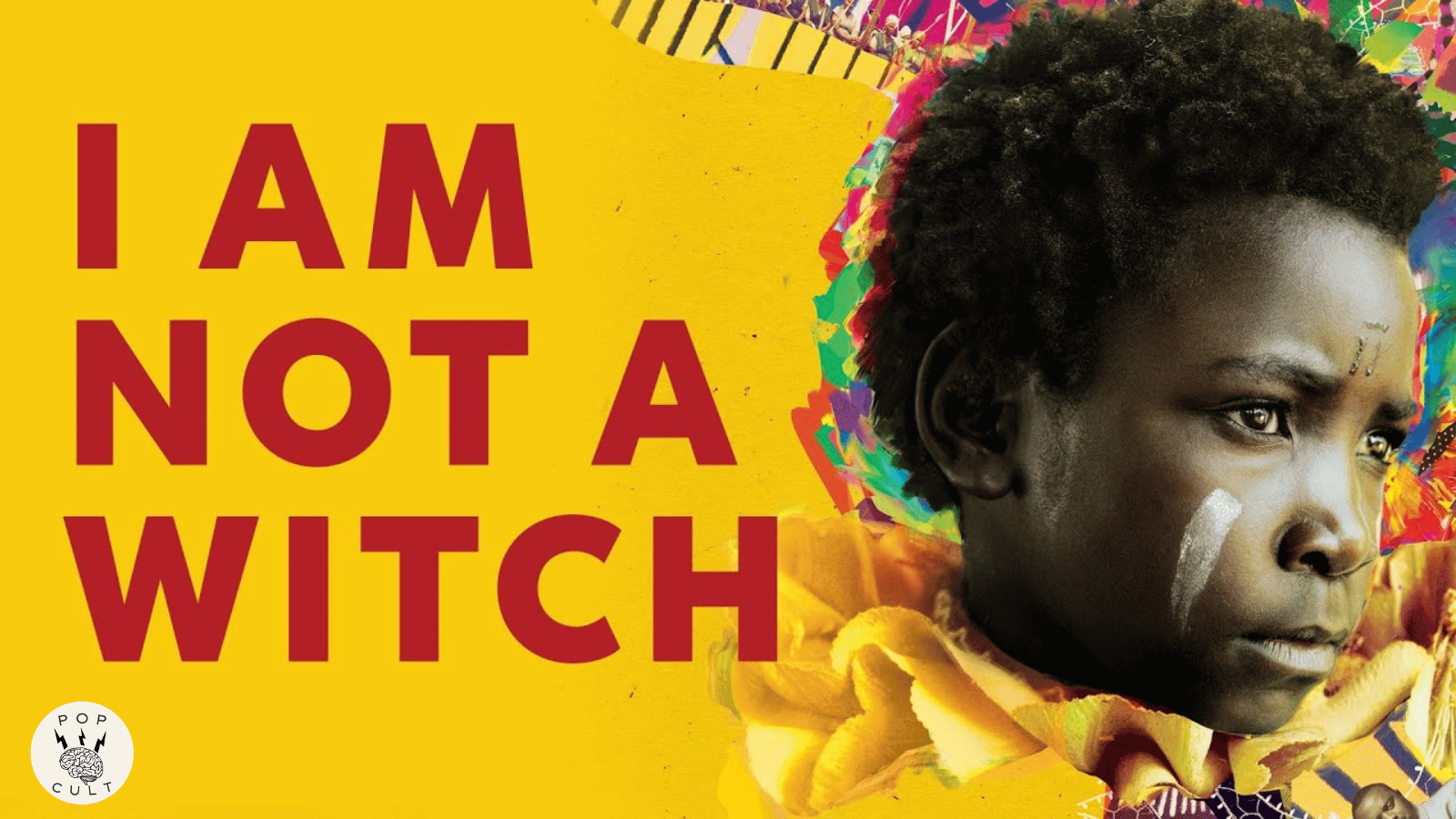
I Am Not a Witch (2017)
Written and directed by Rungano Nyoni
As an American, and especially a homeschooled one raised by evangelical parents, my general knowledge of African geography is abysmal. Let’s not even see what a blank space it is regarding African history. This often makes me sad because I know many facts about European and American history. Africa is where humanity emerged from, so we should know more about this incredible, diverse continent.
Zambia sits at the crossroads of Central, Southern, and East Africa. It is wholly landlocked from the ocean. Bantu expansion in the 13th century, followed by European colonization in the 18th, changed the ethnic makeup of the region in dramatic ways. In 1964, along with several other African nations, Zambia gained independence under a socialist administration that remained in power until 1991. At this point, the economy began to experience mass decentralization as political power fragmented. As with so many former colonies, their economies are so intertwined with European influence that they inevitably succumb to this type of economic warfare.
Rungano Nyoni had read stories about women & girls being accused of witchcraft in her native Zambia. Her life had not been entirely spent in Africa, with her family moving to Wales at age nine. She studied at English universities and thought about becoming an actress at one point. Nyoni found much inspiration in the Michael Haneke film The Piano Teacher, citing Isabelle Huppert’s performance in that picture as fueling her artistic ambitions. After making several short films that garnered acclaim in the festival circuit, the director came to make I Am Not a Witch, her feature-length debut.
A little girl wanders into a village. She doesn’t speak but quickly gains the reputation of being a witch by people who experience slight accidents & misfortunes. It turns out the government has developed a means to handle supposed witches. There is a small camp inhabited by elderly women, each connected to a large wooden spool with a white ribbon. They are loaded up into trucks every morning and made to do forced labor, told that if they break this ribbon, they will turn into a goat. The old women take quickly to the girl, whom they name Shula. Her government handler starts to use Shula to adjudicate local conflicts. She doesn’t have mystic insight and, therefore, makes guesses about the guilty party. The longer she lives in this way, the more it wears her down.
Most obviously, the film critiques how superstition is often used as a form of oppression against the Other. In this case, women who do not behave in the way patriarchy demands. A witch doctor appears several times throughout the film, acting as a functionary for the government. He has turned witchcraft into a commodity that benefits the authority, so he’s allowed to practice.
There’s a moment when Mr. Banda, the man in charge of Sula, sees her as a potential cash cow after turning the child around as a judge. Shula is made to appear on a talk show where Mr. Banda is happy to announce Shula-brand eggs, blessed by the witch (they are not), which makes them more nutritious for the public. When the witch’s facade cracks and the girl’s humanity shines, Mr. Banda sours on her. She’s no longer an object that can make him money.
The witch camp is introduced to the audience in the opening scene of the film, where it is a holding site for slaves but also a tourist attraction where gawking foreigners snap photos of the women sitting on the ground. The women play along, making noises and faces that hint at a supernatural power. Shula eventually ends up in this place, choosing to hide away, only for a group of tourists to find her. One woman, a light-skinned English woman, offers to help her feel better. Her idea? Taking a selfie with Shula.
I think that’s a fascinating detail for Nyoni to include: the tourist woman being someone of African heritage but clearly English. While much of race ideology centers around an over-simplistic view of human relations through skin color, the relationship between native African people and those of the diaspora is very complex and can often be riddled with conflict.
As a public school teacher, I taught for a few years in an area of high poverty and immigration. The public housing near the school was home to Black Americans and many Somali immigrants. Often, tensions from the neighborhood boiled over between the children on the playground. Under capitalism, these tensions are encouraged and exploited because they inevitably take the scrutiny off of the actual culprits. But that has always stuck with me, reminding me that human relations are not as simple as we are often sold.
Nyoni chooses to make her world slightly off-center. This is a magic-realist story where events can be more absurd than in our lives to explore the work’s themes. Lately, I’m finding that fiction seems to have underestimated how absurd reality can become. This is needed because Shula’s story is sad, and so the absurdity manages to add levity to the story. Mr. Bunda is a ridiculous figure more than a threatening one. The humor is dry, like Yorgos Lanthimos or Alejandro Jodorowsky, but not derivative. I can easily see this film on the same shelf as those directors’ work.
The remarkable stand out here is Maggie Mulubwa as Shula. She remains silent for a large portion of the film, so her performance is entirely through her face. Mulubwa was around eight but gave such a rich, multi-faceted performance. At times, she is projecting wisdom beyond her age or incredulity at Mr. Bunda’s behavior & claims. But then Mulubwa can break your heart, reminding us she is only a little child, softly weeping at her situation. She feels trapped, never having had a choice at any step of the way.
David Gallego, a Colombian cinematographer who shot the gorgeous Embrace the Serpent, finds incredible moments to shoot. One of the old women tells Shula that a school is near one of their work sites. She gives the girl a blue ear horn so Shula can listen to their lessons. Gallego’s camera lingers on the horn and the girl’s ear as the soundtrack slowly raises the volume on the sounds of children playing. The encounter with the tourist described above finds Shula hiding in a giant overturned stone head. Gallego puts on in the tourists’ perspective, slowly moving towards this head as Shula becomes visible inside its mouth.
Nyoni’s second feature, On Becoming a Guinea Fowl, was released in 2024 by A24. After seeing this film, I am very keen on checking that film out at some point. I think films like I Am Not a Witch help to push back against misconceptions Western audiences might have about African cinema, which is that it is in some form “lesser.” In terms of budgets and involvement of finance, yes, it is probably less. That means the artist’s vision comes to the surface with much less interference. Nyoni’s voice feels just as strong as any filmmaker I compared her to in this interview, and I think she has some incredible work to share with us, hopefully very soon.

 PopCult Reviews
One thought on “Movie Review – I Am Not a Witch”