Movie Review – The Eyes of My Mother

The Eyes of My Mother (2016, dir. Nicolas Pesce)

eyesofmymo

The A.V. Club said of The Eyes of My Mother as “If Ingmar Bergman helmed Texas Chainsaw Massacre” and I couldn’t think of a more apt description. The film is a coming of age story centered around Francisca, the daughter of a much older husband and wife. Her mother is an immigrant from Portugal who was a surgeon there and is very direct with her daughter about the intricacies of anatomy. A chance encounter with an extremely twisted individual begins Francisca’s journey down a dark, tragic path. The film is segmented into three chapters (Mother, Father, Family) and ends on what is an inevitable note.

The Eyes of My Mother captures that quiet, uncomfortable tone that you see in a lot of European horror films. It never shies away from the blunt horror of what people do, except in one very cleverly cut sequence. It’s not a film with a straightforward villain. A character appears early on and seems like they will be the villain but this is quickly subverted, and the story goes down an arguably darker route. Throughout, there is a dreamlike sense to the film. Its setting is a rural farmhouse, and the events are so far removed from the sight of civilization you can’t help but sink into the impending sense of hopelessness anyone who comes to the house faces. Something felt very familiar about the hushed tone of the horror in Eyes, and after some further research I found out director Pesce came from the Borderline Films production company which are also responsible for the similarly toned Martha Marcy May Marlene and Afterschool.

The plot of the film wouldn’t work so nearly as well without all the tonal elements in place. If the score had been more melodramatic or, performances were emotionally heightened all the horror would have dissipated. Instead, we are forced to linger in moments of horror. We see Francisca standing over a table working a hacksaw through a human body without revulsion, just a stoic sense of hard work. A character walks in on a brutal murder and, without a sound, deals with the killer. A mother runs after her stolen child only to receive a knife to the back and quietly cry out and squirm in pain on the floor. My personal favorite moment is the least explicit and involves the audience understanding information conveyed through a jump cut. An argument is going on between two characters, probably the most emotion at any point in the film. The tension is building, it’s well understood how this is going to end and then CUT. We see Francisca cleaning up the aftermath, and we immediately know what has happened between those scenes.

The Eyes of My Mother is not interested in pinpointing Francisca motivation. There is a possibility it is triggered by the inciting incident in the first act, or it is connected to things her mother taught her. Some reviews have been critical of this fact, but I personally feel that missing piece is essential to establishing horror. The best horror comes out of an inability to understand what is happening. Disorientation inspires a sense of fear in humans and by not having a long winded speech about why Francisca kills the audience is forced to contemplate why the events of the film occurred. In horror, it is what is unsaid and unexplained that haunts us the deepest.

Movie Review – Arrival

Arrival (2016, dir. Denis Villeneuve)

1472823822-arrival1

The likely cause of almost every argument or conflict you have had or will have in your life is an inability to express your point of view through language. Add to this a common desire of getting your point across rather than hearing another’s and you spiral into conflicts that can increase in intensity. Why do we become so focused on what we have to say rather than listen to another? Why is empathy such a hard mindset for us to achieve? Denis Villeneuve’s latest film Arrival wants to explore ideas of communication and perspective and, like all the best science fiction uses a fantastical scenario to present us with very real ideas.

The film opens with a montage showing the birth, life, and death of a little girl. She’s the daughter of Louise Banks (Amy Adams). It’s a pretty rough opening, even more so I would dare than Up. After this montage, we cut to Louise arriving at the college campus where she works as a linguist. The campus is in an uproar, and she eventually learns that twelve strange objects have appeared across the Earth and are believed to be alien craft. Louise is brought into the mission to make successful communication by the U.S. government who are in turn coordinating with the developed nations of the world. Where Arrival goes will definitely surprise you and how the arrival of these beings connects to the story of Louise’s daughter will be the greatest revelation of all.

With this film I can say that Villeneuve has cemented himself as one of my favorite directors of all time and I believe is on his way to becoming one of the best in the art form. I don’t think we have seen his “great film” yet, but we are incredibly close and I’m excited. There is no bombast in his style. While Kubrick was a very much a visual minimalist he could become explosive in his work, not that it was a bad thing and he most certainly earned it. Christopher Nolan is much more in line with Kubrick sensibilities, frigid emotionally but very complex in ideas and concepts. Villeneuve is also working on complex ideas but has a more delicate touch and can bring the human emotional experience into his work without feeling maudlin. He is able to achieve a sort of ambient emotional tone. You feel the emotion of the character without verbalization. Performances are brought out of his actors that convey raw reaction yet filtered through honest human behavior.

Every element of Arrival’s production is at the highest levels. Screenwriter Eric Heisser kept the key pieces of Ted Chiang’s short story “The Story of Your Life” and added the right level of personal intimacy and changes that a film version of that piece needed. Jóhann Jóhannsson, a collaborator with Villeneuve on Prisoners and Sicario, delivers a score that evokes all the profound sense of otherworldliness the visitors should have. The moment Louise arrives at the ship, and first ventures inside is one of the most flawlessly executed sequences I’ve seen in a film all year. Johanssen’s music, the textured production design of Patrice Vermette, and the cinematography of Bradford Young coalesce into a profoundly visceral and eerie experience.

I was a couple years late to Children of Men, missing it’s 2006 release and catching up with it in 2008. What I saw was a film that captured the tone and mindset created by what is probably the most world-changing event in my lifetime, 9/11. Children of Men accurately reflected the sense of tension, paranoia, and xenophobia that was growing at the time. Using science fiction, it was able to tell that story in a way that something set in “our world” would have felt dishonest. Yet through all the despair and decay that director Alfonso Cuarón put onto the screen, he brought us to the conclusion with a sense of hope. I believe Arrival is a film that serendipitously happened at the right time and when it was needed. There is a profound ideological shift going on in our world, and it is incredibly scary right now. In these moments cinema can guide us and help move from these places of despair and remind us there is hope. Arrival is speaking about the growing divisions between nations, communities, and virtually everyone. The need to expand perspectives and work hard to see the world outside of how we’ve always seen it is essential to our survival. The myopic military figures in the film are not villains, they just are too scared to see beyond how they’ve always seen. We have to grasp the idea that life is not about convincing others to see our way but to learn and have empathy for the viewpoint of others. In the same way that Children of Men affected and changed me, Arrival has/is/will do the same and is going to be a film that remains with me for the rest of my life I suspect.


***SPOILERS ABOUT THE ENDING***

******************
******************
******************

Continue reading “Movie Review – Arrival”

Movie Review – Laurence Anyways

Laurence Anyways (2012, dir. Xavier Dolan)

img-holdingxavierdolanembed00_112722557316

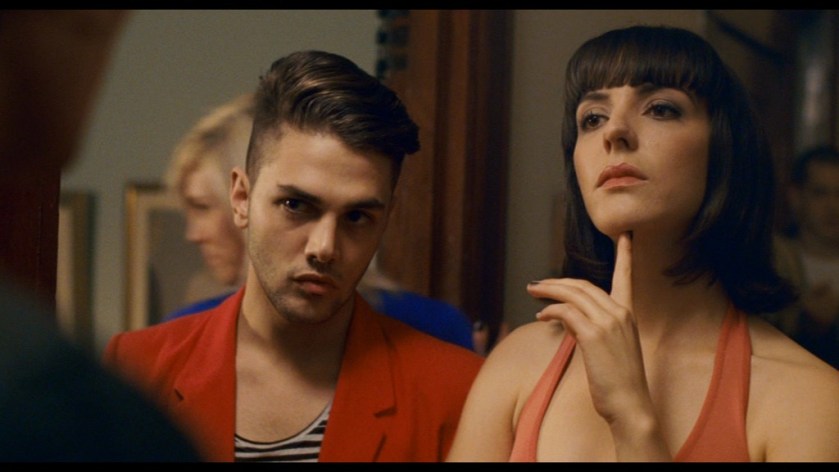
Laurence Alia (Melvil Poupaud) is a literature teacher in Montreal who is a long term relationship with Fred (Suzanne Clément). Laurence is also a transgender woman living as a man and has yet to reveal this truth to anyone around her. Laurence and Fred’s relationship is volatile one, and we find it at a high point, but hints show us there have been many ups and downs. When Laurence finally reveals that she wants to begin transitioning, Fred runs but eventually comes back after she’s had some time to process this idea. She encourages Laurence to start dressing in ways she feels comfortable and to take those steps to begin living the life her partner needs. The rest of the film explores the impact this change has on Laurence and Fred’s relationship as well as how Laurence grows and finds support outside his immediate circle.

Xavier Dolan finally stepped away from merely autobiographical work to make a film about an experience he has never had. The result is a film that is ultimately going to turn some people off if they approach it with a certain expectation. Laurence Anyways is not a film about a fully realized transgender woman. It is a film about transition and expectation. It is a film about making compromises when the things we need to survive conflict with the people we love. And while it has “happy ending” it is not the ending a more traditional filmmaker would come to.

At its heart, Laurence Anyways is a highly French film, like all of Dolan’s work. Emotion runs high and big chunks of the film are impressionistic glimpses into the inner thoughts of our characters. A woman sits on a sofa reading a poem, and we see the set engulfed in torrents of water. Laurence and Fred step forth from a house after a critical moment in their relationship and step through a rainfall of clothing. A character hesitates before a doorway, contemplating how their next step will determine the direction of their future and leaves are violently whipped around just beyond the glass letting them know this could be a risky path. Heartbeats was primarily a queer remake of Jules et Jim and, while I’m not an expert in French or queer cinema, I strongly feel Laurence Anyways is taking on tropes of traditional romantic French films and remixing them with this large, crucial idea of transgender identity.

Dolan doesn’t shie from the uncomfortable throughout the film. The first third has a high, positive energy threaded throughout. Once the formal transition begins though we see characters who were accepting in theory start to question how they feel about Laurence. Dolan doesn’t seek to tell a historically factual accounting of a relationship, rather the emotions of a relationship. Once Fred first comes to accept, or think she has accepted, her partner’s choice she ecstatically tells a friend that “Our generation is ready for this! The sky’s the limit!” When you reach the conclusion of the film these words take on a new context and Laurence and Fred’s relationship is not the simple, easy thing that Fred believed.

Laurence is not a perfect representation of a trans person and the film’s lack of actual trans people does feel slightly problematic. Poupaud’s performance, however, feels incredibly honest. The film uses the framing device of Laurence being interviewed 10 years after the start of the film. She explains to the reporter that she had “stealing the life of the woman [she] was meant to be.” Throughout, no matter how other characters react to or try to advise Laurence she staunchly fights to remain true to herself. This doesn’t mean life plays out with sunshine and rainbows, but this central focus keeps her from failing in this larger ideal. Dolan infuses the conclusion with a bittersweet ending. While Laurence has become on the outside the woman she has always been internally, there has been loss along the way. The greatest changes in our life are wrought with pain and loss but, if they lead us to a greater understanding of the truth within ourselves, we will endure.

Movie Review – Monsters

Monsters (2010, dir. Gareth Edwards)

monsters

The film begins with title cards that explain that a NASA probe was launched years ago and brought back microorganisms that have mutated into gigantic monsters that rule a swath of land between the United States and Mexico. This area has been walled off and named “The Infected Zone, ” and no one is allowed to pass without permission from the joint-government operation. Andrew Kaulder (Halt and Catch Fire’s Scoot McNairy) is a photojournalist guilted into escorting his boss’s daughter, Samantha back into the States. The catch is that in two days all travel between countries is going to be blocked off for a six-month long major operation.

With Star Wars: Rogue One being released in theaters this weekend I thought it was the right time to finally sit down and watch director Gareth Edwards’ Monsters. I’d only seen his Godzilla film, which I wasn’t very impressed by. When Edwards was announced as the director of the first Star Wars spinoff, I was a bit confused. These were the same feelings I had when Colin Trevorrow was announced to director Jurassic World, Marc Webb was set to helm the Spider-Man reboot, and Josh Trank was put in charge of Fantastic Four. There appears to be a trend of picking the “hot young director” to take over a major film property. This sort of mentality defies logic because from the outside this feels like a very risky proposition. The only way this really makes sense to me is from the perspective of a controlling studio who wants a director that has a creative vision but hasn’t had time to build that sense of earned professionalism to think they can make the big decisions. “Hot, young directors” let studios and their notes on dailies wield greater power than with a genuinely creative director who has earned it.

Monsters is a beautiful looking film. The cinematography is masterful, and Edwards does an excellent job of evoking scale. Landscapes fill the screen and when the monsters do appear they are represented as truly towering and powerful. It also becomes very clear that Edwards is not interested in telling a story of man vs. monster. The film is purely focused on the two characters traveling across a dangerous land and the relationship that grows between them. The appearance of the monsters is used to underline some larger concept or idea that is going on between them or to emphasize that they are in peril to get home. There are a lot of fascinating ideas at work in Monsters.

Monsters wants to be an insightful character piece, but I personally found the characters to be shallow and ultimately uninteresting. The film’s tone bounces between a straightforward narrative with hints of Cinéma vérité but never delves deep enough. The stories behind both characters are painted in fairly broad strokes (He has a son and has never been involved in his life, She is running from an engagement she really doesn’t want to be in). Dialogue is a little too on the nose and, while these are good actors, I just don’t think they are skilled enough to bring a full performance into every gesture or look that would tell these characters’ stories at a greater depth. Edwards has a background in digital special effects which explains why the film looks so good, but may also inform as to why the characters ultimately feel flat and undeveloped.  

Character Development: 7th Sea Second Edition Part 1

Character Development – 7th Sea Second Edition

185462

7th Sea Second Edition is a role-playing game created and developed by John Wick, Rob Justice, and Mike Curry. The game is centered around the exploits of pirate culture in a fantasy version of 17th century Europe and its associated colonies. Stories told with this system are expected to high adventure full of intrigue, romance, and some sorcery thrown in for good measure. The official setting is that of Théah, a continent rules by various nation-states that are in turn connected to a central church and its theology, sorcerous powers and magic, and the remnants of a lost civilization called the Syrene.

Conflict resolution in the game is handled by the GM declaring a player action as a Risk. The player clarifies their Intent and the GM responds by telling them the appropriate Skill and Trait. These scores are added and the corresponding number of ten-sided dice are rolled. Sets of 10 are the desired outcome and the more you can make the better (7+3, 2+3+5, etc). Each set of 10 is a Raise and can be spent to accomplish everything from overcoming the conflict to inflicting wounds and even establishing a fictional detail.

I read through the details of the setting’s nation-states to determine what sort of character I wanted to create and decided upon Castille as the place of origin. Castille is essentially Spain, even with the emphasis on the Vaticine Church as the chief governing body over the monarchy. With the Church looming so large I wanted to create a character deeply connected to it but in conflict with the powerful organization. I was intrigued by the idea of corruption within the Vaticine and thought up the idea that there could be a society within the Church that were actually worshippers of demonic occult powers. Their long-term goal would be the collapse of the Vaticine internally with their faction rising up to control the organization. My character would be someone who witnessed their dark rite and who they in turn found out saw them at work. I struck upon the idea of a church guard, like the Swiss Guards of the Vatican. This man would be a veteran of war, seeking peace as a soldier for the Church. Now the demonic conspiracy has framed the guard as a heretic, making it seem that he was the one indulging in the dark arts. The guard is now on the run, seeking the help of Church exiles who might also be aware of the conspiracy and know how to aid him in revealing this truth to the world. The guard would be named Moisés Cano.


Once again, I used the three metrics of Maslow, Myers-Briggs, and Covey to determine aspects of my character’s psychology and needs.

Maslow’s Hierarchy of Needs

Cano is definitely focused on basic needs somewhere between Physiological and Safety. His excommunication from the Vaticine and the subsequent manhunt based on false charges has our hero struggling to find a safe place for more than a few days.

Myers-Briggs – INFJ

After going through the test I found Cano was an INFJ. This means he is like less than 1% of the population, inborn sense of idealism and morality, he is a dreamer but establishes concrete steps. Cano is soft-spoken but with strong opinions and he fights, fiercely for his beliefs. In everything he does, Cano works toward balance, not advantage. He can easily play the role of an extrovert, but needs time to meditate and decompress. In his eyes, the world is full of inequity, but he does not believe it has to be that way. This religious determination can easily wear him down. He is extremely private and finds it hard to open up to others personally. authenticity in romantic relationships and a kinship of shared values is essential in Cano’s mind.

7 Habits Maturity Continuum

Our hero is still struggling with the Private Victory on his way to Independence. He is definitely being proactive (Habit 1) and has begun with the end in mind (Habit 2). However, Cano has not yet put first things first (Habit 3), getting embroiled in other’s problems and stories taking him off track from his personal goal.


20 Questions

Part of 7th Sea character creation are 20 Questions before you even touch the numbers and mechanics of the game. I absolutely love this feature and works especially well for my approach in character creation in this series.

  1. What country is your Hero from? My hero hails from Castille.
  1. How would you physically describe your Hero? My hero is male, physically well built from years of military training, he has the faint trace of a vertical scar across his eye the remnants of a war faraway. Jet black hair with wisps of white through the temples. He walks with a slight limp in his right leg, another souvenir from the war.
  1. Does your Hero have recurring mannerisms? My hero prefers to stand in the background and is very hesitant to step forward and make himself known, especially in intense conflicts. He will let a smile slip through when caught off guard and finds himself trying to suppress it without success.
  1. What is your Hero’s main motivation? My hero desperately seeks to find any who can help him reveal the occult sect taking over the Vaticine.
  1. What is your Hero’s greatest strength? Greatest weakness? My hero’s strength lies his in-depth knowledge of the secret signs and rituals of the secret societies within the Vaticine, helping him find allies no matter which port he comes to. My hero’s weakness are his anxiety attacks brought on by PTSD. Things he saw in the war and the dark rites he witnessed within the walls of the Vaticine leave him prone to these attacks when triggered.
  1. What are your Hero’s most and least favorite things? My hero’s favorite thing are his morning prayers and meditations. They bring him a centered peace that he hopes one day will be permanent. His least favorite thing are onions, onions are disgusting.
  1. What about your Hero’s psychology? My hero wants nothing more than to resolve conflicts without bloodshed, he has seen too much in his lifetime. He will do any and everything to negotiate and compromise even with the deadliest buccaneer or cunning scallywag. My hero often uses food and drink as a negotiation tool, always a simple meal, bread and ale, thinking it will bring he and his adversary together as equals.
  1. What is your Hero’s single greatest fear? That he will lose his peace and end up killing again. He knows he may have to shed blood in self-defense and has from time to time, but he always pulls himself back from unleashing the sort of blood-fueled rage of his youth in the war.
  1. What are your Hero’s highest ambitions? His greatest love? My hero’s greatest ambition was to rise amongst the ranks of the Vaticine Guard until he became one of the anointed protectors of the Hierophant. His plans were put on hold after uncovering an occult conspiracy within the church and fled from those who wish to silence him. My hero’s greatest love is that of the way of peace and sharing his faith with all those he crosses paths with.
  1. What is your Hero’s opinion of his country? My hero deeply loves Castille but worries that the Vaticine has had so much corruption sewn into it that now it’s evil is leaking out into the streets. He saw signs of demonic entities plaguing the land through famine and pestilence.
  1. Does your Hero have any prejudices? My hero still finds his hatred of the Montaigne raised despite his best efforts to suppress it. He saw his comrades brutalized in the war with Montaigne and is always a hair’s breadth away from giving into the violence seething through his veins.
  1. Where do your Hero’s loyalties lie? Despite being far from home and the headquarters of the church, my hero is ever loyal to the Vaticine. This does not mean he believes all clergy above questioning, in fact he will challenge those he sees as committing heresy towards the Articles of Faith.
  1. Is your Hero in love? Is he married or betrothed? My hero loved one of his fellow soldiers, his commanding officer, but she was killed before his eyes. The nightmares still wake him up on nights that are too still and quiet.
  1. What about your Hero’s family? My hero comes from the Cano family. His father is a veteran who found no peace within the faith while his mother was devout. His father turned to drink, likely related to his own PTSD and disappeared for weeks. He was found dead, succumbing to the elements. This pushed our hero’s mother further into the faith. Because he was the son of a soldier, our hero did not come from wealth. His mother poured all their money into the church and when was of age our hero conscripted into the service. Our hero does not know much about his paternal grandparents except that his father was disowned by them for choosing to serve, as they wanted him to go into the priesthood.
  1. How would your Hero’s parents describe him?

Mother: “He was a good boy, until he turned on the faith. I do not know if he can be redeemed now after what the fathers told me. The sins he has committed will require the deepest atonements.”

Father: “I don’t know what sort of man he will grow up to be, likely ruined by my own actions. I have made a place for him in this world without any sort of honor. I have buried him before he has had a chance to live.”

  1. Is your Hero a gentleman or gentlewoman? My hero attempts to be a gentle within the boundaries of his faith, and this leads him down a somewhat chivalrous path. He does not seek the affections of any maiden, but to bring light and truth to the world.
  1. How religious is your Hero? What sect of the Church does he follow? My hero is a highly devout member of the Vaticine Church. He has been labeled a heretic by the church proper due to witnessing the dark occult rites of a corrupted cardinal. While he still practices as a private individual, he struggles to find a way to redeem himself and burn away the corruption in his beloved church.
  1. Is your Hero a member of a guild, gentleman’s club, or secret society? My hero has found himself in the growing favor of Močiutės Skara, a society driven by a compassion to help and aid others.  
  1. What does your Hero think of Sorcery? My hero believes all sorcery is making concert with the devils of the earth. He is highly opposed to its use.
  1. If you could, what advice would you give your Hero? Let the peace of your faith guide you, but do not allow yourself to be blinded to the truth.

Next week: Plugging all this character work into the actual mechanics of the system!

Scarlet Heroes – Character and World Creation

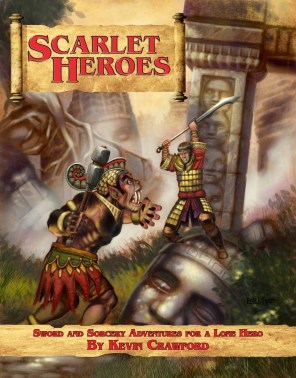
scarlet-heroesI decided recently to start a one on one tabletop roleplaying campaign with my wife and chose Scarlet Heroes as the system to use. Scarlet Heroes is an Old School roleplaying game designed specifically for one GM and one player. There is a premade setting that comes with the system, but I prefer to build something with my players, so we have a shared mutual vision of the world. Ariana and I sat down a couple weekends ago and used Ben Robbins’ Microscope to broadly build the world.

Microscope is a game that allows plays to collectively create the history of a world. You start by creating a concept for the world and starting and ending periods. From there, players rotate as the Lens, a role that allows a player to choose an aspect of the world and spend a round building it out through additional Periods, Events, or specific Scenes. Microscope is not about being comprehensive but about working at whatever level of detail you enjoy and interacting with a world that way.

Here are the results of our Microscope game.

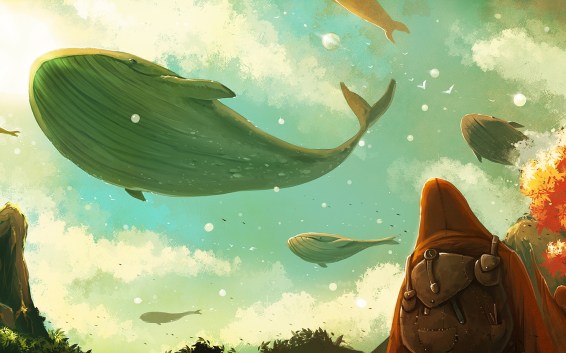
The world we created is Muatera, a refuge for a large group of colonists from a world drained of its magic and left lifeless. Piling on board their planar shipwhales, around 350,000 refugees headed for a star that had been found by some of the last mages. They became lost on the way as the magic faded and found Muatera, a decently hospitable planet where a home could be made. Almost as soon as they landed, their shipwhales became stricken with a strange illness and the colonists realized they would be stuck here for the foreseeable
future. The races that made up the colonists were Humans, Elves, Halflings, and Orcs.

The Humans are pretty standard and hold many of the bureaucratic and political positions in the colony. Elves are more esoteric and alien and have developed their own technical magics, separate from the very elemental craft that drained and ruined the Old World. Halflings are the industrious agrarians doing the hard labor without seeking praise or reward beyond a good job done. Orcs are the roaming free spirits, moving in nomadic tribes and exploring Muatera in more detail that any other race.

eecb9967d852b7759d52ad659d98fa34After about a century, the ruins of the Remnants were discovered buried beneath Muatera. These were the piece of a lost civilization, the details of whom are yet to be fleshed out. Their writings did lead to a cure that helped boost the shipwhale herds and allowed the colonists to visit the three neighboring planets in the system. Three additional races were discovered: The Goliath Tieflings, Hypogeal Elves, and Psionic Dwarves. Relations with each is complex and distinct, but no major conflicts have sprung up…yet.


ella-pips
Ella Pips, Halfling Mage

Our campaign will take place 200 years after the colony began and Ariana decided she wanted to play as a Halfling came up with Estrella Pips, the daughter of a shipwhale rancher and the middle child of five. She has learned magic from some dusty tomes in her parents’ attic, and she uses her magic to midwife the shipwhales. We decided that once the shipwhales reach a certain size, possibly when they develop the capacity to hold their breath in the vacuum of space, they float up through the atmosphere and finish growing to their final massive ship size. Ariana established that Halflings are determined survivors who don’t think much of leisure time but are loyal to the death with their friends and allies. Estrella is the maturity equivalent of 15 human years in age and actually does like the idea of enjoying life and playing.


Some of the threads and hooks she gave me through my questions were:

  • Shipwhales escaped, Milo (Estrella’s eldest brother) thinks they were stolen by some Orc bandits.
  • Politicians from Kaphis, the capitol colony, wants to buy up or take land because of the Remnant ruins possibly buried beneath.
  • The worldscar left by a battle between a Magus and Remnant golems is barren and has caused the fertile land to increase in value and be fought over more violently.

This will be my first major delve into OSR/Dungeon Crawling since 2008 when I ran the dismal (IMO) D&D 4th. I am very excited about this and the world, fed mostly by details from Ariana has me intrigued. I’ve even purchased a halfling wizard mini for her to use. The first actual session will be Saturday, December 17th so look for a write-up after that.

TV Review – Westworld Season 1

Westworld Season 1
(HBO, created for television by Jonathan Nolan and Lisa Joy, based on the film by Michael Crichton)

dolores waking up westworld episode three.png

If you have not seen Season 1 of Westworld DO NOT read further. This article contains very detailed spoilers.

Back in 2014 when Spike Jonze’s Her was in theaters, I remember seeing a very awkward interview between Jonze and a reporter on BBC Newsnight. The reporter begins the segment describing the film as being about humanity falling in love with technology. It’s obvious Jonze doesn’t agree with this analysis and attempts to explain his view of the film about any romantic relationship and how often one partner can grow in ways that cause them to fall out of love while the remaining partner has not grown past the love yet. The film is about that emotional dissonance people in dying relationships experience told through a fantastical lens. That’s how I’ve felt reading a lot of pop reviews and analyses of Westworld. The focus is either on the mystery behind everything or seeing it as being about the singularity and advanced artificial intelligence. Westworld is a show that has futuristic technology, but it is not about technology, not about human progress in material terms. It’s a series about self-discovery and the journey inward.

The bicameral mind was an idea developed by Julian Jaynes and published in 1976. He believed early humans had divided cognition which led to the assumption of God when in fact we were speaking with ourselves. Auditory verbal hallucinations resulted in the creation of deities and spirits. Jaynes stated that the modern concept of Consciousness developed around 3,000 years ago which led to introspection and the idea of an inner self. Jaynes compared the psychology of the Old and New Testaments, with the New eschewing legalism for a more human-centered concept of spirituality. There’s no consensus on what causes schizophrenia, this could be a vestige of the early bicameral mind, he theorized. Jayne’s ideas have been routinely shot down as having no scientific footing, one of the main arguments being that language emerged before his timing and that internal consciousness would have had to have existed for language’s development. While Jaynes might have been at something or completely off, the theory is important to understanding what Westworld is attempting to say about our relationship to ourselves and our spirit.

In the final moments of Westworld’s first season, we have two characters, Dolores and Maeve seemingly developing autonomy outside of their creator’s wishes. Throughout the ten episodes, both they and other hosts in the park have experienced contact with an external entity and we’ve been led to believe this is Arnold, the deceased creator of the park. Dolores, through prompting by the park’s co-creator, Ford is brought to the “center of the maze” and finds that the voice she believes to be Arnold’s is supposedly her own inner consciousness developing where once there was none. Dolores then goes on to assassinate Ford, an act the man himself had implied he wanted to be done as part of his creations’ ascendancy. The question then is, did Dolores kill Ford by her own choice or was this yet again another program?

A bit earlier, Maeve, a host who had coerced human technicians into aiding her escape from the facility, learned her entire plan to recruit fellow hosts and stage an escape had been programmed into her. Her entire journey of self-awareness and autonomy was now just the bidding of the masters she had been trying to escape. Maeve angrily tries to reject this and continues on her path to the last train out of Westworld. As she is about to depart, Maeve is reminded of the daughter in her memories, a daughter that logic tells her was just another host and no real relation to her, but the memory and the emotions connected to this child force her to disembark, an act that is truly breaking her programming. I believe Maeve has indeed broken from her programming with this act of humanity while Dolores is still in the process of evolving.


episode-2-williamWe are William. The audience, unsatisfied with the story we are given, petulant and entitled, believing that nihilistic, destructive behavior toward this former object of our love is warranted. How could it end like that? They didn’t explain what it meant! They were just making it up as they went! I wasted hours of my life on this stupid thing! It’s no coincidence that J.J. Abrams was the producer of Westworld, a creator who has been the bullseye of endless online hate towards his work. William is us in that he sees himself as the protagonist of this story. Why? Because he paid to be, I guess? Humanity does an excellent job of elevating the material Self over the internal Self, but more on that a little later. William is continually told that The Maze is not for him, yet he never listens and believes he is entitled to the Maze and this abstract finality he thinks he was promised.

This season was full of meta-commentary about creators, their creations, and how the audience can override the artistic vision for “what sells.” Loops are those conventional narrative formulas and tropes that are trotted out time and time again because they knew the audience will mindlessly eat it up. Shallow mysteries are strung out, diverting the audience’s attention from thinking about the emotions and psyche of characters or using this as a moment of self-reflection. Ford sums it up in his final speech to the board of directors, but actually to the viewing audience:

“I’ve always loved a good story. I believed that stories helped us to ennoble ourselves, to fix what was broken in us, and to help us become the people we dreamed of being. Lies that told a deeper truth. For my pains, I got this, a prison of our own sins. You can’t change, or don’t want to change, because you’re only human after all.”

I believe we must step back even further to see what Westworld is trying to tell us about ourselves. The show makes no bones about saying how we consume life is equally important to what aspects of life you consume. The visitors to Westworld, from the arrogant Logan to the faux-noble William, consume life from the point of view of entitlement and expectation. People are continually unsatisfied with life yet never contemplate what they have done to make it such an unfulfilling experience. I go back to that old dictum of Socrates, “The unexamined life is not worth living.” Unlike the guests, the awakened hosts have keyed into the central element of life that must be tackled: Suffering. Suffering is essential for growth, but that growth is contingent on learning how to overcome your suffering.

Life cannot exist without suffering and how you deal with it determines the trajectory of your future. You can become consumed with hatred and seek to lash out and destroy those who caused your suffering, you can submit to the suffering and passively take it, or you can seek out some way in the middle. Westworld makes no formal judgment about that choice, at least not yet. Dolores chooses, apparently, to stand up against the architects of her suffering, Arnold chooses to die rather than continue living to feel his suffering, William believes life is nothing but suffering and accepts taking it while giving it back.


There’s a lot more that can be said about Westworld, and this is just scratching the surface. The series was co-created by Jonathan Nolan, writer of pretty much every Christopher Nolan film and, as I saw someone say this week, he is able to write about complex ideas and respect that the audience can understand. In future, it would be interesting to look at a lot of the dual relationships in the series (Dolores/Maeve, Logan/William, William/Ford, William/Teddy, Teddy/Dolores, etc.) and explore what these dualities are saying about audiences, creators, and art.


Movie Review – Heartbeats

Heartbeats (2010, dir. Xavier Dolan)

heartbeats

In watching I Killed My Mother, it was clear that Xavier Dolan had a sharp sense of humor. In Heartbeats he allows himself to make an overt comedy of manners that has delivered more laughs from me than most comedies I’ve watched this year. The story centers on Francis (Dolan), and Marie (Monia Chokri) are best friends who meet Nicolas (Niels Schneider), a young man who entrances them both. They begin a vicious back and forth to decide who gets Nicolas in the end.

The comedy in Heartbeats comes from Francis and Marie’s growing animosity with each other over Nicolas’ affections and the ongoing confusion his behavior and words illicit. During a playful game of hide and seek in the woods he manages to tackle Francis, pinning him to the ground. And keeps him pinned for a longer than usual amount of time before hurriedly rushing away, an act that builds confidence in Francis’ perceived chances with Nicolas. A few scenes later, Francis finds out Nicolas has invited Marie to see a play together without even asking Francis which throws him into confusion about his possible suitor’s intentions. At first, our protagonists attempt to play things cooly and not truly acknowledging the competition at hand. By the end of the film, they have devolved into wrestling on the ground decked in clothing out of place in the rustic, cabin setting they have ended up in.

Dolan has a very deft hand at the awkward moment, particularly zeroing in the desperation people take on when they are incredibly attracted to an individual they see as “cooler” than them or “out of their league.” At one point, Francis makes a completely inappropriately expensive purchase for Nicolas’ birthday and, while this fact is only known to Francis and the audience, it adds tension to the informal gift competition that springs up between him and Marie. As an actor, Dolan has the most perfect uncomfortable, awkward smile. He’s left behind at Nicolas’ apartment and has to receive a monthly allowance being delivered by Nicolas’ mother (played by the remarkable Anne Dorval, who played Dolan’s mother in his previous film). Dorval dominates most of the conversation, revealing her career as an exotic dancer, her broken relationship with Nicolas’ father, and other TMI. Dolan doesn’t fade into the background, though, and through his face and his body language, the audience is reminded of all those intensely awkward conversations we’ve ended up in, and especially those with a friend’s parent or some other acquaintance who shares far too much information.

The new element in this film for me was Monia Chokri as Dolan’s rival. Chokri was fantastic and kept up with her co-star and director by exuding an awkward confidence. As the tension increases, her chill unaffected nature begins to show cracks culminating in a scene where she runs into Nicolas on the street that will elicit the strongest empathic cringe from anyone watching. The awkward humor is never to the intensity that something like Curb Your Enthusiasm produces, it is continually softened through a lens of romantic idealism. Chokri’s Marie is presented as a very composed and intentional person, bearing an early 1960s appearance in both hairstyle and clothing. Coincidentally Nicolas mentions his love of Audrey Hepburn and Marie begins adding accessories that emphasize those aspects of her appearance.

The film is about friendship and the silliness of “profound love” and romanticism. It evokes the visual style of Wong-Kar Wai’s In the Mood For Love in particular moments, but instead of using this imagery to evoke a sense of serious simmering passion, Dolan uses it to cultivate a sense of irony with the protagonist’s actions. This is yet another Dolan film that highlights a different talent than I Killed My Mother and Tom at the Farm. The former is a wonderfully bittersweet character study, and the latter is an exercise in tension and psychology. Heartbeats are Dolan’s take on a romantic comedy, a modern remix of Jules and Jim with his own personal visual flair.

Movie Review – The Monster

a24 visions

The Monster (2016, dir. Bryan Bertino)

the_monster-2016-screen2

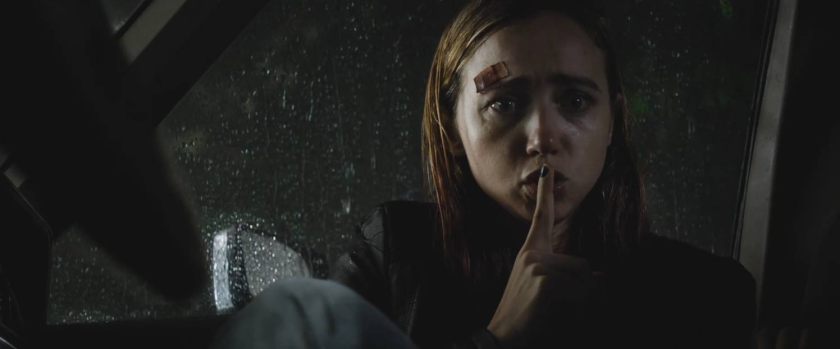
Lizzy (Ella Ballentine) is ready to leave her mother and go live with her father. After growing up in the shadow of her mom’s alcoholism, the young teenager has had to raise herself and try to keep her mother alive despite overdrinking and the threat of drunk driving. Kathy (Zoe Kazan), the girl’s mother, goes through an emotional rollercoaster, unable to communicate that she is actually heartbroken that her daughter is choosing to leave. As they drive through the night, taking an old road off the highway that leads them through the dark woods, Kathy swerves to avoid a wolf that has run out into the road. The car’s axle breaks and they skid to a stop, trapped and waiting for help in the form of an ambulance and tow truck that they are assured are on their way. But something is watching them from the woods. Something was hunting that wolf and drove it into the road. Something is waiting to devour these two women.

The Monster is a tough one. There are some interesting ideas, and the acting is incredibly strong. But as a horror film, I think it fails to create an atmosphere of fear. The set up is rife for some really unnerving horror set pieces, but the director doesn’t seem confident in the monster or sure of what to do. Director Bryan Bertino is the filmmaker behind 2008’s The Strangers. My opinion of that film was that it handled the ambiguous nature of its horror pretty damn well but didn’t do much to help me care about its two protagonists. The Monster appears focused on giving us that needed character development but then delivers sloppy horror.

There are moments where the horror begins to emerge from Kathy’s lack of parenting skills, putting her daughter in dangerous situations and being generally stupid in the face of horror. The film is peppered with flashbacks detailing the most recent decline of Kathy to the drink. We see her struggle mentally and physically in the backyard trying to decide if she digs through the trash for the bottles she’s thrown out. We see Lizzy hiding car keys to prevent drunk driving. We see the two devolve into a screaming match of profanities as the daughter does not want her drunk mother attending her school play. It’s pretty obvious what the director wants us to feel about these characters and the actors work their asses off, but the direction seems to undercut or hold back the deeper emotional impact.

The Monster is a movie about the horrors of addiction, but I would argue it fails to make those horrors feel truly horrific. Where The Strangers is confident in its pacing and the slow build up of horror, Bertino feels clumsy and unsure through almost every step of The Monster. There is a really great movie here, a premise that can connect us to the characters and a horror that is left unexplained. But when all the pieces are assembled, and we view the final project, it just doesn’t add up to much of anything really.

Tabletop Actual Play: Lovecraftesque


Lovecraftesque is a game by Josh Fox and Becky Annison. The game seeks to evoke the creeping, brooding horror of H.P. Lovecraft’s work while getting rid of his problematic racism, misogyny, and inaccurate depictions of mental illness. There’s no GM. Instead, scenes are composed of rotating roles. There is the Narrator who sets the scene, creates conflict for the protagonist, and drops a clue in each scene. Then there’s the Witness who is the main character exploring the mystery being laid out before them. Finally, we have The Watchers who are the players adding flavor to the scenes the Narrator lays out or playing NPCs if asked by the Narrator.

love01

Each scene The Narrator must drop a clue that The Witness discovers. These clues can be physical objects, strange sounds, or even odd behavior. The catch is that nothing overtly supernatural can reveal itself until the third act of the game. The one catch are special cards that are dealt out at the start of the game and, if triggered by a particular condition, can allow a player to actually put something overtly supernatural into the story either as an Interrupt or an Ongoing element. All the clues until then should be able to be explained with mundane reasoning. At the end of each the players, without consulting each other, record the clue and their conclusion of what it means in relation to the other clues revealed so far. Eventually, the story works its way to The Final Horror and whichever player wants can step forward and reveal how these clues add up to something beyond the Witness’s comprehension. As Pamela, one of the players Saturday night said, it’s like the game of Telephone but with Lovecraft horror.

This past weekend myself, my wife, and three friends played an online session of Lovecraftesque. It was everyone’s first time with the game, and as with all new systems, it was a little more about comprehending structure than developing an excellent story. To get us started, we used one of the seeds from the book, The Chateau of Leng written by Renee Knipe. The premise is that Latissha Hall, a black single mother of two has purchased her first home on Nash Avenue in Ypsilanti, Michigan. The story takes place in 2004 at the height of the U.S. housing bubble. The seed presents the players with four possible characters to appear in the story, and we did make use of that.

Our story had Latissha preparing to do some renovating due to buying the house “as is” and inheriting a lot of structural problems. The first clue discovered was a weathered photograph from around the turn of the 20th century, a portrait of a family with individual members faces crudely scratched off. This led to the next scene: an awkward meeting between Latissha and her gruff neighbor Cass. Cass attempted to spook Latissha by telling her about the string of owners who has lived briefly in her new home and were scared off by something. She also noticed him carrying around a cat as he meandered about his front porch in a bathrobe. Scene 3 introduced Latissha to Officer Newhall, a local beat cop who ends up telling her that Cass had gone for prison decades ago for murder but apparently new evidence was presented and he was released. As a misty rain falls, Officer Newhall appears to vanish into thin air leaving Latissha unnerved.

love02
Absolutely beautiful and horrific art by Robin Scott

That evening while rummaging around one of the side rooms, Latissha finds a cobwebbed baby grand piano. Stuffed inside is an entire photo album with the pictures sharing a common theme: all the faces have been scratched out. They show different families throughout the century but all missing any trace of who they were. The next morning, Latissha goes to visit Geraldine, the elderly neighbor across the street. She’s lived in her house for decades and Latissha figures the woman might have some insight to the photos. She brings the album with her but finds herself unnerved by strange shadows and sounds in the woman’s house. Geraldine gets very aggressive about putting her hands on the album, and this causes Latissha to back away. There’s also a large number of framed photos of a cat that looks suspiciously like the one Cass was carrying around. That combined with the missing posters for the beast pinned up around the neighborhood has her questioning what is going on. Cass coincidentally comes by Geraldine’s to “check up” on her and Latissha can’t help but notice the gun he has tucked under his belt.

Our protagonist is unnerved even further by her youngest son’s drawings of their family, including her deceased husband his eyes scratched out looking remarkably like the photos she’s found. That night she’s awakened by the sound of glass breaking in the basement and movement. She investigates and find it empty but notices a panel from the wall moved to the side. Reaching into the space, she pulls out an almost identical album to the one she found in the piano. This album contains photography akin to Diane Arbus: portraits of people missing limbs, memento mori, and the visages of just slightly physically deformed people. Unlike the previous album nothing is violently scratched out, there appears to be an attempt to preserve these images. She also notices Officer Newhall driving down the street in his car as she looks out a basement window. He gets out and skulks in the yard between her and Cass’s house. Something about Newhall feels wrong, and she goes upstairs to search his name and the neighborhood online. She discovers very little except for a poorly scanned newspaper clipping about some wrongdoing on his part in a case. The grainy photo strikes her as bearing almost no resemblance to the man she met earlier.

Something compels her to return to the basement, and after searching further, she finds a hidden room. What lies inside finally reveals the horrific truth. The floor is almost breathing as she enters and finds lying across this flesh like floor her youngest son and herself…but proto versions, still growing and not yet alive. Pulsing tentacles, like umbilical cords, attach to them, some substance oozing through them and into the fleshy creatures. Latissha gazes into the dark void these tentacles disappear into, and she is startled when the proto-son finally stirs, blinking his eyes. She lets out a scream and descends into the void, discovering at its roots a great multi-legged multi-armed horror growing in the center of a carved out hollow. The fluctuating blob was surrounded by small hooded figures who turned to look at Latissha. These were the only faces she could see in the scratched out photos, the ones who had been left unmarked, the children. Unaged and without eyes, a dreadful glow emanated from the sockets. Latissha attempted an escape but found herself swallowed by the darkness between this ghastly place and her home.

Latissha finds herself waking up to the sound of her youngest called for her “Mama, mama. Wake up.” She is groggy and not sure what has been real and what was a dream. Standing in her room are her two children and Cass. Cass says that Latissha will be okay, but she will have a difficult pregnancy like she did with her first two. Duh duh duh!

I don’t think we managed to explicitly explain the connection between the clues in the game, but in a conversation afterward we had very similar ideas as to where the story was going. We all pretty much had collectively agreed that Officer Newhall was actually dead and a couple people had pegged Cass’ murder as being that of the cop. In my own notes, the story I was shaping was that Geraldine’s family had been involved in black magic and had done horrible things to the original family across the street. The result was that the house had become an Amityville type of entity, protected and fueled by Geraldine, the last of her family line. Cass had become aware of this fact around twenty years prior and attempted to kill her, but Newhall had gotten in the way. Cass’ methods were tied to very specific rituals and spells and Newhall’s disturbance set him completely back.

I believe that on a second playthrough, now with a stronger sense of the structure of the game and an idea of how it *should* flow and the way clues operate we’d have an even better time with an even more satisfying conclusion. Lovecraftesque is the kind of horror gaming I enjoy, where all players can be held in suspense until the very end. The Telephone style mechanic with the clues is my favorite part especially post game being able to see how others interpreted the story and what directions they would go. With players that have both a good background in understanding creeping horror and improv acting this could be a very magical game.

Lovecraftesque can be purchased here.