Director in Focus: John Cassavetes – Husbands


Husbands (1970)
Starring Ben Gazzara, Peter Falk, John Cassavetes

Husbands is a very flawed, self-indulgent picture. And it is hard to talk about without bringing up the only Cassavetes film I had seen before this spotlight, Faces. So for this review we will look at where Faces gets right what Husbands fails on. Just like Shadows, both Husbands and Faces adopt the cinéma vérité style, though only Faces really lives up to the tenets of the form. Where Faces is an honest examination of the horrible cruelties couples visit upon each other, Husbands is a self-indulgent mess with occasional moments of brilliance that are snuffed out by moments that drag on without purpose for too long.

Husbands‘ opening credits are a series of still photos of four male friends in their early forties. The photos cut to a cemetery where we learn one of the men died of a heart attack. From there, the three remaining men embark on a series of drunken escapades that typically involve them bothering other people, and eventually traveling to London where they attempt to sleep with some women and fail. In a lot of ways these men are where I see Don Draper headed on Mad Men, except there it will be comprehensible and not a messy blur of film. In Faces, we follow a middle-aged couple who are on their last straw. In the course of one night, they both become involved in trysts that end with their lives changed forever. Both films incorporate loosely improvised dialogue and scenes. In the case of Husbands its a complete and total mess.

Husbands could have said a lot about its time, and the role of husbands and fathers coming out of the 1960s, but it completely fails. It ends up coming across as a Mailer-esque Machofest, where women are treated as objects without a second thought. Yes, Cassavetes doesn’t seem to condone that behavior, but the narrative thread of the film is such a mess its hard to figure out what he intends. I think Cassavetes got so caught up in the aesthetics of the film, he forgot to put a story in there. Both Shadows and Faces are the same cinéma vérité style and have heavy improvisation, but they still had stories you could follow. With a film like Husbands you expect some sort of realization on the part of the characters, they don’t necessarily have to change or grow, but the audience at least should understand something about them better. We get none of that, one man stays behind in London, the other two come home, stocking up on trinkets for the kids and preparing to be chewed out by their wives and that’s it.

I know my mother’s father died when she was twelve and he was only forty-five. His death was around the same time of this film and, after seeing certain shows like Mad Men and other period pieces, you can see that excessive drinking and smoking were a common part of the culture. It would have been interesting for these three to be forced into some self-analysis in the wake of their friends’ death, and this could have been played out in the same settings and scenarios, just reigned in by a tighter story structure. This was the last generation to have participated in a war they believed was honorable in America (The Korean War) and in the time that followed military service became just one way of defining manhood. For these men, hard drinking, hard smoking, and promiscuity outside their marriage was what defined them. Despite their friend, who surely engaged in these behaviors, dying as a result, they indulge and learn nothing. And the story is told in a way that challenges us to even keep watching. A missed opportunity.

Comics Review: Doom Patrol v5 #1-13


Doom Patrol v5 #1-13
Written by Keith Giffen
Art by Andy Clarke

Almost simultaneously Marvel and DC introduced bizarre misfits teams in 1963. Marvel brought the world the X-Men, led by the wheelchair bound Professor X. DC Comics presented Doom Patrol, led by the wheelchair bound Chief. As you well know, only one of these two concepts skyrocketed into great success. That’s not to say Doom Patrol hasn’t been a perennial favorite in the decades that followed. Since the late 1980s, there have been four separate shots at resurrecting the Doom Patrol idea. The most successful was spearheaded by Grant Morrison who took over the second series and brought into the mature readers imprint Vertigo. He injected bits of dadaism and surreality into the series and created a critically acclaimed run. But it didn’t last for much longer after he left. Now Keith Giffen and Andy Clarke are tackling the characters with yet another new angle.

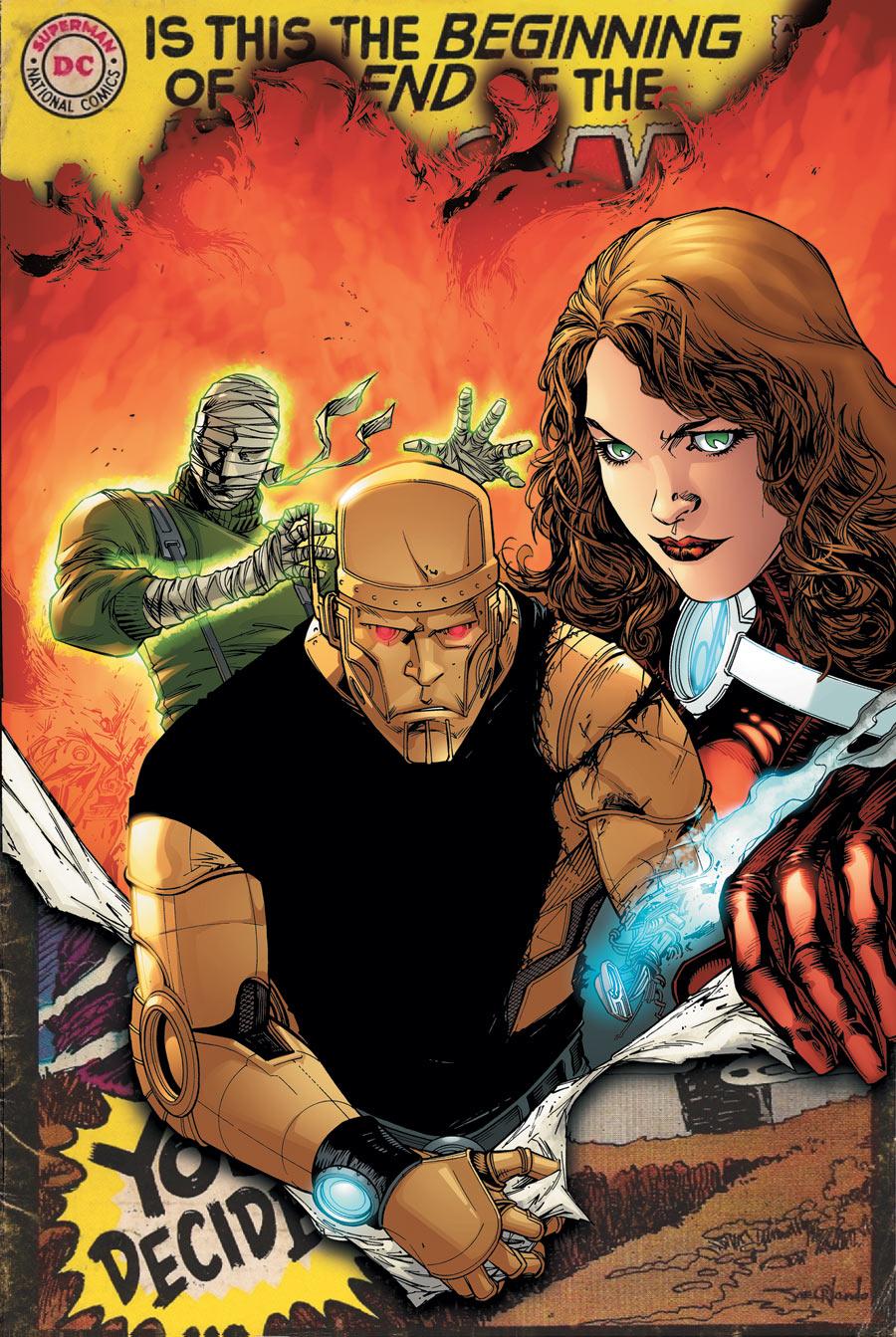
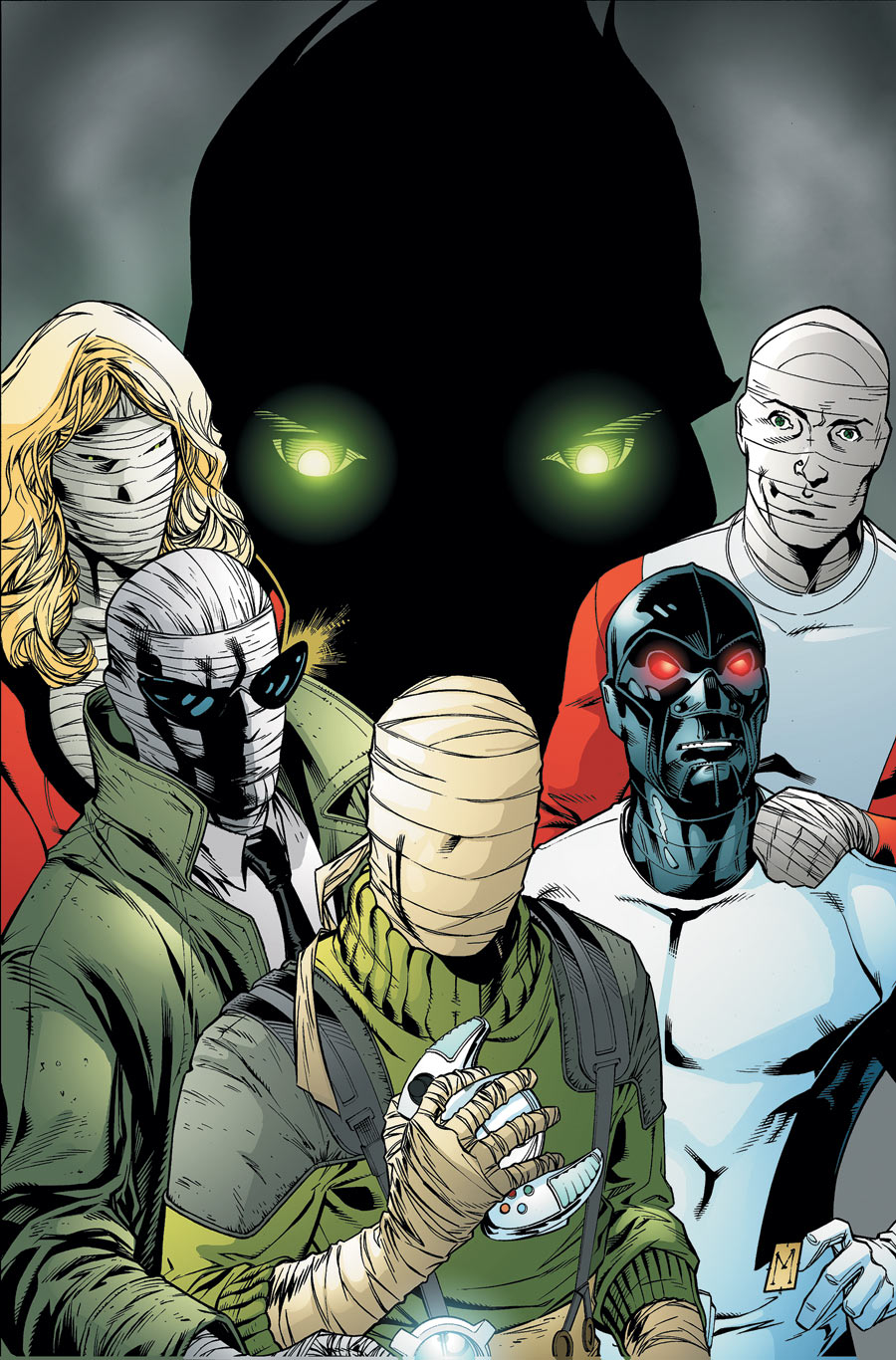
The premise of the Doom Patrol revolves around Niles Caulder aka The Chief. Caulder was a reclusive scientist who had bitterness towards the world. In the interest of his own scientific interests, with a side interest in helping the world, he gathered together three individuals transformed by freak accidents. Pilot Larry Trainor was blasted with strange radiation, forced to wear specially treated bandages to contain his radiation, and could projects hard light version of himself from his body. Rita Farr was a movie actress on the set of her latest picture when she accidentally bathed in mysterious waters and found she could shrink and grow at will. Finally, Cliff Steele was a race car driver fatally injured in an accident. Caulder witnessed it and helped transfer Cliff’s brain is a massive robot body. This trio were often the reluctant aides of Niles Caulder.

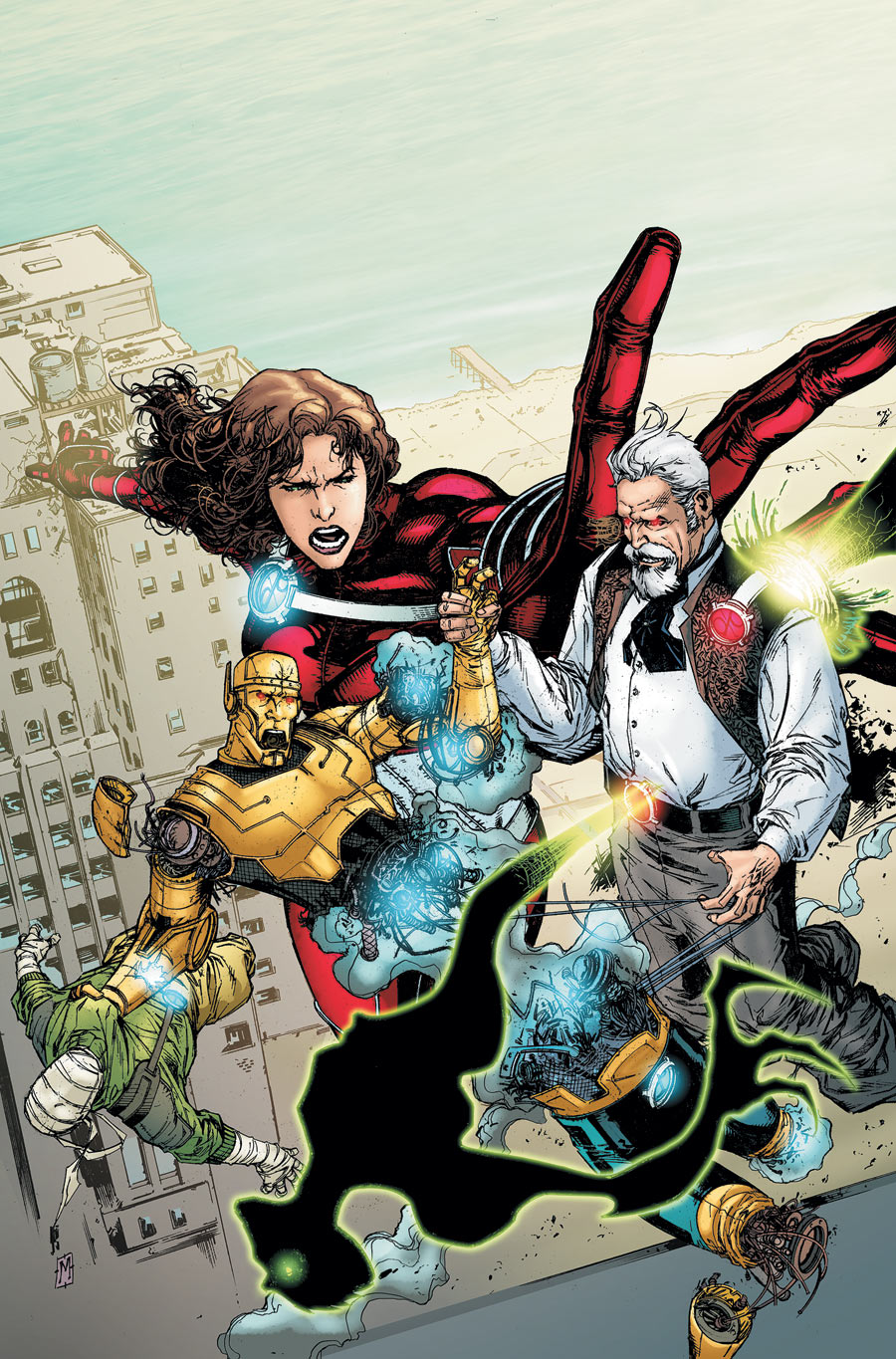
In the current series, the Doom Patrol have relocated to Oolong Island, a locale in the DC Universe most recently used as a haven for various mad scientist supervillains. The Island has been “legitimized” and Caulder brings his team in and uses the newly founded nation as his staging ground for illegal experimentation and missions. The trio of members underneath him are completely mistrustful of him and Rita is especially angered when she learns Caulder has brought her ex husband, Steve Dayton along. Dayton is a telepath who originally used his powers to convince Rita to marry him, they even adopted the Teen Titans’ Beast Boy as their son. Once Dayton’s ruse was revealed the marriage fell apart. Now Caulder uses Dayton to attempt to control Rita.

The plots have been pulled into joining the Blackest Night story running through the books as well as delving into dense Doom Patrol continuity. I can’t see someone who hasn’t read the last twenty years of Doom Patrol stories being able to understand this series. There’s a villain reveal in one of the more recently issues that will fall with a thud for anyone who didn’t read the Morrison run. Though Giffen attempts to provide recaps for new readers: there’s a single issue spotlight on Larry Trainor and another on Rita Farr, 32 pages is simply not enough to create an understanding of these vastly difficulty histories. Despite my love of the strangeness of these characters, I have a feeling we will being seeing the cancellation of the series soon. Its odd because DC attempted a complete reboot in 2004 and it failed miserably as well. I will defend the concept of these characters, and I believe they can work. I just have no idea what it would take for them to lead a successful ongoing series.

Comics Review: S.H.I.E.L.D.


S.H.I.E.L.D. #1-3
Written by Jonathan Hickman
Art by Dustin Weaver

Remember reading in the history book about how Galileo fought back the invasion of Galactus on Earth? You probably don’t, as such stories have been hidden in the shadows by the cabal of S.H.I.E.L.D. This mysterious organization operates from the catacombs of Rome, in the city of Urbis Immortalis. They have discovered how the world will end and fight those forces that seek to bring it about too early. In addition they push humanity’s evolution forward by giving support to all the great minds through out history. In the opening of this series its 1953 and a young man named Leonid is recruited by Agents Nathaniel Richards and Howard Stark.  Leonid learns his father was a super being named the Night Machine who has been in battle with S.H.I.E.L.D. for years. Night Machine causes Leonid to question the true purposes of S.H.I.E.L.D. and the first issue ends with the young man meeting Leonard da Vinci, who has traveled through time to deliver a mysterious device.

S.H.I.E.L.D has all the trappings of a great Grant Morrison comic and these first few issues have already made me think of series like The Invisibles and Morrison’s Batman. These are comics where you have an avalanche of ideas in a single issue, that force you to re-read just to make sure you got each and every little concept. The original premise of S.H.I.E.L.D, created by Stan Lee and Jack Kirby, the group was created by  Nick Fury as a espionage version of the United Nations that worked in the shadows. Hickman’s series purports to do a little retroactive continuity work (retcon) by establishing that the organization was around long before Fury. It remains to be seen if this series in the greater continuity of the Marvel Universe, or its own little pocket, but it does seem to feature cameos by a lot of mainstays.

Why S.H.I.E.L.D stands out so strongly from the rest of the Marvel titles may be because it was originally a creator-owned idea. Hickman hadn’t tied to the MU until his work on Secret Warriors and Fantastic Four gained him acclaim at the company. He’s managed to create a little corner for himself at Marvel and for the incredibly nerdy-minded of us if you pay close enough attention you see references in one book to something going on in the other. Smartly, these are not details that hinge on you understanding the plot, but make you grin when you realize the connections. Its outstanding work from a writer who is still early in his career. Very excited to see what Hickman gets up to in the coming years.

Tube Time: The Lost Room


The Lost Room (2006, 3 episodes)
Starring Peter Krause, Julianna Marguiles, Kevin Pollak, Elle Fanning

Something happened in the motel room in New Mexico back in 1961. But no one is quite sure what it was. The scientific minded believe some sort of event that bent space-time. Others say that God died in that motel room. Whatever happened the room vanished from our reality, but some how the small everyday trinkets inside made their way into the world. A ballpoint pen. A plastic comb. A wristwatch. A room key. They appear to be nothing special. But they are. This is the universe created in the Sci-Fi Channel mini-series The Lost Room. While Sci-Fi has an incredibly erratic track record for original programming, see sawing back and forth between incredibly horrible movies about giant animals killing people and thoughtful, interesting series. The Lost Room definitely belongs in the latter category, but sadly, as much as the mini-series serves as a pilot to an ongoing program Sci-Fi passed. Even though not all of its plot threads are tied up, The Lost Room is an incredibly interesting program that does exactly what great sci-fi should: throw a ton of ideas at you.

Detective Joe Miller, Pittsburgh PD, responds to the scene of homicide. The two victims are covered in horrible burns and appear to be partially phased through the walls and ceiling. Miller investigation leads him into the possession of a motel room key that, when inserted in any tumbler lock door, opens on a motel room existing outside of natural space time. Any object left in the room vanished when the door is closed, the room resetting itself. Powerful forces want this key and as a result Miller’s daughter is in the room without the key when the door closes. She vanishes into thin air and the detective abandons his career to find her again. This journey leads him to discovering the story of the room, the violent cabals that seek to possess the magical items in the room, and finally to a figure whose essence is tied to the birth of this modern legend. Parallel to Joe’s journey is his colleague and forensic scientist Dr. Martin Ruber who becomes obsessed with tracking down objects and believe he has a higher calling. These two stories intersect in some interesting ways and its Ruber’s story that appears to have been the plot line that would have fed into a regular series.

What makes The Lost Room work is that it is unafraid to be science fiction in that it worldbuilds with expertise and presents ideas that you would never think of, but that make complete sense when you think about them. I was reminded by classic sci-fi writers: Bradbury, Ellison as well as a heavy dose of Stephen King as well. The writers cleverly worked to not overpower the Objects, an example being The Comb. The plastic comb can stop time, but only for 10 seconds, and if used in succession too frequently induces vertigo in the user. To use the Objects successfully a person must be able to think outside of typical thought. There’s also the added twist of what happens with objects are used in conjunction, having properties that are unpredictable. The mini-series really left me wanting to know more about this world and what clever Object combinations could be.

Acting wise you have Peter Krause doing an excellent job. Julianna Marguiles has never been an actress I cared for and her character just doesn’t fit in this story very well. Kevin Pollak is one of those solid character actors who, despite or because of his strong comedy background, can play a character as walking the tenuous line between good and evil. Dennis Christopher (Breaking Away), a wonderful character actor was the standout for me. His role of the obsessed Dr. Ruber really hooked me and wanted me to learn where that character would go in the regular series. This is a a great overlooked science fiction story that has begun to find its audience on DVD. The creators recently announced at the San Diego Comic Con that a comic book continuing the story of The Lost Room is in the works so we may very well get a continuation of Dr. Gruber’s story.

Director in Focus: John Cassavetes – Shadows


Shadows (1959, dir. John Cassavetes)

So the new director I will be focusing on till the end of September will be John Cassavetes. I suspect his face will be more familiar to audiences than the films he made. Cassavetes is most well known for the role of Guy in Roman Polanksi’s Rosemary’s Baby. Amongst film nerds, like myself, we know him as the father of American independent cinema. He was the type of rebel filmmaker that you hear about, but whom many independent filmmakers fail to live up to. In this first film. Shadows he used jazz as an influence; the picture was scored with jazz music and instead of a tightly written script, he allowed scenes and dialogue to be improvised. In particular, he shrugged off all public filming laws and would run out on the sidewalk, shoot until they saw cops, then run and hide. The result was a film that caused many walkouts when it was screened for the public, but is on par with the French New Wave films being simultaneously made across the world.

The film focuses on three figures: Ben, Hugh, and Leila. Ben is a leather clad beat-type. Hugh is an African-American crooner. Leila is a burgeoning artist. And they are all siblings, and they are all black. Leila is incredibly fair skinned and the only sign of Ben’s ethnic heritage is his tightly curled haired. Shadows examines racial politics in a very honest way, by looking at how its too complicated to compartmentalize people based on skin color. While most films in contemporary cinema deal with racial issues in a trite and clichéd manner, Cassavetes tells the story of these people in an energetic, mold-breaking way. It’s no wonder people walked out during public screenings, the movie defies narrative conventions in a big way.

The stand out for me was Leila Goldoni as Leila. A reason the film caused a stir when it originally came out was due to Leila actually desiring sex and sharing a scene in bed with a man. Even now having a female character actually want sex is taboo in some circles, we expect the man to take her. The scene is done very cleverly: he offers her upstairs for a drink, grabs a bottle of scotch as they kiss, and she says “I don’t really want a drink”. Without being explicit, Leila admits she simply wanted to come to his apartment for sex. The aftermath of the scene is also done with a remarkable sensitivity. It is Leila’s first time, and while the male character says all the annoyingly dull things, Leila replies with a true maturity. She talks about how it hurt more than she thought, wondering if now she comes to live with him, then admitting she doesn’t want to be with him again. I can’t say I have seen a moment in any other film that captured such a mature view of sex.

The star of the film is Cassavetes and his camera though. Being aware of these cinematic techniques and how the French laid claim to them in the 1960s, we can forget how revolutionary this must have been to see. It can come off as clunky, but there’s some real artistry at work, with the camera being used from hidden locations to film the actors on the street below. Or the way different takes of the same scene are spliced together to create an energetic tone in conjunction with the jazz soundtrack. The film was produced by Jean Shepherd, the author and narrator of A Christmas Story, who was a radio show host at the time. Shepherd played to the art and beat crowds of New York and would have Cassavetes on as a guest promoting his ABC crime series Johnny Staccato at the time. During one broadcast, Cassavetes asked Shepherd listeners that they could help him make his film by sending a dollar or two. By the end of the week the radio station had received a couple thousand dollars, and these donors are thanked in the opening credits. Shadows was truly an independent film made by regular people.

Tune-age: End of Summer Mix 2010

Here’s a mix for your downloading pleasure. It features songs that I first heard this summer, or have some sort of connection to a mood or tone during this season for me. Enjoy.

1. Money – Sharon Jones & The Dap Kings
2. City With No Children – Arcade Fire
3. The Happy Goth – The Divine Comedy
4. Lady Luck – Richard Swift
5. Teenagers – Department of Eagles
6. God Help the Girl – God Help the Girl
7. Airplanes – Local Natives
8. Kim & Jessie – M83
9. Flash Delirium – MGMT
10. Crash Years – The New Pornographers
11. Melectric- Ramona Falls
12. Sleep All Day – The Rural Alberta Advantage
13. Home – Edward Sharpe & The Magnetic Zeroes

Click here to download

Comic Quick Hits

Brightest Day #7 (of 26)

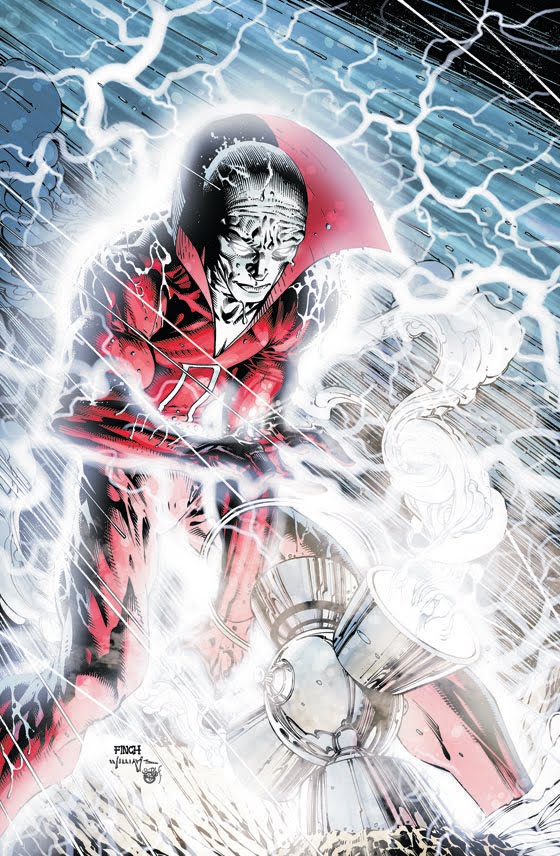
This is the “spine” of the DC Universe for the next year, following characters resurrected at the end of Blackest Night. And this particular issue has been hyped as the “every thing is revealed” moment. Former spectral hero Deadman aka Boston Brand comes in direct contact with the mysterious White Lantern, and when he does all the resurrected heroes and villains hear a voice telling them why they were brought back. Of course this voice is vague as hell, but the most interesting for me was Maxwell Lord seeing that his destiny is kill a character whose book is coincidentally on the ropes for cancellation. As a stand alone story, it wasn’t too great, but for the overall narrative it does set an interesting direction for things.

Superman:  The Last Family of Krypton #1 (of 3)

DC returns to its Elseworlds imprint, a focus on “What If?”, parallel reality type stories. The conceit here is that the entire El family (Jor, Lara, and little Kal) escape Krypton and arrive on Earth in the 1970s. Jor immediately uses his alien technology to make life better for humanity, while Lara pushes the philosophic belief of Rao-ology. Lara is the focus here and becomes concerned about Kal’s isolation in the world, so she begins interviewing Earth family’s to find one he can live with in disguise to learn what it is to be human. Guess who she picks. There’s some sub plot threads involving Jor and his Jorcorp, a company developing household devices using Krypton tech, and the child prodigy Jor hires (said prodigy is a very familiar figure in the Superman mythos). What I really enjoyed was a big divergence from the standard Superman story that centers around Lara and has me looking forward to the rest of the series.

Shadowland #2 (of 5)

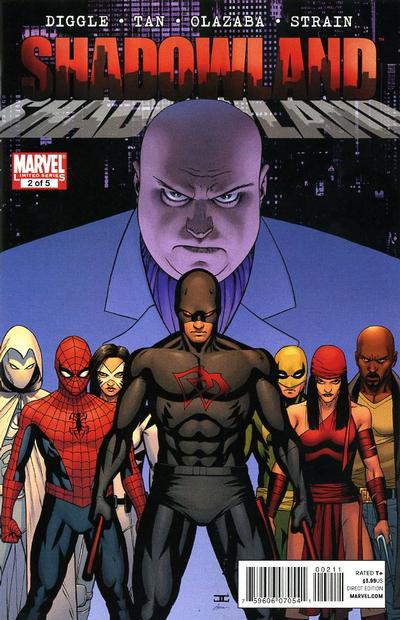
Marvel’s urban NYC event continues. Daredevil, still inexplicably wearing this new costume, is confronted by old friends Iron Fist, Luke Cage, Misty Knight, Colleen Wing, and Spider-Man. Meanwhile, The Kingpin and Lady Bullseye summon a very familiar Marvel comics character to help in their fight. I’m most intrigued about Moon Knight’s involvement in the story. He gets himself captured by Daredevil’s forces and locked up in the Hand’s prison. Moon Knight has always been a great premise to me, like a completely insane Batman with multiple personalities. The mini-series  is keeping me hooked, which is quite an accomplishment, as it features characters I have never clicked with. Definitely much better than Marvel’s last big event book, Siege. I think it works in part because its keeping the scale small and local.

Comics I’m Getting This Week


BOOM! Studios
Irredeemable #16

Dark Horse
Magnus, Robot Fighter #1 (of 4)

DC Comics
Batman: Odyssey #2 (of 6)
Brightest Day #7
Doom Patrol #13
JSA All-Stars #9
Magog #12
R.E.B.E.L.S. #19
Red Hood: Lost Days #3 (of 6)
Red Robin #15
Secret Six #24
Superman: The Last Family of Krypton #1 (of 3)

Dynamite
Black Terror #11

IDW
Kill Shakespeare #4

Marvel
Amazing Spider-Man #639
Avengers: Prime #2 (of 5)
Avengers: The Origin #5 (of 5)
Captain America #608
Casanova #2
Darkstar and the Winter Guard #3 (of 3)
Deadpool #1000
Deadpool: Wade Wilson’s War #3 (of 4)
Gorilla Man #2 (of 3)
Hawkeye and Mockingbird #3
Hercules: Twilight of A God #3 (of 4)
Hit-Monkey #2 (of 3)
Marvel Universe vs. the Punisher #1 (of 4)
Marvelman: Family’s Finest #2 (of 6)
S.H.I.E.L.D. #3
Secret Warriors #18
Shadowland #2 (of 5)
Shadowland: Bullseye #1
Spitfire #1
Young Allies #3$2.99

Vertigo
Greek Street #14
House of Mystery #28
I, Zombie #4
Sweet Tooth #12

Wildstorm
Tom Strong and the Robots of Doom #3 (of 6)

Podcast Recommendations: Comedy and Everything Else

Comedy and Everything Else

I am a big podcast nerd, particularly comedy podcasts. I love hearing my favorite comedians on a weekly/monthly basis instead of waiting for their next album, which might not ever come. I came across Comedy and Everything Else by accident while browsing through the podcasts on iTunes. What caught my eye was that it featured one of my favorite comedians, Todd Glass. The other two names attached (Jimmy Dore and Stefane Zamarano) were completely new to me at the time. What I discovered was a podcast that was both funny, but also explored the nuances of comedy and how comedians view their craft. The episodes are long, many topping over two hours, and I love it. The conversations these people are having are the kind I want to listen to for hours and hours more. The earlier episodes are a little rough in terms of sound quality, but they improve quickly.

The focal point of CEE is Jimmy Dore. Dore is a Chicago transplant to L.A. and comes from your typical large Irish-Catholic family. He’s worked with Doug Benson and Arj Barker’s Marijuna-logues and a highly rated Comedy Central special, Citizen Jimmy, in 2008. Dore’s focus in comedy is on the political, though he works to keep from becoming didactic and aims for a tone of satire in his work. His paramour is fellow comedienne and improvisationalist, Stefane (pronounced Steh-fuh-nay) Zamarano. The duo collaborate on the regular feature “Tuesdays With Moron”, wherein Jimmy has a conversation with himself as the ultra-conservative, Fox News uber-fan Moron. Stef plays Moron’s constantly nagging in the background wife, Terese. Sadly, Todd Glass left in the fall of 2009 after a falling out with Dore. The details of the bad blood has not been publicly released but the absence of Todd was definitely felt while the show worked to redefine and regroup. Glass recently returned to the show as a guest for the 100th episode and, since he suffered a heart attack a few months ago, has reunited with Dore and Zamarano and the conflict seems to have passed.

On the most recent episode, Dore has tackled a controversy in the comedy community surrounding a “Comedy Boot Camp” run by comedians Kyle Cease and Louie Anderson. The program came under fire after Doug Stanhope posted a strong missive about it on his blog, calling up notorious comedy class shills from the past. Dore’s three hour interview with Cease is very interesting and allows the comedian to explain what his program is. Cease doesn’t come off in a great light though, and at time sounds awfully defensive towards hypothetical criticisms Dore throws at him. Dore is also very upfront about his feelings towards comedy classes, particularly ones that cost upwards of $3000 for a week of workshops. There’s some interesting talk about when a comedian is ready to sell himself to the television/film industry and about how a comedian pays their dues and learns their craft. If you are a comedy geek like myself, and appreciate comedy as an art and craft, then I think you will enjoy the topics covered and guests who pop up on CEE.

Comics 101: Booster Gold

Superheroes are honorable and trustworthy figures of great upstanding morals, right? Not in Booster Gold’s case. The hero from the distant future has always been an opportunist, looking for a way to parlay his heroism into corporate endorsements. He came about in the mid-1980s, the perfect super capitalist for the Reagan era. In the two decades since, Booster has gone through many changes and volleyed back and forth between being a humorous or serious character. His partnership with Blue Beetle is legendary, and his ties to the history of the DC Universe are epic. But in the end, he’s just a guy looking to make a buck.

Booster’s story starts in Gotham City of the 25th Century. Michael Jon Carter grew up without a father, his was a drunk who left when he was a child. The pressure to provide for him family started early and Michael eventually gets into Gotham University on a football scholarship, with dreams of going pro. At this point, Papa Carter shows up and convinces Michael to throw his games so his father can win big on bets. Michael tentatively agrees and gets caught, thrown out of the university and forced to get a job as a night watchmen at the Metropolis Space Museum. After getting a good look at all the devices on display, Michael realizes he could take them, use the Time Bubble that is kept in the museum and start a lucrative career in the the past. Employing a security robot named Skeets, Michael jumps back to the late 20th century where he debuts as the superhero Goldstar. When he gains the accolades of President Ronald Reagan, he receives a name change due to the president’s growing senility. Michael’s nickname as a football player was “Booster”, and the president confusingly introduces him as Booster Gold.

During Booster’s early years, he teams with his little sister Michelle Carter who takes his original name “Goldstar” as her own. Booster amasses a large quantity of wealth through his fame, but suffers two tragedies: first, Michelle is killed in battle and second, the CEO of Booster Gold International embezzles all the funds leaving the hero broken and on the streets. His luck changes when businessman Maxwell Lord approaches Booster to join a new incarnation of the Justice League. This allows him to fight alongside such legends as Batman, Martian Manhunter, and Black Canary as well as beginning his long-running friendship with Blue Beetle. Booster and Beetle frequently steal Max’s money to invest in get rich quick schemes, like building Club JLI on the living island of Kooey Kooey Kooey. Booster leaves the Justice League at one point to form the corporate team The Conglomerate, but quickly finds his way back to the JLI. Another dark period began for Booster with the arrival of the alien Doomsday on earth. As the behemoth trudged toward Metropolis, the Justice League tried to stop him. Booster’s futuristic suit, the source of his power was damaged beyond repair. Blue Beetle, a tech whiz ala Tony Stark, builds a bulkier armor for Booster to use.

For a short time, Booster joins an offshoot of the Justice League led by Captain Atom. He goes back to being a solo hero and is able to get a replica of his original costume made for him. The current period of Booster’s life kicked off with the brutal murder of his best friend, Blue Beetle. The murder was the work of their former boss Max Lord, and Booster set off to learn what was going on. He found that Max was working to eliminate superhumans from the Earth, and used normal humans unwittingly fused with a nano-virus. When activated, these humans became OMACs (Observational Metahuman Activity Constructs). A global battle followed, that pitted Earth’s heroes against the OMACs and the giant satellite controlling them, Brother Eye. Booster teams with Batman and the new teenaged Blue Beetle to take down the satellite and they succeed. In the aftermath of this battle, Superman, Wonder Woman, and Batman all take a leave of absence causing Booster to attempt to fill the void of Superman’s absence in Metropolis.

Booster had always relied on Skeets historical database to give him the edge against the enemies, but suddenly Skeets is reporting the wrong information. He also receives competition when the mysterious new superhero Supernova appears in Metropolis and quickly becomes beloved. Looking for answers, Booster travels to the desert bunker of DC’s chief time traveler, Rip Hunter. There he finds a photo of himself circled with the words “All his fault” written next to it. While Booster thinks it is about him, it is revealed Rip has discovered that Skeets has been compromised. The robot sidekick turns on Booster, trapping him in a time loop and beginning a hunt for Supernova and Rip Hunter. When he finally finds Supernova, the enigmatic unmasks himself as…Booster Gold?! Booster escaped the time loop with help from Rip, then traveled back a few weeks to debut as Supernova. It turns out Skeets is actually carrying the minute alien villain Mr. Mind, who has evolved into a new more dangerous form. The monstrous new Mr. Mind chases Booster and Rip through time, accidentally birthing the multi-verse (parallel universes). Skeets is restored, Mr. Mind is defeated, and Booster and Rip begin a partnership.

Most recently, Maxwell Lord has returned from the dead and manipulated Booster and his former Justice League teammates into reuniting. Max has shown a less villainous side, telling Booster he considers him his friend and that all of this has a purpose. It remains to be seen whether Max is playing his former employee or legitimately trying to help him.