Legion (2010, dir. Scott Stewart)
Starring Paul Bettany, Dennis Quaid, Tyrese Gibson, Adrienne Palicki, Charles Dutton, Lucas Black
Author: Seth Harris
A Decade in Love With Movies – 2003 -2006 – An Education
Throughout this period of time, I became a frequent theater hopper at the Green Hills 16. About one or two Saturdays a month, I would walk over to the mall and take advantage of the basement like setup of the 16, where a person could easily move from screen to screen and never be seen. I was able to devour so much cinema during this period, helped in part because the 16 is a Regal Arts Cinema, meaning it focused on artsy fare mixed in with the blockbuster junk. I saw such films as Secretary, Late Marriage, Spirited Away, Adaptation, and more.
I became more and more interested in reading about the ideas behind and interpretations of cinema at this point.
One of the things I began doing at the time was cataloging the films I saw over 2005, a practice I still maintain today. I began to fight my way through the depression and film played a major part. The apartment I lived in had cable with every premium channel plus a DVR unit. I began checking the schedule a week in advance and planning out what to record and was able to see volumes and volumes of excellent film that continued my education. In 2006, I worked for a brief time at the Edmonson Pike branch library and was able to have daily access to great works of film, having 20 or more DVDs out at a time. I was able to continue keeping up with contemporary works as well as back tracking and seeing more historical films.
Sundance Film Festival – The History

Right now the 2010 Sundance Film Festival is in full swing in Park City, Utah. American films of all sorts are being rolled out every day till January 31st. For the blog, I’ll be looking at the general history of Sundance here in part one, and then in part two I’ll look at some of this year’s films that I’m most excited to see.
Film 2010 #16 – Goodbye Solo

Goodbye Solo (2008, dir. Ramin Bahrani)
The James Dean Trilogy – Rebel Without a Cause

Rebel Without a Cause (1955, dir. Nicholas Ray)
Starring James Dean, Natalie Wood, Sal Mineo, Jim Backus, Dennis Hopper
Where in East of Eden, we have the contorting and convulsing Dean, here we have a more muted and subtle performance, and the one that made Dean the icon that he is today. The film was helmed by director Nicholas Ray, who would not find much more cinematic prominence in his career after this picture. It’s also notable that James Dean was only alive for the release of one of his films, the aforementioned East of Eden. Both this film and Giant were released posthumously and caused many fans to read into bits of dialogue here and there in hopes of gaining some insight into the actor’s psyche.
Dean plays Jim Stark, a young man who has frustrated his parents and forced them to move multiple times because of his anti-social behavior. Jim is not a “bad boy”, as the iconography of Dean has informed pop culture, but more of a quiet, troubled young man. And Jim doesn’t have an issue with figures of authority as long as they show him respect. One of the most remarkable characters in the film is Officer Ray Fremick, who genuinely wants to help Jim and offers him an ear any time he needs to talk. In turn, Jim’s parents are an utter mess attempting to hide this to public.
A scene early on sets of the thesis of the film: Jim and his classmates are attending a planetarium show at Griffith Observatory where the presenter tells them of the sun’s eventual implosion and the earth’s destruction, utter the phrase “Through the infinite reaches of space, the problems of man seem trivial and naive indeed, and man existing alone seems himself an episode of little consequence.”. This is why Jim is a rebel without a cause, he fights against a system for no reason other than to fight. At one point in the film, Jim is challenged to a game of chicken by school bad boy Buzz. As they prepare to race, Buzz tells Jim he likes him, Jim asks why they are doing this then, and Buzz replies “Well, what else are we gonna do?”
Another interesting aspect of the film is Plato (Sal Mineo), a fellow student of Jim’s whose father has left and whose mother is little involved in her child’s life. The family’s housekeeper is the most concerned person about Plato, as the boy tortures small animals and grows increasingly aggressive and upset. Plato immediately clings to Jim and, as it wouldn’t have been apparent to audiences in the 1950s, has homosexual feelings for the new boy in school. There are scenes where Plato reaches out simply to touch Jim’s shoulder, and when Jim heads home for the night, Plato informs him that there’s no one at his house and that he and Jim could hang out there if he’d like. I found it to be tremendously progressive for a film of this period to feature a character to so blatantly gay and not make him a villainous figure.
The film shows major growth in Dean’s acting ability, as this character chooses to simmer instead of explode. It’s definitely not his best performance, which I believe is in Giant.
Film 2010 #14 – The Book of Eli

The Book of Eli (2010, dir. The Hughes Brothers)
Starring Denzel Washington, Gary Oldman, Mila Kunis, Jennifer Beals, Malcolm McDowell
The post-apocalyptic world has been the setting for many films, the most obvious that comes to people’s minds would be the Mad Max trilogy. In the last few years we’ve seen I Am Legend, Terminator: Salvation, and The Road. So how does this latest entry into the sub-genre stack up? Not exactly a masterpiece, but not without its merits either.
The story follows the enegmatic Eli (Washington), a traveler across the devastated landscape who lives by a stoic system of conduct. He has the reflexes of superhero and a stony resolve. There isn’t much depth given to the character, and he is definitely in the category of Clint Eastwood’s The Man With No Name. We have no back story ever given for Eli and in fact it probably doesn’t matter too much anyway. There are some interesting twists that provide a different context for the film if you were to go back and rewatch it, however, the film never provides any real reason to want to.
The post-apocalyptic world the Hughes Brothers have designed feels incredibly bland. They add some new details: a world so sun bleached everyone must wear sunglasses when going outside. But other than a few details here and there, there is nothing that sets this world apart from richer futurist visions. The one thing that elevates the picture is the acting, particularly of Washington and Oldman. These two actors are much better than the material they are working with and its only due to their acting prowess that they make it enjoyable.
In the end, its a case of great concepts but poor delivery, very much like last year’s Pandorum. The film feels way too rushed (it’s about an hour and half), and the action doesn’t really kick in until an hour in. This imbalance of the plot can definitely be felt and ends up showcasing some of the sloppiness in the screenplay. It’s a film with a look once its on DVD or you come across it on HBO, but definitely not one to rush out to the theaters and see.
Weekend Trailer Roundup
Here are some of the best trailers I saw this week, hope you see something you like.
Cyrus (dir. The Duplass Brothers) – Premiering at Sundance, this comedy stars John C. Reilly, Marisa Tomei, and Jonah Hill. The Duplass Brothers are known primarily for their work in the mumblecore genre (improvised indie pics). Very interested in what they do with this film.
http://www.youtube.com/v/pVSGYp9CMFc&hl=en_US&fs=1&rel=0
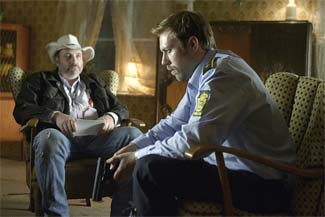
Terribly Happy (dir. Henrik Ruben Genz)- a very crazy looking Danish film, in the vein of Twin Peaks. I am there!
Director in Focus: John Sayles – Lone Star
For the next six months or so, I have decided to take a look at a director whose entire filmography will be new for me. The first director up will be John Sayles. Sayles’ name has come across my radar many times but I’ve never sought out his pictures until now. What I know about him is that he typically prefers large casts and very complex narratives, sort of like Robert Altman but with less improvisation. Sayles has done a tremendous amount of screenwriting work on films as diverse as The Howling, Apollo 13, and The Fugitive. It was an unproduced screenplay, titled Night Skies, that Sayles wrote which inspired Spielberg’s E.T. I hope that you learn as much as I do about a new major director in the American cinema with me as we go.
Lone Star (1996, dir. John Sayles)
Starring Chris Cooper, Elizabeth Pena, Kris Kristofferson, Matthew McConaughey
My feelings after seeing Lone Star was that Sayles made a perfect concept for the first season a television drama. There are so many characters and so many myriad plot strands that the two hours the film takes does not feel like enough to do them justice. Don’t get me wrong, this is a very good film, it just feels like so much for such a small portion of time.
The film is set in Rio County, Texas where two off-duty soldiers discover a partially buried skeleton wearing a sheriff’s badge. Current sheriff, Sam Deeds (Chris Cooper) is called in and an investigation begins revealing the skeleton to be that of Charlie Wade (Kris Kristofferson), who mysteriously disappeared forty years earlier. Sam starts asking questions of the older members of Rio County and is met with many warnings to leave the past alone. Simultaneously, we follow Pilar Cruz (Elizabeth Pena), Sam’s high school sweetheart and current social studies teacher. The circumstances of how their relationship ended becomes entangled in some of the same events that brought about the death of Sheriff Wade.
Much like Guy Maddin’s My Winnipeg, Lone Star is very much about things that happen below the surface level. There is the core mystery of the film, but there is just as much time devoted to the racial history of Texas. One scene involves a meeting of parents upset about the way Pilar teaches the history of Texas, giving a sympathetic view of the Mexicans’ role. A new courthouse is being dedicated during the film and an ongoing argument in the film revolves around whether to name it after Sam’s father, Buddy (also a sheriff) or to name it after a notable Mexican-American in the community. Pilar’s mother clings to her Spanish heritage over her Mexican roots and yells at her cantina’s staff if they do not speak in English.
The only flaw with the film is as I said before, so much for such a small amount of time. There are so many subplots, and they weave and connect together flawlessly, but I think they would have grown and matured better if allowed 12 to 13 hour long episodes to develop. As a series this would have combined the smalltown politics of Friday Night Lights with an investigation concept. The picture left me thinking that in the current climate of series like Mad Men and Breaking Bad, there would definitely be a home for Sayles if he ever wished to developed a series.
Film 2010 #12 – My Winnipeg

My Winnipeg (2007, dir. Guy Maddin)
If you aren’t familiar with Guy Maddin’s style of film making, then viewing one of his pictures can be a very jolting experience. Narrative is secondary to a more stream of consciousness style of storytelling. I’ve been very familiar with Maddin’s work, starting with Twilight of the Ice Nymphs, and this oddity of cinema lead me to watch Tales of the Gimli Hospital, Careful, Dracula: Pages from a Virgin’s Diary, and The Saddest Music in the World.
Maddin has an affinity for German expressionist and Soviet propaganda films from the early days of cinema. As a result, he typically makes black and white pictures that utilize the actual technology of the time period he attempts to recreate. In My Winnipeg, Maddin uses rear-projection and obvious sound stages to create a film that will be unlike anything you see in the theaters. The premise is that Maddin is attempting to psychologically break free from his frigid hometown of Winnipeg, Manitoba. The best way he decides upon doing this is to recreate moments from his childhood, focused around his cold and controlling mother.
Interwoven with these recreations are bizarre, Winnipeg legends. Maddin tells us about the First Nation (would be Native Americans for us) belief that beneath the forks of the rivers that converge in Winnipeg, are a second “forks beneath the forks” that are mystical in nature. This image of a parallel existing underneath what can be seen is crucial to understand what Maddin is doing in this film. All of his anecdotes about Winnipeg involve the idea of a darker side of things, and the world of myth and fable.
Many of Maddin’s claims about Winnipeg are suspect (10 times the number of sleepwalkers than any other city, a city hall built as part of an occult Mason rite) but they act as conduits into the subconscious and representations of the unseen nature of things. The fact that this entire film is a one long poem taking place in the mind of Maddin plays into the examination of a seedy underbelly to things. The film is also able to evoke strong emotion, particularly when Maddin laments the destruction of the city’s professional hockey stadium, a temple to him as he grew up.
What started as a commission by the city of Winnipeg to make a documentary of their city, evolved into an amazing exploration into one man’s psyche. Maddin is a director more interested in making what he likes to see and, if an audience happens to enjoy it, that is simply an added bonus. What Maddin creates as an end result is very similar to the film art created by David Lynch. This is not cohesive story with beginning/middle/end, but is an expression of the artist’s mood.
Film 2010 #11 – Gomorrah

Gomorrah (2008, dir. Mateo Garrone)
In Southern Italy there is a disease that infects the lives of many people living below the poverty line. This disease is a crime cartel known as the Camorra. The mafiosa organization has interwoven itself into the workings of both black market operations and legitimate enterprise, including investing in the construction of the rebuilding at Ground Zero in NYC. Such a concept seems too large to be real, but as director Garrone chronicles in this film, it is all too true.
Gomorrah, based on the nonfiction book by Roberto Saviano, takes an interesting direction in telling this story. The film is divided up into five separate plot strands that occasionally interweave, but more than not remain as their own isolated story. If the plots were to connect, it would cause the film to feel insular rather than expansive, which is the feeling Garrone wants to evoke. The Hollywood version of this film would seek to be sleek, refined, and would desperate to constantly try and engage the audience. Gomorrah, plays out slowly and at a pace that could be infuriating to some viewers. It is a slice of life film, showing how mundane and common these acts of violence and crime are in the lives of the people in these regions of Italy.
The main characters are Don Ciro; a man charged with distributing cash to the families of imprisoned members of the family, Toto; a 13 year old boy who seeks to join the family to gain prominence in his slum community, Roberto; a recent university graduate working with a mob boss to illegally dump toxic waste, Pasquale; a tailor who is struggling to make the order demands of the mob and moonlighting as a sewing instructor for a Chinese-Italian sweatshop, and finally Marco and Ciro; two young men who are caught up in the fantasy of being in the mob and are unaware of the real dangers of pissing off the wrong people.
Instead of focusing the top tier of the mafia and glamorizing it, the film seeks to explore the lives of the people at the bottom rung of the ladder. The lives displayed are gritty and bleak and there doesn’t seem to be much chance of rising out of the mire. The mob has so taken over every aspect of life that they have replaced the government, and in the case of Tito, his biological family. There is much this picture has in common with Fernando Meirelles’ City of God, just even less stylistic. In fact, I believe Garrone is trying to create a film without embellishment so that the every day nature of crime is the main focus. I highly recommend this as counterprogramming to the mainstream films that stylistically glorify the criminal lifestyle