Film 2010 #35 – Shutter Island


Shutter Island (2010, dir. Martin Scorsese)
Starring Leonardo DiCaprio, Mark Ruffalo, Ben Kingsley, Michelle Williams, Max von Sydow, Emily Mortimer, Patricia Clarkson, Jackie Earle Haley, Elias Koteas

My immediate reaction after seeing the first trailer for Shutter Island was that it would be interesting to see Scorsese tackle a film with horror elements. After thinking about this for a little while longer, I realized he already had in Taxi Driver, a film I think of as an urban horror picture more than anything else. Upon further contemplation, I realized we found similarly paranoid protagonists in many Scorsese pictures: The King of Comedy, Raging Bull, Goodfellas, and of course, The Aviator. This is why Shutter Island, while stylistically a departure for the directing legend, is thematically at home in his body of work.
The premise brings U.S. Marshall Teddy Daniels (DiCaprio) to the Ashecliffe Hospital for the Criminally Insane located on Shutter Island. Rachel Solando, a patient at the asylum has vanished so Daniels, and his new partner Chuck Aule (Ruffalo) have come to investigate. Daniels is introduced to the facilities by Dr. John Cawley (Kingsley) and eventually meets the head of the hospital, Dr. Naehring (Sydow), a German who brings back Daniels animosity for the Nazi atrocities he witnessed during World War II. This combined with strange nightmares about Daniels’ late wife intensify his paranoia while on the Island and he begins to formulate what he believes is the real horror going on behind the scenes on Shutter Island.
What hits you first about this film is the score. The music was designed and chosen by long-time friend of Scorsese and former member of The Band, Robbie Robertson and he proves he has an ear for some powerful modernist compositions. There are elements of Bernard Hermann yet never played to the point of absurdity. Because of the strong musical elements they create a balance with the unscored moments. An encounter in a cave among the cliffs of the island goes unscored, despite there being revelations made there that would have received a crescendo of strings in an older picture. It’s those choices of presence and absence that strike the right balance in the film.
At its core, this is simply a variation on the haunted house trope. What sets it apart from a B-movie are the very powerful artistic masterstrokes Scorsese uses. The dream/nightmare sequences Daniels experiences, whether they be in sleep or in the middle of the day, inform the audience with the clues the investigator fails to find in the conscious world. I was particularly intrigued by the cultural paranoias of the day that seeped into the fiber of the film. We have Daniels haunted by the sights of Jews frozen to death at Dachau and his unit subsequent expunging of the camp’s guards in an era where PTSD was not something remotely thought about. In addition, characters mention the fears of atomic annihilation as a result of the Cold War, the idea of Nazi scientist-torturers being granted pardons for service to the US military, and brainwashing techniques of HUAC. This constant atmosphere of not-knowing and being watched makes Shutter a perfect companion piece to The Aviator.
Shutter Island may not end on the most satisfying of notes, but there really is no other way for it to end. Such a story can’t deliver any true sense of justice and still remain true to its film noir and horror roots. From the first time we see Daniels, hunched over a toilet as the ferry rocks around him, it is apparent this character is in bad shape. An odyssey to an island of madness can never make such a condition better.
Film 2010 #21 – A Face in the Crowd


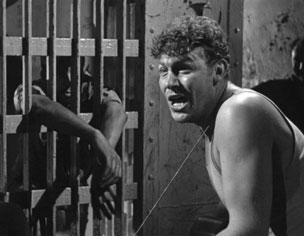
A Face in the Crowd (1957, dir. Elia Kazan)

Starring Andy Griffith, Patricia Neal, Walter Matthau
Sheriff Andy Taylor this ain’t. If you familiarity with the acting of Andy Griffith doesn’t expand much further than The Andy Griffith Show then prepare to be shocked by this picture. Released three years prior to the television series, the role Griffith plays is that of a scoundrel, liar, womanizer, emotionally abusive drunk. The character’s profession as a television personality delivering blues-based country music and humorous monologues about his upbringing in North Carolina is remarkably similar to how Griffith made his start in show business. However, the darker aspects of the character are believed to be inspired by television and radio personalities Arthur Godfrey (who fired an employee on air in 1953, revealing his controlling personality) and Uncle Don, a child TV personality who was caught calling his audience “little bastards” on air.
The story begins with Marcia Jeffries, the niece of a radio station owner in North Arkansas who hosts a series called “A Face in the Crowd”, whose focus is finding everyman figures with dynamic personalities. She comes across Larry Rhodes, a drifter picked up for public drunkenness. Larry is a very charismatic person who pulls people in and Marcia decided to make him a regular on the station, nicknaming him Lonesome Rhodes. Lonesome rises up through a local television station in Memphis and is eventually picked by a national network in New York City. All the while, he reveals his true nature to Marcia as someone not truly as “salt of the earth” as he claims.
The film feels prophetic, but when its based on personalities and hosts of the past it reveals how cyclical the fame and media machine truly is. It is inevitable that parallels would be drawn between this film and Bill O’Reilly, Rush Limbaugh, Glenn Beck, and countless other politically driven svegalis who emphasize their simple roots and connection to the common man. Lonesome Rhodes is a sympathetic character at points in the film, but never an admirable one. The theatrical audience could easily be pulled in by Lonesome’s grin and “fuck you” to the Man take on his earlier career.
The film is a pretty standard cautionary tale and director Kazan knows how to use his camera to accentuate the madness that begins to overtake Lonesome. I absolutely loved a montage that shows how Lonesome’s national television series becomes a hit. It was the perfect example of how to use montage in an effective way that isn’t simply cheating on the part of a screenwriter. I also loved a sequence near the end where Lonesome is taking an elevator down to the limo waiting for him. The camera cuts between the elevator buttons lighting as he descends and simultaneous descent of his approval in the eyes of the public and his sponsors. Brilliant, classic piece of cinema.

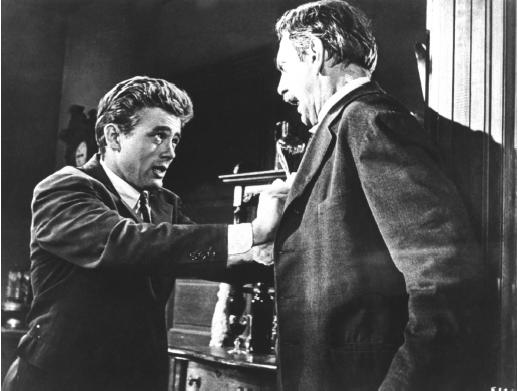
The James Dean Trilogy – Rebel Without a Cause


Rebel Without a Cause (1955, dir. Nicholas Ray)
Starring James Dean, Natalie Wood, Sal Mineo, Jim Backus, Dennis Hopper

Where in East of Eden, we have the contorting and convulsing Dean, here we have a more muted and subtle performance, and the one that made Dean the icon that he is today. The film was helmed by director Nicholas Ray, who would not find much more cinematic prominence in his career after this picture. It’s also notable that James Dean was only alive for the release of one of his films, the aforementioned East of Eden. Both this film and Giant were released posthumously and caused many fans to read into bits of dialogue here and there in hopes of gaining some insight into the actor’s psyche.

Dean plays Jim Stark, a young man who has frustrated his parents and forced them to move multiple times because of his anti-social behavior. Jim is not a “bad boy”, as the iconography of Dean has informed pop culture, but more of a quiet, troubled young man. And Jim doesn’t have an issue with figures of authority as long as they show him respect. One of the most remarkable characters in the film is Officer Ray Fremick, who genuinely wants to help Jim and offers him an ear any time he needs to talk. In turn, Jim’s parents are an utter mess attempting to hide this to public.

A scene early on sets of the thesis of the film: Jim and his classmates are attending a planetarium show at Griffith Observatory where the presenter tells them of the sun’s eventual implosion and the earth’s destruction, utter the phrase “Through the infinite reaches of space, the problems of man seem trivial and naive indeed, and man existing alone seems himself an episode of little consequence.”. This is why Jim is a rebel without a cause, he fights against a system for no reason other than to fight. At one point in the film, Jim is challenged to a game of chicken by school bad boy Buzz. As they prepare to race, Buzz tells Jim he likes him, Jim asks why they are doing this then, and Buzz replies “Well, what else are we gonna do?”

Another interesting aspect of the film is Plato (Sal Mineo), a fellow student of Jim’s whose father has left and whose mother is little involved in her child’s life. The family’s housekeeper is the most concerned person about Plato, as the boy tortures small animals and grows increasingly aggressive and upset. Plato immediately clings to Jim and, as it wouldn’t have been apparent to audiences in the 1950s, has homosexual feelings for the new boy in school. There are scenes where Plato reaches out simply to touch Jim’s shoulder, and when Jim heads home for the night, Plato informs him that there’s no one at his house and that he and Jim could hang out there if he’d like. I found it to be tremendously progressive for a film of this period to feature a character to so blatantly gay and not make him a villainous figure.

The film shows major growth in Dean’s acting ability, as this character chooses to simmer instead of explode. It’s definitely not his best performance, which I believe is in Giant.

The James Dean Trilogy – East of Eden

East of Eden (1955, dir. Elia Kazan)
Starring James Dean, Raymond Massey, Burl Ives

This month, I’ll be looking at the three core works of James Dean’s sadly short career. I didn’t see any of these films until 2007 when, while living in Washington state, I decided to check out Giant from the public library. What I discovered was the reason behind an icon. So often a pop culture figure’s work has been so far removed from our contemporary experiences that it is hard to understand exactly how they became so iconic. I have found that Dean was indeed a brilliant actor with a potential I don’t see in many others.

Dean made his starring role debut in Elia Kazan’s East of Eden (based on the novel of John Steinbeck), playing the tragic loner Cal Trask. Cal is the son of Adam, a farmer and brother to Aron. Throughout his life, Cal has been overshadowed by Aron’s accomplishments and looked at as the black sheep of the family. The mother mysteriously disappeared when the boys were children and Cal remembers little of her. The story is a reworking of the Cain and Abel story and mixes it with the gorgeous landscape of Salinas and Monterey, California.

The filmmaking at work here is a unique artifact of its time. Kazan is a deft director who is responsible for such masterpieces as On the Waterfront and A Streetcar Named Desire. And it was Kazan’s keen eye who discovered James Dean as he was performing on Broadway. Dean was a major proponent of method acting, a technique that transitioned from the more classical theatrical style of acting into a more psychological and physically interpretive method. Method acting bridges a sort of gap between acting and dance. This is seen in the way Dean almost spasms through his performance, he twists and contorts his body in unison with the psychological torment. The character of Cal is stunted mentally and Dean chooses to express that through his movement. Cal is constantly jamming his hands into his pockets, kicking at the dirt nervously, just like an awkward adolescent.

Dean was reportedly very uncooperative on set, and Kazan admitted he would encourage this by antagonizing the actor. Kazan believed that keeping Dean in such a mentally upset state would, in turn, enhance the anger and frustration of Cal on the screen. Dean’s co-star, Julie Harris is credited with truly enhancing the performance by adjusting her own to become more low-key and further highlight the distinction of what Dean was doing. For a first major film performance, Dean delivers in an astonishing way. Method acting was a new and exciting development in theater and its no wonder audiences were entranced with Dean.

Coming up next: I take a look at the film that made Dean an icon, Rebel Without A Cause.