Movie Review – Out of the Blue

Out of the Blue (1980)
Written by Leonard Yakir and Brenda Nielson
Directed by Dennis Hopper

As we close out our series on American Disillusionment in the 1970s, our eyes return to Dennis Hopper, who we last saw in The Last Movie. That was the last film he directed before this picture. Out of the Blue is a transitory film, moving its focus from the boomer generation’s self-involved anxieties to see what happened to Generation X in their parents’ emotional absence. It’s a painfully nihilistic film that continues Hopper’s career-long struggle with wanting the American mythologized to him while seeing that it is falling apart before his eyes. His take is expectedly reactionary and therefore unable to provide a fully coherent point, but the emotions that underlie the story are genuine. It’s the story of a generation already lost before getting on their feet.

Continue reading “Movie Review – Out of the Blue”

Comic Book Review – Thor by Walt Simonson

Thor by Walt Simonson Omnibus (2011)
Reprints Thor #337-355, 357-369, 371-382, Balder the Brave #1-4
Written by Walt Simonson
Art by Walt Simonson and Sal Buscema

I can’t say I was a fan of the Thor comic books growing up or even as an adult. I loved mythology as a child, and D’Aulaire’s Book of Norse Mythology got me hooked. But something about Thor just didn’t hook me. I was certainly intrigued by the art I saw, but the stories, with their very austere manner of speech, were a little much. Every time a new creator comes onboard the title, I will give it a chance, only to find myself growing bored. I wish I could tell you I fell in love with Walt Simonson’s legendary Thor run, but I can only really say that I respect it, and there were parts I enjoyed a lot. He’s undoubtedly a lover of Norse myths and infuses the series with it from the first issue.

Simonson had done pencil work on Thor when Len Wein wrote the title. He worked on Thor for about a year in the late 1970s, but by the time Simonson took over as both writer/artist, he’d intentionally worked to change his style. I don’t know how to fully describe Simonson’s artwork, but it’s not like much else I’ve ever seen. It has traces of styles present in illustrations from the 1960s and 70s. Male characters are often “chunky,” square in shape, and broad-shouldered. Female characters are smaller but still powerful, agile, and muscular. That’s really just describing the heroic and villainous characters. Supporting characters come in a wider variety of shapes. Volstagg and his wife are both very plump and round but not drawn for comic effect, instead presented as just who they are. Movement feels fluid due to Simonson’s line work; there’s a visual path used to show characters flying through the sky or bringing a weapon down on an enemy.

Simonson opened his run by shaking things up. He introduces Beta Ray Bill in #337, a figure who, for people outside the comics, will sound insane. Bill is an alien, specifically a Korbinite. His people have been displaced from their home in The Burning Galaxy and have a massive space ark working its way through the universe to find a new home. The Korbinites use their technology and willing test subjects to create a champion. Bill is the one who passes the tests, and he is transformed into a fierce cybernetic warrior. SHIELD detects the ship crossing through our solar system, and Nick Fury calls on Thor to help investigate. Thor loses his hammer during the fight, and Bill can lift it, transforming him into a variation on Thor. Eventually, Bill and Thor become friends, and Odin is able to forge Stormbreaker, a new hammer just for Bill.

Thor had always been one of the more Jack Kirby-influenced Marvel comics, so blending high fantasy and mythology felt like a natural fit. Beta Ray Bill is also such a unique character that throwing him on the cover of that first issue felt like a declaration that Thor was getting a major shake-up. During Simonson’s run, Bill is paired with Lady Sif, one of Thor’s potential paramours, and I found their dynamic to be far more interesting than any relationship the title character ever had. Bill’s story also ties directly into the central story arc that makes up the first big chunk of Simonson’s run. His homeworld was overrun by fire demons who ended up being the acolytes of Surtur, a devilish figure in Norse mythology. 

Simonson had previously done art for the immensely popular Star Wars title Marvel published at the time, which is where his art style was really reinvented. When he gets Thor, he’s employing those skills to present large-scale space battles and showcase the scope of the mythology that runs through this pocket of the Marvel universe. Throughout the first year of issues, we’re constantly teased that something is happening in the background that will tie these stories together. A shadowy figure forges a large sword on an anvil, and the narration frames this as more than just a blacksmith. Making this weapon is a cosmic act; the hammer working the metal is cosmic thunder. Eventually, we’ll see this sword being wielded, and its swing will rent a chasm through the Nine Realms. It’s not a sword; it’s a manifestation of ancient dark power. 

While Simonson ties his epic stories to events on Earth, this run was the one where Thor’s human ties were quietly pushed into the background. Previously, Donald Blake had been Thor’s human form on Earth. It’s relatively straightforward that these are two separate entities, and Simonson has Blake disappear, and Thor simply never turns back into him. Instead, the hero establishes a secret identity of Sigurd Carlson, rents an apartment in NYC, and gets a job as a construction worker. Unfortunately, the Carlson identity doesn’t seem to be an element Simonson loved dearly, as it is used as a plot device and then discarded for most of the run. 

Thor having a mortal persona has just never made sense to me. It makes sense for Spider-Man or Iron Man; they were someone before they became the superhero. Thor is just Thor; that’s who he was born as. On the other hand, Thor had been handled a little like Captain Marvel/Shazam in his creation. Blake would smash his wooden cane down and, in a blast of thunder & lightning, be transformed into the hammer-wielding Norse god. By discarding Blake, it would be as if Billy Batson shouted Shazam and never went back. In Donny Cates’ current run on Thor, he’s had a storyline that addressed the abandonment of Donald Blake. If you are a fan of that aspect of Thor, I do not think you would enjoy how that story turns out.

Simonson also clearly loves the character of Balder the Brave, like a whole lot! Balder doesn’t exist in the MCU; maybe in the future? In Norse mythology, he plays the role that Thor has been thrust into in the movies. Balder is the golden child of the Norse pantheon; he’s the God of Light and, therefore, deeply beloved by Odin. In the myths, Thor is a cantankerous moody figure. It makes sense as he’s the God of the Storm; they pop up and are destructive, and suddenly everything is calm again. Balder is having an existential crisis when Simonson’s run begins. In the comics, he goes through the story of a myth where Balder is betrayed by Loki and dies. Balder is back in the land of the living but shaken up by that experience, growing overweight from depression and just hanging around Asgard doing nothing.

Balder’s story happens with small connections to Thor’s and feels like a separate comic book inside Thor’s title. Balder encounters the Norns, the triplet goddesses of destiny. They show him a vision of what will come for Asgard, which sets him off on a redemption arc. He transforms himself into the hero he’s supposed to be and fights entities from throughout Norse mythology. Simonson does some deep cuts to build out the world of the Nine Realms. Thor & Balder’s great-grandfather Buri shows up for a bit to cause problems while Odin is experiencing one of his many deaths. To his credit, Simonson brings out a lot of humanity from characters that so easily could have been written as distant from human experience.

Some new elements are also introduced, and I don’t think they are great. Malekith, the Dark Elf, is introduced here, and I was surprised at how inconsequential he feels. He’s certainly a threat, but one that is overcome easily to make way for the war with Surtur. Lorelei is the little sister of The Enchantress, and she just feels like a repetition of that character but less interesting. There’s also Kurse, a character that the writing seems to want you to believe is a possibly amnesiac Thor, but of course, isn’t. I like how Simonson took the Dark Elves of Svartalfheim and made them one and the same, essentially with the Faerie. I don’t think The Wild Hunt storyline here is entirely coherent, but I get what Simonson was going for. Also, I think this run does some interesting things with The Executioner, and I wish Simonson had used him more.

I can’t say this earned its spot as one of my favorite Marvel runs of all time. I think it was essential to read it as one of those benchmarks in the history of the comic medium. This clear vision remade Thor and influenced everything that has come after. It could be argued that almost every creative team that came after Simonson is actively repeating the stories & themes he told or pushing back against them with a deep awareness of how they transformed the book. If you are a fantasy fan or someone who enjoys the big, bold action-oriented stories that comics can tell, this omnibus will pack a mighty punch for you.

Patron Pick – Blow Out

This is a special reward available to Patreon patrons who pledge at the $10 or $20 a month levels. Each month those patrons will pick a film for me to review. If they choose, they also get to include some of their own thoughts about the movie. This Pick comes from Matt Harris.

Blow Out (1981)
Written & Directed by Brian De Palma

In 1966, Italian director Michaelangelo Antonioni wrote & directed Blow-Up, a mystery film about a fashion photographer who believes he may have caught a crime on film while shooting in a park. When director Brian De Palma was working on Dressed to Kill, he started to think about reframing Antonioni’s film around sound rather than images. By late 1980, De Palma was shooting Blow Out in his hometown of Philadelphia, working alongside many recurring collaborators. The result is a film made in the vein of dozens of 1970s political thrillers, wrapped up in the post-Watergate paranoia that has fueled Americans’ minds ever since. 

Continue reading “Patron Pick – Blow Out”

Patron Pick – The Lion, The Witch, and The Wardrobe (1988)

This is a special reward available to Patreon patrons who pledge at the $10 or $20 a month levels. Each month those patrons will pick a film for me to review. They also get to include some of their own thoughts about the movie, if they choose. This Pick comes from Bekah Lindstrom.

The Lion, The Witch, and The Wardrobe (1988)
Written by C.S. Lewis & Alan Seymour
Directed by Marilyn Fox

I remember having the first book of The Chronicles of Narnia read aloud to me around seven or eight. It was my first introduction to C.S. Lewis’ series and immediately piqued my interest. A couple years later, this British television mini-series aired on PBS’ Wonderworks, a children’s anthology, and I was pulled in right away. While it doesn’t compare to the lavish production values of 1980s blockbusters, it did make me feel like I was passing into another world. Narnia felt very real and honestly very frightening. The series does not hold back on some terrifying imagery for a little kid. Many years passed before I rewatched it and what I found was that, while very faithful to the book, it does not hold up from an adult perspective.

Continue reading “Patron Pick – The Lion, The Witch, and The Wardrobe (1988)”

Comic Book Review – Batman: The Caped Crusader Volume One

Batman: The Caped Crusader Volume 1 (2018)
Reprints Batman #417-425, 430-431, Annual #12
Written by Jim Starlin, Mike Baron, Robert Greenberger, and Christopher Priest (as James Owsley)
Art by Jim Aparo, Ross Andru, Norm Breyfogle, Mark Bright, Dave Cockrum, Dick Giordano, and Pablo Marcos

Jim Starlin had established himself as the new main writer for the Batman title by this point following a spotty run by Max Allan Collins. While Collins chose to play loose with the timeline, setting some stories earlier and others closer to present day, Starlin shrugs all that off and firmly plants his feet in the present. Robin (Jason Todd) is about 15/16 and Batman has an established lengthy history. If you compare this to John Byrne’s work on Superman that series feels like it is starting fresh with the hero, reintroducing his villains. Starlin came from a place that all of Batman’s rogues’ gallery is well-known already. That didn’t mean he was just going to play with the toys he was given and this collection begins with the introduction of a villain who is still around today.

Continue reading “Comic Book Review – Batman: The Caped Crusader Volume One”

Comic Book Review – Batman: Second Chances

Batman: Second Chances (2015)
Reprints Batman #402, 403, 408-416 & Batman Annual #11
Written by Max Allan Collins, Jo Duffy, and Jim Starlin
Art by Jim Starlin, Denys Cowan, Chris Warner, Ross Andru, Dick Giordano, Dave Cockrum, Kieron Dwyer, Mike DeCarlo, and Jim Aparo

Batman: Second Chances collects the issues just before and following Frank Miller’s iconic Year One arc. The stories here focus mainly on establishing a grittier tone for the post-Crisis Batman while developing Jason Todd, who served as Robin. The result is a jumble of small arcs and one-offs that aren’t brought together for any thematic purpose. Instead, this is just a means to collect some stories that would never have a place otherwise. Nevertheless, I enjoyed it as a historical artifact, a record of what Batman comics felt like in the late 1980s before other creators like Alan Grant and Chuck Dixon became the architects of a new Batman mythos.

Continue reading “Comic Book Review – Batman: Second Chances”

Comic Book Review: Batman: The Dark Knight Detective Volume 1

Batman: The Dark Knight Detective Volume 1 (2018)
Reprints Detective Comics #568-574, 579-582
Written by Mike W. Barr, Joey Cavalieri, and Jo Duffy
Art by Alan Davis, Paul Neary, Jim Baikie, Terry Beatty, Norm Breyfogle, E.R. Cruz, Carmine Infantino, Dick Giordano, Pablo Marcos, and Klaus Janson

At the same time, Frank Miller was reinventing the Batman mythos in the pages of the titular book; very different things were happening in Detective Comics. It was a very different experience and an example of how DC Comics editorial had not thoroughly planned out the post-Crisis period, much like how the New 52 reboot wasn’t as coordinated as it could have been. Things begin messily with Joey Cavalieri penning a Legends crossover. If you have read the Legends storyline (one I highly recommend), you’ll quickly pick up that this crossover is entirely unnecessary and not coordinated with the actual event. You can see this in G. Gordon Godfrey, who looks like this in Legends and looks like this in Detective Comics. I thought there’d be some sort of editorial guidance for artists when using characters from crossovers so that they would, at minimum, look the same. 

Continue reading “Comic Book Review: Batman: The Dark Knight Detective Volume 1”

Comic Book Review – Batman: Year One

Batman: Year One (2007)
Reprints Batman v1 #404-407
Written by Frank Miller
Art by David Mazzucchelli

I’ve immensely enjoyed going back to older DC Comics these last few years, and every once in a while, you’re reminded of how great a particular work is after it faded in your memory a little. Batman: Year One is a comics masterpiece. One thing I’ve liked to do is go to the DC Database, search an issue I’ve read and see what else was published that same month. It can give you a great picture of what the publisher felt like at the time. Batman #404, the opening chapter in this story, hit the stands in February 1987, almost one full year after the final issue of Crisis on Infinite Earths (March 1986) was published and a month before Legends wrapped up (April 1987). This was right in the middle of DC Comics reinventing itself as a modern comics company, trying to catch up with the headway Marvel had. Year One was sharing the comics rack with Byrne’s Superman run, Watchmen was halfway through its twelve-issue run, George Perez’s Wonder Woman #1, and a handful of mini-series and other comics attempting to inject some new life into these characters. Nothing came close to Batman: Year One.

Continue reading “Comic Book Review – Batman: Year One”

Comic Book Review – Suicide Squad Volumes Five and Six

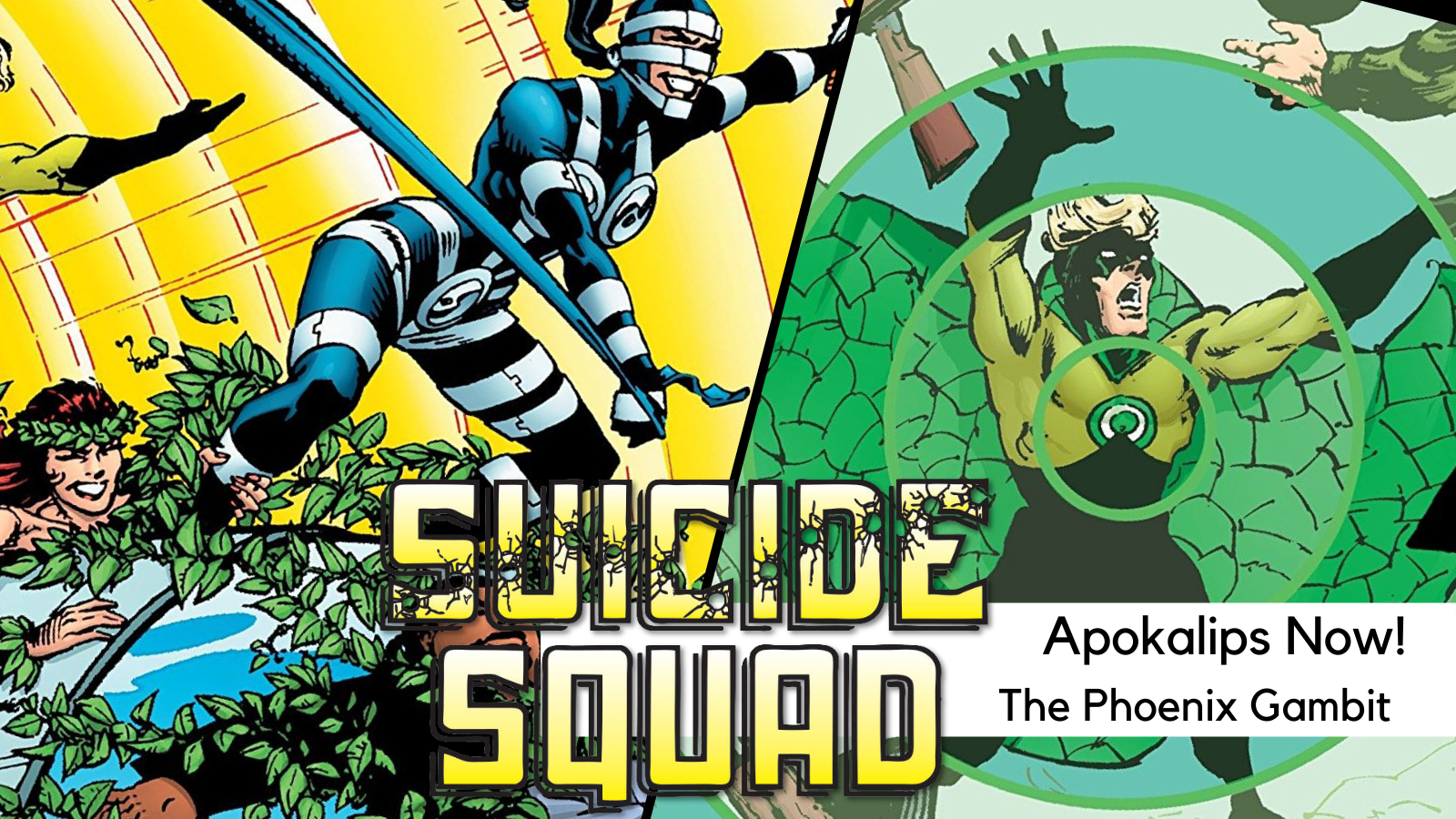
Suicide Squad: Apokolips Now (2016)
Reprints Suicide Squad v1 #31-39
Written by John Ostrander, Kim Yale, and Robert Greenberger
Art by John K. Snyder III, Luke McDonnell, Grant Miehm, and Geof Isherwood

Suicide Squad: The Phoenix Gambit (2017)
Reprints Suicide Squad v1 #40-49
Written by John Ostrander, Kim Yale, and David M. DeVries
Art by Geof Isherwood, Luke McDonnell, and Mark Badger

Suicide Squad had an interesting conceit that allowed it to shift the narrative focus every few issues. It was also easy to drop new characters into the book and toss them out when needed, as they were primarily supervillains going through Belle Reve’s revolving door or getting killed on the missions. For the first two and half years of the title, that was how things were, but in the wake of The Janus Directive, it appeared John Ostrander was interested in dramatically shifting what the Suicide Squad would be. Before he can head off in a new direction, though, he has to wrap up loose ends from previous years.

Continue reading “Comic Book Review – Suicide Squad Volumes Five and Six”

Comic Book Review – Suicide Squad Volumes Three & Four

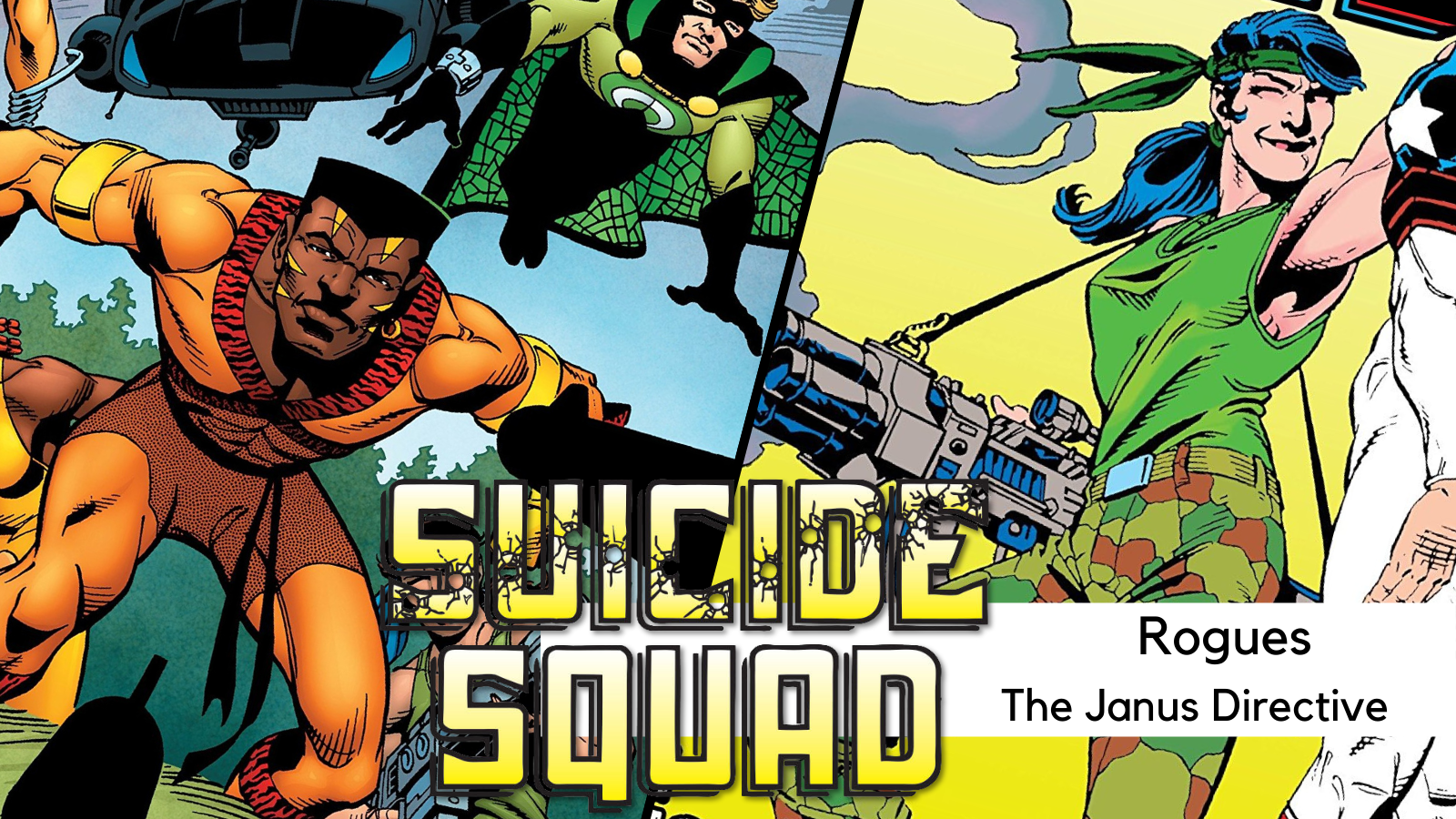
Suicide Squad: Rogues (2016)
Reprints Suicide Squad v1 #17-25, Annual #1
Written by John Ostrander (with Kim Yale and Larry Ganem)
Art by Luke McDonnell, Graham Nolan, Peter Krause, Keith Giffen, and Grant Miehm

Suicide Squad: The Janus Directive (2016)
Reprints Suicide Squad v1 #26-30, Checkmate #15-18, Manhunter #14, Firestorm #86, and Captain Atom #30
Written by John Ostrander (with Paul Kupperberg, Kim Yale, Cary Bates, and Greg Weisman)
Art by Grant Miehm, Steve Erwin, Rick Hoberg, John K. Snyder III, Pablo Marcos, Doug Rice, Tom Mandrake, and Rafael Kayanan

The first year and a half of Suicide Squad had writer John Ostrander figuring out what the book would be. This means several cast members rotate in and out, never having clear arcs. By this point, the core members of the group were established. Amanda Waller. Rick Flag. Bronze Tiger. Deadshot. Nightshade. Captain Boomerang. There were recurring team members like Nemesis, Shade, Duchess, and others, but they didn’t quite reach the level of development seen in these characters. “The Nightshade Odyssey” brought some science fiction dimension-hopping to the book, but Ostrander pulled back on that quite a bit and decided to center his stories in the global political sphere.

Continue reading “Comic Book Review – Suicide Squad Volumes Three & Four”