Hypothetical Film Festival – Unreliable Narrators

There’s a very interesting plot device called the Unreliable Narrator, wherein the point of view you are getting the story from comes from a person who is possibly skewing the facts in their favor, creating a story that is not quite true. Here’s some films that use that idea to great effect.


Rashomon (1950, dir. Akira Kurosawa)
Rashomon was the introduction of Kurosawa and post-war Japanese cinema to the world. The framing of the story was unlike anything that had really been seen in cinema, but had roots in older literature, particularly Shakespeare (whose works would be a major influence on Kurosawa throughout his career). A woodcutter and priest are seeking shelter in the husk of an old building while it storms outside. A passerby enters and they explain a strange murder of a samurai and the court case in which his wife, the bandit being accused, and the spirit of the samurai himself all testify. Through the three differing viewpoints we get three different pictures, with the added framing of these figures telling us the story. It’s a like a hedge maze of narrative.

Amadeus (1984, dir. Milos Forman)
The elderly composer Salieri tries to kill himself but is stopped. Later he is visited by a young priest and the old man tells the tale of his rivalry with Wolfgang Amadeus Mozart and how Salieri believes he killed the virtuoso. Salieri of course frames himself as pious and obedient, devoted to tradtion. Amadeus is seen a lewd and bawdy figure. Salieri sees his craft as a gift from God and cannot comprehend how someone as heathen and ribald as Amadeus was given a gift that far surpasses his own. The question we must ask is, how honest is this portrayal of the composer, and is this Salieri’s attempt to justify his hand in Amadeus’ death?


Memento (2001, dir. Christopher Nolan)
Both the film that introduced us to director Nolan (The Prestige, The Dark Knight) and what presents probably the most unreliable of unreliable narrators. Leonard is a man without the ability to form new memories. This was the result of a break-in at his home years prior that also resulted in the death of his wife. Now Leonard is on a hunt for the man responsible. Because of his lack of new memory he has tattooed key facts about the assailant on his body. Beyond that, he carries a Polaroid camera where ever he goes, photographing acquaintances and scribbling notes about them on the pictures. But what does Leonard really know? As we experience time in the same way Leonard does, we will ask lots of questions and when the disturbing conclusion comes about we will be left questioning Leonard himself.

Spider (2002, dir. David Cronenberg)
Dennis Cleg (Ralph Fiennes) has just been released from a mental asylum. The reason why he was there in the first place is not revealed at first, instead we follow him to the work home he has been assigned to in an attempt to transition back into society. He immediately draws the ire of the housekeeper and befriends housemate Terrence (John Neville). Mixed into his day to day life are nightmarish flashbacks to his childhood, focusing on his alcoholic father (Gabriel Byrne) and his beaten down mother (. The story of their tumultuous relationship is what forms Dennis and ultimately drives him to the asylum. The reason behind his nickname, Spider, is tied directly to this childhood incident. But then you must ask yourself, how reliable are the childhood flashbacks of a psychopath?


Bubba Ho-Tep (2002, dir. Don Coscarelli)
The film is told from the perspective of Elvis Presley (played brilliantly by Bruce Campbell), or it could be mechanic Sebastian Haff. Presley explains that he traded places with Haff in the 1970s to get away from the business, and for some reason the staff of his nursing home doesn’t believe him. Also living in this home is a black man who claims to be President Kennedy (Ossie Davis), explaining that he was dyed black and abandoned in the nursing home after the assassination attempt. Terrorizing the elderly at night in this home is an ancient Egyptian mummy who, for some reason, has taken on the garb of a cowboy. The two men, unable to get the staff on their side, take matters into their own hands and battle the mummy. But what if they are simply just two crazy people?

My 40 Favorite Film Moments – Part 8

35) The Wedding of Kermit and Piggy (The Muppets Take Manhattan, 1984, dir. Frank Oz)

It will never be a canonical great moment in cinema, but for me as a little kid it was the perfect ending to the Muppet film trilogy. You get an insanely large cast of characters, including those from just around the block on Sesame Street. Also, Piggy’s laugh when Kermit asks about Gonzo still cracks me up.

http://www.youtube.com/v/w0ChbqaTIs8&hl=en_US&fs=1&

36) Pure Imagination (Willy Wonka and the Chocolate Factory, 1971, dir. Mel Stuart)

Gene Wilder in the 1970s is always perfection. And this song works perfectly to introduce us to the inner working of the fantastical chocolate factory.

http://www.youtube.com/v/RZ-uV72pQKI&hl=en_US&fs=1&

37) You’re Shit (Happiness, 1998, dir. Todd Solondz)

One of the most funny and depressing movie openings ever.

http://www.youtube.com/v/KrnZcI3JS60&hl=en_US&fs=1&

38) Chance Enters The World (Being There, 1980, dir. Hal Ashby)

In Peter Sellers’ final performance he gave us the best film of his career. The mentally challenged Chance is forced to leave the brownstone for which he gardened after the owner dies. It’s implied Chance was the owner’s illegitimate son, and he never left the house in his life. This scene is gorgeous piece of comedy following Chance on his first day out.

http://www.youtube.com/v/3BsiHydrT6U&hl=en_US&fs=1&

39) Sardine? (The ‘Burbs, 1988, dir. Joe Dante)

This film was watched endlessly in my house as a child, and I think it is still one Tom Hanks’ best comedies and criminally underrated. This is the perfect scene of awkwardness as the characters meet the neighbors they suspect are serial killers

http://www.youtube.com/v/HW5nUF2P1XE&hl=en_US&fs=1&

40) Starchild (2001: A Space Odyssey, 1968, dir. Stanley Kubrick)

The most hopeful film ending of all time!

http://www.youtube.com/v/c1IPrx-zC1Y&hl=en_US&fs=1&

My 40 Favorite Film Moments – Part 7

31) Dancing Chicken (Strosek, 1977, dir. Werner Herzog)

The final scene of a very odd film about Germans coming to live and work in rural America. Don’t ask questions, just experience.

http://www.youtube.com/v/lUcTvhyof8I&hl=en_US&fs=1&

32) I Knew These People (Paris, Texas, 1984, dir. Wim Wenders)

This is a slow burning film, but when it hits it emotional peak (this scene) it devastates you. Harry Dean Stanton has never been better, and Nastassja Kinski is perfection. One of the most over looked films of the 1980s. If you haven’t, find this and watch it!

Wild Card Tuesdays – True Stories


True Stories (1986, dir. David Byrne)
Starring David Byrne, John Goodman, Swoosie Kurtz, Spalding Gray

I remember making long trips in the car as a child and feeling a sense of excitement as we pulled onto off ramps, stopping a strange gas stations and towns on our way. The journey and these stops always held much more interest to me than the destination it seems. I can distinctly remember driving through the Smoky Mountains and drinking Faygo Root Beet, a brand I had not had before. True Stories felt, for me, like stopping in of those little towns along the way and staying a bit longer than usual. Virgil, Texas is however a byproduct of the strange mind of David Byrne, lead singer of The Talking Heads. Things are quite off from the real world, but that just makes it all that more interesting.

Byrne is the nameless narrator, decked out in stereotypical Texan gear: Ten gallon hat, western wear, cowboy boots, and driving around a cherry red Cadillac. He delivers exposition with a very monotone demeanor, explaining the underlying psychological aspects of urbanization creeping into Virgil. Among the cast are John Goodman as Louis, a man so desperate to find a mate he has a marquee outside his home reading “Wife Wanted”, Swoosie Kurtz as Miss Rollings, a rich woman so lazy she never leaves her bed, and Spalding Gray as Earl, a man who has not spoken to his wife in 15 years but still seems to have a happy life at home. The stories are all leading towards a town-wide celebration taking place on stage being constructed in the wilderness. The Narrator visits with the characters who seem to have a familiarity with him, and various Talking Heads songs are re purposed to expand upon characters’ motivations.

I’ve always enjoyed when musicians set out to make films. They are rarely huge hits and usually end up as cult classic movies. I knew going into this one that Byrne has a very unique sensibility, which I had seen in videos of his concerts, and in particular the Jonathan Demme concert film Stop Making Sense. That sensibility is translated here into a film that is more like a quirky short story collection than anything overly cinematic. And it totally works. Certain songs, like “Dream Organizer”, so perfectly work for the character they are attached to that you have to wonder if this was the character Byrne had in mind when he originally wrote the song. The cinematography is also top notch, I think a lot of that coming from Byrne’s background in art school. The composition of many shots are not what we expect, leaving tons of negative space, and making for something that could be a framed photo on its own.

It’s also interesting to see some actors before they made it big, and one whom I never thought of as a traditional film actor. Spalding Gray was a quite a surprise to see, as I only knew him through his monologues (you should all check out Swimming to Cambodia). He does a decent enough job, though comes off a little stiff. Goodman and Kurtz are definitely the best of the bunch, each hamming it up in a way that totally works with the atmosphere Byrne has created. Jo Harvey Allen was also a standout as a perpetually lying woman who takes credit for “writing half of Billie Jean” as well as being JFK’s lover in Texas, whom he met with before the assassination. The film is definitely a fun, quirky picture that can be incredibly refreshing compared to most Hollywood films.

My 40 Favorite Film Moments – Part 5

21) I’m Easy (Nashville, 1975, dir. Robert Altman)

In this ensemble cast film, Altman had his actors write and perform their own songs. Keith Carradine plays the third member of a country folk trio who is a bit of a lothario. The women gathered in the Exit/In all believe the song is written for them, when in reality its for Lily Tomlin’s character a gospel singer and married mother of two who has been having an affair with the singer. The way the camera works in conjuction with the actors’ faces is beautiful.

http://www.youtube.com/v/6KZ8PRWChb8&hl=en_US&fs=1&

22)You’ve Got Me? Who’s Got You? (Superman: The Movie, 1979, dir. Richard Donner)

Its by no means the greatest film ever made, but it holds a sentimental place in my heart. And this moment, where Superman makes his public debut is just wonderful. It doesn’t take itself too seriously and it doesn’t need to be grim n’ gritty or “badass”. It’s just a perfect superhero moment. And I must admit, I’ve used the flying statistic line many times.

My 40 Favorite Film Moments – Part 4

16) Interrogation (The Dark Knight, 2008, dir. Christopher Nolan)

My favorite comic book based film, and an all around great movie. The screenplay is one of the tightest I’ve ever encountered and this is a great scene that really gets to the heart of the relationship between The Joker and Batman. The Joker is in love with Batman, not that he wants to have sex with him, but he is emotionally fulfilled by Batman’s existence. Without Batman, The Joker would have no one worthy of him to combat.

http://www.youtube.com/v/YPuToZT0vfY&hl=en_US&fs=1&

17) What’s In The Box (Se7en, 1995, dir. David Fincher)

This is one of those instances where every one is hitting their mark and it all comes together to make such a great film. I’m usually not a fan of Fincher, but the cinematography and editing here plus the actors all delivering make for one of the best climactic film scenes ever.

My 40 Favorite Film Moments – Part 3

11) Rhapsody in Blue (Manhattan, 1979, dir. Woody Allen)

New York is one of the great mythical cities, in that there is the New York that is real and there is the New York that is a fantasy of our minds. Allen captures this magical New York perfectly in the opening of Manhattan, using classic black and white photography as well as the signature George Gershwin tune.

http://www.youtube.com/v/uyaj2P-dSi8&hl=en_US&fs=1&

12) Please Don’t Tell My Mother (One Flew Over the Cuckoo’s Nest, 1969, dir. Milos Forman)

This was one of the first films to showcase the acting chops of Jack Nicholson, but I like this scene because of the performances Louise Fletcher and Brad Dourif bring to the table. It is rare you see a scene so perfectly acted. All of these actors are at the top of their game.

My 40 Favorite Film Moments – Part 2

6) Waiting For a Train (Once Upon a Time in the West, 1969, dir. Sergio Leone)

Wordless, with a soundtrack provided by found objects in the setting. A squeaky windmill, a dripping water tower, the steady rhythm of a steam engine. It provides the perfect introduction to the film’s protagonist, Harmonica (Charles Bronson).

http://www.youtube.com/v/bW-jSa9_k3M&hl=en_US&fs=1&

7) Getting Baptized (Ed Wood, 1994, dir. Tim Burton)

Hack director Wood has gotten financing from an L.A. church. One of the conditions for the money to come through is that the entire cast and crew of Plan Nine from Outer Space will be baptized. The unaffected homosexual producer Bunny Breckenridge (Bill Murray) takes the hefty spiritual ritual with little thought in a cleverly funny moment. This is also Burton’s masterpiece in my opinion.

http://www.youtube.com/v/VdSFP9nu1R8&hl=en_US&fs=1&

8) Flowers (Harold and Maude, 1971, dir. Hal Ashby)

Ashby is one of the greats of the 1970s, and this scene featuring Ruth Gordon, Bud Cort, and the music of Cat Stevens is a picture of perfect composition. The transition from the field of flowers to the military cemetery is a very beautiful one.

http://www.youtube.com/v/h0FX_ROcNV4&hl=en_US&fs=1&

9) He’ll Keep Calling Me (Ferris Bueller’s Day Off, 1989, dir. John Hughes)

This scene is a perfect summation of the profound indecision and anxiety Cameron suffers from. Throughout the film, he’s a character who is simply pushed around by his off screen father or by Ferris or by authority in general. This is every thing going on in his brain.

http://www.youtube.com/v/CdcFYNe9U7A&hl=en_US&fs=1&

10) Make the Sun Rise (Black Orpheus, 1959, dir. Marcel Camus)
Set during Carnival in Brazil, the film retells the mythic story of Orpheus and Eurydice through an Afro-Brazilian guitarist and the woman he loves. In this final scene, we see that the tragic story of these lovers is part of a cycle and this children are beginning to play down a path that is both beautiful, but painful.

http://www.youtube.com/v/v0jZRkFtksI&hl=en_US&fs=1&

Director in Focus: Brian De Palma – Casualties of War


Casualties of War (1989)
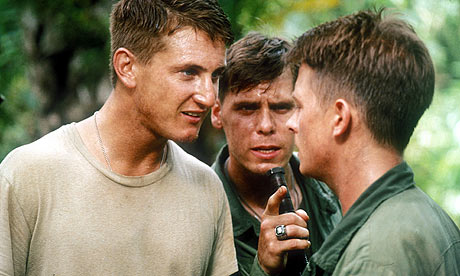
Starring Michael J. Fox, Sean Penn, John C. Reilly, John Leguizamo, Don Harvey, Thuy Thu Le

Coppola made Apocalypse Now. Stone made Platoon. And De Palma made Casualties of War. At the end of the 1980s De Palma was secure in his place as a Hollywood film director. When he had been closing out the 1970s he was still immersed in Hitchcoclk style thrillers. A decade later he’s made a gangster epic (Scarface), a 1930s historical crime film (The Untouchables), and a Vietnam War flick. Despite the change in venue and content, there are the same cinematographic trademarks (deep focus and POV tracking shot). But how does this film shape up next to the other great Vietnam War flicks?

PFC Ericksson (Fox) is out on patrol with his unit when they are ambushed. He’s standing over a Viet Cong tunnel and falls half way in. As a Cong soldier inches closer, knife in teeth, Ericksson is saved in the nick of time by Meserve (Penn). Later, they both witness their commanding officer getting gunned down and Meserve takes over. He becomes obsessed with revenge and leads his group of five men to a village where they kidnap a  young girl with the intent to rape and savage her. Ericksson is frozen as he must decide whether to protect this innocent or honor the bonds of his military brotherhood.

Casualties is by no means a perfect film, but it is a surprisingly mature film for De Palma, where he seems to be balancing his camera flourishes with a thoughtful look at the nature of war. There are still some cringe inducing line deliveries and Penn’s Maserve is played a little too broad for my taste. I did like Meserve’s speech about hating the Army. Often in pop culture, the soldier who brutalizes for pleasure is made out to be a dedicated troop. It feels more realistic that such a sociopath would despise the lack of self-decision that comes with the military. Once Meserve is out of the eye of his superiors he adopts his own sense of law. Ericksson provides a balance as a soldier who appreciates the idea of duty and rank. When Ericksson goes to report what he has seen he goes through the proper channels of authority. Meserve tries to get revenge under the radar.

De Palma ends things in a way I didn’t expect. Moments before the credits rolled, I felt the film hinting at a possible dramatically violent finale, but then it ends in an ambiguous way. The message of the film is hammered way to bluntly, though. De Palma does an excellent job of telling this story in a clear, comprehensible way and he uses some interesting technical skills. At the end I felt a certain dissatisfaction with  product. It’s not as high an artistic achievement as Apocalypse Now and its doesn’t have the emotional weight of Platoon. It is a well made piece of cinema with some very enjoyable acting, but definitely doesn’t score as high as some of De Palma’s other films for me.

Next: The first big disaster, Bonfire of the Vanities.

The Summer Blockbuster: 1986 – 1995

Coming out of the mid-80s, if you had money invested in Steven Spielberg and George Lucas you were probably incredibly rich. They had success after success, not just in their own films, but in those of directors they were producing and supporting. However, there would be an odd dip that occurred in the remainder of the 1980s. A few film franchises would rise to prominence, Lucas’ stock would plummet, and Spielberg would attempt to try out some non-science fiction and fantasy films.

While science fiction flicks made big box office they also cost big budgets to make. It’s no surprise that many studio attempted to go with smaller budget films and these typically focused on “rah rah” crowd pleasers are mixtures of action and comedy. The Karate Kid franchise was one of those “rah rah” type films that aimed dead center at kids and young adolescents. You have a young man, bullied at school, who is taught how to fight by a wizened karate master. He’s able to overcome the bullies through beating them up. You also had the first three films of the Lethal Weapon series which raised Mel Gibson to prominence and managed to pull in big audiences on a fairly small budget, something studios always like to see. Along with Lethal Weapon, there was Beverly Hills Cop I and II, which vaulted the already popular Eddie Murphy into an even higher level of celebrity. Even today, if you notice every summer seems to have one Eddie Murphy film (this year’s is Shrek 4).

There was also use a big name actor to sell the film, rather than a premise. In 1986, Tony Scott’s Top Gun was released and took Tom Cruise, who had appeared in quite a few films before then, most notably Tony’s brother Ridley’s Legend, to stardom. Top Gun works as both a star making vehicle and a “rah rah” America movie. Tom Cruise’s Maverick leads his flight unit take on North Koreans flying a fictional style of fighter jet on par with the American F-14s. Despite the implausibility that North Korean would ever be able to compete with the US Airforce, the film was a huge hit and a high selling soundtrack. Tom Hanks was the other actor to make his way up to super stardom during the 1980s. Penny Marshall’s Big was his breakthrough, a simple story of a teenage boy who becomes an adult after making a wish. Budget-wise this was an incredibly cheap film to make. No real special effects and no actors who were huge names, at the time. What made the film such a great success was the honest charisma Hanks brings to all his roles. There are few actors that handle a film so naturally. Hanks would be attached to many more summer movies to come, most notably Sleepless in SeattleForrest Gump, and Apollo 13 and  both films that went against the Spielberg/Lucas formula for a blockbuster.

But you can always rely on certain films being a success based on the name attached to them in the director’s seat. James Cameron, unlike Spielberg, didn’t produce a prolific amount of work but it seemed that he didn’t need to to become notable. Cameron made non-summer movies The Terminator and Aliens which set him up for Terminator 2: Judgement Day. Character-driven films weren’t Cameron’s strong suit and he relied a lot on technology, particularly new types of computer generated effects not yet seen by the public. His T-1000, the liquid metal villain of T2 was a huge shift in special effects driven film making. However, his next film, True Lies would be a non-CG focused film with Arnold Schwarzenegger and Jamie Lee Curtis fighting Middle Eastern terrorists.

At the end of the day though, you could always rely on familiar names, be it director or franchise to fuel a successful movie. Spielberg put out the third Indiana Jones film at the end of the 1980s and established a new franchise with Jurassic Park. Jurassic was a type of film that really overtook pop culture in 1993 in a way it would be hard for a single film to do now. It was one of the last pre-internet media fueled movies and was in theaters from June of ’93 all the way to October of the same year. Disney also came to the forefront for the first time as a major summer draw. It seems like an obvious company to make summer blockbusters but they had never done so. They got their legs wet with The Little Mermaid and Beauty and the Beast, both Holiday season releases. Nothing compared to the success of The Lion King. It was a reworking of Hamlet, an odd piece of source material for a summer movie, but it worked. Audiences went again and again and since Disney has had a picture in the running every summer, though now its CG Pixar features.

Next: Batman, Spider-Man, and Star Wars