
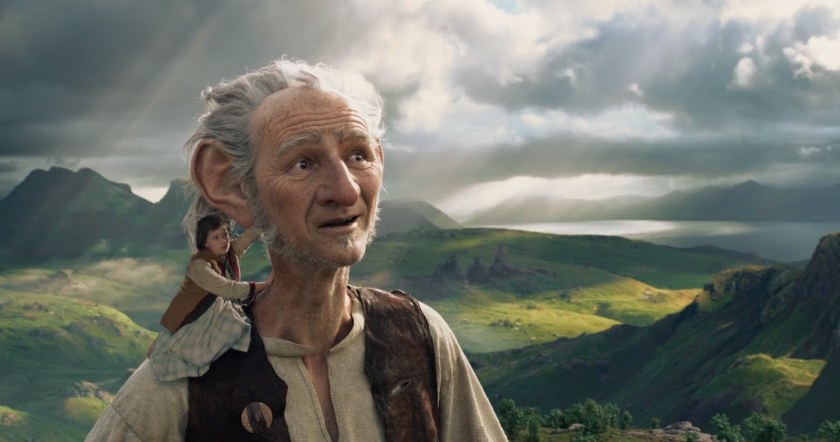
On a dark night, at the witching hour, an orphan named Sophie glimpses a strange shadow on the streets, quickly realizing it’s a giant. She rushes to hide under the blankets of her bed, but a massive hand reaches in through the window and carries her off to Giant Country where her adventure begins. There she learns that her abductor is big friendly giant and that his kin are the ones she needs to watch out for.
I have been a lover of Roald Dahl since I was very little and had Charlie and the Chocolate Factory read to me chapter by chapter at night. From there I remember books like The Twits, Matilda, and of course The BFG. Of Dahl’s children’s books The BFG is one I don’t think about often. I remembered the illustrations by Quentin Blake with the giant’s comically oversized ears, but as for the story I didn’t remember much of it. Steven Spielberg is another figure I remember vividly from my childhood. I can’t say what the first Spielberg movie I saw was, I have memories of a some scenes from E.T. early on, but I would guess the first one I watched in its entirety was Raiders of the Lost Ark. Spielberg is known for the sentimentality he tries to weave into his work, which would seem to be in opposition to the sometimes caustic wit Dahl brings to his writing.
The acting in The BFG is pretty much perfect. Mark Rylance as the titular giant has captured every aspect of the character from his soft garbled understanding of language to his jumps from hunched shuffler around his cave to nimble leaper through the city streets. Ruby Barnhill as Sophie delivers a very confident performance, never coming across as an act-y kid, but feeling like an actual Dahl protagonist. The supporting cast doesn’t have much screen time, but they do their jobs adequately, the evil giants being the big standouts. The film lives or dies on the performances of Rylance and Barnhill and they are very strong.
The plot of The BFG is quite different than I think we’ve become accustomed to lately. This is an older style of Spielberg storytelling, where there is no epic battle between the forces of good and evil. The conflict is solved fairly quickly with a short exciting moment. The emphasis is on our two central characters and their relationship. An element of the Tim Burton directed Charlie and the Chocolate Factory that irked me was the addition of backstory to Wonka. It felt like the most unnecessary and pointless addition to a story that didn’t need it. In the same way we got the backstory of the Grinch or prequels attempt to fill in the gaps, these choices miss the point. We don’t need to know the origin of Santa Claus to love Santa. We don’t need to know how the Easter Bunny got his eggs to love Easter.
Dahl understood the details children are truly concerned about and he knew that they would accept larger than life characters without questions about where they came from. This is where the film shines because it flows like a Dahl narrative more than any other adaptation of his work I’ve seen. The plot is a lovely mess and not much really happens. But the time we spend with these two characters as they learn about each other is action enough. I loved how long some conversation scenes were, just these two bantering and hearing The BFG transformation of the English language.
I enjoy the latest superhero beat ‘em up very much. But it is very heartening to see a film like this still being made. It’s a picture about kindness and understanding. The BFG loves to help other but is very insecure about his speech and what other might do to him if they discover his existence. Problems are not solved through violence, but through peaceful means. Yes, the mean bad giants get what’s coming to them but it’s not being blown away and destroyed. Even they have a place in the world. And in this current climate, learning to understand that even your enemies deserve life and place in the world is a refreshing idea.
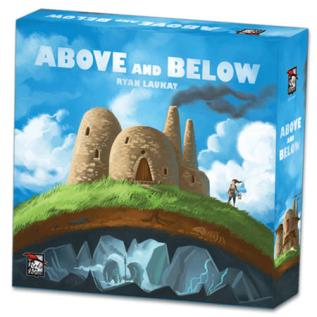 Above and Below is the story of rebuilding after disaster. Your village was destroyed by barbarians and you’ve moved your people to a new place to start a new life. However, you find beneath the ground is an intricate series of tunnels and the opportunity to discover great treasure. You’ll need to build new buildings, recruit new villagers, harvest resources, and explore the world below to win.
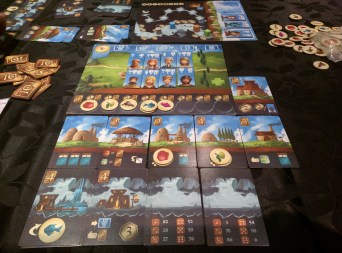 I was reminded a bit of IDW’s Machi Koro, a city building game, where certain cards are considered top shelf premium ones based on their cost and benefits. In Above and Below, there are six star buildings that provide multiple benefits if you can afford their large cost. There’s also four interchangeable star buildings that provide similar but less powerful benefits. Three pools replenish during your rounds of play: new villagers, regular buildings, and underground buildings. Each playthrough created vastly different villages for the both of us. Resources are harvested either from buildings or going into the caves. Once you have resources you can either stockpile them (which increases your income) or offer them up for sale to other players. At the end of the game you add up the resources you have stockpiled and multiply them by a point value based on where they were place on the stockpile track. So, selling resources can help the buyer increase that score while giving the seller a few quick gold pieces.
 Two women marked by death attempting to understand the evil that lives in the shadows. This pretty much sums up the basic concept of Gail Simone’s first venture into Vertigo Comics territory. Chloe Pierce’s fiance killed himself and she miscarried their child. Now she wants to know what a Scientology-like cult run by Astrid Mueller. Astrid is a German woman who was brutally run down by a madman in a car when she was a child. After that experience she began to see what we might call “demons”. However, the series makes an effort to challenge our preconceptions about the nature of these monsters. In this first volume, we follow parallel stories of Astrid confronting a literal demon from her past while Chloe must decide if she trusts Astrid’s cult while attempting to figure out why her fiance killed himself.
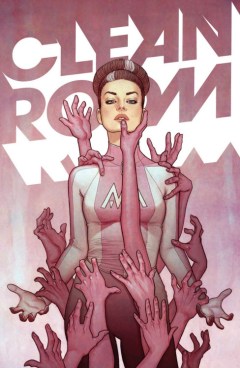 The artwork is very uneven. Artist, Jon Davis-Hunt draws an awesome demon, and brings a lot of interesting variety to their designs. Elements of insects and sea life are interwoven into his monster work and this adds to a sense of the larger than our perception Lovecraft style of horror. However, his normal humans often look like mannequins. His figures are very posed and there is a lack of sense of movement through the panels. It improves as the series goes on, but still retains a stiffness. His linework is very smooth and detailed though.



 Continuing threads laid in Batman: Rebirth, our story begins with Batman and Gordon meeting on the police station rooftop to discuss a raid on a nearby military base. The police have not located all the stolen weapons and fate would have it one of them is launched and strikes a commercial airliner over Gotham. The rest of the issues is tightly written action sequence that has Bats communicating with Alfred and his new partner, Duke Thomas (formerly of We…Are Robin). Alfred and Duke runs ops from the Batcave and guides Batman through the process of literally lassoing the plane and steering it around Gotham. The big twist is the final panel introduction of Gotham and Gotham Girl, apparent Superman and Supergirl analogs? The weakest part of this issues is some of David Finch’s art, I have never been a huge fan of his work. I definitely disliked his recent Wonder Woman run and really hated his Batman: The Dark Knight ongoing. There’s some stronger panel structure here and it does look like he is working well with Tom King. Probably the DC ongoing I am most excited to keep reading, mainly due in part to what a phenomenal writing of Tom King!
 PopCult Reviews