Asian Cinema Month – My Neighbor Totoro

My Neighbor Totoro (1988, dir. Hayao Miyazaki)

Hayao Miyazaki, Japan’s answer to Walt Disney, is mainly concerned with the rural and natural settings of Japan, rather than bustling metropolises. He can go very dark with this message (Princess Mononoke) or light (Ponyo), but he always returns to the ideas of children in an environment populated with copious vegetation and mystic animals. Once again, the children of the story need the help of a being from the forest to overcome the troubles of their lives and its all told in the type of lush animation you expect from Miyazaki.

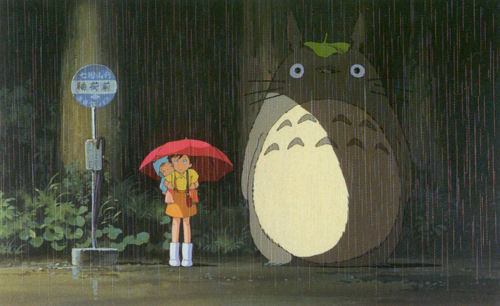
Satsuki and Mei have just moved to a country house with their father to be close to the hospital their mother is staying in. The first day in the new home they are enthusiastic to explore, and encounter soot spirits, ashy ghosts that skitter away into holes in the wall when light enters. Little Mei explores further while her older sister is at school and follows a couple of magical rabbit-like creatures into the forest where she meets a gigantic sleeping furry beast. The creature identifies himself with a series of yawns which Mei hears as “Totoro”, the name she assigns him. The two girls eventually deal with a crisis moment involving their mother’s health and Totoro comes to the rescue to help diffuse the pain they feel with some lighthearted fun.

What I liked about the film was its rejection of the American fantasy formula. The drama here is kept very minimal and in the background. An adult audience is going to understand the mother’s condition as being a dark point in the picture, but it is presented in such a way that it won’t upset younger viewers. Miyazaki is able to tell stories for children, and adults not yet swallowed up by cynicism, in a way better than Disney ever has. The Disney films never feel like a real world, merely a construct and complete fantasy. Miyazaki infuses his worlds with details that make it feel like a place that could really be out there. They are the type of simple fantasies a child would truly dream up.

There is no need for princesses in Totoro. These are real little girls, captivated with simple things and vulnerable when it comes to the idea they might lose a parent. The creatures are never frightening and the children rush into the unknown without a sense of fear. It’s incredibly refreshing to see this kind of animated film, a style we see little of in the States.
Asian Cinema Month – Ponyo


Ponyo (2009, dir. Hayao Miyazaki)
Starring (English dub) Noah Cyrus, Frankie Jonas, Tina Fey, Matt Damon, Cate Blanchett, Liam Neeson, Betty White, Cloris Leachman, Lily Tomlin, Carlos Alazraqui

It was freshman year of college and it was a Friday night. We decided to see a movie. We let Clint pick, usually a bad choice…however, he decided on a Japanese animated feature called Princess Mononoke. I make no bones about the fact that I pretty much detest anime. I’ve tried to watch multiple series and can barely make it past the first episodes. Anime films, however, I have been able to tolerate fairly well. Well, that evening as we settled in to the barely occupied theater, I was overcome with amazement at the lush imagery before me. This blew anything Disney made right out of the water. The themes were complex and aimed more at adults than children. After that I would go to see Nausicca of the Valley, Spirited Away, Kiki’s Delivery Service, and Howl’s Moving Castle. All of these are the work of master animator Hayao Miyazaki.

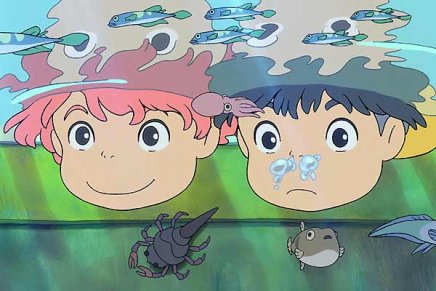
Deep beneath the ocean lives Fujimoto (Neeson), an wizard who has abandoned the surface world and raises his fish daughters to fear humanity. The eldest of these guppy-like creatures escapes and is found by Sosuke, the young son of a navy officer and a nursing home attendant. Sosuke names the fish girl Ponyo and has to avoid her being taken away by a number of human forces. Eventually, Fujimoto surfaces and wants his daughter back while Ponyo has come to enjoy the surface and wants to become human. Some of these elements sound familiar? Yes, this is a Japanese re-imagining of The Little Mermaid.

The plot of the film is incredibly simple and I was reminded of the lighter Kiki’s Delivery Service. There’s never any real peril or chance anyone might actually die. You would think with the stakes being so low the picture would be a bore, but it most definitely isn’t. What pulls you in is the seemingly infinite imagination of Hayao Miyazaki and epic skill of his animators. Every film Miyazaki releases reveals why CG animation will never trump the power of high quality cel animation. It might not be as quick, but when given the proper time and skill you have unparalleled works of art. The wordless opening sequence of the picture is breathtaking, featuring the nighttime migration of jellyfish then transitioning to a panorama of sea life.

The adventures of Ponyo and Sosuke are pure wish fulfillment. I was particularly enamored with their excursion of a tiny steamboat through a flooded village. It felt like that exact thing so many kids would imagine while playing on the couch or in the backyard, the idea of freedom to travel and explore. Ponyo is a delightful character, she is constantly discovering the surface world and find joy in such simple things. Her first sip of hot cocoa drives her wild, her first warm meal puts her into a sleepy coma, and there’s never an adult admonishing for such exuberance. While you may think this is a film made for children, its just as much for adults, tapping into that time of discovery and play I think many of us miss.

Newbie Wednesday – How To Train Your Dragon


How To Train Your Dragon (2010, dir. Dean DeBlois, Chris Sanders)
Starring Jay Baruchel, America Ferrara, Gerard Butler, Craig Ferguson, Jonah Hill, Christopher Mintz-Plasse, T.J. Miller, Kristen Wiig

In 1981 we got Dragonslayer, which was a step up in the medieval film genre in terms of effects. In 1996 Dragonheart was released, and while its hard to dislike a film with both David Thewlis and Sean Connery, the picture never stuck with me as a re-watchable one. In 2002, the movie was Reign of Fire…and well, lets try to forget that one. The latest dragon-centric film is Pixar Animation’s How To Train Your Dragon, from the writer/director team behind Lilo and Stitch and Mulan. And how does this flick stack up against its fire-breathing brethren?

Hiccup (Baruchel) is the son of a gruff Viking king (Butler) whose village is regularly attacked by a variety of diverse dragons. During one of these attacks, Hiccup witnesses an elusive go down in the forest outside of his village and ventures into the wilderness to find it. The two are confrontational at first, but grow on each other. Simultaneously, Hiccup is being pressured by his father into being a dragonslayer. What is he to do as he begins to understand this creatures better than anyone in his village?

What this movie does best is put you on the back of a dragon. The flying scenes are far and away the best aspect of the picture, many times done from the POV of Hiccup. There’s also an interesting variety of dragons presented in the film, each with quirk that makes them unique and different. The look of the flick is thanks to cinematographer Roger Deakins (“No Country for Old Men”, and pretty much every other Cohen Brothers film ever). I also liked that the film focused on thinking your way through a problem over just rushing into battle. Hiccup’s tendencies to go to books and conduct scientific study pay off and save his father and the entire village.

I liked that the film shied away from previous Dreamworks ventures, which seem to rely so heavily on modern pop culture references. It felt more like a Pixar film in establishing its own universe. However, every character except for Hiccup feels underdeveloped. It would have been nice to get some backstory on the village and how their conflict with the dragons developed. Despite these hiccups (pun intended) in the story, its still one of the better and more intelligent films marketed towards kids.

Film 2010 #30 – The Secret of Kells


The Secret of Kells (2009, dir. Tomm Moore, Nora Twomey)

Starring Brendan Gleeson, Mick Lally
When the 2010 Oscar Nominations were announced I’m sure I wasn’t the only one who wondered “What the hell is The Secret of Kells?” Well, it’s an independently produced Irish film that played for a week in L.A. to qualify for the Academy Awards. The nomination will definitely garner attention for the film when it receives an expansion on American screens on March 12th, but is the picture deserving of the nom? A million times yes, and while Up will probably win because of its notoriety and box office, The Secret of Kells brings a style drastically different from the Disney formula that dominates American animation.
The story of The Secret of Kells is based in the history of Ireland circa 1006 A.D. The Vikings are massacring and raiding any village them come across in the hopes of amassing gold. The Abbey of Kells has become a sanctuary for many monks whose island homes have been burnt to the ground. Now, surrounded by the deep forest, they have gone back to creating gloriously intricate illuminated texts while the Abbot Cellach works to finish the wall before the Vikings arrive. Cellach’s nephew, Brendan befriends Brother Aidan, the monk who has been working on the Book of Iona, believed to be the most beautiful illuminated manuscript ever made. Aidan enlists Brendan’s help in gathering the supplies needed to finish the text by gathering inkberries for him in the forest. Brendan sneaks away, meeting the fairy Aisling, who introduces him to the wonders of the world outside the walls of the abbey.
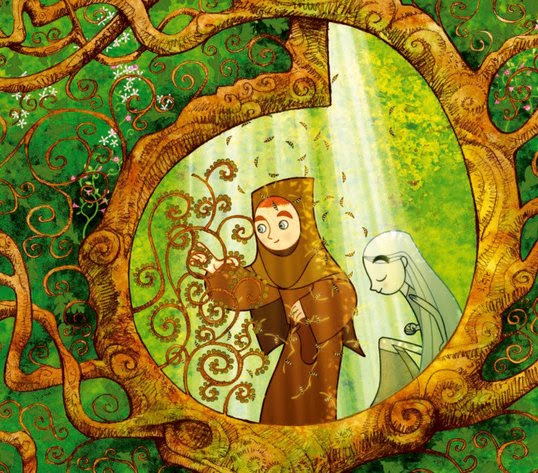
The intricacies of the animated work in this film are astonishing. From the moment of the prologue, narrated by Aisling, there is no doubt that the love put into the picture is remarkable. The clever reasoning behind the level of detail is a direct nod to the craftsmanship put into illuminated manuscripts by monks. The same swirls, flourishes, and Celtic crosses seen in the texts can be found hidden amongst the gnarled roots of trees and clusters of leaves and flowers. The subtext here is that Brendan can only rise to the level of his hero, Aidan, by journeying beyond the walls of his limited experience. Someone like Aidan has been able to create such a beautiful piece of art because he has confronted his fears and conquered them.
While Brendan’s story does follow closely to the accepted hero’s journey archetype, there are many story beats that separate this film’s plot from others. The unblinking look at violence at this period of time and this part of the world is very much there. When the Vikings rear their ugly heads it is apparent that they leave few alive in their wake. There is also tragedy of other sorts in the film’s climactic sequence involving the unfinished abbey and its weak scaffolding. But the subtext throughout is telling us fear will be your end. Running frightened and unthinkingly at the sight of your fear leads you into destruction, but those characters who use their wits and remain calm are able to escape.
My own personal opinion is that the originality of content and artistic achievement of The Secret of Kells earns it the Best Animated Feature. However, the Academy Awards is usually more reflective of a mix between artistic elements and public awareness, meaning Up is the most likely candidate. Not to take away from Pixar, they would probably argue in favor of Kells as well, but I am excited for this film to reach a wider audience and gain more enthusiasm like mine.

Film 2009 #20 – Waltz With Bashir

Waltz With Bashir (2008)
Directed by Ari Folman

In 1982 Israel invaded Southern Lebanon, citing an assassination attempt on their U.K. ambassador as the impetus. The conflict brought them up against the PLO, Muslim Lebanese forces, and Syrians. Working with the Israelis were the Lebanese Phalangists. The Phalangists claimed secularism but are mainly supported by Maronite Christians, a sect of the Catholic Church founded in Syria in the 7th century. This mad cluster of forces came together for a bloody war that increased in intensity with the assassination of Lebanese president Bashir Gemayel. The Phalangists, incredibly loyal to Bashir, culminated the war with the Sabra and Shatila massacres, where Palestinians families were bombed and those that survived the bombing where then lined up against walls and executed by firing squad.

This is the waking nightmare Ari Folman finds himself sinking into. The film begins with a meeting in 2006 between Ari and a friend. The friend has begun having horrific dreams about his participation in the 1982 First Lebanon War. This pushes repressed memories of Ari’s participation into the fore of his consciousness and the movie unfolds from there. Ari learns through interviews with friends he served with about what happened during their tour and how they were complicit in the Sabra and Shatila massacres. Ari has a recurring vision of three naked young men emerging from the water at night and walking towards the shore where an urban landscape is lit by flares, falling like stars from the sky. Once in the city they find themselves overcome by screaming grieving Palestinian women. In the climax of the film Ari has finally sorted these memories out and we see what really happened and why he is haunted by these images.

What sets Waltz With Bashir apart from a standard documentary or war film is that it is made from a combination of standard cel animation, 3D computer animation, flash animation, and rotoscoping (animating over live action film). This allows director Folman a freedom that his small budget would not have allowed for a live action film. Complex battle scenes are recreated with ease but also without losing their weight and depth. The animation also aids in creating the nightmarish tone Folman wants to wash over us. If the roots of this war don’t come across in the film, that is intentional. We’re seeing the events from the eyes of a 19 year old boy who doesn’t understand what is happening other than it is his legal duty as a citizen of Israel to serve in the military. The film is a definite descendant of Apocalypse Now, even paying homage to that masterwork with a scene of lounging soldiers on the beach including one surfing as bombs fall.

There are so many scenes that create a sense of the bizarre and senseless. One soldier recounts becoming sick to his stomach over the side of a boat the night before the invasion. After the young man blacks out, he dreams of a giant naked woman swimming to the boat, cradling him in her arms and swimming away with him as his unit is bombed. In another scene, a soldier recounts the slaughter house the Phalangists created from the Palestinians they slew. The camera is low to the ground as we float across dead earth littered with rotting gnarled trees, corpses, and eyes and ears floating in formaldehyde jars.

Waltz With Bashir is a very timely film during this current incarnation of the Israeli/Palestinian conflict. It reminds us that it’s not the men on the ground on either side for us to blame, but the men at the top who give the orders and expect mindless allegiance whose hands are drenched in blood. It was reported that this film received a 20 minute standing ovation at the 2008 Cannes Film Festival. Ari Folman won a 2008 Golden Globe for this film and in his acceptance speech mentioned that over the course of making it eight babies were born. He said he had a particular hope for those eight children: “I hope that one day when they grow up that they watch this film together and they see the war that takes place in the film like an ancient video game that has nothing to do with their lives whatsoever.”