Movie Review – Trash Fire

Trash Fire (2015, dir. Richard Bates, Jr.)

TrashFire_Trailer

Owen and Isabel have an extremely unhealthy relationship. He has a laundry list of neurosis and treats Isabel like a doormat. She openly despises him. For some reason, they seem unable to break this relationship off, kept in each other’s toxic orbits. Everything changes when Isabel despondently reveals she is pregnant. Owen appears to change his tune, but she explains she wants him to get back in touch with his estranged family. When Owen was a child, his parents were killed in a house fire he blames himself for. His sister lived, but suffered third-degree burns over her entire body and now lives with the acidic grandmother. The couple makes a trip to visit these two strange family members, and the secret behind that house fire slowly comes to light.

Like many horror films these days, Trash Fire has a lot of interesting pieces but fails to come together as any enjoyable experience. It’s the greatest flaw is the inability to settle on the tone. The first third of the film presents itself as a pitch dark comedy and arrival at the grandmother’s home has enough quirky strangeness that it feels like this is what the film will be. However, the last third of the movie goes completely off the rails and bounces back and forth between comedy and horror, before finally settling on pure nihilistic horror for the finale. At some moments it seems to want to comment on relationships, in others, it seeks to be a satire of fundamentalist religion. And for all it’s plot spasms it ends up equaling nothing at all.

I had previously seen Bates’ Excision, a horror film with similar problems. There is no arguing that he has a distinct style. His scenes are framed in the static medium and wide shots, with subjects dead center in the camera. A line of symmetry splits the subject down the middle, and they are typically flanked by set details on either side. This type of framing is so associated with Wes Anderson at this point that we are subconsciously pushed towards expecting dry comedy, and that appears to be the case…at first. Bates continues to use this framing even in scenes that he intends to evoke great horror. It just falls so flat, so hard.

I don’t have a problem with a film featuring unlikable protagonists, as long as it knows how to handle them just right. Bates does not, so when the tragedy of the finale occurs, I didn’t care because he’d done nothing to frame his protagonists in legitimate conflict with the antagonists. I guess the protagonists weren’t murderous, but they didn’t even exhibit charisma or charm to make me root for them. Unlikable doesn’t mean they have to completely unrelatable. Bates also features his star from Excision, Annalynne McCord as Owen’s scarred sister. She does fine with the material she is given, but I can’t help but imagine how a more nuanced actress could have made the character more interesting.

The worst thing about Trash Fire is that it is a dumb film that thinks it is very clever (the same problem Excision had, hm). Mr. Bates is not a bad filmmaker; he is just aiming to make a kind of film he isn’t necessarily suited for. There is a sense that he is somehow elevating the material when at its heart it is pure horror shlock. If he could embrace it for the particular horror subgenre it is and have fun with the material, he might have a decent flick.


Movie Review – Entertainment

Entertainment (2015, dir. Rick Alverson)

entertainment-rick-alverson-gregg-turkington-1

Entertainment is an anti-film. It is the opposite of life affirming, life refuting. It is a road trip to nowhere, about a man who fails to find himself and instead lost forever. Entertainment is purgatory. This is the intent of director Rick Alverson, who helmed the abrasive 2012 independent film The Comedy. In the same way that Tim & Eric deconstruct comedy, Alverson is breaking down the aimless dreamer in search of their dream.

The focus of Entertainment is an unnamed Comedian (played by Gregg Turkington). While the protagonist may be nameless, fans familiar with Turkington’s stage persona of Neil Hamburger will know that this is a fictionalized version of the performer. The Hamburger persona is an assault on the audience of his comedy shows. His material is exaggeratedly homophobic, misogynistic, grossly sexual, and crude. The concept behind this is a comedian who thinks so little of his audience he believes this is the best they deserve. Contrasted with this is Turkington endlessly waiting between shows. He goes on local tours of industry in the Southwestern United States: an airplane graveyard, an oil field, a ghost town built as part of a mineral boom. The landscapes he walks through are husks.

The Comedian himself is a husk. He’s in his forties, performing at low-end dive bars or worse. The first location we see him at is a prison. His last location is at the birthday party of a spoiled rich, aggressive man (played by Tim Heidecker). That final performance concludes with The Comedian bursting out of a cake and bursting into tears. He ends up spending time with a financially successful cousin (John C. Reilly) who tries to advise him on his comedy act, continually saying it’s great but then talking about making it appeal to “all four quadrants.” As we get to know the cousin we see his misery come to the surface as well.

Two constants refrain throughout the film. The first is Eddie the Opener (Tye Sheridan) a clown/mime who opens The Comedian’s sets. Eddie hasn’t been worn down by the road yet. He shares the cynicism of The Comedian towards the audience but takes joy in the performance. The other refrain is The Comedian’s nightly voicemails to an unseen estranged daughter. He expresses frustration eventually at his inability to get a hold of her, the messages growing more and more desperate.

Both Turkington and Alverson have a keen interest in discomfort and provocation. In an interview with Vanity Fair, Alverson explains his personal view on “positive” cinema:

There’s a common insistence that representations of the positive lift us up and buoy us. I’ve never experienced that. At least not in a prolonged way. The idea of resolution has always seemed weird to me. I think if a movie has any naturalistic pretensions or elements in it at all, it needs to respect and represent the disjointed and difficult nature of the world. You can’t solely promote a fantasy version of the formal experience of living. There’s a necessity for a kind of balance in the field—90 percent of the fare for American audiences operates by those conventions and leaves the viewer satisfied in a very tidy, efficient way. They are unaltered in a way that is so disconnected with our daily experiences. Both The Comedy and Entertainment are in a long tradition of cinema flirting and pushing back against that impulse.

Entertainment is not a film that will appeal to everyone. Because some moviegoers have that expectation of films making them feel good, they are going to react angrily at movies like this. I suspect Alverson would welcome that reaction. The majority of movie studio fare is emotionless, just a series of dramatic formula plot points, but never anything that evokes honest emotion. It’s important that we have films like Entertainment and The Comedy because they remind us that the emotions that rise out of dissonance are some of the most real movies can make us feel.

Movie Review – Deadpool

Deadpool (2016, dir. Tim Miller)

DeadpoolShocked

Deadpool is a tricky film to write about because the movie comments on itself and its genre so incessantly that it is likely making the criticisms a reviewer would pen before they do so. That doesn’t mean it is a movie that is critic-proof by any means. Deadpool is an incredibly self-aware movie, and when any piece of media exhibits that much meta-commentary, it begins to walk a thin line between remarkably clever and self-sabotaging. I believe Deadpool walks that line to its finale but never actually falls to either side, leaving it an adequate movie.

Wade Wilson aka Deadpool has always stood as a fourth wall breaking antidote to the soap operatic X-Men corner of comic books. I can’t say he’s a character I have ever enjoyed solo and I’ve made a couple attempts to get into runs that have a lot of critical praise. When I have enjoyed Deadpool, it has been in the context of a team setting, with ‘Pool as a background commenter. I loved Rick Remender’s X-Force run which had Deadpool in a very crucial but not main character role. It was a just enough self-awareness to help balance a storyline that was bleak and dealt with heavy themes. His role in the current Uncanny Avengers comic book is also fun, and he’s balanced with a team that is taking matters seriously.

In regards to the film, I deeply appreciated that it jumped into the action and let the origin unfold in small chapters along the way. It pushes the expectations of what comic book super movies can be with gratuitous violence, sex, and language. Just like science fiction, super movies should be a wider swath of tones and content than they currently are. However, for as much winking and nudging Deadpool does it doesn’t break any real conventions of the super movie formula.

The opening credits announce the cast as a list of formulaic stereotypes (A CGI character, British bad guy, comic relief sidekick) and then go on to feature those specific characters. Not once does the script attempt to surprise us with something new. Yes, there are tons of sight gags, but they don’t stretch the genre conventions in any way. We still have a tragic origin, torn from the woman he loves, a hero out for vengeance, a showdown with the villain that puts the woman in peril, and a big ‘splosion at the end. I was particularly let down by the pat happy ending that I felt kicked the legs out from underneath the filmmakers’ entire tongue in cheek approach.

Deadpool also has significant tonal problems. It wants to be nihilistic yet then endearing about its lead and his love interest. But I found myself not caring about the two of them because the film had done such an efficient job of pushing this “give no shits” mentality. There is an underlying desperation in the humor of the movie; it is another case of the filmmakers’ attempting to underplay their concern yet at the same time obnoxiously yelling their jokes in our faces. It ends up feeling very forced and when the jokes don’t hit they are the cringiest of cringe. What I expected and truly wanted out of Deadpool was for them to push the boundaries of the character’s anarchy even further. Shoehorning in a cliche lost love plot just doesn’t work for this character. It works for a movie studio that, while allowing the director and screenwriters to joke about cliches, still demands these cliches are present in the film because of how well they test in focus groups.

What Deadpool should have been and could have been was a middle finger to the entire supers genre. It stands as a missed chance to openly parody and mock the very cliches it goes on to present with a knowing shrug. There were so many instances where fourth wall breaking could have gone further, where genre play could have been more outlandish, so many times the decision could have been made to tear the structure of the movie apart to make more than just a slightly sillier comic book movie but into something amazingly hilarious and destructive.

Movie Review – Hunt for the Wilderpeople

Hunt for the Wilderpeople (2016, dir. Taika Waititi)

1200 (1)

Ricky Baker is a young boy in New Zealand who has reached the end of the foster system. This brings him to a farm on the edge of Bush and into the lives of Bella and her husband, Hec. Bella immediately takes a shine to Ricky while Hec remains on the sides and grumpy. Events transpire that force Ricky and Hec to endure each other in the dark reaches of the Bush. The public believes Hec has kidnapped Ricky and manhunt ensues that forces the two to become family, yet not lose their respective abilities to irritate the other.

Director Taika Waititi gathered a significant amount of interest with his mockumentary What We Do In Shadows, chronicling the days of a quartet of vampire roommates in Wellington, NZ. Previously he had helmed smaller independent films Eagle vs. Shark and Boy. Throughout his work, he is a constant collaborator with Jemaine Clement of Flight of the Conchords fame. And, if you are familiar with that comedy duo then the style of humor present in Waititi’s work is strongly comparable. The jokes are very silly, very dry and everything holds a sense of endearment for the oddball quirks of the characters.

Wilderpeople is a film of many techniques and themes, and it could have easily fallen apart trying to carry so much weight. Miraculously, it balances all of these elements and presents a story that is both rife with pathos but never maudlin. There are sweeping epic helicopter shots of characters traversing the wild, yet the movie maintains a very intimate, independent tone. Characters are absolutely silly and absurd, but we never lose sight of the humanity the film is in touch with. In many ways, Wilderpeople feels like a movie you would have stumbled across in the 1980s, an emotional and smart cult classic that would grow in popularity year after year.

What so many American studio comedies get wrong is the idea that improv equals funny now. This is easily seen in the dozens of comedies released that have hours of deleted scenes where actors merely riff. Wilderpeople delivers its seemingly improvised comedy so effortlessly that the craftsmanship of writer-director Watiti is an invisible hand. And that is the hallmark of not just a good, but a great director, that they recede into the film and that its voice is singular yet diverse. The film has an overall sense of style and humor, but each character speaks in a way that is true to them. The supporting cast are remarkable, and my particular favorite is Rachel House (you probably heard her as the grandmother in Moana) as Paula, the absurd social worker who seems to simultaneously love and hate Ricky.

This picture has me excited to see what Waititi does with Thor: Ragnarok. Marvel Studios made headlines when Edgar Wright dropped out of Ant-Man citing the studio’s desire to focus on the franchise connections between its movies than allowing diverse voices to emerge out of the work. From the visuals I’ve seen, it appears this next Thor movie will be very different from its predecessor’s. My greatest hope is that Waititi’s sensibilities for voice and humor are allowed to come through.

Movie Review – Toni Erdmann

Toni Erdmann (2016, dir. Maren Ade)

toni-erdmann

German music teacher Winfried Conradi is happy in his simple life, playing oddball pranks that no one actually falls for and just create awkward moments. His favorite prop is a pair of novelty teeth he wears and fails to get a laugh out of anyone. His daughter, Ines, is a business consultant working out of Bucharest, Romania currently trying to outsource labor for the oil industry. Winfried decides to surprise her with a visit and discover she not the sort of person he hoped she’d become. Ines has been consumed by her work and adopted a very corporate philosophy through every aspect of her life. The trip goes south when Ines sleeps through a meeting with a client because he father wanted her to get her rest. He retreats back to Germany and Ines goes about trying to salvage things on her end. But then man in a tangled messy wig and novelty teeth pops up calling himself Toni Erdmann. He claims to be a life coach and looks a hell of a lot like Ines’ father.

Toni Erdmann is being referred to as a comedy, but it does everything it can to defy many audiences’ expectations of what makes a film comedy. The traditionally set up and pay off formula for gags is not present. Scenes open without any clear sense of where we are going, and sometimes we get a pin on some moment. Other times the scene just ends, and we move onto the next one. This is all very intentional and not the sign of poor writing. Rather this is a deliberate subversion and makes the film a representation of everything Winfried is trying to do to his daughter. There are some scenes where he pulls the omnipresent novelty teeth from his pocket, pops them in his mouth, begins to play out a bit, and just as quickly slumps his shoulders, and the teeth go back in the pocket. He perpetually seems to be met with incredulity by Ines and her associates. An incidental laugh will occasionally occur but never for the reasons Winfried intends.

Ines is forever frustrated by her father and focuses on gaining the respect she believes she deserves in her very male dominated profession. Her adherence to stepping in line with Western capitalism elicits a quandary from her father about her humanity. That comes at a very tense moment and acts as the crux on which the film flips. She has tolerated him to this point but after this she tells him he must leave. Later, her boss labels her a feminist as he goes on about the direction he believes their business proposal should take. Ines replies “I’m not a feminist, or I wouldn’t tolerate guys like you.” This is less a commentary on a feminism than it is the way in which the world she finds herself is systematically erasing a sense of self. Every decision she makes is calculated based on the effect it will have on her career interests. Winfried seems to believe he can save her through his shtick and that eventually her shell will crack.

Toni Erdmann is a long film, just short of three hours. This is also a part of the subversion. Jokes are meant to be punchy and quick. The film, like Winfried, lingers longer than we expect it to. The awkwardness increases and we wonder when this nuisance will just move along. We also see Ines as the pestered working parent and Winfried as the obnoxious child fawning for attention. Through all of this subversion and intentional annoyance, there is a genuinely real story about parent and child trying and failing to reconnect. It’s a situation many of us have faced as we get older and find ourselves distanced physically, emotionally, and ideologically. Even the way the film brings about it’s “happy ending” doesn’t follow the conceits you would expect to see. Toni Erdmann is a truly bizarre but fantastic film that earns the “it’s not for everyone” motto.

Movie Review – My Beautiful Laundrette

My Beautiful Laundrette (1985, dir. Stephen Frears)

laundrette8_original

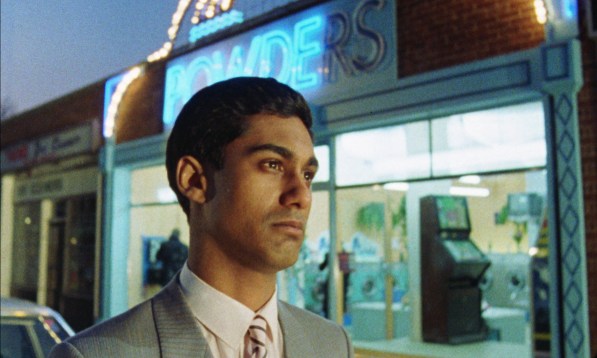
Omar Ali (Gordon Warnecke) is a young Londoner adrift. He’s dropped out of school and spends his time caring for his father Hussein, bed-ridden and increasingly inclined to drink since the suicide of his wife the previous year. Hussein realizes his son needs to expand his horizons, so he sends Omar to Uncle Nasser who sets him to work washing cars in a parking garage before handing over his failing laundrette. Omar envisions this facility becoming a place the reinvigorates the neighborhood and beginning his fortune. Through circumstance, he reunites with Johnny (Daniel Day-Lewis), an old schoolmate who got caught up in the right-wing nationalist movement. Johnny breaks away from his mates but struggles. He and Omar have romantic feelings for each other but exist in two very different communities in their city.

Laundrette is a film very much of its time. Within minutes, the hardships brought by Margaret Thatcher’s tenure as Prime Minister are felt. London is run down, slum lords rule the roost, and anyone who can’t find a job is tossed out on their ass. The Pakistani community is not feeling the purse strings tighten as much and are seeking out fairly non-glamorous avenues to keep the money rolling in. Omar’s father is a socialist and journalist, two things that stand in contrast to the other highlighted members of his community’s ideals. While Hussein rails against Thatcher to Omar, Nasser talks with delight about how he has benefitted from her policies. Many Pakistani characters admit they feel torn between two homes, but Nasser bluntly states that as Pakistan became increasingly theocratic, it was obvious that people like him who enjoyed Western values had to leave.

However, these ideas are never really explored in depth. This is because Laundrette is a film so stuffed with ideas and wanting to say so much about them it never gets the opportunity to say much about anything. It intends to be a slightly light slice of life type film, but also a commentary on contemporary politics, but also a love story, but also a movie about Anglo-Pakistani identity. I kept thinking the picture had all the potential to be a fantastic mini-series, a Pakistani Shameless, about communities in the poor neighborhood in conflict. The romance between Omar and Johnny is meant to be the core of the film based on promotions but I felt it was secondary to the exploration of racial identity in Thatcher’s England.

When the film comes up in conversation, it is often to highlight the breakout performance of Daniel Day Lewis. I found him to be a little dull and nothing spectacular. He wasn’t terrible, the film just didn’t have the time to develop his character to become anything interesting. Omar, the protagonist of the movie, is more interesting but I never felt the deep struggle between his love for Johnny and his community in the way I believe Frears intended. The romance is never something the characters suddenly begin confronting their family about. It’s left a little ambiguous as to where they go from here. The third act shows that life isn’t going to run smoothly for the couple. When the film ends the story doesn’t. You can feel that life will continue for these people and it won’t go smoothly. But in times of government austerity life is a struggle that only those we love can help us through.

Movie Review – Sing Street

Sing Street (2016, dir. John Carney)

e95a78d0a8bdfc12dd50023c9d8822ea4a084546

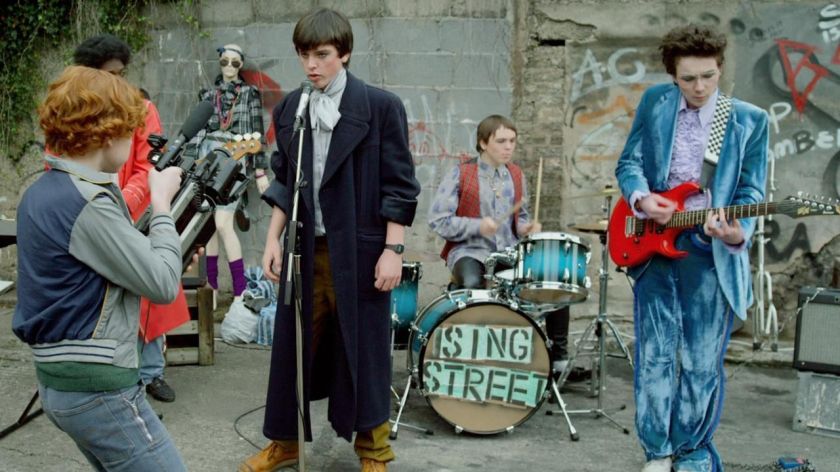
Conor Lawlor is fifteen years old and, with his two siblings, stuck in the middle of his parents’ deteriorating ends up at Synge Street, a free state school run by the Christian Brothers. The school is managed chaos, full of delinquent young men and priests who brutalize their students. Conor meets Raphina, a girl who lives across the street from the school and after seeing a Duran Duran music video for the first time decides he wants to form a band. The group is assembled from the boys he attends school. At the same time, his older brother begins educating Conor on various bands of the day (The Cure, Spandau Ballet), and slowly Conor develops his own sense of songwriting. The endeavor awakens a love of songwriting in him, and the band becomes more than just something to impress a girl, and their relationship becomes more than merely a crush.

By the mid-1980s due to economic stresses, young Irish were immigrating to London in significant numbers. Early in Sing Street, we see a news report covering this and mentioning the fact that many of this young people arrived with little to no money and quickly ended up on the ferry back to Ireland. Conor’s parents’ problems come from both a marriage that is drained of love and the economics issues that have come up. The Catholic Church also looms as an institution that not only oppresses Conor but even his parents. At one point his older brother says, “Two Catholics in a rented flat with a screaming baby who just got married because they wanted to have sex. They didn’t even love each other.” So while the tone of the film is generally upbeat, there is an honesty in the events unfolding.

The style of humor in Sing Street is a mix of dry and playful. I was reminded of the great recent Irish sitcom Moone Boy during a lot of the interactions between the boys in the band. There’s this sense of heightened wit among the children where they come across as wise beyond their years. Other moments have the feel of a Wes Anderson film like Rushmore or Bottle Rocket, that mix of staged scenes and rough energy. The side characters never overtake the main story but are painted with just the right full broad strokes that we have a definitive sense of who they are without the film having to overtly explain.

The music, written by Gary Clark a veteran of the music industry in the 1980s who still writes and produces has a very genuine feel. Each song is directly mimicking a particular band’s style and reflects exactly how a young songwriter would operate, first simulating the music they like as they develop their own sensibilities. I was born in 1981 so much of the music featured in the film I don’t necessarily look back with nostalgia. I certainly enjoy the lighter pop of that era, despite my dark tastes in nearly all other media, and I found the music well done.

Sing Street is a feel good coming of age movie, and I approach this type of film with a lot of trepidation. So often these films depend on a false sense of emotion. They use lazy shorthand to get across the feelings they want to evoke in the audience. Sing Street always manages to keep itself grounded and never tread into those maudlin spaces. Even the film’s “happy ending” leaves the real conclusion for these characters open. The message is that we don’t know what happens when we risk for those higher aspirations, but the risk itself is a victory.

TV Review – Search Party

Search Party (TBS)

Created by Sarah-Violet Bliss, Charles Rogers, Michael Showalter

search-party.png

Dory (Alia Shawkat) has no real aim in life. She works as a personal assistant to a rich housewife and in dwindling relationship with her boyfriend. On a walk to work one morning, she comes across a Missing poster for Chantal, a girl she vaguely remembers from college. Apparently, during the weekend of her older sister’s wedding shower in the Hamptons Chantal vanished and her family is starting to think she may have been killed. Dory believes otherwise and makes this mystery the center of her life. She enlists her nebbish boyfriend (John Reynolds) and two best friends (John Early and Meredith Hagner). The quartet attempts to solve the mystery while getting distracted by their day to day lives and bouts of narcissism and ennui.

The depiction of Millennials in popular media has come under scrutiny in the last few years. Shows like Girls, The Big Bang Theory, Two Broke Girls, and more recently The Great Indoors have created some contentious dialogue about just how the Millennial generation should be portrayed. Writer-Directors Bliss and Rogers had previously produced Fort Tilden, an independent film about two of the most grating, yet somehow endearing 20-something young women on a Godot-esque trip to hang out with some guy at Fort Tilden. There was a certain endearing quality to these two central characters despite their surface level vapidity. They were complex and not just figures of ridicule.

Bliss and Rogers bring this same layered sense of character to Search Party and, because of its ability to spend more time with its characters, does an even better job than Fort Tilden. Alia Shawkat leads the cast and could have easily become the straight woman to the antics of John Early and Meredith Hagner. However, she delivers the best performance I’ve ever seen out of her, bringing realism to the feeling many people in their late 20s feel about prospects for their future. Searching for Chantal allows Dory to feel like she is actually doing something rather than just existing. As Maeby Funke in Arrested Development, Shawkat played the kid smarter than all the adults but here she is a character who makes mistakes and gets lost in her own frantic energy to hunt down the truth. There is comedy here but with a lot of well-measured pathos interwoven.

John Early is the obvious stand out from the supporting cast as Elliot. I became a quick fan of Early from a small role he performed in Netflix’s Wet Hot American Summer series, and he went on to be featured in an episode of their The Character anthology. Here we have Early played a character he has mastered, the self-involved insecure, dumb guy. He brags about his charity to bring water bottles to the children of Africa and gets comically frustrated when confused friends start to question the whole premise of the charity. He frequently brings up his teenage bout with leukemia as a way to avoid criticism though it rarely has anything to do with the feedback he’s getting. Meredith Hagner plays Portia, a wealthy kid who has recently booked a role on a Law & Order pastiche. The most painfully real and funny part of this gig is she’s a blonde white woman cast as a Latina police detective and seems oblivious to the inaccuracy. Hanger and Early have fantastic comedic timing and often have the opportunity to play off each other.

The cast member that surprised me the most is John Reynolds as Dory’s boyfriend Drew. This character could easily have come off as a flat, easy to dislike antagonist to Dory. Instead, Bliss and Rogers choose to introduce him that way at the start and subsequently develop him to challenge our first impressions. The relationship between Dory and Drew is much more interesting than I initially expected it to be. In the same way, the characters feel like they are going to fall into those lazy Millennial stereotypes, but the creators work hard to find the genuine humor in that but also show us these are fleshed out people.

At its core, Search Party is a comedy and mystery. The good thing is this is a comedy that is actually funny. The jokes are smart and situational. Nothing feels contrived, and the best humor comes out of the character interactions. This is balanced with a considerably strong mystery. As Dory investigates, she goes down dead ends but always seems to find at least one clue that keeps the momentum going. The answers behind the mystery are satisfying, and even the red herrings turn out to be incredibly entertaining.

I was honestly surprised at how much I enjoyed Search Party. I’ve become tired of the lazy portrayals of Millennials in media and this series manages to acknowledge the truth of some of those stereotypes while adding depths to character types that are often punchlines in other series.

Movie Review – Heartbeats

Heartbeats (2010, dir. Xavier Dolan)

heartbeats

In watching I Killed My Mother, it was clear that Xavier Dolan had a sharp sense of humor. In Heartbeats he allows himself to make an overt comedy of manners that has delivered more laughs from me than most comedies I’ve watched this year. The story centers on Francis (Dolan), and Marie (Monia Chokri) are best friends who meet Nicolas (Niels Schneider), a young man who entrances them both. They begin a vicious back and forth to decide who gets Nicolas in the end.

The comedy in Heartbeats comes from Francis and Marie’s growing animosity with each other over Nicolas’ affections and the ongoing confusion his behavior and words illicit. During a playful game of hide and seek in the woods he manages to tackle Francis, pinning him to the ground. And keeps him pinned for a longer than usual amount of time before hurriedly rushing away, an act that builds confidence in Francis’ perceived chances with Nicolas. A few scenes later, Francis finds out Nicolas has invited Marie to see a play together without even asking Francis which throws him into confusion about his possible suitor’s intentions. At first, our protagonists attempt to play things cooly and not truly acknowledging the competition at hand. By the end of the film, they have devolved into wrestling on the ground decked in clothing out of place in the rustic, cabin setting they have ended up in.

Dolan has a very deft hand at the awkward moment, particularly zeroing in the desperation people take on when they are incredibly attracted to an individual they see as “cooler” than them or “out of their league.” At one point, Francis makes a completely inappropriately expensive purchase for Nicolas’ birthday and, while this fact is only known to Francis and the audience, it adds tension to the informal gift competition that springs up between him and Marie. As an actor, Dolan has the most perfect uncomfortable, awkward smile. He’s left behind at Nicolas’ apartment and has to receive a monthly allowance being delivered by Nicolas’ mother (played by the remarkable Anne Dorval, who played Dolan’s mother in his previous film). Dorval dominates most of the conversation, revealing her career as an exotic dancer, her broken relationship with Nicolas’ father, and other TMI. Dolan doesn’t fade into the background, though, and through his face and his body language, the audience is reminded of all those intensely awkward conversations we’ve ended up in, and especially those with a friend’s parent or some other acquaintance who shares far too much information.

The new element in this film for me was Monia Chokri as Dolan’s rival. Chokri was fantastic and kept up with her co-star and director by exuding an awkward confidence. As the tension increases, her chill unaffected nature begins to show cracks culminating in a scene where she runs into Nicolas on the street that will elicit the strongest empathic cringe from anyone watching. The awkward humor is never to the intensity that something like Curb Your Enthusiasm produces, it is continually softened through a lens of romantic idealism. Chokri’s Marie is presented as a very composed and intentional person, bearing an early 1960s appearance in both hairstyle and clothing. Coincidentally Nicolas mentions his love of Audrey Hepburn and Marie begins adding accessories that emphasize those aspects of her appearance.

The film is about friendship and the silliness of “profound love” and romanticism. It evokes the visual style of Wong-Kar Wai’s In the Mood For Love in particular moments, but instead of using this imagery to evoke a sense of serious simmering passion, Dolan uses it to cultivate a sense of irony with the protagonist’s actions. This is yet another Dolan film that highlights a different talent than I Killed My Mother and Tom at the Farm. The former is a wonderfully bittersweet character study, and the latter is an exercise in tension and psychology. Heartbeats are Dolan’s take on a romantic comedy, a modern remix of Jules and Jim with his own personal visual flair.

Movie Review -Funny About Love

Funny About Love (1990, dir. Leonard Nimoy)

funny-about-love_8col

There was a kind of movie made in the late 1980s through the mid-1990s that grates on me. These films were usually set in New York City and focused on a wealthy white person experiencing some mid-life crisis or first world problem. The soundtracks were bouncy and goofy in the beginning and then when some maudlin moment occurred, they would switch to a mournful and grating harmonica to underscore the wistful turmoil. Of course, the films would ensure a happy ending for their already entitled protagonist leaving the audience with little to nothing to think about. These films have evolved over the years now star actors fishing for dollars apparently. They are films made by directors like Nancy Meyers (It’s Complicated) or Charles Shyer (Father of the Bride). They are not intentionally offensive movies, but their whitewashed landscapes and conflict based on economic lives that are living at the peak of Maslow’s Hierarchy ring incredibly false. Funny About Love is one of those films.

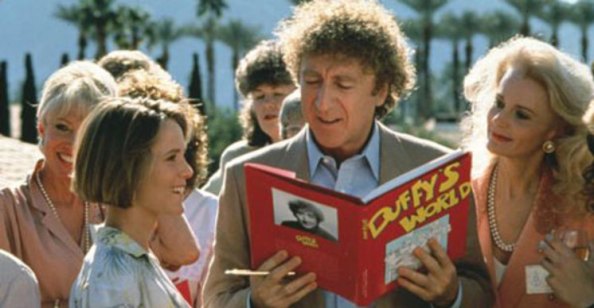
I can’t say what possessed Wilder to take this role. He has chemistry with Christine Lahti, but the material he is given to work with is horrendous. In comedy, it is important to establish the tone you are going for early on. Audiences want to know if this will be a light comedy, cerebral, dark, etc. Funny About Love veers back and forth through its interminable one hour and forty-seven minutes. There is the soft, playful banter between our co-stars which signals a light, romantic tone. Twenty minutes later a character is crushed by a falling stove, and this is played for laughs? The film is based on an article from Esquire titled “Convention for the Love Goddesses” where writer Bob Green gives a speech at a sorority convention. That does happen in the film, the third act for about 15 minutes. I strongly suspect we are dealing with a script that was butchered, reshaped, and revised by studio executives. The impetus of the plot revolves around having children and with the style of the film’s poster I suspect Look Who’s Talking had an influence on the film’s direction. While we remember Leonard Nimoy’s passing as the man who played Spock, we must also acknowledge the incredibly terrible films he made outside of the Star Trek franchise, this being chief among them.

There is no reason to dwell on this particular film; it does not merit much study or discussion. However, due to it being the second to last Wilder feature film, we can use it as a point of meditation. How did Gene Wilder go from being in the golden era of Mel Brooks and commanding a very charismatic leading man performance in films like Silver Streak to a procession of milquetoast WASP-y duds? There was a moment in the late 1970s/early 1980s where his career took this turn. Post-Silver Streak, his films had middling success, Stir Crazy was the one box office success in a sea of bombs. I suppose it could just be an instance where an artistic eye and mind change over time, influenced by the movie business, encouraged to make decisions because of the prodding of others.

Wilder’s final theatrical film, Another You which I reviewed here, is such a horrible period on the sentence of Wilder’s career. It was likely a good thing he began to fade from the spotlight at this time. He’d do a single-season run of an NBC sitcom in the 90s, Something Wilder, which I nostalgically remember with positive vibes but suspect I’d hate if revisited. When he passed, Wilder was talked about in the context of Willy Wonka and Young Frankenstein. We have a remarkable penchant to cling to the positive images of those film faces from our past. And that’s a good thing. The worst of Wilder’s career has been forgotten, the only drug out occasionally by people like me, but then to quickly fade from memory again. It is better that we hold with fondness our memories of Wonka and Dr. Frankenstein because that is the Gene we love.