Movie Review – Haunted Honeymoon

Haunted Honeymoon (1986, dir. Gene Wilder)
hauntedhoneymoon2

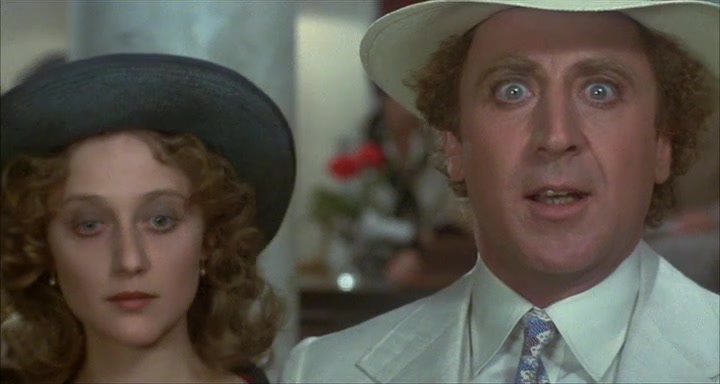
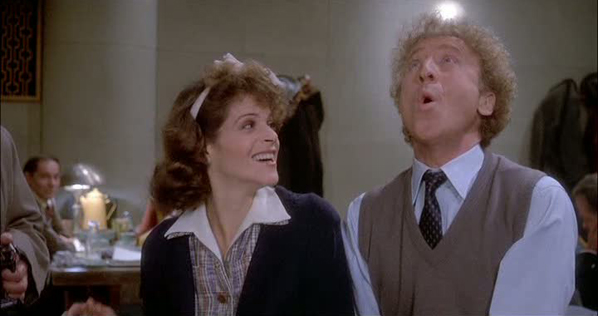
Larry Abbot (Wilder) is a famous radio actor and heads to his family’s palatial estate in upstate New York for his wedding to Vicki (Gilda Radner). Larry has been plagued by strange speech problems and goes into fugue states upon hearing certain words. His Uncle Paul has an idea for radical therapy where he will scare Larry into being cured. However, there is a werewolf stalking the property and a murderous conspiracy afoot.

Haunted Honeymoon starts with quite a bit of potential. The tone set by the music and the introduction to the mansion is very reminiscent of Young Frankenstein. We’re teased with some interesting horror and mystery, but then the plot kicks in. The story of Haunted Honeymoon is so overly convoluted and unfunny that the film falls apart within moments. There is the plot thread of Larry’s psychological ailments, a conspiracy to get control of the matriarch’s will, a werewolf stalking the grounds, a mesmerizing magician, Larry’s ex-girlfriend showing up as his cousin’s new girlfriend, the impending wedding of Larry and Pearl and those are just a few. At one point, as members of the family begin arriving there is little to no formal introduction to who these people are and how they are connected so the narrative crumbles. It gets even more confusing when Larry’s therapy begins, and it’s not made clear what’s the therapy and what is part of the murderous conspiracy.

Wilder and Radner’s personal love story seems to be the engine for the film, but it is just not enough to make the movie entertaining. In retrospect, the film is quite sad because the chemistry between the two is apparent. Jonathan Pryce stars as the cousin and does a fine job; he’s one of those actors that always seems to do well. The standout of the cast is Bryan Pringle as the family’s drunk butler. His interactions with Wilder are the closest the film gets to actual comedy. The film has an overall feel of a movie out of the 1940s and attempts that style of comedy but it never quite hits. The only moment that captures the clever physical comedy of the era involves Wilder pretending to own the legs of a person he has knocked unconscious, very apparently inspired by Charlie Chaplin.

The film also highlights a major problem Wilder has in the majority of the films he writes and directs (his work as the writer of Young Frankenstein not included), a lack of firm conclusions. Haunted Honeymoon, much like The Woman in Red, just sort of ends. But even worse than The Woman in Red’s utterly disrespectfully unfunny ending, Haunted Honeymoon doesn’t know how to end itself, so it pulls a “Gotcha! We were just joking”. Then the finale is topped off with a final scene that leaves the audience scratching its head and wondering what the hell the point of all this was.

Gilda would pass away two years later. Wilder’s life during this time was focused solely on her care, and there were no films made until 1989’s See No Evil, Hear No Evil. It began to feel like Wilder just didn’t have many films left in him. Between Gilda’s death and poor reception of his films, he was becoming more and more disenfranchised with the industry. He would make two more movies, never directing another: Funny About Love and Another You. Next time, we’ll look at Funny About Love.
Movie Review – The Woman in Red

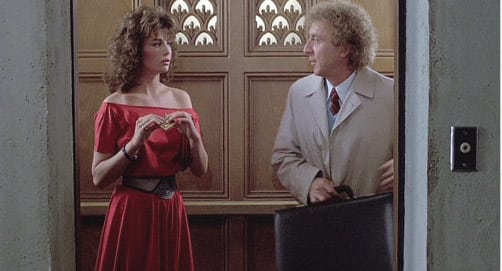
The Woman in Red (1984, dir. Gene Wilder)

woman-in-red

Teddy Pierce (Gene Wilder) begins the film standing on a ledge, just outside a window. Through voiceover, he takes us back to his fateful meeting with the Woman in Red (Kelly LeBrock) and how it led him to this place. He was a faithful husband and a doting father, comfortable in his job as an advertising executive. At first, Teddy’s gestures towards The Woman are scrambled around, and co-worker believes they are aimed at her (Gilda Radner). When the relationship finally does get off the ground, it becomes a series of lies and comically awkward scenarios where Teddy tries to dodge and mislead his wife (Judith Ivey).

One of the biggest wrinkles for me as I watched this film was the way Teddy’s infidelity was played for laughs. I can’t imagine this film being made today without some genuine pathos being written in for Teddy’s wife. There is a single moment in the third act that seems slapped in to handle any dislike the audience had for our protagonist, but it didn’t make me feel that he was justified in any way. I kept thinking about the culture Mad Men depicted and how this felt like the last vestiges of that, crumbling away in the early 1980s. Teddy has a cohort of buddies (Charles Grodin, Joseph Bologna, and Michael Huddleston) he pals around with and engages in raucous pranks on unsuspecting people. It appears that the intent was to make us think this was cute. Instead, it comes across as obnoxious and beneath characters that are supposed to be grown, professional men.

Despite the odd dismissiveness of the wife’s feelings, there are some moments of real consequence for side characters. Joseph Bologna’s character is notorious for his infidelities and early on in the film his wife leaves him. It feels like this will be handled seriously, as a counterpoint to what Teddy is contemplating. But then the film undercuts this plot halfway through, and it leaves Bologna’s character as having learned nothing from the ordeal. These are not “manly-men” per se though; they are a type of “fraternity of men” in their dynamic. So it shocked me that around the halfway mark it is very subtly and very honestly revealed that Charles Grodin’s character is gay. The words “gay” or “homosexual” are never spoken, the rest of the guys never rib him about it and the fact is just something they all knew and accepted. Grodin’s partner learns he’s been cheating on him and leaves their home. Grodin has a very real, emotional moment contemplating how his philandering has affected his life. For 1984, I was honestly shocked that a gay relationship was shown with such acceptance.

Wilder adapted the film from a French picture titled Pardon Man Affaire but infuses it with the Wilder tropes (red-faced hysterics, sad puppy-faced mugging, bawdy nebbish-ness). It just doesn’t work in the end. Reflecting on the films Wilder directed (Sherlock Holmes’ Smarter Brother, The World’s Greatest Lover, and this) it becomes a parade of diminishing returns. His work has moments of brilliance, but as a whole, they are muddled, confusing, and rarely funny. It’s clear to me Wilder has a very distinct point of view throughout his work, it is just messy and meandering. The one bright spot in The Woman in Red is Gilda Radner in a nearly wordless performance as a co-worker who mistakenly believes Teddy is after an affair with her. Where in Hanky Panky she is cast as “generic female supporting character” here she is allowed to flex her comedy and acting chops, proving what a great talent she was just with her face.

At this point in his career, Wilder has settled into the role of the WASP-y milquetoast, and it is clear that his greatest performances were behind him. He would direct one more film, though, Haunted Honeymoon, which is what I’ll be reviewing next time.

Movie Review – Hanky Panky

Hanky Panky (1982, dir. Sidney Poitier)

hanky_panky_1982_3h2016

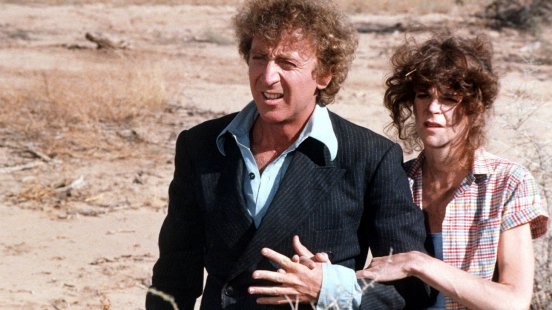
A Chicago architect named….(wait for it) Michael Jordan (Gene Wilder) is headed back to his hotel after brokering a deal in New York City when a woman on the run from a couple menacing fellows stumbles in. He quickly becomes involved in an international game of spies and espionage. He gets help from a reporter (Gilda Radner), and the two go on the run after Jordan is framed for murder.

Much like I felt about Poitier’s previous Gene Wilder venture, Stir Crazy, this movie is an utter failure as a comedy. And it’s not too great of an action/thriller film either. The MacGuffin that drives the whole plot is very confusing and unclear, and even at the end, I was still trying to figure out what the big deal was. Things start out interesting enough. A mysterious man wakes up, disoriented, sees a strange painting of a Southwestern landscape on his bedroom wall and proceeds to hang himself. It’s a pretty intense hook. Then we move to Kathleen Quinlan as the woman whose path crosses Jordan’s. She is playing it straight, which is perfect for an action comedy. The comedy comes from moments in the story but the story itself takes things seriously.

I kept thinking back to how good Silver Streak was, how it balanced genuine situational comedy with a legitimately exciting and interesting conspiracy story. Lots of things happen in Hanky Panky and the two leads go to lots of locations, but it never feels like it amounts to anything. It is a lot tighter in its structure then Stir Crazy but still misses the mark on the actual comedy. There’re some instances of Wilder’s trademark outbursts, but they hit too frequently and don’t feel appropriate for the scenes.

The strangest thing to me throughout the whole production was how underused Gilda Radner was. She was known for being a very high energy comedic talent, and she is a fine actor. They just never give her anything to play off of or do other than eventually become the damsel in distress. I got similar feelings from when I see Kristen Wiig in certain productions that seem to ignore her comedic talents.

As far as Wilder’s career, this was near the point where it was beginning to slow down regarding hits or highly memorable work. From interviews I’ve read, he seemed to be a particular actor, so I assume he was looking more at films that interested him rather than would do well. He also began his relationship with Gilda Radner at this point. We’ll see the pair again in his next film, The Woman in Red as well as Haunted Honeymoon. I’ll be posting about both of them very soon.

TV Review – Atlanta: Season 1

atlanta_ka_p11273_fin_01_couchfrontc

The city of Atlanta exists in a strange space geographically and culturally. Burnt to the ground during the American Civil War, rebuilt and exploded into a major hub in the Southeast for manufacturing and the civil rights movement, now a diverse and constantly shifting urban space. It’s one of the largest cities in America, but it’s surrounded by lush, verdant hills. It’s the place where the city meets the country. It’s a place where rappers hang out in the woods wearing their hunting camo. Donald Glover wasn’t born here, but he was raised in the contradiction that Atlanta is, and he understands the true wonder of that beautiful, messy conflict of ideas.

Earn (Glover) doesn’t so much as live in Atlanta, as he exists there. He dropped out of Princeton. He lives with the mother of his child, but their relationship is complicated, and she sees other men with no argument from Earn. He works a dead-end at the Atlanta airport. Even his parents won’t let him in the house because they know he’ll ask for money. When his cousin Alfred releases a regional hit as the rapper “Paper Boi,” Earn sees this as an opportunity to make something of his life as Alfred’s manager. But that’s not really what the show is about; Atlanta spends the next nine episodes challenges the viewer’s’ notions of just what the show is and what is it about.

Glover plays with traditional television structure, partially inspired by the work done by Aziz Ansari’s Master of None and Louis C.K. on his FX series. The success of the latter show has opened doors for creators like Glover and Pamela Adlon’s Better Things not to be forced into typical three-act sitcom structure. Atlanta has no loyalty to any one character and will allow the focus to meander depending on the interest of the moment. Sometimes we have Earn hustling for Alfred. Others we follow Alfred’s right-hand man, Darius as he goes through a series of deals and bartering for some unknown purpose. On the show’s most interesting episodes it highlights a day in the life of Vanessa, Earn’s on again/off again after she makes a career ending mistake. There’s also an entire episode framed as a local program on issues in the black community, where Alfred is confronted over transphobic comments.

The play between relationships is what makes Atlanta so engrossing. Earn and Alfred are arguably the show’s core relationship, and they don’t behave like a typical performer/manager. Their familial connection seeps into every aspect, and Alfred makes concessions that you would not see a performer do for someone that is going to take 5% of their paycheck. And Earn looks after Alfred in a more intimate way than most managers.

Even more interesting is the relationship between Earn and Vanessa. From their first scene together, waking up in bed and beginning their morning routine there is a palpable tension. As the series goes on, we get two spotlight episodes with just her and one crucial episode about the next stage of she and Earn’s relationship. Vanessa is a highly educated woman who has ended up sidetracked with a child and undefined relationship. We see her interact with peers from college who have made their living in possibly questionable ways and Vanessa ponders other paths.

What kept me coming back to Atlanta was the magical realism of the series. Smartly, Glover and company don’t go overboard in the first couple episodes, hinting at the less familiar elements of the series. Glover has described the series as “Twin Peaks with rappers, ” and this comes through during Earn’s encounter with a strangely stoic man on the bus offering him a Nutella sandwich before exiting the bus and wandering off. As episodes roll up, we find Justin Bieber played by a young black man, the quirky inhabitants of a police lock up; an opportunistic social media-driven pizza delivery man, a slimy club promoter who escapes through secret passages, and many more strange and interesting side characters. Glover believes Atlanta is a magical place and works to convince us of the same.

Movie Review – The World’s Greatest Lover

The World’s Greatest Lover (1977, dir. Gene Wilder)

the-worlds-greatest-lover-1977-1

Rudolph Valentino is the sex symbol of the century! Rainbow Pictures executive Adolph Zitz (Dom DeLuise) is furious over Valentino and Paramount Pictures’ success. He strikes upon an idea: hold a contest for The World’s Greatest Lover, a man who they will make into the new star of the ages and get the female moviegoers to forget about Valentino. Cue Rudy Valentine (Gene Wilder), a man incapable of holding down a job due to his nervous tic of sticking out his tongue when he’s nervous. Rudy and newlywed bride Annie (Carol Kane) travel from Milwaukee to Los Angeles for his chance to become a star. A wedge is driven between the couple after they arrive and mishap piles upon disaster to impede Rudy from reaching his goal.

From the opening scene of The World’s Greatest Lover, I was laughing. And the laughs came pretty consistently throughout, probably the funniest of the Wilder films I’ve watched in this batch so far. There is the playing up of Wilder’s manic rage for comedy. And while in some films it befits this character, in this one it is the perfect tone to take. The absurdity of Wilder competing with Valentino is apparent off the bat, but having the character be so arrogantly assured of himself makes it that much funnier. It also doesn’t hurt that here, like in Silver Streak, Wilder is so naturally damn charming.

On the same level as Wilder in the picture are DeLuise and Kane. I can’t say I saw too much of DeLuise’s work in the past, but he just brings such a massive level of energy to his performances that it overwhelms you. He has got to be one of the better blowhards I’ve ever seen in a film. Much like Wilder, the sort of manic switch from furious to inviting creates a wonderfully tense comedy in each scene. Kane is unlike anything I’ve seen her in before. If you’re more familiar with her later work (The Addams Family, Kimmy Schmidt) then you’ll be stunned by how demure and innocent she can play. You don’t question for a second why Rudy is in love with Annie, and you also don’t ask why she is falling out of love with him.

The World’s Greatest Love is not Wilder’s finest work. Regarding directing, it is an improvement on Sherlock Holmes. He feels very comfortable with large set pieces and manages to balance comedy and sentiment well. There are some moments where the plot goes off track and Wilder indulges in some scene he cooked up that isn’t necessarily essential. There is also a love of an older style of comedy from the 1920s and 30s that is being recreated in the 1970s and viewed in the 2010s may not translate.

This was Gene Wilder at his peak. He’d just made Silver Streak and was a full-fledged movie star at this point. From here on out his career would be a mixed bag with a lot of less than stellar vanity projects. The Frisco Kid with Harrison Ford would come in 1979, Stir Crazy in 1980, and then the big moment of his life: meeting Gilda Radner on Hanky Panky, which is what we’ll look at next time.

Movie Review – The Adventures of Sherlock Holmes’ Smarter Brother

The Adventures of Sherlock Holmes’ Smarter Brother (1975, dir. Gene Wilder)

shsb-gene-marty-3

England’s foreign secretary has a critical document stolen from his home. There’s only one person who can track it down, Sherlock Holmes, with his assistant Watson of course. However, Sherlock knows this case will be a bit more complicated than his typical work and assigns it to his oft-overlooked little brother, Sigerson (Gene Wilder). Sigerson teams with Scotland Yard’s records clerk Orville Sacker (Marty Feldman) to uncover the circumstances behind the theft. The trail appears to lead to Bessie Bellwood (Madeline Khan) who claims the foreign secretary is her father. Also involved and lurking in the shadows in the infamous Professor Moriarty (Leo McKern).

Coming off the massive success of Young Frankenstein, Wilder was able to write and direct Smarter Brother. He brought Marty Feldman and Madeline Khan back into the mix, and it’s pretty obvious there’s an attempt to recreate the magic of Mel Brook’s Young Frankenstein. The film most definitely does not achieve that, but it isn’t a complete failure. There are some genuine laughs, and the plot structure holds up well. The comedy informs the plot which in turns let’s many jokes hit well. The problems arise in the form of the comedic tone. The script doesn’t quite know if it wants to be a farce of Sherlock Holmes stories or a simple comedy-adventure. There are moments with exaggerated sight gags, but then more subtle wordplay humor. The comedy rules of the universe aren’t established as clearly as Young Frankenstein does in its opening moments.

Wilder is hitting his mark quite well; he has the charming personality with the moments of ridiculous outburst. He has a couple of set pieces that involve stunts on top of horse carriages and some good sword fighting. You can see the seeds of a film like Silver Streak being sewn with Wilder’s interest in living out the dashing hero trope. I was particularly impressed with Marty Feldman’s acting. I don’t have a considerable knowledge of his work beyond Young Frankenstein, but I didn’t expect the sort of quiet, sly character we get. The dynamic between Wilder and Feldman is developed further here with Feldman’s Sacker being the smarter of the pair and playing his quiet intelligence off of Wilder’s arrogant Sigerson. Madeline Khan delivers yet another force of nature comedic performance. While we have many strong female comedic actresses today, I don’t know too many who just have the sheer power that Khan brings again and again to every film. She seems like she was a very fearless actress who understood what made comedy funny at its core more than most.

Helping from the sidelines are McKern as a Moriarty with a strange nervous tic, Dom DeLuise as Gambetti the loud and boorish opera singer, and Roy Kinnear (Veruca Salt’s dad from Willy Wonka) as Moriarty’s always shat upon right hand. Everyone does well with what they are given, but like I said it doesn’t reach near the comedy heights as Young Frankenstein. One set piece does stand out as some brilliant writing from Wilder, a staging of Verdi’s opera Un Ballo in Maschera, translated into English by DeLuise’s Gambetti. The lines are sung in a very casual, informal, almost slang version of English undercutting the rich production design. “Let’s drink some sexy wine” becomes one of the key lines of the performance.

As far as the less notable Wilder films I’ve explored, this stands out as one of the better works. This gives me hope for The World’s Greatest Love, The Woman in Red, and Haunted Honeymoon, all directed by the man. Wilder’s next picture would be Silver Streak, but that would be followed up by The World’s Greatest Lover which has him playing an actor during the silent film era. And we’ll look at that, next time.

Movie Review: Start the Revolution Without Me

Start the Revolution Without Me (1970, dir. Bud Yorkin)

720full-start-the-revolution-without-me-screenshot

There was a certain genre of film in the late 1960s and early 1970s that eschewed plot for zany, madcap romps. This can be seen in films like the original Casino Royale, The Magic Christian, and to some extent, It’s a Mad, Mad, Mad World. These are those decent budget films that just blow the roof off and have little to no narrative coherence. I can’t say with certainty, but I believe the writings of authors like Terry Southern and Tom Wolfe, the exploits of Ken Kesey’s Merry Pranksters, and the over “swinging” nature of the 1960s fed into this anarchic strain of filmmaking. Another film that I believe had a strong influence on this particular picture was the 1963 picaresque Tom Jones, an adaptation of the novel and similar, albeit less farcical skewering of 19th European society and culture.

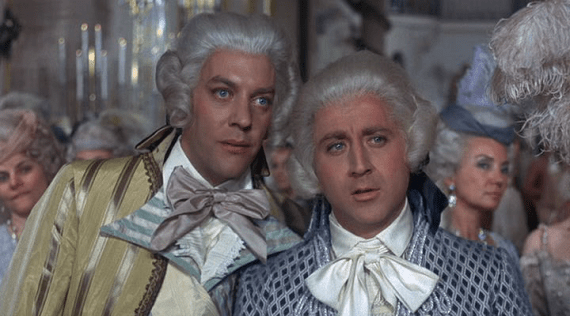
Start the Revolution begins with Orson Welles standing at a picturesque estate and detailing the events that led to the splitting two sets of identical twins between a common peasant and the Duke de Sisi of Corsica. The two sets of twins (one of each played by Donald Sutherland and Gene Wilder) end up leading very different lives. Claude and Charles become reluctant members of the French Revolution while Philippe and Pierre are spoiled degenerate aristocrats. Through a series of ridiculous circumstances the twins switch roles with the peasants mistaken for their royal counterparts and bedding down in Versailles while the Corsican brothers are pushed into the midst of the revolution.

The premise isn’t an entirely original one with twins switching places and being mismatched, and there is a lot of fun story potential when you add in the setting. However, the humor never stretches beyond a certain hackneyed level of writing. The jokes are very obvious and not too clever with some bright spots. A royal dance at the palace highlights the treacherous nature of the royal court as everyone is exchanging notes about whom each other should discreetly assassinate or poison. The other rare moments of brilliance come from Gene Wilder’s portrayal of the utterly demented Corsican brother Philippe. It’s one of those performances where he amps up the manic rage, and it works well in the first act of the film until the focus shifts more heavily to the peasant brothers.

In the context of Wilder’s career, Start the Revolution comes very early on. At this point, he’d made his big screen debut in Bonnie and Clyde and The Producers. His performance in the latter film is what likely got him this part as his performance highlights the emotional outbursts Leo Bloom showcased. The same year he co-starred with Margot Kidder in the light comedy Quackser Fortune Has a Cousin the Bronx (a film that appears to be nigh impossible to find). In both Start the Revolution and Quackser, Wilder attempts English and Irish accents which do not work. With this being the early part of his career he was still searching for the types of roles he would feel comfortable with. He was intelligent enough to know accents were not his strong suit.

Wilder would go on to star as Willy Wonka in 1971, followed by a breakout role in Woody Allen’s Everything You Wanted To Know About Sex (But Were Afraid to Ask). A re-teaming with his Producers’ co-star Zero Mostel in Eugene Ionesco’s Rhinoceros came next. The high point of his career (Blazing Saddles and Young Frankenstein) took him from obscurity to stardom, with The Little Prince tossed in for good measure. This brings us to the film we’ll look at tomorrow: The Adventures of Sherlock Holmes’ Smarter Brother.

Movie Review – Ghostbusters (2016)

Ghostbusters (2016, dir. Paul Feig)

ghostbusters-2016-cast-proton-packs-images

Erin Gilbert is a physics professor on a tenure track a Columbia University but hits a road bump when her past as a paranormal investigator comes back into her life. She ends up working alongside her old partner, Abby, and a new one, Holtzmann, to investigate hauntings in New York City. They recruit Patty, a subway token operator with an encyclopedic knowledge of the city and Kevin, a ditzy secretary to take on an overflow of angry and vengeful spirits that seek to reclaim the land of the living.

Ghostbusters is arguably the most written about film of 2016, inspiring very polarized reactions online. It’s no surprise that the announcement of an all-female cast drew ire and admiration from the camps you would expect. In the lead up to its release, it was difficult to find any conversation that didn’t devolve into an online shouting match. I can’t say I was excited about the remake, but I hadn’t been a big Ghostbusters fan since I was a kid. They are enjoyable movies but nothing that hooked me and brought me back on a regular basis.

I’ve been a big fan of Paul Feig since his work on Freaks and Geeks. I was a senior in high school when that series came out, and it immediately caught my attention. I am a huge fan of Bridesmaids, one of the few films I’ve paid to see multiple times in the theater. It was one of those instances of an entirely perfect cast and well-written script. I enjoyed his follow up The Heat quite a bit but wasn’t too warm on his action-comedy Spy. Bridesmaids still stands as my favorite of his films and a hard movie to top.

If you look at the five highest grossing comedies of 2015, the list goes as follows: Minions, Pitch Perfect 2, Hotel Transylvania 2, The Spongebob Movie, and The Peanuts Movie. My tastes in comedy and the mainstream audience’s comedic preferences are not aligned in any manner. Just a matter of different taste, neither is better than the other. Major film studios are most interested in making broad, inoffensive comedies that they can sell to international audiences. Comedy is very hard to translate because so much of it is based on language play. To dodge that problem modern comedy has adopted even more of an emphasis on physical humor. Look at trailers for comedies; it’s a litany of people falling or getting hit in the head. This isn’t new; it’s just becoming more prevalent as studios look to broaden their revenue streams.

Ghostbusters, due to studio influence, rather than letting comedic minds work without hindrance, ends up being just another mediocre big budget comedy. It’s not an affrontery to humanity as the MRAs would have you believe, but it’s not a revolutionary beacon to womankind either. It’s a seed for a possible franchise as Sony seeks to recover from its failure to do so with Spider-Man. Set pieces are emphasized over interesting and potentially funny character interaction, and the finale is another cut and paste special effects deluge.

After watching the Richard Pryor and Gene Wilder films and reflecting on my love of improv comedy, I’ve come to realize that less is better when it comes to ad libs. You need a very talented comedian to pull off good improv. The success of films like Anchorman has convinced some studio execs that just letting the funny people riff results in comedy gold. It only works if the structure around them is strong enough. I don’t think Kate McKinnon is untalented, but she doesn’t appear to have the support of a strong script and editing, so her comedy feels very shallow and not as intelligent as I know she is. The direction she seems to be given is “make a silly face and contort your body.” I found Leslie Jones to be the funniest character in the film because she is more grounded and if she was improv-ing than she does it in a very nuanced way.

Ghostbusters was never a piece of cinematic art. It was a studio comedy that picked up traction over the years. The newest film isn’t a failure, but it’s just another middle of the road movie with a couple of light chuckles. What’s most annoying is the push to intentionally grow a franchise. Sony seems to believe that by plugging Paul Feig and his acting troupe into a film will result in The Funny. They fail to recognize that the reason why a movie like Bridesmaids was so funny in the first place was the freedoms the creative talent was given to structure a funny story and that is was something new and so the direction of the story was unexpected. Ghostbusters is a fine film for a rental and watch, kids would enjoy it, but it’s not very memorable.

The Pryor/Wilder Quartet -Stir Crazy

Stir Crazy (1980, dir. Sidney Poitier)

5449_1

Stir Crazy is the second collaboration between Gene Wilder and Richard Pryor. This time, they are brought together by actor/director Sidney Poitier. The premise has the men as friends and roommates burnt out from life in New York City. They set out for the American Southwest where Wilder promises they will live a free and happy life. However, they end up framed for a bank robbery and receive a sentence of 125 years. Life is prison quickly drives them nutty, and they find a possible escape when it turns out that Wilder is a natural for the rodeo. The prison warden has a tournament coming up and plans to use Wilder to break his losing streak.

Since Silver Streak, life for Wilder and Pryor has been busy. Wilder has made The World’s Greatest Lover, inspired by a Fellini film, and The Frisco Kid, a Western that made Harrison Ford his co-star. Both films were considered significant failures at the box office. Pryor had two more successful comedy albums and starred in Car Wash, some forgettable comedies, and in Paul Schrader’s (Taxi Driver) drama Blue Collar. The comedian has also suffered a heart attack in 1977 but seemed just to double down on drug consumption which led to reportedly unprofessional behavior in being late the set of Stir Crazy. There was a lot of tension behind the scenes between Poitier and Pryor, and it can be felt a bit on the screen.

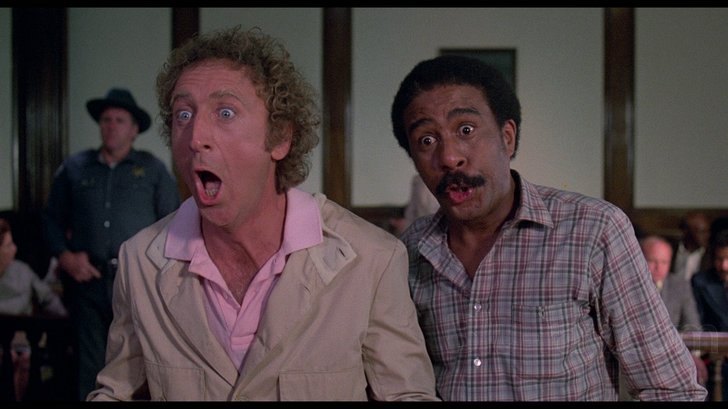
Stir Crazy is a pretty major disaster of a film. Silver Streak was a very tightly written and plotted, while Stir Crazy plays it way too loose and gives its two leads way too many scenes to mug and improvise in. There are multiple instances where Wilder especially is encouraged to just riff, and they fall flat in a huge way. His character mainly feels all over the place, in some moments being a naive doof and in others a Bugs Bunny-esque trickster. It becomes impossible near the end to know when he is genuine and when he is messing with the prison staff. There are a couple of moments where the two pull off genuinely humorous reactions. The sentencing scene is the highlight of the film with the result feeling natural and playing to the actors’ strengths. The scene where the two men are thrown into the county jail after their arrest is also funny until Wilder begins ad libbing a kung fu bit that just doesn’t work.

The film suffers from a lot of tone and plot problems. The film switches plot tracks numerous times with many characters introduced and ending up completely unimportant to the movie. JoBeth Williams shows up halfway through the film as an intended love interest for Wilder’s characters but goes nowhere and somehow still ends up with Wilder despite the story never earning that. After reading about the tension between Poitier and Pryor, I suspect Wilder had more plot added to his character as both a way to pad for Pryor’s absence and as a way to get a dig in at the comedian.

With contemporary sensibilities, it’s very hard to watch the Rory character, a horrible gay stereotype that I hope we have moved past. Rory is immediately attracted and clings to Pryor’s character. Pryor’s disgust at the attentions of a gay man is played for laughs culminating in the man kissing Pryor in the final scene. The comedian let’s lose an exaggerated “Yuck” to make sure we, the audience know he doesn’t return the affection. It’s a very gross type of character to include and he ends up being completely one dimensional.

Stir Crazy was the third highest grossing film of 1980 yet still was nominated for a Razzie. It was the highest grossing film by an African American director until I believe, The Wayans Brothers’ Scary Movie (2000). It’s an incredibly diverse cast in a very sloppy film with some problematic elements. Poitier would go on to direct Hanky Panky (also with Wilder), Fast Forward, and Ghost Dad. We’d see Pryor and Wilder come together nine years later in See No Evil, Hear No Evil which we’ll talk about next week.

Podcasts You Should Be Listening To #2

Tanis (Pacific Northwest Stories, Hosted by Nic Silver)

tanisWhile I really don’t enjoy found footage horror films, when the genre is applied to literature or, in this case, audio drama, it works much better in my opinion. The premise of Tanis is that journalist Nic Silver is attempting to uncover what Tanis, a word mentioned in a myriad of sources, is. Is it a person, a place? Why are famous occultists obsessed with it? How does it connect to other urban legends and modern horrors? If you are a fan of slow burning, very creepy, conspiracy theory stories Tanis will provide you with many hours of entertainment. Currently, Season 1 (12 episodes) is available with Season 2 on its seventh of 12 total episodes.

 

Filmspotting (WBEZ Chicago, Hosted by Adam Kempenaar & Adam Larsen)

filmspottingThis was the first movie podcast I ever listened to starting way back in 2005. At the time it was Adam and Sam Van Hallgren hosting, but the latter has moved on to a producing role. No matter the hosts, the film has always maintained a high level of discussion about film. Kempenaar is an instructor at the University of Chicago and Larsen spent over a decade reviewing films for the Chicago Sun-Times. Both men have a very deep knowledge of film and work to spotlight picture beyond what has currently opened at the cineplex. This podcast has probably been the biggest inspiration to my love of film introducing me to filmmakers like Wim Wenders, John Cassavetes, and Robert Altman. Even if you have an extensive film knowledge you will learn something from listening to this series.
 

How Did This Get Made? (Earwolf, Hosted by Paul Scheer, June Diane-Raphael, and Jason Mantzoukas)

how did this get madeInspired by Mystery Science Theater 3000 and a plethora of books detailing the “worst films ever made” these three comedians and actors set out to make a series where they explored travesties of cinema in depth. Episode One spotlighted Burlesque; Christina Aguilera and Cher’s gaudy passion project. From there they have looked at films like The Last Airbender, Masters of the Universe, and Zardoz. Some particular highlights have been A View to a Kill, Glitter, and the god awful sequel to Saturday Night Fever, Staying Alive. A very high energy podcast that has very charismatic and witty hosts that make watching bad films a pleasure.
 

With Special Guest, Lauren Lapkus (Earwolf, Hosted by…?)

lauren lapkusLauren Lapkus had become a staple on Comedy Bang Bang thanks to her variety of characters. When she decided to start her own podcast instead of hosting she opted to make the host rotating and to play a different character on each episode. This lets the guest come up with the concept of the show, the topic of conversation and even the basics of Lapkus’ own character. In fact, Lapkus doesn’t know any of this information until they start recording the episode and loves being made to improvise it all on the spot. A nice surprising podcast that never fails to present something unique and funny.