Movie Review – Welfare

Welfare (1975)
Directed by Frederick Wiseman

Frederick Wiseman has made his career focusing on institutions, and while he has branched off in later years ever so slightly, the most significant change in his method of filmmaking is going from tight 90-minute movies to large sprawling epics. It makes sense; the topics of his work are vast & challenging to grasp. You need time to let them breathe and for narratives to emerge. Welfare clocks in at nearly three hours long. I argue passionately that not only is this Wiseman’s masterpiece, but it is also one of the greatest documentary films ever made. Within this relatively short time, the audience will experience every stage of life and almost every element that brings drama into our lives.

Continue reading “Movie Review – Welfare”

Movie Review – Juvenile Court

Juvenile Court (1973)
Directed by Frederick Wiseman

Frederick Wiseman’s seventh film, Juvenile Court, came after producing at least one documentary a year from 1968. High School & Law and Order each contemplated how American institutions subjected people to forms of control. The former sees how we teach children as wrapped up in authoritarian ends, while the latter is about how authoritarianism is exercised in the community. It makes sense that Wiseman would make Juvenile Court as it is where these two paths converge, the place where young people are brutally institutionalized to “get them in line.” In a film that foresees Wiseman’s magnum opus, Welfare, he constructs tighter narratives, following a small number of young people and families through the court process.

Continue reading “Movie Review – Juvenile Court”

Movie Review – Law and Order

Law and Order (1969)
Directed by Frederick Wiseman

The police are not your friends. They are, in fact, an occupying force planted by those in positions of power who have tremendous wealth. The police are actually state-sponsored gangs, as you can see from their origins and the ongoing criminal money-making schemes so many of them have going on the side. Many articles on the Los Angeles County Sheriff’s Department’s deputy gangs and their activities can be found if you want to know more. This is standard practice when you give a select group of people in a society permission to commit nearly unaccountable acts of violence under the guise of “protect and serve.” In 2005, the U.S. Supreme Court ruled the police have no obligation to protect any person from harm. The police exist solely to protect the interests & investments of the ruling class. They would easily kill any one of us in service to that duty.

Continue reading “Movie Review – Law and Order”

Movie Review – High School

High School (1968)
Directed by Frederick Wiseman

While the asylum featured in Frederick Wiseman’s debut documentary Titicut Follies is not an institution most of us would ever experience firsthand, America’s education system is far more universal. Asylums and schools are strangely similar. They house people who would otherwise be deemed a danger to themselves and others if they roamed the streets unattended. They are run by rigid rule followers under the guise of caregivers. While the individual nurses and teachers at each respective institution may be doing their best, those higher up on the chain of command who control the purse strings often overlook great suffering that they could otherwise alleviate. In 1968, the American high school was a powder keg on the frontline of growing cultural discontent, making it a fascinating environment.

Continue reading “Movie Review – High School”

Movie Review – Titicut Follies

Titicut Follies (1967)
Directed by Frederick Wiseman

These days, you wouldn’t be blamed for thinking the documentary is purely a vessel for true crime. The media landscape has become saturated with docs that are akin to a segment on Dateline NBC about spouses becoming homicidal or people joining cults. While those things happen, they are far outside the norm of human experience. This is why I gravitate to the documentarians of the 60s and 70s when the form flourished and we got some incredible films. Few filmmakers in this corner of cinema do it better than Frederick Wiseman. During the first half of March, we will look at six of his most highly regarded works, which turn his eye towards the institutions and offices of authority that direct life in the States.

Continue reading “Movie Review – Titicut Follies”

Movie Review – A Decade Under the Influence

A Decade Under the Influence (2003)
Directed by Ted Demme and Richard LaGravenese

Across the globe, there have been numerous cinematic movements. Two of the most influential were the French & Italian New Waves. Through revolutionary experimentation with style & content, the artists behind these movements were able to show how film could tell stories far beyond what people had once imagined. These films often touched on political topics, particularly social injustice and hypocrisy among the ruling classes. The United States saw a similar but much smaller film movement in the 1960s, but something different from the upheaval brought about by their European counterparts. John Cassavettes helped birth American independent cinema, but it was not widely recognized at the time. It would be the 1970s when the States would see their own transformation of movies.

Continue reading “Movie Review – A Decade Under the Influence”

Movie Review – This Film Is Not Yet Rated

This Film Is Not Yet Rated (2006)
Written by Kirby Dick, Eddie Schmidt, and Matt Patterson
Directed by Kirby Dick

The United States is currently experiencing one of its most consistent features: moral panic. Every generation has gone through multiple cycles of this nonsense, yet we seem to learn nothing from them. Social media is the root of all evil in society. Or it’s LGBTQ people existing. Or it’s an accurate survey of American history. Or it’s rap music, dancing, comic books, video games, television, comprehensive sex education, the list goes on and on and on. Shortly after its creation, the novel was said to be aiding in the decay of society. All these young people spending hours in books thinking about people and places that don’t exist. Oh, the humanity! 

Continue reading “Movie Review – This Film Is Not Yet Rated”

Movie Review – Overnight

Overnight (2003)
Written and directed by Tony Montana and Mark Brian Smith

At some point in the early 2000s, a DVD of The Boondock Saints showed up in my dorm and was watched incessantly by several of the other guys on my floor. I will admit I have seen it more than once, mainly because it seemed to be ambient white noise in many dude’s dorm rooms at the time. I couldn’t articulate my criticisms of the picture then, but it felt like a loud and pointless exercise in cliche machismo. Just a few years later, another DVD showed up in my dorm, and that was the documentary Overnight, which told the behind-the-scenes stories of the man who made The Boondock Saints and helped me finally understand why I hated that picture.


As the title suggests, seemingly overnight, Troy Duffy went from being another schlub to being in the middle of a bidding war over his screenplay for The Boondock Saints. It was Miramax, headed by convicted rapist Harvey Weinstein, that won. They offered Duffy $450k to rewrite and direct the film, even dangling the final cut as an added cherry. The film would be given a $15 million budget, while Duffy’s band, The Brood, would write & record the soundtrack. Hey, and while they were at it, Miramax offered to buy J. Sloan’s, the bar where Duffy worked, and would act as co-owners with him. Two of Duffy’s friends, as well as the managers of The Brood, decided to document this rise to fame in Hollywood. Instead of a story of triumph, they chronicled a perfect example of mediocrity and self-destruction.

In 2024, masculinity in America has completely lost the plot. Faced with a society growing more accepting of transgender and nonbinary people, a subset of American reactionaries have decided to attempt a shitty cosplay of characters from 300. Combined with the supplement grift, an extension of the centuries-long tradition of snake oil, it has created one of the most obnoxious, idiotic bursts of meaningless noise I have ever experienced. You can see the roots of this mindset in the way Troy Duffy accepts this rash of good luck with a sense of entitlement. Of course, Troy should have all these things; he’s super awesome, right?

You can understand the hunger to get out from the grinding gears of capitalist wage slavery, but Duffy, like so many before him, is drunk on the consumption culture of America. Promises of making him co-owner of his workplace send the future director into nightly drinking binges with his buddies, chucking glasses across the bar to hear them shatter against a wall. He regularly puffs on cigars and buys office space to prop his shoes up on a desk. He does what so many of us working poor people do when we have this opportunity, which is to behave like a child’s version of a rich person. Why would a stand-up fella like Harvey Weinstein ever lie to Mr. Duffy? He’s a man of his word, right?

Duffy failed to calculate how to hold onto the riches he attained. Because he started from such a place of resentment, he demands what his movie should be and who should be in it. Like so many people at the top of the American food chain – well, let’s not go that far – like many of the people who believe the delusion that they are at the top of the food chain, Duffy thought he could throw his weight around, and people in Hollywood would do as he commanded. He forgot that he lived in a nightmarishly transactional and vindictive society. Hollywood even more so than other parts of the country. Soon enough, no one returns his calls, and Duffy is left in the dark about whether The Boondock Saints will ever be made.

The thing about Troy Duffy, for all his posturing to present himself as a Boston townie, what we don’t see in this documentary is that he was actually born & raised in Connecticut, attending private schools, and had a Harvard-educated father who was an English teacher that had his children regularly write book reports for him. There’s nothing necessarily wrong with these things (though I personally think private schools should be banned), but it reveals that Duffy’s pose as some sort of “guy from the streets” is a farce. 

The true face of privilege emerges as the man torpedoes his own film career and then proceeds to fuck things up for his band, which includes his own brother. At one point, a producer overseeing the recording of The Brood’s first album remarks that Duffy’s brother is the creative heart of the band, something Troy surely picks up on, leading to him trashing things like a spoiled toddler. The directors of Overnight recorded their own firing as managers of the band, cut out from every last dime with no acknowledgment of their work to get to this point. 

Duffy never sees the failures as his own fault or the result of just how the Hollywood system works. Nope, there’s a tinge of conspiracy theory in his words. They have it out for him because his movie is so good, and they know it. As someone who has had the displeasure of seeing The Boondock Saints multiple times, it is not good, save Willem Dafoe’s performance, which is not helped in any way by Duffy’s horrible writing. Eventually, he would get the damn thing made after obtaining more financing from Franchise Picture. A dismal debut at Cannes in 1999 resulted in no one clamoring to buy the thing. The Columbine shootings would be cited as a reason why, but the imagery of The Matrix didn’t seem to slow that movie’s success down.

I won’t say that Duffy is talentless. Based on his background, I expect him to have a solid understanding of literature and writing. However, arrogance can be a hell of an obstacle to overcome. The Boondock Saints is such a dismally lousy movie because it is someone trying to write characters whose experience he only knows from other movies. He’s not a poor kid from Boston and didn’t try to educate himself on what that would be like. Instead, he lazily cribs from more talented filmmakers like Tarantino and Rodriguez, thinking he can lift the best bits and have a good movie.

While Overnight is not a spectacularly shot documentary, the camera work here is often horrible; it is a rare up-close glimpse of someone self-sabotaging with such vivid detail. There never seems to be a moment that the film’s subject is aware enough to understand how someone outside this situation will view him. He is wholly subsumed in his narcissism, happy to ruin the opportunities of people around him to soothe his own fragile ego.

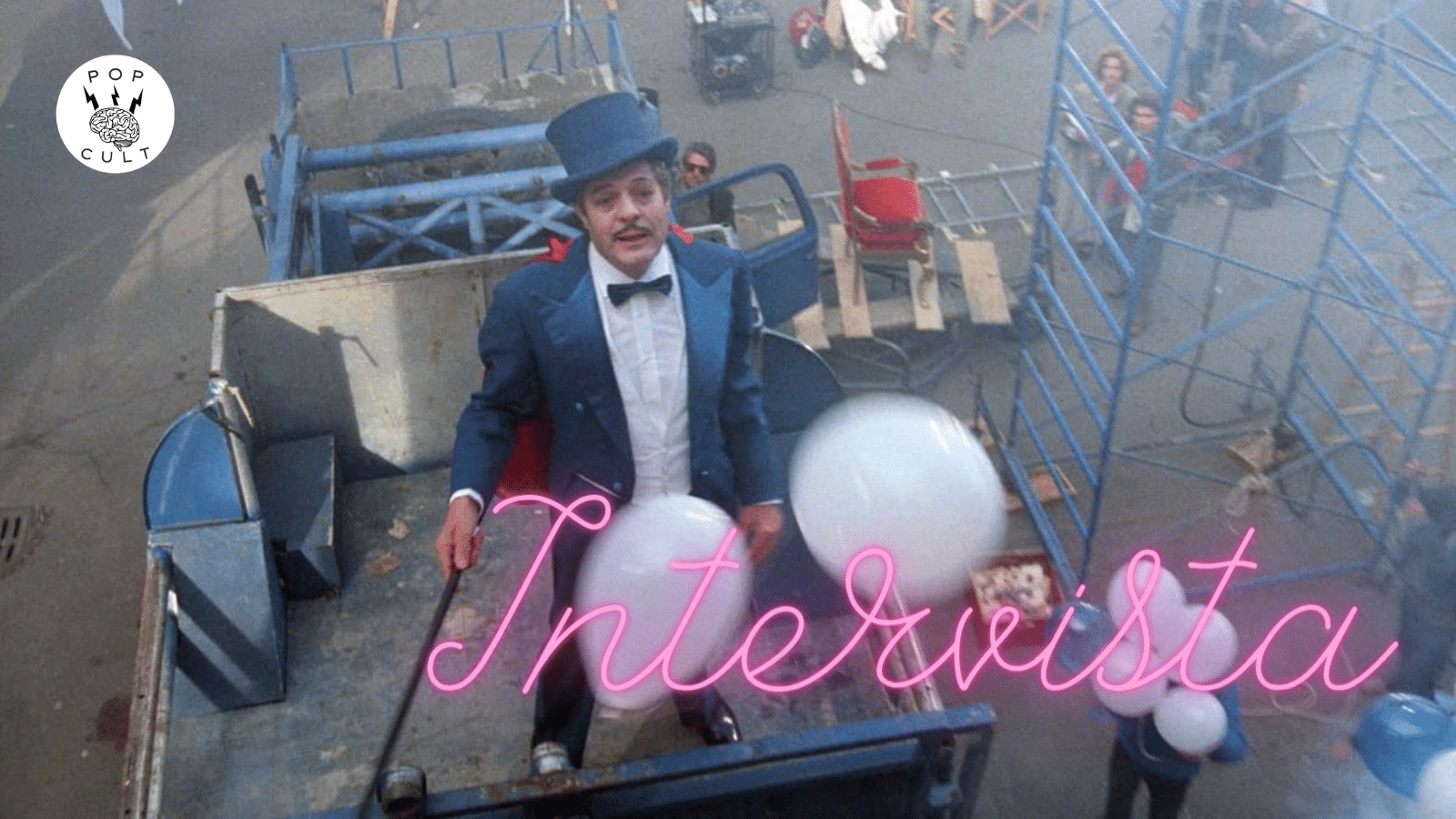
Movie Review – Intervista

Intervista (1987)
Written by Federico Fellini and Gianfranco Angelucci
Directed by Federico Fellini

When you think of Federico Fellini and movies about movies, you probably think of 8 ½, and rightly so. It’s one of the best movies ever made and the best movie about a movie ever made. However, I already reviewed it when I did a series on the iconic Italian director in 2022. When I discovered this late-career picture, I put it in this series instead. Intervista was Fellini’s second to last film, and like most artists in old age, as they grappled with their mortality, he returned to his memories. This wasn’t new for Fellini; nostalgia has always played a significant role in his work. 8 ½‘s beautiful dream/memory sequences of Guido’s and the reflections of childhood presented in Amarcord are some of the strongest examples of this in his films. Intervista is a movie about falling in love with making movies, and Fellini goes back into his memories of this time.

Continue reading “Movie Review – Intervista”

Movie Review – Gaza Fights For Freedom

Gaza Fights For Freedom (2019)
Written by Abby Martin and Mike Prysner
Directed by Abby Martin

You can watch this documentary in its entirety here. It is age-restricted so I cannot embed it, sadly.

One of the talking points of the pro-occupation crowd is to talk incessantly about 7 October 2023. If you respond by bringing up other relevant dates and incidents that establish a slow-rolling genocide, the counterargument is that they are talking about “right now,” not the “ancient past.” When asked for their justifications of why the occupying force should have any claim in Palestine, they will respond with “evidence” from a dubious religious text by practitioners of the religion this occupying force has appropriated that this is their homeland circa two millennia earlier. 

Continue reading “Movie Review – Gaza Fights For Freedom”