Criterion Fridays – Knife in the Water


Knife in the Water (1962, dir. Roman Polanksi)
Starring Leon Niemczyk, Jolanta Umecka, Zygmunt Malanowicz

It’s funny how across the Atlantic and behind the Iron Curtain, things were much the same in both the United States and Eastern Europe in the 1960s. If you are familiar with Mad Men, then you have seen the sort of character Niemcszyk is playing. He has the slicked back hair, the suit, he’s a professional. Yet, he is also a Hemingway-esque macho man, who isn’t going to let some young upstart get away with thinking he matters. Polanksi’s first splash on the international scene is a fable-like story about some archetypal characters and relationships.

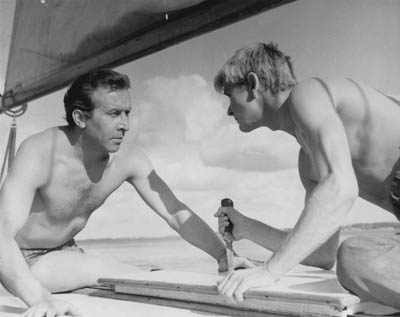
Andrezj (Niemczyk) and his wife are taking a drive through the countryside, on their way to their boat for a day of sailing. The tension is palpable in the care, neither speaks, until it is broken by a young hitchhiker standing in the middle of the road. Andrezj can tell that his wife is momentarily attracted to the young man so he offers to give him a ride, and eventually invites him onto their boat. This is all part of a disturbing psychological mind game is playing with his wife, using the hitchhiker to prove a point. As the young man flips between adolescent mood swings and is manipulated with ease by Andrezj, the older gentleman remains calm and poised, right up to the finale where both the characters and the audience are left wondering what happened and how these characters move on.

The rivalry between the two men is incredibly realistic. If you have been around immature adolescents (and sadly grown men even) you have seen the way they can get caught in a playful game of oneupmanship that devolves into a primitive fist fight. Through out the film, Andrezj intentionally puts the hitchhiker in a position of submission, giving him commands and emphasizing important maritime rules, while simultaneously breaking these same rules moments later in a bid to shove it in the young man’s face. Because of the wife’s initial flirtation with the hitchhiker we assume this is all about her, but I found that she recedes into the background till the final moments of the film. Instead, these young men are simply in a battle for alpha male status, not over a woman, but just in terms of their own relationship.

The wife is very enigmatic character, behaving without reaction for most of the film. She’s first presented as a prim and proper type, silent, not in subservience to Andrezj but in defiance of him. Once on the boat, she goes about her work mechanically, bringing about noshes when they are expected, preparing the soup when it  is needed, battening down the hatches at the approach of a thunderstorm. Very subtly, her inner sexuality is revealed until she is completely nude near the end of the picture. In this moment, she defies Andrezj in a very interesting way that further pushes him down, keeping him from attaining the status of alpha.

In such a simple plot, lies an infinitely complex series of ideas and themes. In many ways, this would work as a companion piece to the similarly psychological and deceptively simplistic Funny Games. Both films are exploring weighty ideas using a framework that is easy for any audience to understand.

Wild Card Tuesdays – The Bad Lieutenant: Port of Call: New Orleans


The Bad Lieutenant: Port of Call: New Orleans (2009, dir. Werner Herzog)
Starring Nicolas Cage, Val Kilmer, Eva Mendes, Fairuza Balk, Xzibit, Jennifer Coolidge, Brad Dourif, Michael Shannon

At one point in this film, I swear Nicolas Cage was attempting to channel Tony Clifton, the obnoxious lounge singer persona adopted by Andy Kaufman on occasion. This unofficial sequel to the 1992 Bad Lieutenant film is such a bizarre piece of cinema that lives somewhere between classic film noir and surrealist Lynch land. And there really is no other actor who could bring the right level of insanity to this role other than Cage. Even when its impossible for the audience not to react with laughter, Cage is going to keep pushing the boundaries of what we will tolerate.

The film begins in the aftermath of Hurricane Katrina, Terence McDonagh and his partner, Stevie Pruit find a prisoner in the jail with water up to his neck. Instead of rushing to help they place bets on how long it will take the man to drown. Eventually, McDonagh decides to jump in and help, however the water is to shallow and he injures his back. McDonagh is a scumbag. He has the officer running the evidence room sneaking a cocktail of drugs out for him, he stalks college aged kids leaving nightclubs to confiscate their drugs, he has a prostitute girlfriend he seems in no rush to help get out of the business, and he’s just an all around asshole. A crime scene is discovered where an entire family has been killed execution style. McDonagh begins to uncover that the father was dealing drugs on another man’s territory and attempts to solve the case using methods that pretty much violate every law on the books.

Director Herzog employs some awfully strange choices in making this film. McDonagh’s drug use causes him to have hallucinations that the audience gets to see. During surveillance on a suspect’s house he swears there are two iguanas on the table while the other officers simply give each other confused looks. Later, after a mobster is killed Cage tells the killer to shoot again because “his soul is still dancing”, reflected by a break dancer spinning in the middle of the room. There are other pieces of scenery that keep that wacked out feeling continuing through the film. Actors like Brad Dourif, Michael Shannon, and Fairuza Balk add that twisted atmosphere to every scene they are in.

McDonagh is constantly on the go. There isn’t a single scene where we see him in his home, ready to fall asleep for the night. Instead he is always wheeling and dealing, playing one party against the other in incredibly flimsy ways that you know are going to catch up to him sooner or later. He owes thousands to bookie Dourif and tries dealing drugs out of the evidence room to pay it off, while trying to avoid the suspicion of his superiors. There really isn’t a film comparable to the insanity of this one and if you are a film lover like me, whom finds a sick enjoyment in Nicolas Cage’s frantic nature then  you desperately need to pick this up.

Jolly Good Thursdays – Five Minutes of Heaven


Five Minutes of Heaven (2009, dir. Oliver Hirschbiegel)
Starring Liam Neeson, James Nesbitt

There is no collective event as traumatizing and as haunting in the United States as the conflict in Northern Island has affected those people. In 1975, Ireland was under siege by a civil war where neighbor killed neighbor. The IRA killed those who were Protestants and loyal to the British, while the Ulster Volunteer Force (UVF) would kill Catholics who were disloyal to the Empire. These murders were typically carried out by adolescent males, coerced into proving their loyality to their faction by terrorist cell leaders. In many ways, this is a parallel to the Islamic fundamentalist terrorism today; young men too dumb to know better end up dying or killing another. Over time, if they live, the glory fades and they are left with the emptiness of what they believed was a great act of glory.

Alistair Little was 16 when he killed James Griffin, 19. Alistair wanted to prove himself to Ulster and heard about a Protestant friend being hassled by Catholics. He and a group of boys steal a car, get ahold of a gun, and show up on James’ doorstep, shooting the young man dead. Witness to this crime is Joe Griffin, James’ 11 year old brother. Thirty years later, the BBC wants to put together a documentary that culminates in Alistair and Joe meeting. Alistair has served 12 years in prison for burglary and appears to have worked towards getting young men out of the situation he ended up in. Joe has agreed to meet but is both apprehensive and enraged at the prospect of finally confronting his brother’s killer. For the rest of his childhood, Joe was blamed for not doing something to save his brother by their mother, and now the grown man wants to unleash all of this pent up rage on Alistair.

Five Minutes plays out in a very unexpected way, primarily because it’s structured as a four-act play. Each act isn’t contained in a single set but is contained by a certain focus. The first act is the recreation of the murder in 1975, the second act is the build up to the documentary meeting between the two men, and so on. The acting weight is focused squarely on Neeson and Nesbitt and they are overqualified for the job. Nesbitt in particularly is able to see saw his character psychologically, increasing the intensity as the hour of he and Alistair’s meeting grows closer. A large piece of this are internal monologues, Joe simply looking in the mirror of his dressing room, pulling the knife he has brought to exact his revenge and mulling over if he should simply leave or go through with this.

Neeson is equally good but in a different direction. He plays Alistair with subtly, he’s a man who wants his victims to be able to confront him and knows they don’t care if he is sorry or not. As he tells one of the BBC crew, he wants them to step in and keep Joe from hurting himself. As we see later in the film, he is completely willing to let Joe unleash his anger on him. But he’s not just out to give victims their peace, Alistair also wants forgiveness. He’s closed himself up in an estate flat in Belfast, never married and has no children and spends his days either in non-violence support groups or stewing in his home. It is inevitable that these two men are going to meet, but the film lets us wondering under what circumstances will it be and under whose terms.

Jolly Good Thursdays – I Capture the Castle


I Capture the Castle (2003, dir. Tim Fywell)
Starring Romola Garai, Rose Byrne, Henry Thomas, Marc Blucas, Bill Nighy

This is not the sort of story you would expect from Dodie Smith, the same author behind 101 Dalmatians. Instead of a tale aimed towards the younger set, this is a coming of age story set in the mid-1930s. Themes of wealth and love and how the two are intertwined make up the spine of the picture and, what might have been a trite film, is aided by great performances to become something quite a bit better than that. The picture manages to be both an escapist romance and a grounding story of how much love can hurt.

The film opens with the Mortmains’ arrival at an old castle where their author patriarch has relocated them. The events are narrated by middle child Cassandra (Garai), who is overshadowed by their father’s second wife Topaz and Cassandra’s older sister, Rose (Byrne). The castle, which was a magical place when they first came to live there, has become a dank and moldy tomb for the family. Things begin to change when the owners of the castle, American brothers Simon and Neil Cotton arrive to decide what they are going to do with the estate. Rose sees this as her opportunity to marry into money and tries to woo Simon, the elder brother. However, Cassandra is also smitten with Simon and Neil has feelings for Rose.

The Mortmain family is incredibly eccentric and director Fywell is tasked with finding humor in their quirks as well as showing they have consequences. This is particularly highlighted through Mr. Mortmain, a successful author when his family was young, but who has failed to be able to write anything of value since. At first his hang ups and odd behavior come across light, but as the film progresses we see the detrimental effect that have on his entire family. Cassandra is also forced to face the fact that her father’s mental state may be beyond help. That’s quite a heavy weight for our plucky 16 year old protagonist to handle. In a similar fashion, Rose’s vapidity and desperation to find a man are played for laughs at the start, but when she enters into a relationship with a man she doesn’t actually love we can see how a harmless quirk becomes destructive to many people.

The film is not a major cinematic achievement by any means, but it is a very solid and well paced story about eccentric people having to deal with how their behavior effects others. The story is a very mature one, that lets the characters lose themselves in the giddiness of a first love, but also grounds them by not having everything tied up in a neat package. There is hurt and not much closure for our protagonists. In many ways this is a more adult Nicolas Sparks tale, that refrains from maudlin sentiment and allows its characters to have real flaws.

Director in Focus: Brian DePalma – Body Double


Body Double (1984)
Starring Craig Wasson, Melanie Griffith, Gregg Henry, Deborah Shelton

This film wouldn’t exist if it weren’t for Vertigo and Rear Window. Once again, de Palma returns to his filmmaking mentor, Alfred Hitchcock to inform his own work. However, coming off of the stylistically redefining Scarface, Body Double feels like a Cinemax softcore porn with a creative cinematographer’s flourish lain over the top. For all the moviemaking love put into this film there’s just something off about it the whole time that taints it from living up to de Palma’s previous Hitchcock homages.

Jake is an actor working on a B-horror film, Vampire’s Kiss. He experiences a moment of claustrophobia during a scene in a coffin and the director tells him to take the week off. Jake arrives home to find his girlfriend in bed with another man and ends up homeless. Things are not going so well. He meets a fellow actor, Sam who needs a replacement for a house sitting gig in the Hollywood Hills. Jake happily takes the job and Sam lets him know about the woman across the street who nightly stands naked right in front of the large windows. Jake begins watching her obsessively and begins to realize she is in danger as a menacing figure stalks her. There are lots of twists and turns, but if you are an observant film goer you will probably figure out the picture’s twist early on.

What hurts the film about as equally as the lackluster script are the uncharismatic actors. Craig Wasson is so incredibly bland his performance comes across as comically bad. His interactions with Gregg Henry, who plays Sam, feel incredibly odd and unnatural, and this never comes across as intentional. Beyond Jake, there isn’t much acting going on in the film. All of the other characters, particularly female characters are flat props used simply to create peril and have violence rained down upon them.

The picture definitely feels like a film only the 1980s could have produced. It is full of excess and gratuitous sex that is put in the film merely to satisfy de Palma’s proclivities as well as to make Hollywood execs happy. Jake is eventually pulled into the harsh world of pornography to track down a woman that has a connection to the mystery he has become involved in. This gives de Palma the opportunity to shows lots of naked ladies (something he enjoys doing a little too much). At the end this will feel like de Palma’s cheapest film, a sidetrack back to Hitchcock country and a strange work to bridge the gap between Scarface and his later entrance into Hollywood big budget movies.

Asian Cinema Month – Yi Yi


Yi Yi (2000, dir. Edward Yang)
Starring Nien-Jen Wu, Elaine Jin, Issei Ogata, Kelly Lee, Jonathan Chang, Hsi-Sheng Chen

The one thing all families have in common is that they are complex beyond belief and filled with emotional nuance. This millennial picture focused around a typical middle class family in Taipei is able to explore the fragmented lives of the individuals without resorting to clichéd dysfunction. The drama is kept moderate yet the film is never too slow to disengage the audience. If you are of the mind to enjoy explosive Michael Bay-esque movies than this may not be the best bet for you at the moment. If instead you want to patiently follow the rise and fall of a quiet family then you are in for something very fascinating.

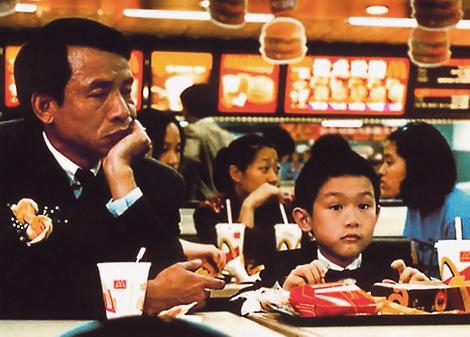
The film opens on the wedding of NJ’s brother-in-law. NJ is the patriarch of the central family in the film and he is a very patient and loving father. His son, Yang wants McDonald’s rather than the food being served at the reception and NJ submits to the child. On their way back to the party, NJ runs into his college sweetheart at the same hotel for a business meeting. Something appears to be rekindled between the two. NJ’s mother-in-law ends up in a coma shortly after the wedding and his wife becomes emotionally broken. The burden of tending the household falls on their teenage daughter, Ting. Ting has become friends with the new neighbor’s daughter and is caught in a high school love triangle with the girl’s boyfriend. Yang is constantly picked on by an older girl at his school and become very reclusive and obsessed with taking photos of mundane things.

The hits the three hour mark and is as epic as it is subtle and contemplative. There’s no sweeping score or dramatic crescendos. It’s simply life being played out and framed as if the mundane is just as epic as mythical heroes’ journies. The structure of the film is that of an entire human existence. We open on a wedding, end on a funeral, and in between there is love, heartbreak, tragedy, murder, people sharing good times over a warm meal, people feeling alienated, attempted suicide. But the picture never feels over the top or campy. The tone is kept tempered so this feels like dipping your hand in vat of pure distilled humanity.

I was made to think of Hollywood attempts at family dramas and how I can never fully engage with those characters because the script is forced to follow a 90 minute template. Yes, three hours is a long time for a film of this nature, but it is absolutely essential. And even three hours isn’t long enough to know these characters. No one is overly dramatic despite the situations they are put in. NJ is tempted with getting back together with his lost love and the outcome is left ambiguous. NJ does business with a Japanese video game developer during the film, Ota, who is one of the most intriguing characters in the film. He feels very real, a businessman who didn’t get to where he was because he was ruthless, but because he recognized the need of every person to be inspired by something.

This has to be one of the most positive, yet real films about people I have ever seen. It will leave you asking a lot of questions about our families, about the distance we have from them, and how large the scope of our lives truly is.

Asian Cinema Month – In the Mood For Love


In the Mood For Love (2000, dir. Wong Kar Wai)
Starring Maggie Cheung, Tony Leung

In writing poetry or prose you have a toolbox called language. This toolbox contains things like grammar, syntax, meter, rhyme, etc. Film has a toolbox as well, but is much much larger. And the idea of having more to work with sounds like it would be easier than writing, however more does not equal easier. In the film toolbox you have elements like sound and images. And subsets of sound would be dialogue, character’s accents, soundtrack, sound effects, sound mixing. Under images we find art direction, costume design, lighting, and the most vital of all cinematography. For even the most seasoned artist, misusing these tools is an easy thing to slip up and do. With this feature from director Wong Kar Wai every single tool is used perfectly and produces a flawless example of how rich style can blend with very clear, stated substance.

The film opens in Hong Kong in 1962. Chow (Leung) is renting a room in an apartment building on the same day as So (Cheung). They pass in the hall, barely acknowledging each other. Cut to a few days later and they happen to both be moving in on the same day. Chow’s wife is seen only from behind, her face intentionally not revealed. So’s husband travels abroad to Japan almost every other week and is glimpsed in a similar fashion. The months roll on and both Chow and So become convinced that their spouses have begun an affair. Not knowing how to deal with this they attempt to recreate the circumstances that led their spouses astray with themselves to understand what happened.

The plot is very loose and is carried mostly by the atmosphere created by Wong Kar Wai and his cinematographers, Christopher Doyle and Pin Bing Lee. You rarely see cinema filmed so beautifully and with such delicate craft. I found this to be the kind of film where I don’t remember scenes of dialogue or action, rather I remember images like paintings. Chow sits over his typewriter working on a story and the smoke from his cigarette billows up above his head. The rich detail of every gray tendril of smoke is captured on screen and I felt excitement at such a profoundly beautiful image. The film’s simple theme (a longing tune played on violin) is used repeatedly in scenes where Chow and So are navigating past each other, both physically and emotionally. The camera peeks around door frames, into crowded rooms of neighbors gathered to play cards. We see Chow and So separated by these people who are caught up in raucous laughing, and the tension bleeds off the screen.

The film is able to convey the conservative social pressures of the time. Chow and So meet in his bedroom, merely to share food and must be cautious of Chow’s landlord. They are unable to touch, made clear in a scene where So reaches for Chow’s hand after being caught up in a rare moment of happiness and then quickly withdraws. The film is greatly concerned with absence: the absence of the spouses, the absence of companionship or love, the absence of the spouse’s full identities. A title card that introduces the film reads “the past was something he could see but not touch”, a phrase that sums up what this lush film is all about.

Jolly Good Thursdays – Nil By Mouth


Nil By Mouth (1997, dir. Gary Oldman)
Starring Ray Winstone, Kathy Burke, Charlie Creed-Miles, Laila Morse

I didn’t plan it this way, but Nil By Mouth is the perfect co-feature for yesterday’s Harry Brown. Both films take place in the government funded estate housing and focus on some of the harsh and brutal realities of life there. While Brown goes for a more Death Wish, hyper-violent tone, Nil By Mouth is a documentary-like look at the people Harry so eagerly murders. The film’s violence is not constant but comes in explosive and jolting moments. Every thing orbits around a single act of violence that takes place in the middle of the picture.

Ray (Winstone) is an ox, a violent brute of a man who is having his second child with Valerie (Burke). He maintains a disinterested relationship with her, going out at night with his mates, ingesting all sorts of drugs, drinking copious amounts of booze, and soliciting women at seedy strip clubs. When Valerie stays out to play pool with friends, Ray explodes. Also living in this war zone is Billy (Creed-Miles), Valerie’s brother and Janet (Morse), Valerie’s mother. Billy is a heroin addict who is constantly borrowing money from his mom and sleeping on a roulette wheel of couches. Janet is a helpless figure, standing back and watching her children’s lives decay and, in Billy’s case, driving him to drug dealers’ houses so he can score.

The most obvious element that carries the film is Ray Winstone. I’ve seen Winstone in films like Sexy Beast and The Proposition and in both of those he plays more of the simmering, muted type. Here he is like a British Jake Lamotta, exploding but never in a showy way, more of a man who has never seen men react anyway other than with violence. There’s a moment in the film when he has a conversation with his best mate Mark and talks about how unloving his father was. This monologue lays it out on the table that these men exist in a cycle of brutality. Why should we expect them to know how to show affection or control their rage when they have never seen a man do so, and when they live in a world where you prove yourself through the violence you inflict on others.

Not to be overshadowed is Kathy Burke as Valerie. Burke knows how to tap into the working class up bringing of her character. Valerie knows that her safety is dependent on Ray’s presence. She overlooks his nightly outings and has a pretty strong suspicion he cheats on her with other women. Their relationship has come to the point where she simply doesn’t care. She is pregnant with their second child and states that she wanted to have another child, but didn’t want to find a different father. There’s no love for Ray, he’s just there. And Ray is with her so he has an anchor point to return to at the end of the night.

The film is soaked in profanity, but that is an accurate depiction of this world and the natural grammar of the place. I was reminded of Mike Leigh’s films about the English working class and how often they are cited as “brutally true to life”. They really have nothing on the grim reality of Oldman’s directorial debut. It’s not an easy film to watch. The accents are thick and require the American viewer to play close attention, and the subject matter is not pretty. However, we have to see the full view of these people so that we don’t slip into the Harry Brown mentality.

Newbie Wednesday – Harry Brown


Harry Brown (2009, dir. Daniel Barber)
Starring Michael Caine, Emily Mortimer, Charlie Creed-Miles, David Bradley, Ben Drew, Jack O’Connell

In the States we call government housing The Projects, in the UK they have the Estates. This is setting of this bleak and tragic story of a man who is alone. The film doesn’t flinch from showing shocking acts of brutality and doesn’t raise up one figure as a champion over another. Harry does what he does, but why? The motives for the killing spree remain vague when you begin to examine things closely. Is it in retribution for his friend? Or is their something much darker going on?

Harry Brown, is ex-marine and pensioner living in the Estates. His wife is living in the hospital stuck in a catatonic state. He has one friend in the world, Leonard, whom he meets at the corner pub for a pint everyday. Leonard is fed up with the way drugs are sold openly and people like himself are harassed by the hoodlums that roam the estates. One morning, Harry wakes up to learn Leonard was found stabbed to death in a pedestrian tunnel. This seems to be the final straw for Harry and he embarks on a crusade to avenge his friend, killing young men where ever he goes.

The film eventually goes down a fairly predictable road with Harry’s action parallel by a police investigation about them. What is more interesting is all the subtext brought to the film, possibly not intentionally. There is a lot of work put into making the world Harry inhabits grimey and flithy and despicable. So we are naturally appalled by the various denizens he encounters. As an audience we are clearly set up to cheer for Harry and boo all those nasty villains (see Gran Torino). However, there is a moment near the end of the film where Harry asks a character to kill him. This immediately caused me to re-evaluate what had gone before. Here’s a man whose wife is gone and has just lost his best friend. He lashes out, presumably because he wants but he then wants to simply die at the end. His entire crusade was a nihilistic one. Harry lost all he loves and now he wants to explode, hitting what ever he can in his path.

If it wasn’t for Michael Caine this would have been a forgettable film. There is something about just his subtle looks that elevates the film. In one scene he sits across from a drug dealer whose girlfriend is overdosing on heroin. The slight glances and looks he makes around the room feed the audience tons of information. While Clint Eastwood seemed one note through Gran Torino, Caine delivers a multi-layered performance. Emily Mortimer is also wonderful as the detective in charge of Caine’s case. By the end, she’s the only virtuous character in the film. She has been devoted to her job and wants to solve the murders. However, we can see the world crumble around her.

Harry Brown definitely wants to be a lofty film, but its very much a continuation of the Death Wish premise. I admit there is some greater emotional depth here. The disappointment for me came from how undeveloped characters are. There is no motive for anyone save Harry and it left me feeling like the picture was very hollow.

Asian Cinema Month – Eat Drink Man Woman

All this month, in honor of Asian Heritage Month, I will be looking at some major films from the contemporary Asian cinema canon. While the term “Asia” can refer to areas as diverse as the Middle East, India/Pakistan, and the South Pacific, I will be focusing mainly on films out of China, South Korea, Japan, and Hong Kong. In the future I definitely plan on having a month devoted to Middle Eastern cinema….maybe not so much India, just not a fan of their pictures, too many crazy musicals.


Eat Drink Man Woman (1994, dir. Ang Lee)
Starring Sihung Lung, Kuei-Yei Yang, Chien-lien Wu, Yu-Wen Wang

Mealtime is a proven way of bonding with others. Whether its over a campfire, at a booth in a diner, or around the family dinner table, the act of breaking bread with others unites people in a very beautiful way. Even many animals hunt and dine together in packs, with somewhat of an understanding of the bonding that occurs when they do. Ang Lee presents the story of how food and the act of eating cobbles together a group of disparate people into a family.

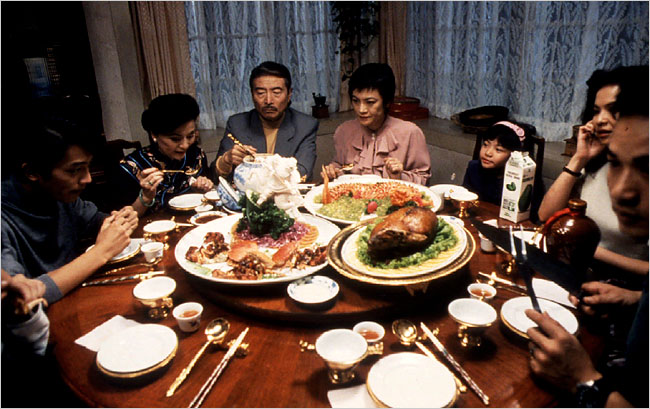
The film is set in Taipei, Taiwan and focuses on Chu, the partiarch of a family made up of three daughters. Chu’s wife died years earlier and now his three daughters live at home with him, each feeling the burden of watching after their obstinate and independent father. Every Sunday, Chu prepares a lavish feast of traditional Chinese cuisine, much more than enough for this small group. Chu has also unofficially adopted his middle daughter’s old schoolmate and her daughter. As the story progresses, his three daughters begin to find men with whom they contemplate leaving home for. In many ways, this story is a variation of Fiddler on the Roof, very much about family and tradition.

I really liked this film, much more than I anticipated. I’ve been sort of back and forth with Ang Lee (didn’t care for Crouching Tiger, Hidden Dragon but love Brokeback Mountain) so I wasn’t sure how I would feel about this picture. I think Lee is best when he is dealing with small, character driven stories. The family surrounding Chu are very complex and real. There are no easy solutions and no acts of serendipity. The high drama you would expect from a Hollywood version of this tale is non-existent, yet there are emotional stakes. Chu has lost his sense of taste and so the act of preparing this meal has a deeper meaning to it. The eldest daughter is also a wonderful chef, but no thanks to Chu. He makes sure the kitchen is off limits to his children, so she learned from Chu’s best friend and fellow chef when she was a child.

The way Lee films the cooking sequences is an example of a director at their peak. Everything about the methodical ways Chu prepares his dishes and the care he puts into them is absolutely apparent. The flavor of the dishes comes through the screen somehow and you can feel the steam coming off the dumplings and rich flavor of the stews and steamed fish. If you were putting together a list of films about food, this one definitely make it high on the list.

There honestly wasn’t much about this film I didn’t enjoy. It’s a little over two hours, yet I was so engaged by it I never felt like checking the timecode to see how much was left. I was completely absorbed in the world and especially the characters Lee was presenting. While he has gone on to make bigger budget films, my hope is that Lee can always remain close to his early roots, making films that found their wonder in people, rather than effects.