Criterion Fridays – Make Way For Tomorrow

Make Way For Tomorrow (1937, dir. Leo McCarey)
Starring Victor Moore, Beulah Bondi

The economy is bad. Unemployment. The Housing Market. Small Businesses. Crashing every day. During The Great Depression, cinema reflected this moment in history where the common man was struggling to make ends meet. People were losing their homes, ending up jobless and on the streets, and Hollywood wasn’t afraid to put that up on the screen.There were many escapist pictures in the theaters during the Great Depression, particularly musicals, but even those had elements of the financial struggles people were under going. Not so now. Particularly during the summer, we have mindless film after mindless film, featuring people so distant and out of touch with our own reality that, for myself, I become disengaged. What I am shocked to see is reality reflected on the screen.

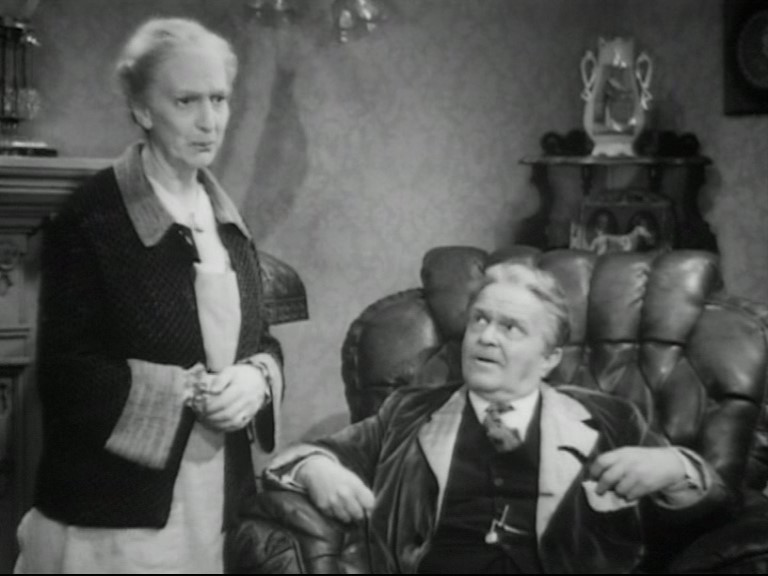
Barkley and Lucy have been married for fifty years when the bank notifies them that their home for all this time is being taken away. Barkley hasn’t worked in four years and he and Lucy don’t have enough money for a new place right away. They contact their four adult children and explain the situation. Behind the couple’s back, the children fight about who will take them, with it being decided that Lucy will go to stay with George, the eldest son, and Barkley will go to Cora, the eldest daughter. Lucy soon finds George’s wife and teenaged daughter don’t care for her presence in the home. Hundreds of miles away, Barkley has come down with a cold and is bedridden. Cora is infuriated she has to deal with him, but puts on the facade of a caring daughter when the doctor comes calling.

Make Way For Tomorrow introduces an idea that would still be controversial today in many circles: Do not live your life as a parent completely when you have children, you must have a definition outside of that. The children in the film are not monsters; stepping back when can see things from their point of view. But we also sympathize greatly with Barkley and Lucy, they truly gave every thing they had to their children and it may have not been the smartest move. Once their children became adults they vanished from their parents’ lives and only now have becoming aware of the financial situation back home. The relationship between Barkley and Lucy is deeply loving, its rare that I see a couple on screen when I completely buy their relationship. The paths the film leads them down are not happy ones, like the title suggests, it becomes about accepting change in your life.

Orson Welles said of this film that “it would make a stone cry”. He was exactly right. The love between these people is so pure and beautiful. The final sequence of the film involves them taking an unexpected car ride to the hotel where they honeymooned fifty years earlier. The coat check girl, the hotel manager, every one treats them in the way we wish their children did. The drinks are on the house, the band conductor plays an old tune when Barkley and Lucy hit the dance floor. Victor Moore and Beulah Bondi master these characters with a sly humor that undercuts a lot of the sadness that pervades the film. It doesn’t end on a hopeful note, but a realistic one, an admonition that life changes in ways don’t want. We are powerless to fight it, so instead we should embrace the people around us.
DocuMondays – Prodigal Sons


Prodigal Sons (2008, dir. Kimberly Reed)

It is impossible to watch this film and not be affected in someway. It is one of the most inside looks at a family and their struggles, particularly with mental illness. I can’t say I have ever seen a documentary that captured such intensely intimate and violent moments on film. While the details of this particular family may seem drastically different from your own, when looking at the core nature of the relationships it is like any other: there is a lot of emotional pain and little done to resolve it for years. It’s one of those documentaries that is bound to ignite arguments about what is incited by the director and what is the natural progression of these people in this situation.

Kimberly used to be Paul, the high school quarterback and basketball center. After leaving Helena, Montana as a teen, she moved to San Francisco and embraced her life as a woman. Meanwhile, older adopted brother Marc was in a car accident that left him permanently brain damaged. Marc has trouble building new memories and for him Kim is Paul. In addition, youngest brother Todd he came out of the closet and moved away to California. The center of the film is the three brothers issues of identity as it relates to their relationships with each other. Marc is having trouble with medication that is used to balance him and lashes out repeatedly in violent ways that chill you to the bone. This is told through the filter of Kim, who is angry that Marc still thinks of her as Paul, and its unsure if this is a choice Paul is making or if he is physically incapable of permanently processing this.

The documentary is sold in its trailer as being about the discovery of Marc’s biological family. It turns out he was the son of Rebecca Welles, daughter of director Orson. Kim follows with her camera as Marc travels to Croatia and meets Welles’ lover Oda Kodar. Kim and Marc seem to bond over this trip and it appears that he has control over his temper. The next time they meet up though, Marc flips out about a broken gas gauge on a truck and physically assaults Kim, all of it recorded on camera. Things continue downhill at the family Christmas when Marc brutally tackles Todd from behind, police are called, and Marc grabs a knife. He ends up in a mental institution. Tragically, Marc died as the result of a seizure in May of 2010.

The film has to re-find its footing a few times as it starts out as being about Kim returning to Helena for the first time as a woman. It quickly becomes about she and Marc’s relationship, in particular his jealousy at never being the “good one”. Kim was the straight A student and star athlete. Marc was held back in preschool and drank and partied to excess. Now that Marc has suffered this injury he has faded from being able to impress, now he appears to use his disability to make every family get together about himself. But how much does Kim incite and how much is Marc manipulating? The film never completely answers this, but it will stay in your mind for a long time.

Asian Cinema Month – Yi Yi


Yi Yi (2000, dir. Edward Yang)
Starring Nien-Jen Wu, Elaine Jin, Issei Ogata, Kelly Lee, Jonathan Chang, Hsi-Sheng Chen

The one thing all families have in common is that they are complex beyond belief and filled with emotional nuance. This millennial picture focused around a typical middle class family in Taipei is able to explore the fragmented lives of the individuals without resorting to clichéd dysfunction. The drama is kept moderate yet the film is never too slow to disengage the audience. If you are of the mind to enjoy explosive Michael Bay-esque movies than this may not be the best bet for you at the moment. If instead you want to patiently follow the rise and fall of a quiet family then you are in for something very fascinating.

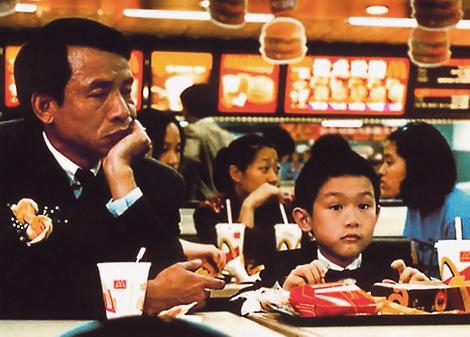
The film opens on the wedding of NJ’s brother-in-law. NJ is the patriarch of the central family in the film and he is a very patient and loving father. His son, Yang wants McDonald’s rather than the food being served at the reception and NJ submits to the child. On their way back to the party, NJ runs into his college sweetheart at the same hotel for a business meeting. Something appears to be rekindled between the two. NJ’s mother-in-law ends up in a coma shortly after the wedding and his wife becomes emotionally broken. The burden of tending the household falls on their teenage daughter, Ting. Ting has become friends with the new neighbor’s daughter and is caught in a high school love triangle with the girl’s boyfriend. Yang is constantly picked on by an older girl at his school and become very reclusive and obsessed with taking photos of mundane things.

The hits the three hour mark and is as epic as it is subtle and contemplative. There’s no sweeping score or dramatic crescendos. It’s simply life being played out and framed as if the mundane is just as epic as mythical heroes’ journies. The structure of the film is that of an entire human existence. We open on a wedding, end on a funeral, and in between there is love, heartbreak, tragedy, murder, people sharing good times over a warm meal, people feeling alienated, attempted suicide. But the picture never feels over the top or campy. The tone is kept tempered so this feels like dipping your hand in vat of pure distilled humanity.

I was made to think of Hollywood attempts at family dramas and how I can never fully engage with those characters because the script is forced to follow a 90 minute template. Yes, three hours is a long time for a film of this nature, but it is absolutely essential. And even three hours isn’t long enough to know these characters. No one is overly dramatic despite the situations they are put in. NJ is tempted with getting back together with his lost love and the outcome is left ambiguous. NJ does business with a Japanese video game developer during the film, Ota, who is one of the most intriguing characters in the film. He feels very real, a businessman who didn’t get to where he was because he was ruthless, but because he recognized the need of every person to be inspired by something.

This has to be one of the most positive, yet real films about people I have ever seen. It will leave you asking a lot of questions about our families, about the distance we have from them, and how large the scope of our lives truly is.

Jolly Good Thursdays – Nil By Mouth


Nil By Mouth (1997, dir. Gary Oldman)
Starring Ray Winstone, Kathy Burke, Charlie Creed-Miles, Laila Morse

I didn’t plan it this way, but Nil By Mouth is the perfect co-feature for yesterday’s Harry Brown. Both films take place in the government funded estate housing and focus on some of the harsh and brutal realities of life there. While Brown goes for a more Death Wish, hyper-violent tone, Nil By Mouth is a documentary-like look at the people Harry so eagerly murders. The film’s violence is not constant but comes in explosive and jolting moments. Every thing orbits around a single act of violence that takes place in the middle of the picture.

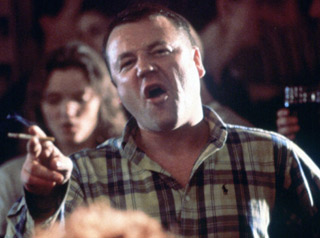
Ray (Winstone) is an ox, a violent brute of a man who is having his second child with Valerie (Burke). He maintains a disinterested relationship with her, going out at night with his mates, ingesting all sorts of drugs, drinking copious amounts of booze, and soliciting women at seedy strip clubs. When Valerie stays out to play pool with friends, Ray explodes. Also living in this war zone is Billy (Creed-Miles), Valerie’s brother and Janet (Morse), Valerie’s mother. Billy is a heroin addict who is constantly borrowing money from his mom and sleeping on a roulette wheel of couches. Janet is a helpless figure, standing back and watching her children’s lives decay and, in Billy’s case, driving him to drug dealers’ houses so he can score.

The most obvious element that carries the film is Ray Winstone. I’ve seen Winstone in films like Sexy Beast and The Proposition and in both of those he plays more of the simmering, muted type. Here he is like a British Jake Lamotta, exploding but never in a showy way, more of a man who has never seen men react anyway other than with violence. There’s a moment in the film when he has a conversation with his best mate Mark and talks about how unloving his father was. This monologue lays it out on the table that these men exist in a cycle of brutality. Why should we expect them to know how to show affection or control their rage when they have never seen a man do so, and when they live in a world where you prove yourself through the violence you inflict on others.

Not to be overshadowed is Kathy Burke as Valerie. Burke knows how to tap into the working class up bringing of her character. Valerie knows that her safety is dependent on Ray’s presence. She overlooks his nightly outings and has a pretty strong suspicion he cheats on her with other women. Their relationship has come to the point where she simply doesn’t care. She is pregnant with their second child and states that she wanted to have another child, but didn’t want to find a different father. There’s no love for Ray, he’s just there. And Ray is with her so he has an anchor point to return to at the end of the night.

The film is soaked in profanity, but that is an accurate depiction of this world and the natural grammar of the place. I was reminded of Mike Leigh’s films about the English working class and how often they are cited as “brutally true to life”. They really have nothing on the grim reality of Oldman’s directorial debut. It’s not an easy film to watch. The accents are thick and require the American viewer to play close attention, and the subject matter is not pretty. However, we have to see the full view of these people so that we don’t slip into the Harry Brown mentality.

Asian Cinema Month – Eat Drink Man Woman

All this month, in honor of Asian Heritage Month, I will be looking at some major films from the contemporary Asian cinema canon. While the term “Asia” can refer to areas as diverse as the Middle East, India/Pakistan, and the South Pacific, I will be focusing mainly on films out of China, South Korea, Japan, and Hong Kong. In the future I definitely plan on having a month devoted to Middle Eastern cinema….maybe not so much India, just not a fan of their pictures, too many crazy musicals.


Eat Drink Man Woman (1994, dir. Ang Lee)
Starring Sihung Lung, Kuei-Yei Yang, Chien-lien Wu, Yu-Wen Wang

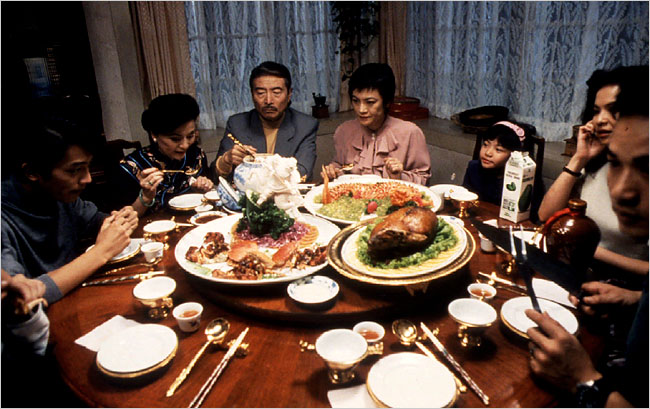
Mealtime is a proven way of bonding with others. Whether its over a campfire, at a booth in a diner, or around the family dinner table, the act of breaking bread with others unites people in a very beautiful way. Even many animals hunt and dine together in packs, with somewhat of an understanding of the bonding that occurs when they do. Ang Lee presents the story of how food and the act of eating cobbles together a group of disparate people into a family.

The film is set in Taipei, Taiwan and focuses on Chu, the partiarch of a family made up of three daughters. Chu’s wife died years earlier and now his three daughters live at home with him, each feeling the burden of watching after their obstinate and independent father. Every Sunday, Chu prepares a lavish feast of traditional Chinese cuisine, much more than enough for this small group. Chu has also unofficially adopted his middle daughter’s old schoolmate and her daughter. As the story progresses, his three daughters begin to find men with whom they contemplate leaving home for. In many ways, this story is a variation of Fiddler on the Roof, very much about family and tradition.

I really liked this film, much more than I anticipated. I’ve been sort of back and forth with Ang Lee (didn’t care for Crouching Tiger, Hidden Dragon but love Brokeback Mountain) so I wasn’t sure how I would feel about this picture. I think Lee is best when he is dealing with small, character driven stories. The family surrounding Chu are very complex and real. There are no easy solutions and no acts of serendipity. The high drama you would expect from a Hollywood version of this tale is non-existent, yet there are emotional stakes. Chu has lost his sense of taste and so the act of preparing this meal has a deeper meaning to it. The eldest daughter is also a wonderful chef, but no thanks to Chu. He makes sure the kitchen is off limits to his children, so she learned from Chu’s best friend and fellow chef when she was a child.

The way Lee films the cooking sequences is an example of a director at their peak. Everything about the methodical ways Chu prepares his dishes and the care he puts into them is absolutely apparent. The flavor of the dishes comes through the screen somehow and you can feel the steam coming off the dumplings and rich flavor of the stews and steamed fish. If you were putting together a list of films about food, this one definitely make it high on the list.

There honestly wasn’t much about this film I didn’t enjoy. It’s a little over two hours, yet I was so engaged by it I never felt like checking the timecode to see how much was left. I was completely absorbed in the world and especially the characters Lee was presenting. While he has gone on to make bigger budget films, my hope is that Lee can always remain close to his early roots, making films that found their wonder in people, rather than effects.

Wild Card Tuesday – Eve’s Bayou


Eve’s Bayou (1997, dir. Kasi Lemmons)
Jurnee Smollet, Samuel L. Jackson, Meagan Good, Lynn Whitfield, Debii Morgan, Diahann Carroll, Vondie-Curtis Hall, Branford Marsalis

The thesis statement of Eve’s Bayou is declared early on in the main character’s voice over as an adult, recalling the events that transpired in her 10th year. “Memory is a selection of images, some elusive, others printed indelibly on the brain”. This is a story told through the filter of years gone by and originally seen through the eyes of a child. Adult Eve tells us that when she was 10 she killed her father and the film gives us a couple explanations for this, emphasizing the distortion that occurs as a result of experiencing time passing.

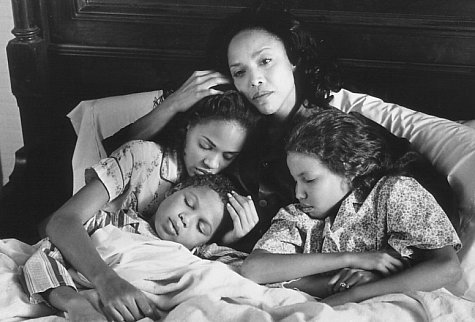
The story begins with young Eve (Smollett), a resident of a Creole parish in Louisiana who lives comfortably on the estate of her doctor father (Jackson). It’s the early 1960s and the patriarch of the family is caught by Eve having sex with one of his patients in the carriage house during a party in the home. He negotiates with the little girl afterwards, trying to convince her she didn’t see what she thought and making promises of lavishing her with more attention than her older sister, Cicely (Good). More and more people in their small town become aware of what is going on within Eve’s family and it becomes apparent that things will end on a dark note.

Eve’s Bayou is full of classic Southern Gothic atmosphere, yet evoked a lot of European slow paced family dramas. Think William Faulkner meets Ingmar Bergman. The film is stylistic rich and uses the Creole religious practices as a framework for foreshadowing and mixing the dreamed up with the real. When Eve is told stories by her family we see them acted out around her, the characters appearing suddenly in mirrors and Eve standing in the middle of them. The film can can delve into the overly melodramatic at times, but because of the setting and general tone it doesn’t seem too out of place.

Eve’s Bayou isn’t a perfect film, but for a first time venture into directing it is incredibly impressive. Director Simmons uses many African-American female crew member (including an amazing cinematographer) and focuses her story around the women of the family. What is so fascinating to me is the otherworldly nature of the place and time Simmons is capturing. The Creole culture has always occupied a different place in the racial history of our nation, and it is interesting to see a pocket of America where the economy and culture were driven by African-Americans. Eve’s Bayou is about these places that seem unreal and about how our minds retain and discard the details of our history.

Film 2009 #121 – Tetro

Tetro (2009)
Directed by Francis Ford Coppola
Starring Vincent Gallo, Alden Ehrenreich, Maribel Verdu, Klaus Maria Brandauer

The Family has always been an important element in Coppola’s work. In The Godfather he examined the literal family and the symbolic family of the Italian mafia. The Outsiders and Rumble Fish took a close look at the divide between brothers by blood and brothers in gangs. Outside of his films, Coppola’s family has had an integral role: music in his early films was typical composed by his father Carmine, sister Talia and daughter Sophia employed their acting skills. And many of his family members have become involved in the industry, albeit changing their names for various reasons.

This element of family and changing names is a core part of Coppola’s newest film, Tetro. The film centers on Bennie (Alden Ehrenreich), a teenage boy living aboard a cruise ship who take advantage of a stop in Bueno Aires to visit his estranged brother Angelo (Vincent Gallo). Angelo has taken to calling himself Tetro (a variation on the family surname) and lives with a beautiful psychiatrist named Miranda (Maribel Verdu). Bennie finds Tetro is incredibly reticent to talk about their childhood and Bennie has been left in the dark about the family’s affairs his entire life. Their father, Carlo, a world famous composer is a dark shadow that hangs over them. As Bennie pries despite Angelo’s protestations he uncovers the dark truth about their family and finds his perceptions of life forever changed.

The film makes direct reference to Powell & Pressburger’s The Red Shoes, the tale of a ballerina driven to destruction by her mentor’s obsessions and Tales of Hoffman, a film adaptation of the opera about a poet struggling to find the middle ground between his literary passions and the passions of his heart. These inform us of the internal workings of Tetro, who presents himself to Bennie as a closed book. Bennie’s curiosity leads him to a suitcase full of Tetro’s writings which have dramatized their family’s history but also lack a concise ending.

Coppola employs an interesting technique with the present reality being a stark black & white while memories and fantasies are filmed in digitally faded Technicolor, resembling paintings almost. These color sequences are either memories from the direct POV of Tetro, meaning the camera is his eye, characters speak directly to him and us the audience, or they are ballet sequences composed of pas de deux between a male and female dancer. The music alternates between melodramatic opera and ethereal voices to symbolize Tetro’s strange reaction when staring into the heart of a lightbulb.

This film and 2007’s Youth Without Youth symbolize Coppola’s new direction. In the 1980s, the prestige he had garnered in the 70s frittered away and he began to focus more on producing and funding burgeoning filmmakers. The death of his son, Gian-Carlo also drove his own works to lessen or fail to love up to his promise. In interviews he calls this return his period of “student films”. These are the movies he wants to make and he has gathered enough wealth in his life that he can drop a few million of his own dollars into a film and not worry about whether it makes back its budget. This sort of artistic freedom is seldom seen in Hollywood anymore. Here’s to Coppola continuing this new artistic journey for years to come.