
Mae Volume 1 (Dark Horse)
Writer: Gene Ha
Artist: Gene Ha
 Narnia. Wonderland. Oz. These are some of the more well-known dimensions storybook heroines travel to, where they go to partake in great adventures against terrible evils. Comic creator Gene Ha (Top Ten) is building a world like this of his own, but instead of telling us the story of the main female protagonist we enter in the middle of the story and see it through the eyes of her estranged younger sister, Mae.
For most of her life, Mae failed to keep up with her older sister Abbie. It seemed that the older girl was always running away from home and getting into trouble. It’s been seven years now since anyone in their small midwestern town has seen Abbie, and Mae has gone on with her life. Then Abbie shows up suddenly, clad in strange military garb and being pursued by inhuman creatures. It turns out Abbie is a major hero in the land of Mňoukové, a world populated by magical creatures and Eastern Europeans immigrants that accidentally crossed over a century ago. This is a world where science is merely a more unusual form of magic and city-states are at constant war.
The first volume of the series feels very much like a setting up of the pieces. The first couple issues stay in the mundane world and let us get to know Mae and her family and friends, as well as flesh out the strained relationship between her and Abbie. There is also some nice mystery building but nothing that is stretched out for too long. The payoff and journey to Mňoukové happen briskly into the series. Once we’re in the other world, some nice strokes of worldbuilding are delivered, but as I said before nothing is actually resolved, it’s mostly set up for where the series is going to go.
I’ve been a big fan of Ha since reading his work with Alan Moore on Top Ten in 1999. More engrossing than Moore’s writing was the rich, detailed world Ha built in the book. Every panel of Top Ten was crammed with details, easter eggs, and bits of minor but rewarding world building. Mňoukové is beginning to be fleshed out, but I get the sense Ha is taking a much slower burn pace with plans to carefully reveal the corned of this place. That said, the momentum feels a little stifled, and it is hard to get a sense of where the series is going.
I liked that the factions in Mňoukové are much more complicated than your typical storybook fare. There is no obvious Wicked Witch or Queen of Hearts. This is shown through Mae’s sense of being overwhelmed as her sister confidently navigates the hierarchy of nobles, allies, and enemies. The core mission for these two is to rescue their father, and because of this web of characters, I found myself forgetting that’s why they were there. I know that’s simply the conceit to get the sisters together and in Mňoukové, but I hope that future volumes build that sense of momentum and keep going in one direction.
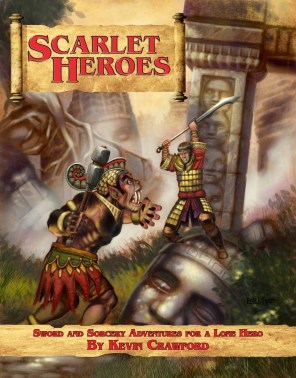 I decided recently to start a one on one tabletop roleplaying campaign with my wife and chose Scarlet Heroes as the system to use. Scarlet Heroes is an Old School roleplaying game designed specifically for one GM and one player. There is a premade setting that comes with the system, but I prefer to build something with my players, so we have a shared mutual vision of the world. Ariana and I sat down a couple weekends ago and used Ben Robbins’ Microscope to broadly build the world.
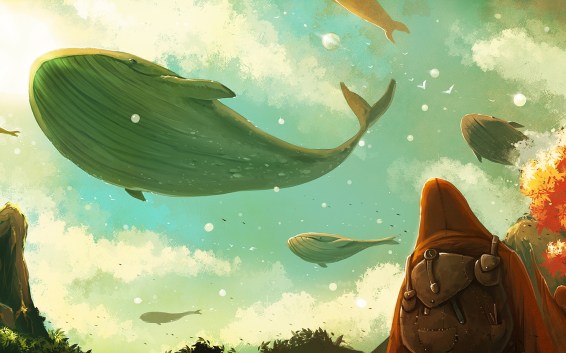 After about a century, the ruins of the Remnants were discovered buried beneath Muatera. These were the piece of a lost civilization, the details of whom are yet to be fleshed out. Their writings did lead to a cure that helped boost the shipwhale herds and allowed the colonists to visit the three neighboring planets in the system. Three additional races were discovered: The Goliath Tieflings, Hypogeal Elves, and Psionic Dwarves. Relations with each is complex and distinct, but no major conflicts have sprung up…yet.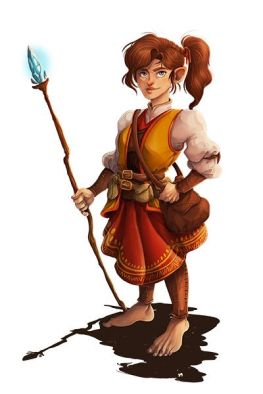
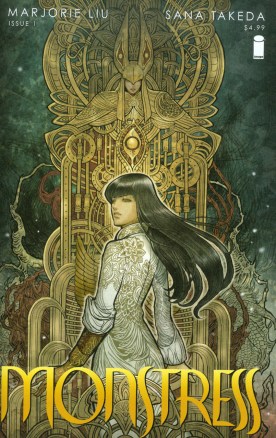 At first glance, the protagonist on the cover of Monstress doesn’t look very monstrous at all. Maika is a beautiful young woman without horns or scales or anything denoting a monster nature. That’s sort of the point in this exploration of prejudice and feminism brought to us by writer Marjorie Liu and artist Sana Takeda. The beautiful art deco style cover is immediately given a counterpoint in the first full page panel: Maika naked, a chain collar around her neck, a riding crop under her chin, and the revelation that her right arm from the elbow down is missing. On her chest is a tattoo of a vertical eye. This rather ugly reveal presents what will be the theme of the series, a beautiful ornate baroque world that is hiding a society built on violence against the Other.
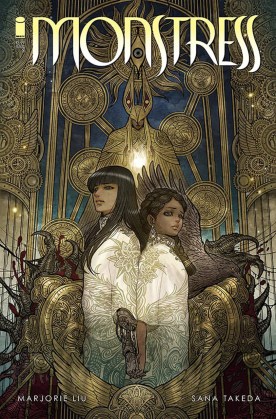 The growth of Maika is the focus of the series. She starts single-minded and willing to let the innocent die if it means she gets closer to her goal of revenge. As she spends time with other characters she has a conflict with her inner nature and by the end of the first arc, she has learned the value of compromise. Her two companions, Kippa, an Arcanic with fox like attributes and Master Ren, a clever and witty cat, feel like paper thin characters. I was reminded of some forgotten animes that featured characters just for the cuteness appeal. There are hints at deeper levels and a rich history to the villains in The Cumea but it’s not explored very deeply in this first arc.
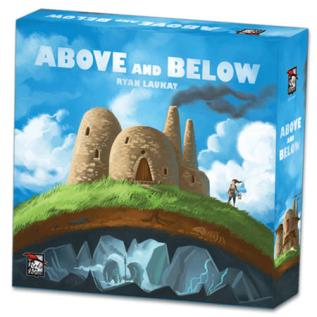 Above and Below is the story of rebuilding after disaster. Your village was destroyed by barbarians and you’ve moved your people to a new place to start a new life. However, you find beneath the ground is an intricate series of tunnels and the opportunity to discover great treasure. You’ll need to build new buildings, recruit new villagers, harvest resources, and explore the world below to win.
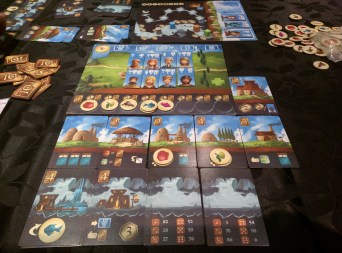 I was reminded a bit of IDW’s Machi Koro, a city building game, where certain cards are considered top shelf premium ones based on their cost and benefits. In Above and Below, there are six star buildings that provide multiple benefits if you can afford their large cost. There’s also four interchangeable star buildings that provide similar but less powerful benefits. Three pools replenish during your rounds of play: new villagers, regular buildings, and underground buildings. Each playthrough created vastly different villages for the both of us. Resources are harvested either from buildings or going into the caves. Once you have resources you can either stockpile them (which increases your income) or offer them up for sale to other players. At the end of the game you add up the resources you have stockpiled and multiply them by a point value based on where they were place on the stockpile track. So, selling resources can help the buyer increase that score while giving the seller a few quick gold pieces.

 PopCult Reviews